
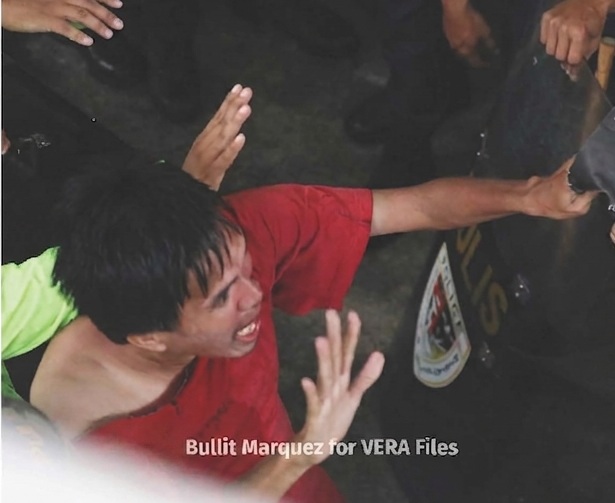

After almost seven months, the violence of the protest action in Manila has conveniently receded from public memory, were it not for an arrest in Guimba, Nueva Ecija. This first week of April, enforcing an arrest warrant for robbery and homicide, the police captured a supposed leader of a gang whom the police is also accusing of inciting unrest during the Sept. 21, 2025 Trillion Peso March protest.
The police still seemed to be working on the theory that the violent turn of events during the September 21 protest was hatched in a conspiracy. That it was not a spontaneous expression of rage by the youth so disgusted by massive theft and corruption committed by people in the government.
As the police continue to search for those whom they think were ultimately responsible for the violence in Manila on September 21, the Sandatahang Dahas of the UP Third World Studies Center conducted a detailed visual investigation to determine just how violent the police was in the same protest action.
No single event in 2025 produced as many incidents of state-related violence as the September 21 protest. The Sandatahang Dahas monitor of the UP Third World Studies Center recorded a total of 390 killings and 520 injuries resulting from incidents of state-related violence throughout 2025. Of these, 194 injuries erupted from that protest alone, with 151 of these being police officers, and 43 being civilians.
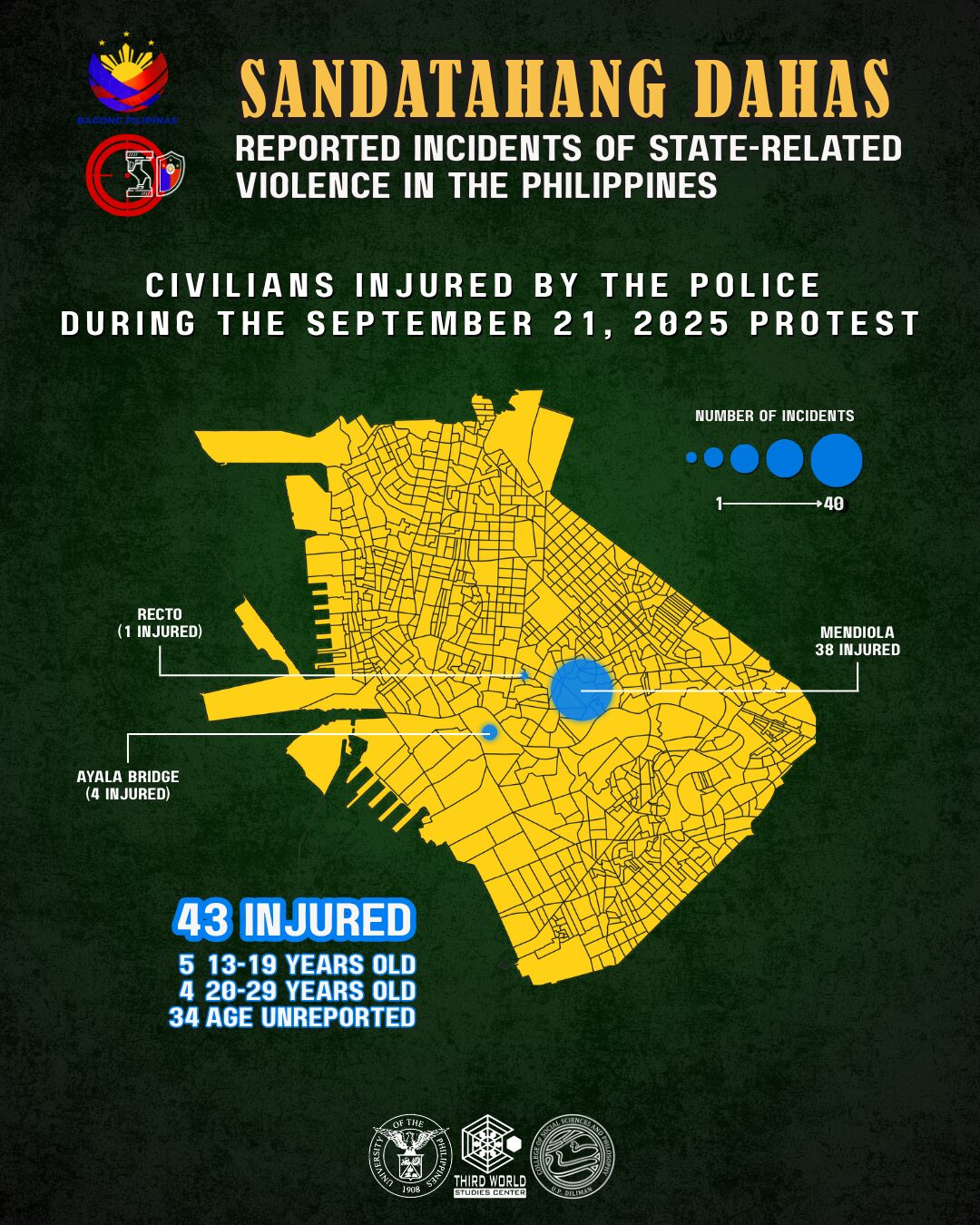
The number of police injured by civilians comes from the Philippine National Police (PNP) chief Jose Melencio Nartatez Jr. However, no such accounting was done for the civilians hurt by police, despite viral videos online showing their excessive use of force. The PNP has stated that 76 civilians were injured, but it was unclear if they were hurt by police or fellow civilians. In the absence of any official data from the police or other investigating bodies, Sandatahang Dahas, as a monitor of state-related violence, had to establish a minimum number of civilians hurt by the police during September 21 protest.
This was done by modifying our established data gathering method, which initially only relied on reported numbers from the media and official statements of law enforcement organizations. Using live coverage videos from established news agencies and journalists, we meticulously counted incidents wherein a protester was seen being physically harmed by uniformed police members. Identifying markers such as clothes, hairstyles, and belongings were used to differentiate the victims. These incidents were then cross-checked with other news media sources to ensure that we were counting distinct individuals, with no duplications. Thirty-two individuals, one of them reportedly a minor, were recorded through this method.
Aside from conducting our own visual investigation, reports from Amnesty International and Bulatlat were added to the count because they described individuals who were beaten by police while detained, which would have been impossible for us to see through the video coverage. Eleven individuals were noted from these reports. Thus, Sandatahang Dahas reports a total of 43 civilians injured by police during the September 21 protest.
This number comes with certain caveats. First, because we only used news sources, videos taken by other witnesses, if uncorroborated by the news, were not included. Second, while the police employed other methods to subdue protesters, such as water cannons and teargas, these incidents were also not included due to the difficulty of determining how many were affected. Finally, we only counted incidents wherein a uniformed police member harmed a civilian. While plainclothes officers may have been deployed during the protest, they were not included in the possible perpetrators because they could not be differentiated from true civilians.
Thus, it is highly likely that this count does not encapsulate the full range of violence experienced by the protesters on September 21. We are putting forward these 43 civilians as merely the minimum number of those harmed by the police.
Historically, protests are held every September in the Philippines to remember the brutality of Ferdinand Marcos Sr.’s martial law, which officially started on September 21, 1972. In 2025, this month also coincided with the height of the controversies surrounding ghost flood control projects helmed by the Department of Public Works and Highways, with accusations of widespread corruption of public funds worth billions of pesos. Such were the circumstances that led over 80,000 people to march nationwide.
In Metro Manila, two major protests took place: the “Baha sa Luneta” in Manila during the morning and the “Trillion Peso March” in Quezon City in the afternoon.
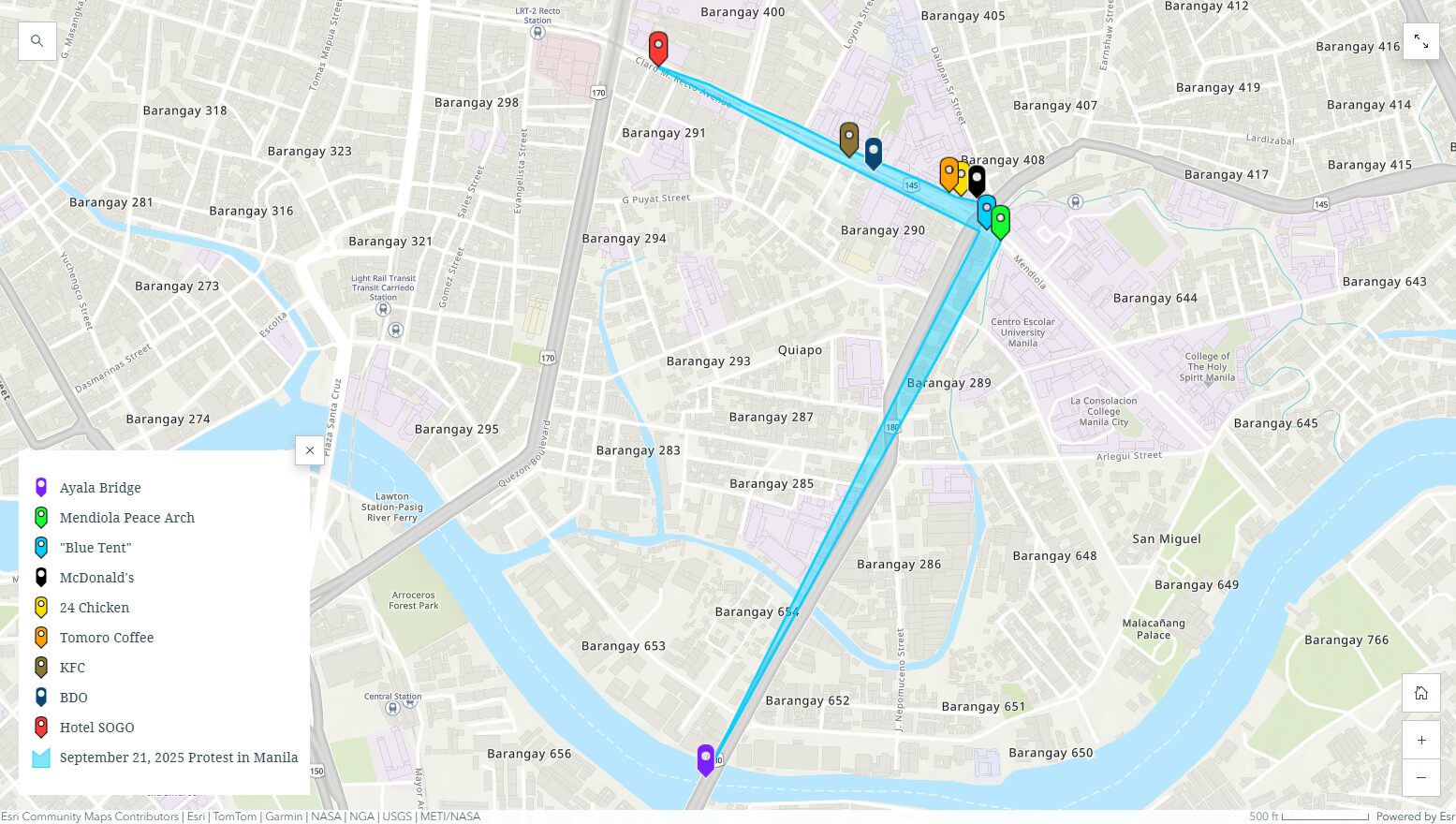
Map showing where civilians were hurt by the police on September 21, 2025. An interactive version of the map can also be accessed here.
Ayala Bridge
Violence first erupted when a group of protesters broke away from the main contingent in Luneta and marched at around 2 p.m. to Ayala Bridge, the other side of which were the contiguous streets of Gen. Solano and JP Laurel that lead directly to the Malacañang Palace. The crowd was met by uniformed police officers on standby, their shields barring protesters from crossing further. Many began to attack the officers by punching and kicking their shields and hurling rocks, bottles, and other projectiles. Some police officers were seen fighting back, using their shields to push the protesters. Some protesters even threw molotov cocktails at a container truck that was in front of the bridge, causing it to burst into flames. A motorcycle was also burned alongside the truck. After a few minutes, the fire was put out.
At around 2:20 p.m., police began their dispersal of the protesters. A group of more than 10 policemen, all in complete riot gear, swarmed a protester in front of the Metro Oil gas station before repeatedly kicking him until he fell. The Philippine flag he brought was trampled to the ground.
Police were then seen rounding up around a dozen protesters and had them lie face-down on the pavement after being arrested. At around 2:30 p.m., it began to rain, which temporarily stopped further escalations of violence. From Luneta and the Ayala Bridge, protesters made their way to Mendiola for a short program to end the protest.
Mendiola
Hundreds of police were barricaded in front of the Mendiola Peace Arch. In addition to the police’s shields, steel and concrete barriers and barbed wire stood between them and the protesters. The program ended at around 3:30 p.m. Similar to what happened in Ayala Bridge, a deluge of stones, plastic bottles, and even traffic paraphernalia such as cones were hurled at the police, who raised their shields to deflect.
Around 10 minutes later, the police again began their violent dispersal, this time with no holds barred.
Police were seen utilizing excessive force even while their victims appeared defenseless and cooperative. Using their riot sticks, at least a dozen police officers hit University of the Philippines Diliman student Mattheo Wovi Villanueva while dragging him away. Similarly, a man with a buzzcut was surrounded by several police who punched him repeatedly, pushed him around, and hit him with their batons even when it did not seem as if he was fighting back. Next to this incident, another swarm of PNP officers violently kicked and hit a shirtless man, even as he was already laying defenseless on the ground. A photo captured by photojournalist Raffy Lerma showed the man with bruises all over his face and body. Unmistakably, a boot print can be seen on his bare torso.
Near a Tomoro Coffee, two men were seen being aggressively dragged by groups of police. One of them, a shirtless man with his hair in braids, was punched by police even as he was already being led away. In front of McDonald’s, several police officers surrounded a man wearing a black t-shirt with a text design saying “peace” and beat him to the ground. A policeman was seen trying to stop his fellow officers, but they continued to hurt the protester.
There were also instances when police officers mauled civilians to the point of tearing their clothes apart. In front of a 24 Chicken, a man was shoved violently by different police officers several times. His black t-shirt was torn apart, and he was almost stripped to his underwear as he was being hauled away by the PNP. Near a Banco de Oro, a shirtless man was pummeled by police officers as he was lying unmoving on the pavement. In an attempt to haul him up, he was further injured, with his head even hitting the ground. His mother flew from Bacolod to Manila the next day and begged the Manila Police District (MPD) to let her take him out for a CT scan. She found out what happened to him through the video circulating online.
In another instance, four people were seen being battered by a hoard of police across the street from a KFC. They could be seen holding on to each other, seemingly as a way to protect themselves, yet a group of about 15 officers and one SWAT member (with a rifle strapped across his chest) pulled them away from the street.
Police did not limit their violent dispersals to the protesters. The National Union of Journalists in the Philippines released a statement regarding the harassment of some photojournalists while covering the protest. Far Eastern University student and photographer Zedrich Xylak Madrid was aggressively pushed by police as he was trying to photograph the aforementioned man in braids who was also being hurt by police. His experiences were documented by fellow photojournalist Lisa Marie David. David also mentioned how police were trying to stop her from taking photos by blocking her view with their riot shields.
The violent dispersals in Mendiola lasted around past 6:00 p.m. By then, some of the protesters had gone to Recto Avenue.
Recto
The Recto Avenue branch of Hotel Sogo was reportedly vandalized and ransacked by some protesters, its glass doors and windows smashed. A video circulated online of a SWAT member dragging a boy to the 2nd floor of the hotel and presenting him to the employees to be heinously punched, over and over, despite his repeated cries of “Tama na po (Please stop already).”
MPD spokesperson Maj. Philip Ines stated that the officer merely brought the boy to be identified, not to be harmed by the employees. “‘Yung mga galit na staff doon ‘di napigil ang emosyon (The angry staff just couldn’t handle their emotions),” he said. Regardless, the boy would not have been hurt had the SWAT member not dragged him to the hotel, which is why we are including this incident in our count.
Two people died as a result of the September 21 protest, yet neither are included in our count. A watch repairman admitted to stabbing a 15-year-old boy because he feared the destruction of his repair stand. He has since surrendered to the authorities. Eric Saber, 35 years old, was hit by a stray bullet in the neck as he was passing by Recto. He died two days later. Human rights groups allege that he was hit by gun-bearing police. However, the MPD has denied the use of their firearms. As of writing, there is no conclusive evidence that the police were responsible for his death. Therefore, we did not include him in our count.
Civilians beaten while detained
Amnesty International reported that even civilians uninvolved in the protest, much less in attacks against the police, were detained and beaten up. Testimonies by the victims pointed to a tent in Mendiola where police took them in and harmed them physically. Alias “Rey” recalled how he was punched and kicked by police who said he was responsible for killing two other officers, despite the fact that no police died during the protest. Seventeen-year-old alias “Ahmed” was arrested with his relatives “Yusuf,” 18, and “Ali,” 19, by police who took them to the tent before punching them in the face and hitting them with their batons. They were told they were being arrested for inciting violence against police, despite Ahmed saying they were not even part of the protest, and were just passing through on their way to buy rice.
Bulatlat reported the similar experiences of Polytechnic University of the Philippines student Daniel Gio Caballes. The order was to “arrest everyone wearing black,” leading to Caballes’ brutal arrest by the police, despite being uninvolved in provoking violence against the state forces. He was reportedly beaten and threatened while in detention.
A total of 216 individuals were arrested during the protest, with 91 of these being minors. The youngest was reportedly 12 years old. Philippine law states that warrantless arrests are only valid for 36 hours; however, most of the protesters were released days beyond that period. As of January 2026, cases of sedition have been filed against 90 people involved, with the Department of Justice starting the preliminary investigation.
Meanwhile, the House of Representatives Makabayan Bloc has filed a resolution urging the Commission on Human Rights (CHR) to launch an investigation against the reported “brutality, alleged torture, and other human rights abuses” done by the police. While the CHR has committed to a probe, there have been no updates as of writing.
Undoubtedly, police officers were hurt by the protesters, even while wearing complete riot gear. The injuries they sustained required many of them to seek medical assistance after the protest. Equally undoubtedly, however, was the violence they unleashed upon the scores of protesters on the streets of Manila. Despite this, Department of Interior and Local Government Secretary Jonvic Remulla praised the police for their behavior: “I would like to commend the PNP for their professionalism and discipline yesterday. They adhered to the law and followed their instructions.”
If the instructions were for the police to respond to the protesters with near unrestricted force, then Sandatahang Dahas data shows that they did exactly that.
[Aidrielle Raymundo is a university research associate at the Third World Studies Center (TWSC), College of Social Sciences and Philosophy, University of the Philippines Diliman. She also did the graphics accompanying this report. The data for this monitor were compiled with the contributions of TWSC researcher Joel Ariate and student assistants Nadine Castillo, LJ Meriño, and Aaliyah Nicole Ybera. To learn more about Sandatahang Dahas, visit its website and for the latest updates, follow the Sandatahang Dahas in these social media platforms: social media platforms: X (formerly Twitter), Instagram, Threads, and Bluesky.]
Thumbnail photo of protest in Mendiola by Bullit Marquez.