
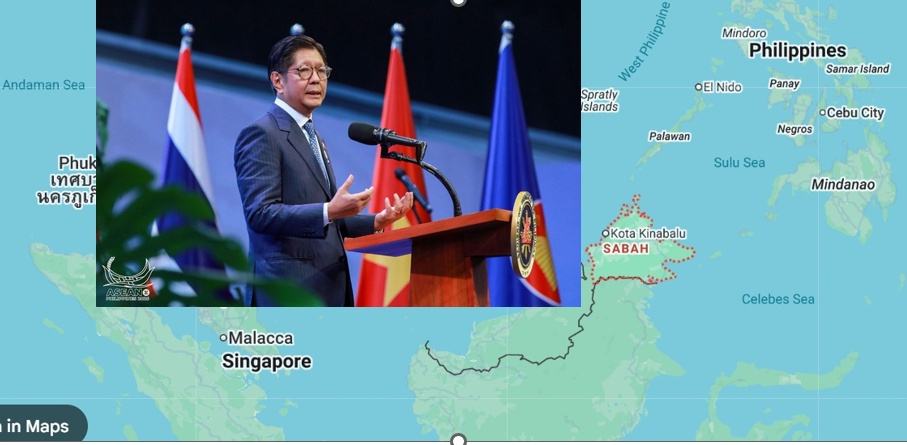

In his press briefing at the close of the 49th ASEAN summit on Nov. 17, President Marcos reported a major development in the ASEAN Power Grid initiative with the signing of an enhanced memorandum of understanding which he said would “advance cross-border electrical connectivity.”
He said several of the 11-member countries of the regional group already have cross-border agreements on energy sharing. On the part of the Philippines, the president said, “I am also happy to report that the first undersea cable for sharing of energy is going to be laid between Malaysia, Sabah in particular, and Philippines in Mindanao. And this is the first undersea cable as well. So that is – the beginnings that were on land are now extending into the sea.”
Immediately, we texted high-ranking foreign affairs officials: Has the Philippines dropped its claim on Sabah?
One official immediately replied: “Sorry, I need to send that query to the policy team – I’m doing mainly bilaterals for ASEAN.”
From another official: “I was not there. But it will take an express, deliberate and unequivocal act to drop the claim.”
What happens now with that “Malaysia, Sabah in particular” statement of the President?
The DFA official stressed: “It will take more than that to drop the claim.”
We are waiting for DFA’s clarification on this matter.
History of Philippine claim
Meanwhile, a review of the Philippine claim on Sabah goes back to more than three-and-a-half centuries ago when the Sultan of Brunei, who owned the timber and mineral-rich land known as Saba or Sabak, gave it to Sultan of Sulu Salah ud-Din Karamat Bakhtiar in 1658 as a reward for helping quell a rebellion.
In 1878, Sulu Sultan Jamalul Alam Kiram leased it to the Hong Kong-based British North Borneo Co. of Baron Gustavos von Overbeck and Alfred Dent for 5,000 Malaysian dollars a year. It became known as North Borneo.
In 1946, Overbeck and Dent, without permission from the Sultan, transferred the territory to the British government when the company ceased operations.
On Sept. 11, 1962, Sultan of Sulu Mohammad Esmail Kiram ceded to the Philippine government full sovereignty, title and dominion over the territory. President Diosdado Macapagal filed the Philippines’ claim over Sabah with the United Nations.
In 1963, the British government, again without permission from the Sultan of Sulu, transferred Sabah to the newly formed Federation of Malaysia.
There are an estimated 800,000 Filipinos in Sabah, most of them undocumented. Malaysia, which has continuous physical occupation of Sabah state, has repeatedly encouraged the Philippines to establish a consulate there but the Philippines declined because that would be tantamount to dropping its territorial claim.
The Philippines does not claim the whole of Sabah, which is a quarter of the size of the Philippines. The Philippine claim covers much of eastern Sabah based on the 1878 agreement between the Sultanate of Sulu and the British North Borneo Company.
Does not involve sovereignty
The question now: Is the “Malaysia, Sabah in particular” mentioned by the President, in the area being claimed by the Philippines? If it is, how will this affect the Philippine claim?
Lawyer Romel Bagares said, “Both countries can simply agree the grid agreement does not involve or affect sovereignty claims.”