
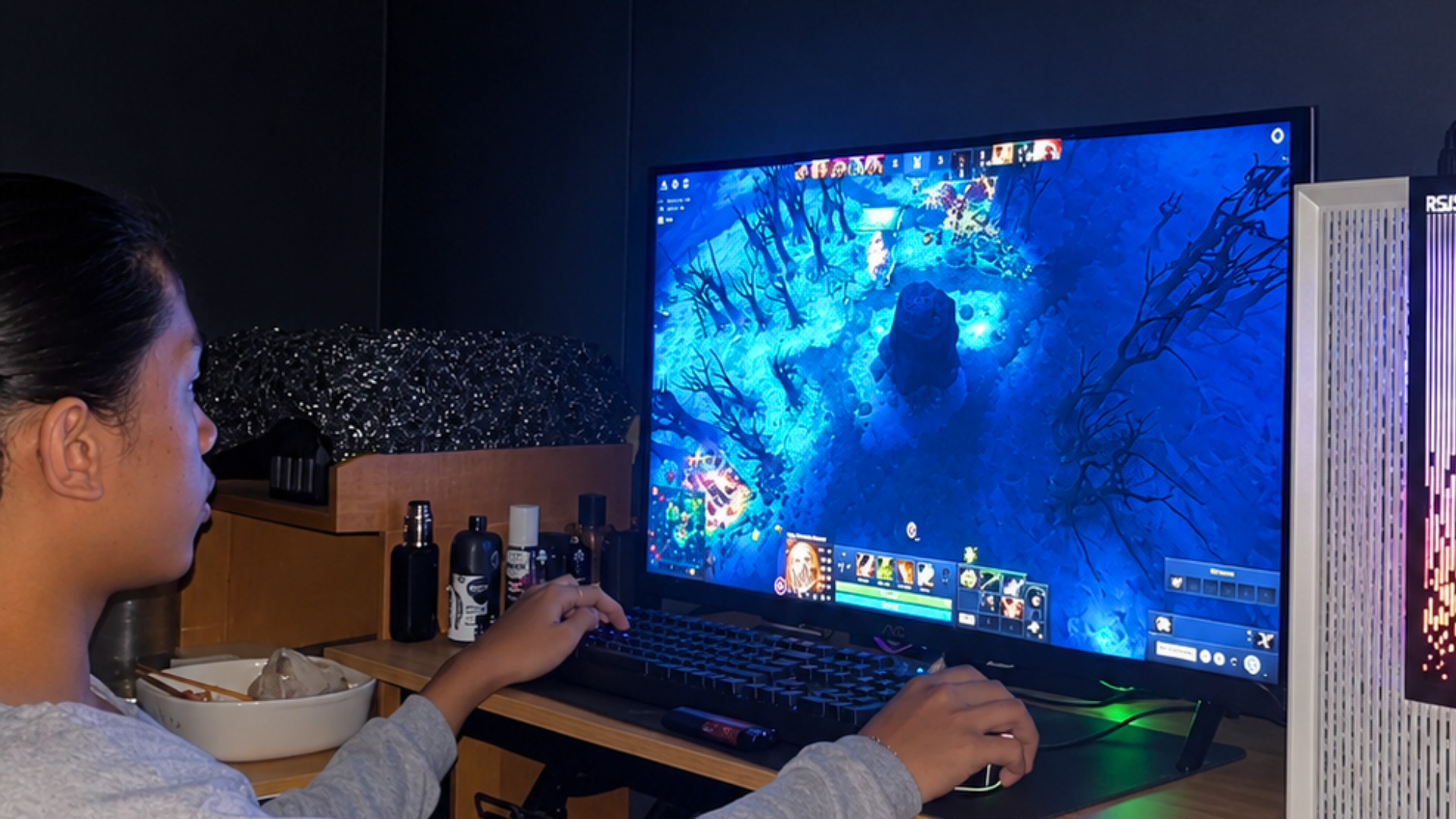
Between juggling school, work and regular gym workouts, Ronian still manages to squeeze in time for gaming.
The free time he has, usually in the evening after work, is spent flexing his online gaming muscles. Weekends give Ronian more time to relax and spend longer hours playing with friends.
He has gone through them all – Roblox, Mobile Legends and League, among others – and the 21-year-old enjoys the challenge of getting better, competing against other players and working toward becoming one of the best at what he plays.
The B.S. Information Technology student understands that winning is not always the goal for someone who engages in online gaming. It is their way of unwinding, hanging out with friends, talking and playing after a day filled with other responsibilities. Ronian also works as head of documentation at an accounting firm.
“Gaming spaces are mostly for fun and bonding,” he said. “Hindi naman palaging about winning, minsan gaming is simply a way para mag-relax after school o kapag may mga free time ka. (It’s not always about winning, sometimes gaming is simply a way to relax after school or whenever you have some free time.)”
For most gamers, gaming is a simple and casual part of everyday life. But when it’s linked to violence, such an ordinary hobby can be subjected to intense scrutiny.
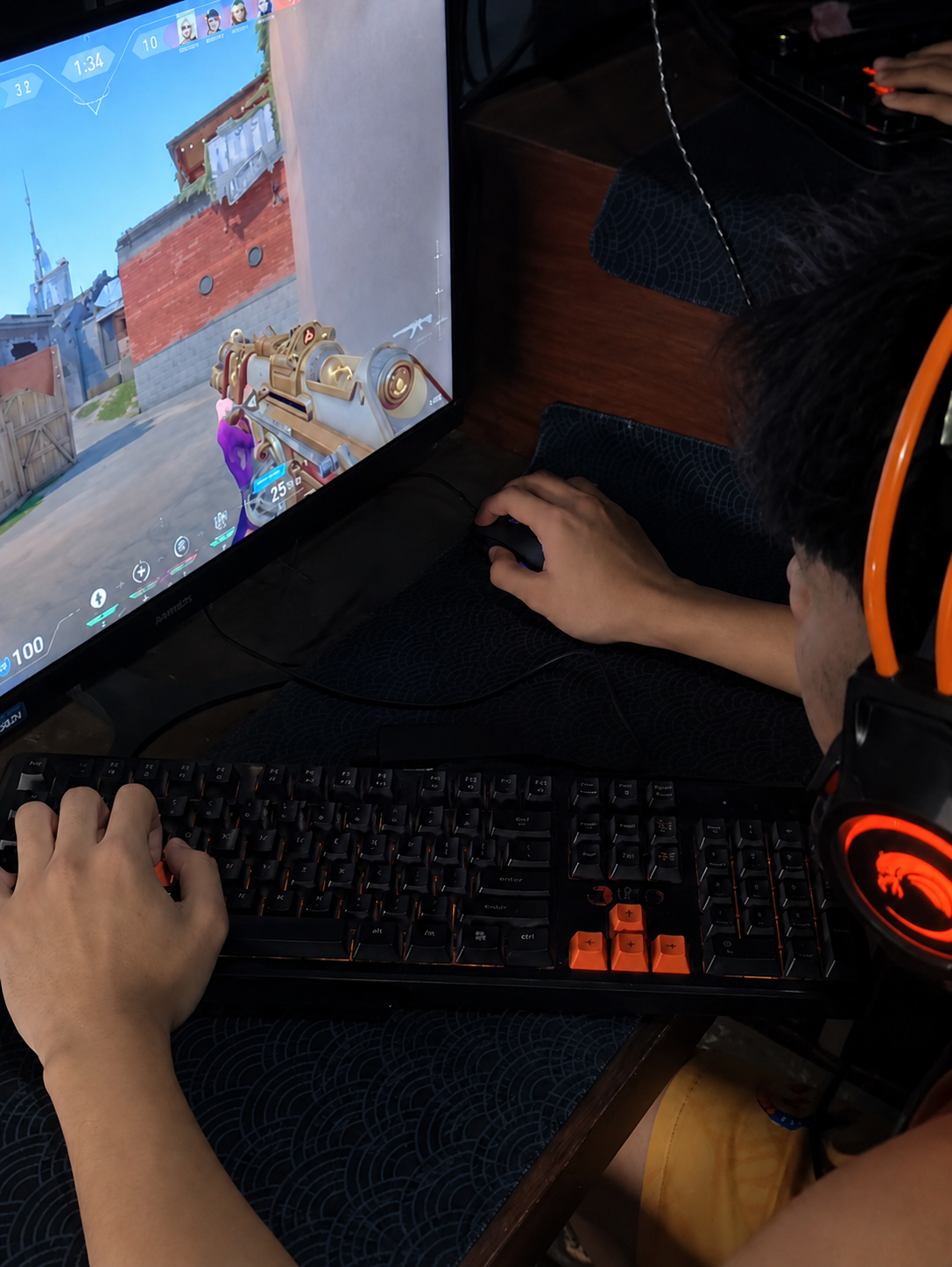
Gaming and real-world violence
In the last several months, there has been a spate of violent school incidents around the country, with students both as perpetrators and victims. For every fatality and injured student, there was one concern: the impact of video games and online platforms on the lives of young people.
In the wake of these disturbing events, online games are again caught in a familiar debate: do violent video games cause real-world violence?
Ronian finds this suggestion disappointing. “Para sa akin, medyo disappointed ako kapag sinasabi agad ng mga official or public figures na video games ang cause ng violent behavior (Personally, I’m a little disappointed when official or public figures immediately say that video games are the cause of violent behavior,)” he said.
He contends the discussion often overlooks the difference between playing a game and the player acting on what they see on screen, as well as other factors that shape a person’s behavior.
When gaming becomes the headline
The debate gained renewed attention following the Aug. 18 shooting at the Ateneo de Zamboanga University, where two students were killed. Authorities examined the suspect’s online and gaming activity as part of its investigation, while Interior Secretary Jonvic Remulla publicly raised Roblox as a possible influence.

Months earlier, the mobile sandbox game GoreBox had come under scrutiny after reports that one of the suspects in the Tacloban City shooting incident played the game. The Cybercrime Investigation and Coordinating Center subsequently took action involving access to the game through digital storefronts.
Concerns about young people’s online activities continued after the Sept. 18 shooting at Banga National High School in South Cotabato. Authorities also raised questions about online activity, threats and harmful digital communities.
The incidents have prompted broader questions about the digital spaces young people occupy, from games featuring fictional violence to platforms where users communicate and interact.
But finding a game or platform in someone’s digital activity does not, by itself, prove that it caused a violent act.
For gamers such as Ronian, the public discussion can have consequences beyond the headlines. When a tragedy becomes associated with a game, he said, people may begin judging both the platform and the people who play it.
“Sometimes, mas nag-i-ingat din kami sa mga sinasabi o ginagawa online, (Sometimes, we are also more careful about what we say or do online,)” he said to show how gamers have become more cautious when it comes to their online behavior.
He thinks that people unfamiliar with gaming may not understand how young players use these platforms. Gaming, he stressed, is not purely for entertainment but also a space to socialize and work together with other players.
“I think people who don’t play video games often misunderstand the gaming community, minsan iniisip nila na (they sometimes think that) gamers are just playing all day, or gaming is always a negative activity, ” he told VERA Files.
The gaming experience is more than that, Ronian emphasized. How gaming affects a person also depends on how they use it and manage their time.
“One person’s actions don’t automatically represent everyone who plays video games,” he added.
Not the whole story
For years, researchers have been discussing the relationship between violent video games and aggression. One of the challenges is distinguishing aggressive thoughts or behavior from actual acts of violence.
Research findings on this relationship have varied, with some studies reporting associations between violent video games and aspects of aggression, while others have questioned the strength or interpretation of such findings.
A 2019 study published in Royal Society Open Science examined 1,004 adolescents aged 14 to 15 and found no evidence of a link between violent video game engagement and aggressive behavior in the study.
The researchers pointed out that their findings did not support the notion that violent video games are tied to increased aggression among the youth or make them necessarily more aggressive.
The American Psychological Association (APA), in its 2020 resolution, also warns against using violent video games to explain serious acts of violence. Its resolution states that their findings should not be misinterpreted to attribute mass shootings to violent video game use and notes that violence is a complex social problem involving multiple factors.
Violence may also relate to contexts outside of the media, such as family life, peer experiences, social context, and personal circumstances, including access to support.
Ronian makes a similar distinction based on his own experience as a player.
“May clear difference between enjoying violent content sa isang game and actually wanting to do something violent in real life,” he pointed out.
With gaming, he explained, there is fictional violence that is part of the game. But just because someone likes that type of content, doesn’t mean they want to imitate or carry this out in real life. He feels that a lot of different factors can play into a person’s actions, and not just their games.
This, however, does not mean gaming platforms should be exempt from scrutiny. Ronian admitted that online platforms can lead to toxic behaviour, bullying, scams and inappropriate content and interactions with strangers, particularly among younger players.
These are issues that should be addressed on their own. He suggested that platforms increase their security, have better reporting systems, and institute ways so parents stay informed about what their children are doing online.
Ronian added that schools should teach responsible internet use to students and help ensure that younger users are protected. Gaming, he believes, should not be used as a scapegoat when looking into factors that may contribute to violence.
Recognizing risks in digital spaces does not automatically establish that video games cause serious real-world violence.
Looking beyond the screen
Dr. Gutsdozer “Doc Guts” Tancio, a licensed psychologist and founder and head psychologist of Bataan Mental Health and Psychological Services, said understanding violence among young people requires looking beyond a single activity or form of media.

“Walang single determinant na mag-e-explain kung ano ‘yung dahilan bakit naging bayolente ang isang bata o isang tao, (There is no single determinant that can explain why a child or a person becomes violent)” he told VERA Files.
He explained that a variety of factors may interact to influence a young person’s behaviour, such as temperament, family and home environment, emotional difficulties, relationships and the developmental issues that come from adolescence.
Further, adolescents are still developing their emotional and impulse regulation, which may have a bearing on how they react when faced with a difficult scenario.
Rather than attributing behavior to one influence, Tancio said, it is important to consider a young person’s experiences and circumstances.
“Hindi enough na naglalaro ng COD, ng Genshin, ng Mobile Legends yung isang tao para all of a sudden, bigla siyang mag-amok at gumawa ng mga bayolenteng bagay sa paaralan, (It isn’t enough that someone plays COD, Genshin, or Mobile Legends for one to suddenly go on a rampage and commit violent acts in school,)” Tancio said.
He also advised against mental illnesses being used as an easy explanation for violence.
“Hindi lahat ng may mental health ay nagiging bayolente, (Not everyone with mental health [condition] becomes violent,)” he underscored.
For Tancio, the circumstances surrounding a young person matter. Losing a game and becoming frustrated is different from physically hurting another person.
He is not saying that individual behavior should be ignored. But instead, one needs to consider what else may be going on in a person’s life to understand it.
These factors may include family relationships, peer dynamics, school pressures and access to support. Focusing mainly on a game can lead to an incomplete picture of the other factors that may be influencing a young person’s behaviour.
Wider online world risks
Tancio also drew a distinction between the fictional violence shown in video games and the real-world violence that can spread on social media.
When previous attacks and their perpetrators are widely available and the attention given to the attacks becomes widespread, then social media can become a catalyst for copycat attacks, he said.
The concern is not only the presence of violence in a game, but also how real incidents can be captured, shared and repeatedly brought to public attention online. According to Tancio, this can contribute to what he referred to as copycat attacks.
Gaming and social platforms can present youth with the risk of being bullied, seeing inappropriate content, and engaging with unhealthy communities or strangers. Such risks are worthy of consideration, especially if children and adolescents are involved.
While Meta, Facebook’s parent company, said it would provide subscriber and traffic data to the National Bureau of Investigation once a threat to child safety is flagged and before an actual attack occurs, several concerns raised before a congressional inquiry still need to be addressed by Mark Zuckerberg’s organization.
For Ronian, the answer to these issues isn’t to ban or demonize gaming, but to make online environments safer.
Tancio added that understanding young people’s well-being also means considering their lives outside the internet. The support systems, family relationships, and situation of the youth can be as important as what they experience online.
Together, their perspectives point to the need for a conversation about youth safety that recognizes risks in digital spaces without attributing a person’s behavior solely to a video game.
Beyond the blame
For Ronian, gaming is a hobby that fits around college, work and other responsibilities. It provides a chance to unwind, play and socialize with fellow players, both at an evening session and on a longer weekend.
His experience doesn’t reflect everyone’s experience, and the actions of one player do not automatically represent an entire gaming community.
But it offers a perspective often missing when video games become part of the public conversation after a tragedy: what gaming actually means to the people who play.
“I think people should not immediately blame video games kapag may incident na kasama or involved iyong violence, (when there is an incident that includes or involves violence,)” he said.
“Dapat tinitingnan muna iyong (we should first look at the) bigger picture and consider the different factors that may have contributed to the situation.”
He believes the discussion should recognize possible risks while understanding that gaming is also a normal form of entertainment and social activity for many young people.
Editor’s Note: Calista Garcia is a Polytechnic University of the Philippines student writing for VERA Files as part of her internship.