

Editor’s note: This article mentions suicide and self-harm.
The recent school shootings across the country have forced educators to re-examine the environments affecting emotional growth of today’s youth.
“Bakit sila nagalit? (Why did they become angry?),” child and adolescent psychiatrist Mary Annjoy Aguadera asked. Based on her assumptions and experience treating children who exhibited hostile behaviors, she said there is no single answer, but an accumulation of contributing factors.
“Being hurt, provoked, teased, threatened or bullied endlessly; not succeeding in what they plan to do or not being able to do what they want to do – all these could build up anger,” she said.
On September 18, a Grade 9 student at Banga National High School in Banga, South Cotabato fired at fellow students killing three and injured at least six more before turning the gun on himself.
A month earlier, August 18, a 10th-grade student of Ateneo de Zamboanga University Zamboanga City, fired into a classroom killing a classmate, then killed himself.
On June 22, two students aged 14 and 15, opened fire at San Jose National High School in Tacloban City, Philippines, killing three students and injuring 20.
Aguadera said it is important to see what triggered the children to attack others and turn on themselves. Some common warning signs include suddenly being quiet and isolated. For teachers, it is important to pick up the warning signs and report them to the clinic or the guidance personnel to investigate further.
Suicide ideation and even suicide jokes are “a cry for help,” she said, and it is urgent to “sit down with them, ask them how they are, what they are going through — show them that there is someone who is concerned.”
The psychologist said children who feel seen, heard, and supported “will postpone their plans to end it all for later until suicide is no longer an option.”
The need for conversation
Emma Llanto, pediatrician and adolescent medicine specialist and chief of the Division of Adolescent Medicine at the Philippine General Hospital, said preventing a harmful future for children means having early conversations and guidance on body safety, consent, healthy relationships and respecting personal space and privacy as they gain access to digital platforms at younger ages.
My personal interviews with two students revealed a deep feeling of isolation.
Kyle, a 14-year-old Grade 9 student of the Ramon Magsaysay High School in Quezon City said he is bullied and teased by classmates for posting unflattering photos on Facebook.
He said he knows of two friends are also being bullied. “They think we’re all just fooling around, and that things will be better after high school. But this is today, it really sucks. I don’t know how to talk about it with someone.”
He said he is always angry and, despite having friends, he feels alone.
Sam, 15, in Grade 9 at the St. Stephen’s High School in Tondo, Manila, lives with his bickering stepfather and mother. “If he doesn’t hurt my mama, he turns to me, yells at me and beats me up,” he says.
“While I’m relieved to escape the troubles at home, school is also a terrible place; I see the teachers and classmates I can’t stand. My friends don’t even know how I feel.”
Asked in separate interviews how they would address their anger and feelings of isolation, both boys said it is easy to hit someone to seek revenge for the pain inflicted on them, but Kyle gave a light-hearted jab: “I only shoot someone in my thoughts po.” Sam was firm: “Kaya ko pa naman po. (I can still manage).”
Both said there was never a violent incident in their schools such as the ones they saw on the news about students their age involved in school shootings. They recalled teachers and security personnel breaking off fights among students, which rarely occur.
On better days, Kyle hangs out with friends, eating burgers and fries. Sam spends time in a friend’s house before going home. To feel even better, both boys play digital puzzle and competitive games “Candy Crush,” “Free Fire Battle Royale” and “Mobile Legends Big Bang,” either alone on their phones and tablets, or with friends.
Llanto said, “Some adolescents pick up behaviors with lifelong effects – smoking, vaping, alcohol use and unhealthy eating habits.”
“It gets worse when they exhibit disturbing behaviors that would mean a symptom of other problems,” especially that threats and bullying now are both physical and digital.
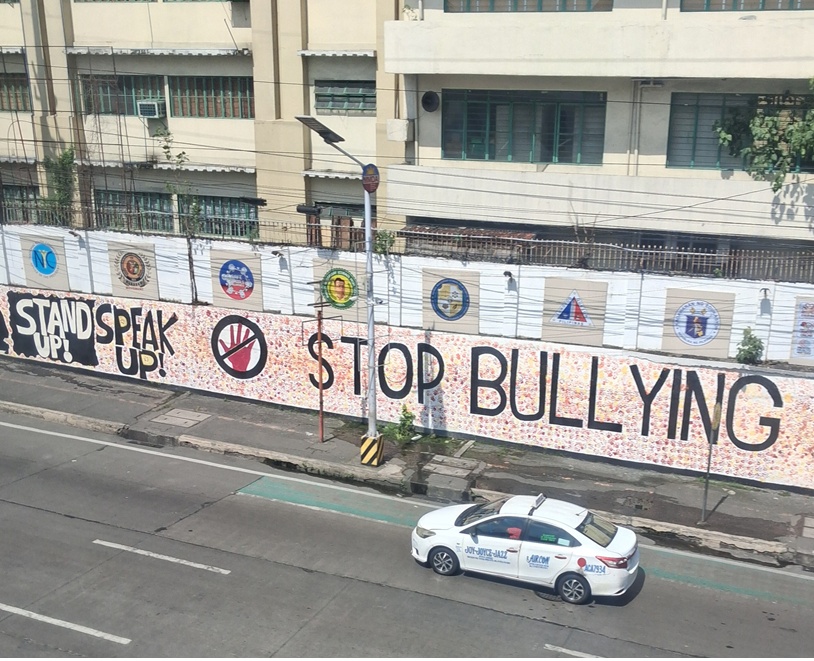
Is the anti-bullying law being implemented adequately?
Kyle and Sam said they recognize that it is tough for young people like them to be in an environment where many things are happening that grown-ups become numb to their problems.
Kyle said he feels trapped. “There is nowhere better to be.” Sam said he wished that the world “could be a bit kinder.”
Aguadera, who is also a consultant at the Manila Doctors Hospital and the government-run Quirino Memorial Medical Center and San Lazaro Hospital, said “all her referrals have a history of bullying.
She wondered if schools have anti-bullying programs or are implementing the law requiring all elementary and secondary schools to adopt policies to prevent and address bullying. She took note of adverse situation in some schools, where one teacher handles a large class of 35 or more students and unresponsive to complaints of parents of bullied children.
The Anti-Bullying Act of 2013 or RA 10627 defines bullying as repeated, harsh use of physical acts that cause pain, harm, fear, and a hostile environment; may be verbal or social bullying such as negative comments about one’s appearance, or cyberbullying aided by electronic technology.
“Is it all just on paper? Are the schoolchildren and teachers aware? Does a child know who to talk to when bullied? When a child speaks up, do teachers, guidance counselors and other school authorities listen and help?” Aguadera asked.
Ivanhoe Escartin, a retired Department of Health psychiatrist, appealed for restraint in the media coverage and in posting content on all social media platforms that show images and videos that play up the school incidents.
Escartin, who currently teaches medical students and health workers at the National Center for Mental Health and the PGH Department of Psychiatry and Behavioral Medicine, said news reporting protocols must be reviewed since the media landscape has changed.
“It is important that we don’t give children more ideas; that we prevent more copy cats,” he said.
He also asked that enforcers and authorities “not to put these children in a box” by singling out video games as a major reason.
Aguadera said “apart from passing away time, children play video games because it’s their outlet.” Escartin agreed: “It is better to help children connect as humans so that they don’t develop destructive behaviors.”
Escartin said it is crucial for the government to gather all agencies and sectors concerned and to “sit down and look at a template at understanding the world of children and adolescents while reinforcing respect and values.”
If you or someone you know is struggling or in distress, help is available 24/7: National Center for Mental Health (NCMH) Crisis Hotline: Landline (Luzon-wide toll-free): 1553Mobile: 0917-899-USAP (8727) / 0966-351-4518 / 0908-639-2672