
Social media remains a major source of news for Filipinos who do not trust the platform compared to other forms of media, independent pollster Momentum Research said on August 27.
Results of its nationwide survey of 1,487 Filipino adults conducted between Aug. 18 to 23 has revealed a clear contradiction in their everyday media habits, according to Momentum founder and chief executive officer Cleve Arguelles.
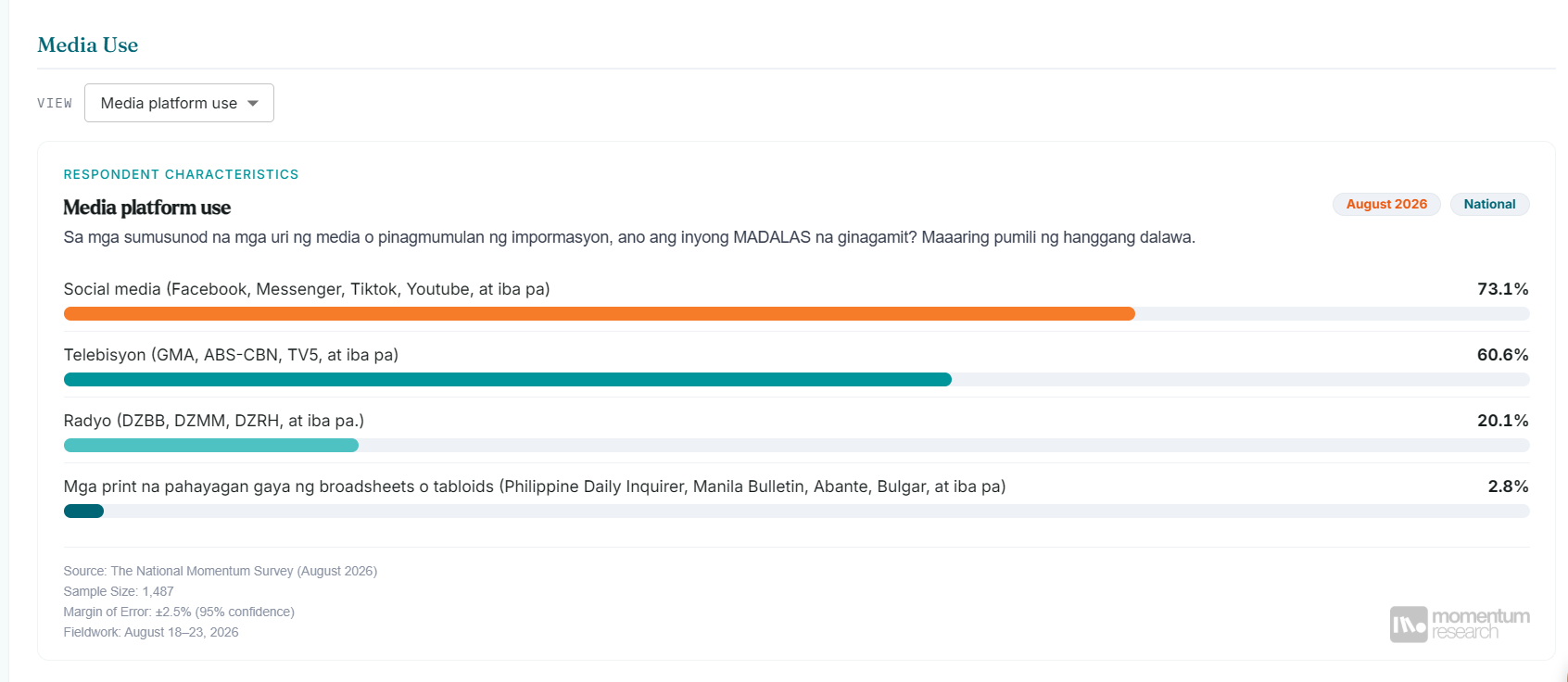
Nearly three-quarters (73.1%) of the respondents use Facebook, Messenger, TikTok and YouTube regularly to get news, but more than half (54.5%) say social media is the form of media they trust the least.
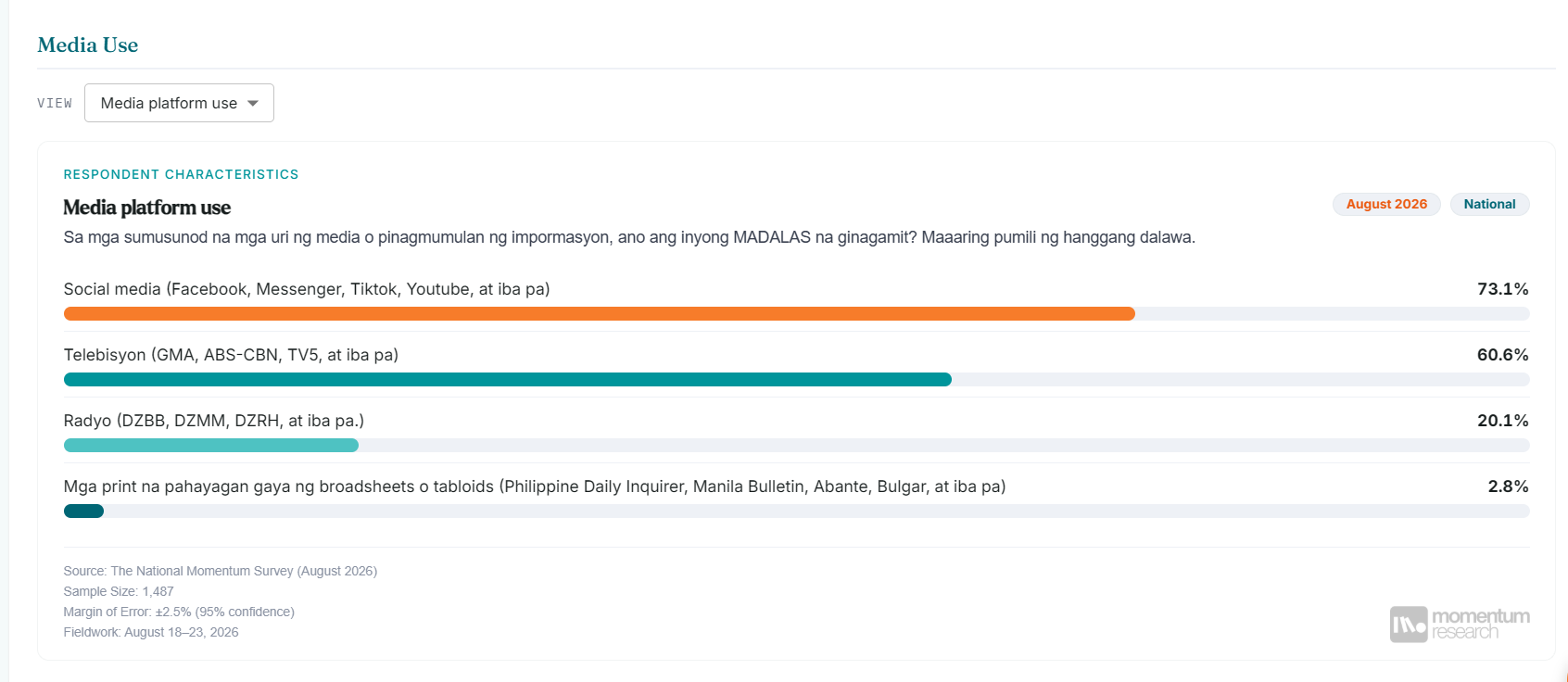
Television remains the most trusted, indicating that over half or 53.2% say that television — led by GMA, ABS-CBN and TV5 — is the platform they trust the most. Only 28.2% place primary trust on social media, trailed by radio with 15.0% and 3.7% for print.
While television maintains high regular viewership at 60.6%, radio sits at 20.1% and print newspapers at 2.8%. The heavy migration toward digital platforms, however, has created what researchers describe as a fractured information environment.
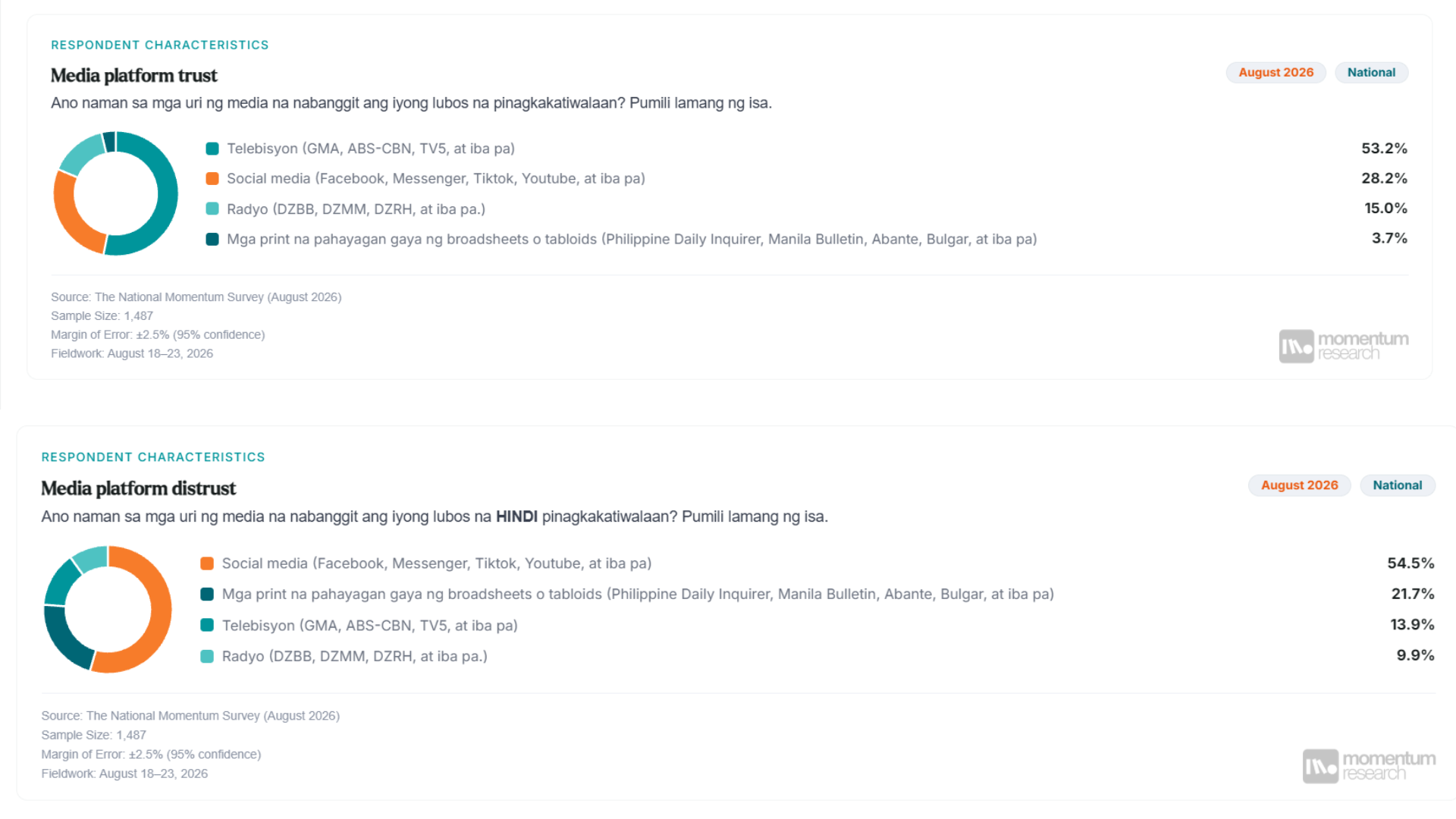
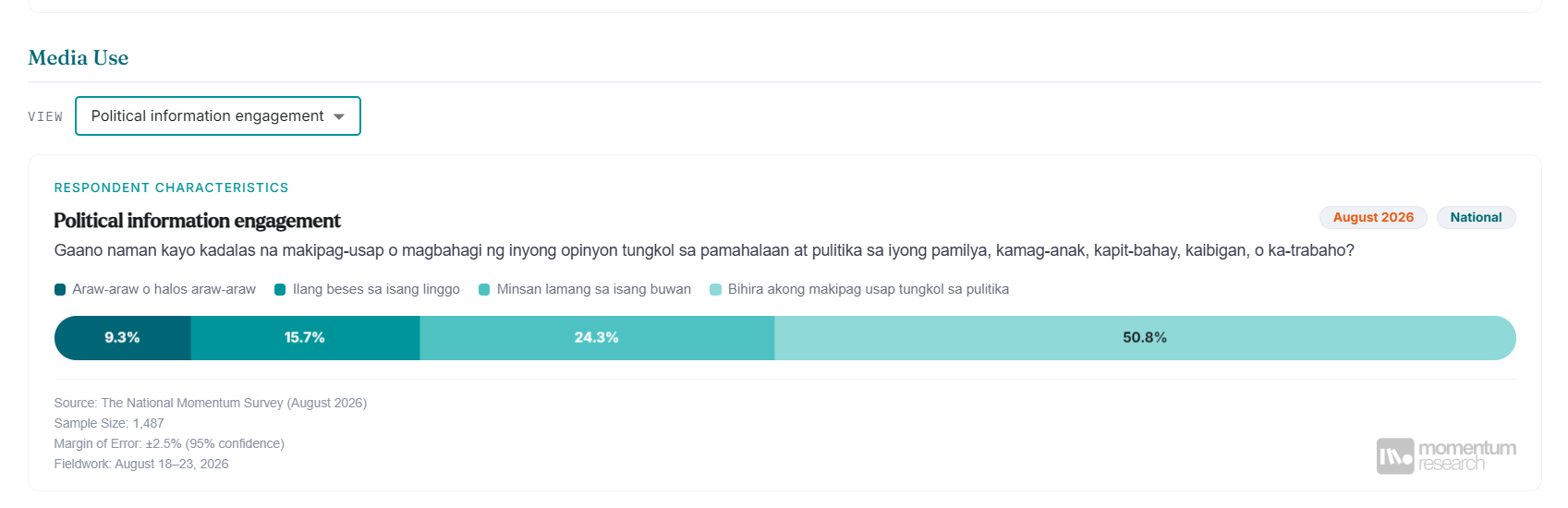
The divide is deepened by low everyday political discussion. The survey found that 41% of respondents seldom keep up with political news, while 51% rarely talk about politics in their regular social circles.
Arguelles said the findings reflect an increasingly fragmented information environment where Filipinos may consume and interpret political information within different media ecosystems.
Consolidation in 2028 electoral preferences
Despite this, Vice President Sara Duterte maintains her lead in early preferences for the 2028 presidential race.
She has a national presidential voting intention of 45.8%, up two points from Momentum’s July survey. Naga City Mayor Leni Robredo trails at 19.5% followed by Sen. Raffy Tulfo at 13.3%.
In hypothetical one-on-one matchups, Duterte would have a clear lead:
- 58% to 33% against Robredo; and
- 64% to 22% against Sen. Risa Hontiveros.
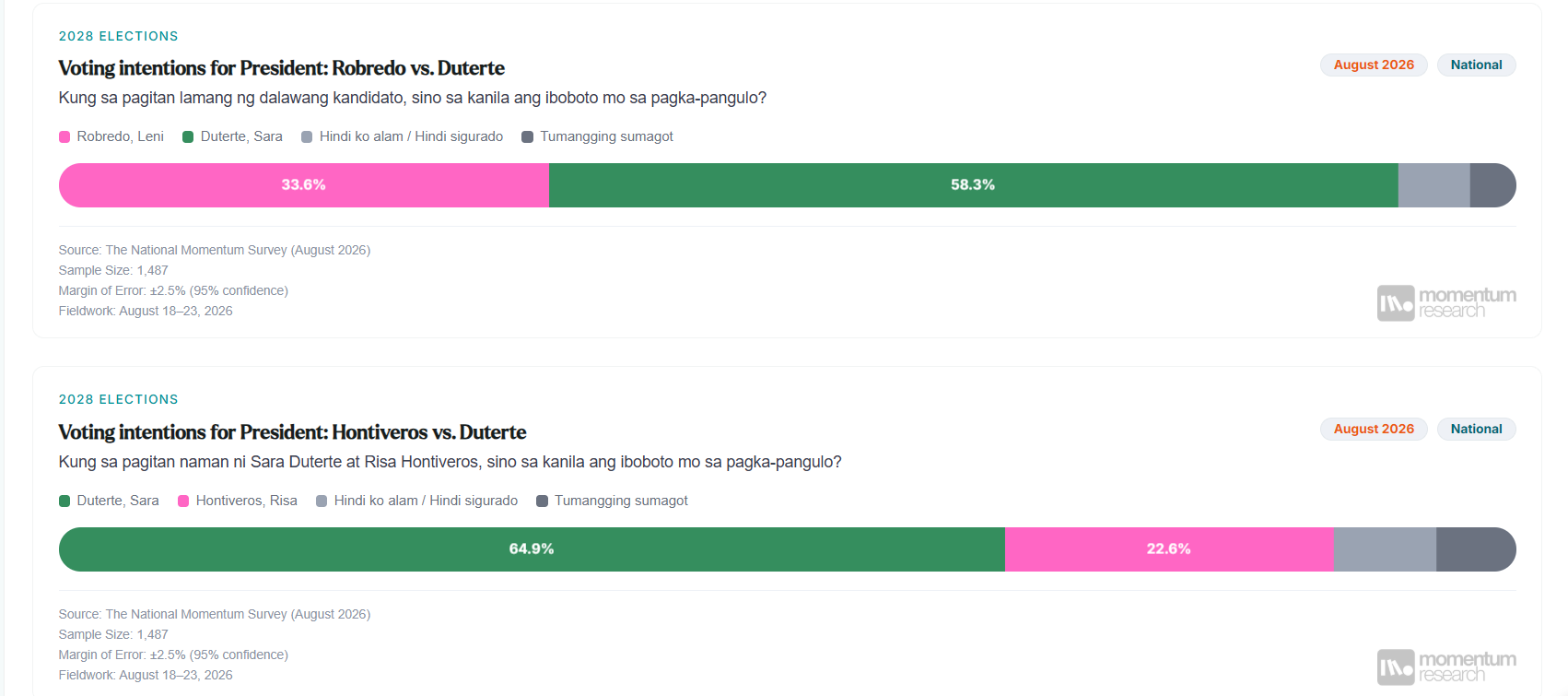
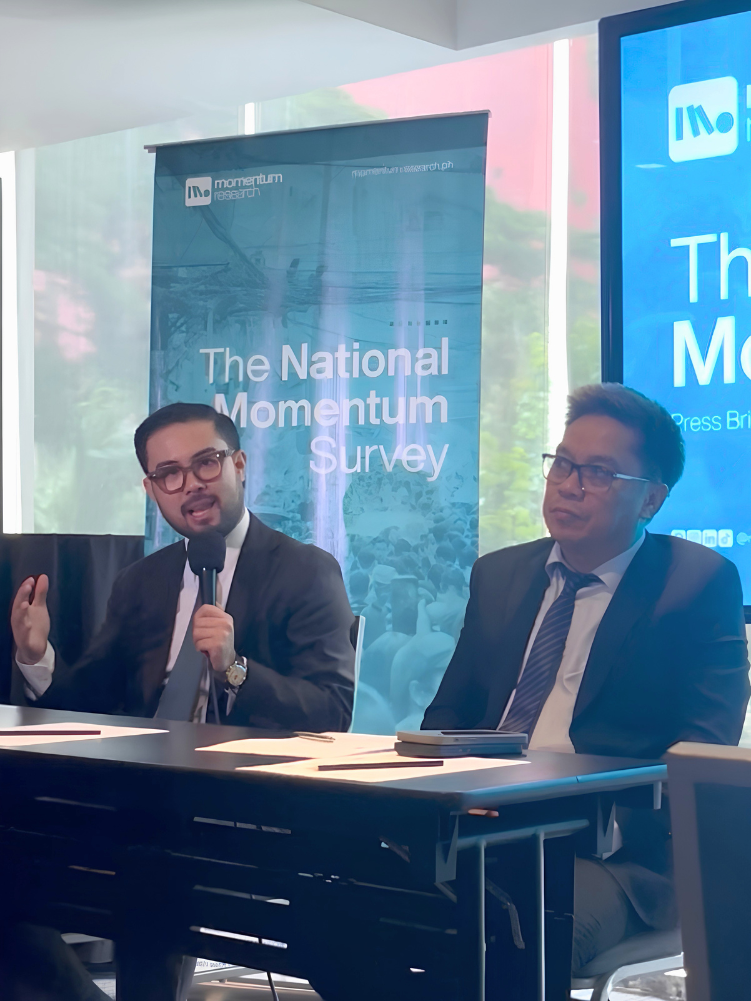
Political analyst Dennis Coronacion said at the Aug. 27 press conference that support for Duterte has remained resilient in part because of how political developments are circulated and framed on social media.
In Mindanao, where Duterte has 78% presidential preference, legal challenges and legislative hearings are often circulated on social media as specific and pointed attacks by the administration. Coronacion said this framing has helped maintain Duterte’s support among her base rather than undermine it.
Meanwhile, Sen. Raffy Tulfo has the most support at 25% in the vice presidential race, with Sen. Robin Padilla at 14% and Sen. Bong Go at 13%.
Ground realities vs. policy scapegoating
The gap between legislative focus and actual public priorities is equally visible in national policy debates.
The findings also contrast with recent public discussions that have placed attention on video games and online content following incidents of school violence. Respondents instead put greater emphasis on physical school security and anti-bullying measures:
- 75.8% demand stricter physical security in schools,
- 53.7% call for stricter anti-bullying enforcement,
- 30.4% support expanding professional mental health and counseling services,
- 26.1% back tighter government monitoring of social media and online content;
- 26.0% seek stricter implementation of gun laws.
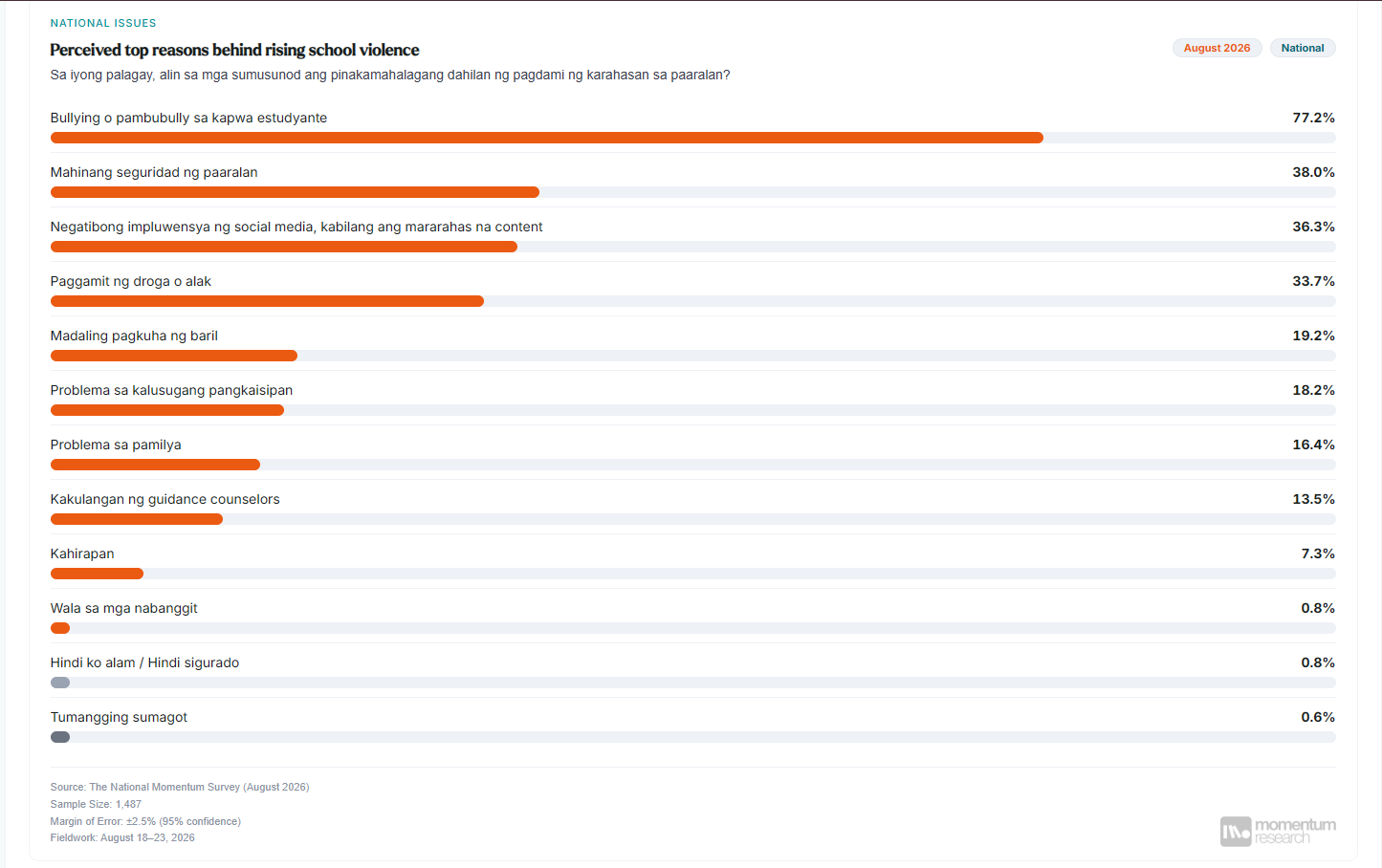
Overall, 81.7% of Filipinos agree that school violence is a “very big problem,” and 69.0% really worry about the violence that happens to relatives of students. Respondents say bullying (77.2%) and weak campus security (38.0%) are the two most frequent root causes of the incidents, followed by violent social media content (36.3%) and substance use (33.7%).
When it comes to juvenile accountability, 42.3% feel a combination of punishment and rehabilitation is warranted, while 31.9% say the most effective way to deal with serious youth offenders is to treat them as adults, and 21.2% believe that the best way is to prioritize rehabilitation.
Public concerns stay firm on larger social, economic and governance issues, aside from campus safety. About 73% of Filipinos think that the nation is on the wrong path, with corruption paired with worries over the flood control scandal, as top concerns at 47%
On other issues, 79% say the Barangay and Sangguniang Kabataan elections this November should not be postponed; 45% approve of the administration’s West Philippine Sea policy but 44% disapprove of it.
Some 33% are against the proposed Pax Silica artificial intelligence hub in New Clark City due to power grid (51%) and water supply (47%) depletion concerns.
Editor’s note: Calista Garcia is a Polytechnic University of the Philippines student writing for VERA Files as part of her internship.