
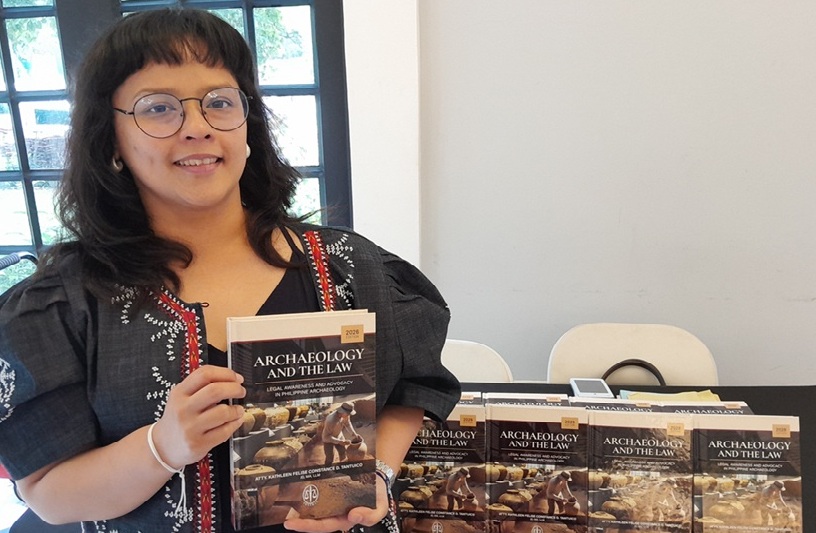

The bespectacled Kathleen Felise Constance dela Cuesta Tantuico may strike one as a studious hoarder of degrees the way one can be a hoarder of hobbies. This 38-year-old author of the ground-breaking book Archaeology and the Law: Legal Awareness and Advocacy in Philippine Archaeology has been praised by Raul Pangalangan, professor emeritus of the University of the Philippines College of Law, former judge of the International Criminal Court (ICC), incoming dean of the new Pamantasan ng Pasig school of law and a member of the newly formed Truth Commission, for being “the first and only Filipino lawyer-archaeologist (who has) identified legislation that impinges upon archaeology as a discipline.”
Tantuico has a bachelor’s degree in social sciences, specializing in cultural heritage with a minor in history from the Ateneo de Manila University, a master of arts in archaeology from UP, a juris doctor degree from the UP College of Law and a master of laws in international law with focus on law and society from the University of Kent in Canterbury, England.
She could’ve had her fill of lucrative professional practice abroad, but she has chosen to come home and publish a book that recommends that “archaeologists should engage policymakers in crafting laws relevant to archaeology,” in the introductory words of Dr. Armand Salvador Mijares of the UP School of Archaeology. After all, the country is too vulnerable to be left in the hands of unscrupulous hunters still after the fabled Yamashita treasure.
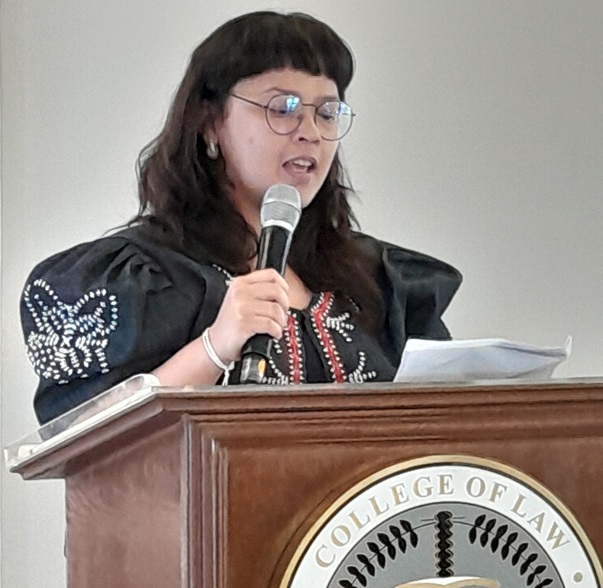
In her remarks at the launch held at The Blue Room of Atencio-Libunao Hall, UP Diliman, Tantuico told of how “law and archaeology seem like disciplines that belong to entirely different worlds. Archaeology is often associated with the past—with excavations, artefacts, ruins and the attempt to understand the lives of those who came before us. Law… is often concerned with the present and the future. It shapes conduct, institutions, responsibilities and the standards by which societies choose to govern themselves.”
She has been asked many times how these two fields are connected. She said, “Perhaps the best way to answer it was to write this book.”
In a brief conversation with VeraFiles.org, she recalled how as a child, her dream was “to go on an adventure, to discover hidden treasures.” Later in college, she initially enrolled in European Studies until she met a teacher in sociology, Zarina Medina, a young professor who was one of the star students of the specialization program in cultural heritage. Tantuico shifted to socio-anthropology, minoring in history, her interest in cultural heritage ignited.
In 2009, her class attended the first Ateneo laboratory field work that took them to Tayabas, Quezon. She said, “Since then, I’ve been interested in archaeology.” At her departmental graduation, they had then Quezon City Vice Mayor Joy Belmonte as speaker. Tantuico found out that Belmonte was also into archaeology before she entered politics.
Another important teacher she cited was Fernando Zialcita, also of the Ateneo, who introduced her to the idea that “heritage was not simply about old objects or historical curiosity, but about identity, memory and the preservation of culture itself.”
When she moved to UP for its archaeological studies program, she joined the summer field schools as a volunteer.
She said, “What began as simple curiosity became years of participation in archaeological excavations across the country. Archaeology became more than an academic discipline. It became a way of seeing the Philippines differently. Beyond the theories discussed inside classrooms, field work allowed me to encounter communities, landscapes, histories and material traces of the past in a far more immediate and human way. It revealed how archaeology is not only about uncovering artefact but also about understanding the many layers of history, identity and memory that continue to shape the nation today.”
What made her curious about the role of law in archaeological practice was the case of the Kennewick Man in Washington state, the US where the remains of a human skeleton, thousands of years old, were found in 1996 on land claimed by Native American tribes.
Tantuico narrated, “At the heart of the controversy was the Native American Graves Protection and Repatriation Act, or NAGPRA, a federal law that governs the treatment and repatriation of Native American human remains and cultural objects. The tribes argued that the remains should be returned and reburied in accordance with their traditions and beliefs. Scientists and archaeologists, on the other hand, argued that the remains were of immense archaeological and scientific significance and should be studied further. What followed was a lengthy legal and ethical battle that raised legal questions.”
It was found that the skeleton belonged to a white man, a Caucasian. The US Court of Appeals ruled that archaeologists could study the remains because there was not enough proof to show a direct cultural affiliation with a tribe under the law.
Tantuico said, “What made the case so fascinating was not the legal outcome itself but the fact that archaeology, ethics, science, indigenous rights, public policy and law had all collided in a single controversy. It made me realize that archaeology does not operate in a vacuum. Archaeological practice is shaped by legal systems, ethical obligations, institutions and competing ideas about heritage, ownership, memory and justice.
It was then that she decided to take the entrance exam to the UP College of Law. There she learned the language of rights, obligations, justice and advocacy. Among the landmark cases they studied was Oposa vs. Factoran, where the Supreme Court recognized “the concept of intergenerational responsibility and that the present generation carries responsibilities not only to itself, but also to generations yet unborn.
She continued, “For me, that idea resonated deeply with archaeology and heritage protection…In many ways, archaeology is the protection of the memory of past generations such that future generations are aware of them. We, as the present generation, inherit the traces of the past, but
we also hold them in trust for the future. Thus, the responsibility for future generations will never be complete if we do not think of how to protect past generations as well”
In 2016, she cited a development that solidified her interest in cultural heritage law. The ICC, led by Filipino Judge Pangalangan, convicted Ahmad alFaqi al-Mahdi for “the intentional destruction of religious and historic structures in Timbuktu in an armed conflict. For the first time, the ICC treated the deliberate destruction of cultural heritage as a war crime under the Rome Statute. This case was a powerful reminder that attacks against cultural heritage are not merely attacks against buildings or objects, but are also attacks against identity, memory, history and the dignity of communities themselves.”

Tantuico mentioned how in 2017, the Supreme Court promulgated its ruling in Knights of Rizal vs. DMCI, a case many Filipinos remember as the “photobomber” condominium behind the Rizal Monument in Luneta. Justice Antonio Carpio wrote the ruling that allowed the building of the high-rise building to proceed. He reasoned that “there was no existing national or local law prohibiting structures from obstructing the sightline or visual corridor of historic monuments.”
To Tantuico and those in the heritage sector, “the case exposed a significant gap in Philippine cultural heritage legislation. It demonstrated that even when a structure or development may appear culturally inappropriate or damaging to historical integrity, heritage protection efforts can still fail when legal safeguards are insufficient or poorly articulated… The case reinforced a difficult but important lesson: Heritage protection cannot rely on sentiment alone. Without strong legal frameworks, institutions and enforceable policies, even nationally significant cultural symbols remain vulnerable”.
She warned, “Archaeological sites across the country continue to be looted, disturbed and destroyed before archaeologists even had the opportunity to properly examine them. Much of this can be traced to a law that many archaeologists know all too well, the Philippine Treasure Hunting Law. Institutionalized during the Martial Law era, the law created a permit system regulating treasure hunting activities in the country.
She added, “If you are familiar with the term ‘Yamashita Treasure,’ this legal framework is one of the reasons why treasure hunting became so deeply embedded in the public imagination…This law essentially allows individuals, upon securing permits and complying with certain requirements, to conduct treasure hunting activities, even in areas that may possess archaeological significance. From the perspective of heritage protection, this creates enormous risks.”
There are pending bills in the Senate and House of Representatives that propose the repeal of this law and the strengthening of archaeological and heritage protection measures.
In this way, Tantuico’s research and published work support these legislative efforts. But, she again warned, “Laws do not change simply because scholars write about them. Legal reform requires sustained public advocacy, institutional support and continued engagement from communities, professionals and ordinary citizens alike. Otherwise, many initiatives relating to arts, culture and heritage risk quietly being pushed aside, especially in societies where economic pressures dominate public attention.”
She also cited the Marawi seige in 2017 “where mosques, other historic buildings and traditional houses were destroyed. The destruction and looting of cultural heritage during war is not simply tragic. It can also constitute an international crime. So when temples, churches, mosques, archaeological sites, museums, manuscripts or cultural objects are intentionally destroyed, what is being attacked is not only property. What is being attacked is memory, identity, history and the cultural continuity of entire communities.”
She called for “more conversations among lawyers, archaeologists, planners, local governments, educators, developers and communities.” This would lead to “more public understanding that heritage protection is not an abstract academic concern, but a matter of national memory and intergenerational responsibility.”
Tantuico concluded that “heritage protection does not fail only when laws are absent. Sometimes, it also fails when society forgets to look for them, invoke them, strengthen them or insist that they matter. Thus, I challenge archaeologists to be more present in the legislative process. How? I provide the step-by-step process in my book. No excuses.”
Published by Central Book Supply Inc., the book is available at the publisher’s office at Phoenix Building, 927 Quezon Ave., Quezon City or visit its website at https://central.com.ph/product/tantuico-archaeology-and-the-law-legal-awareness-and-advocacy-in-philippine-archaeology/?srsltid=AfmBOoqH0AYBWV22_4refRa5qq-DvQV4SMssO2PqBEq8Y-Is5ry1KMIN&fbclid=IwY2xjawSIR9JleHRuA2FlbQIxMABicmlkETFoQjFqbjFJZURaVWpRRGNTc3J0YwZhcHBfaWQQMjIyMDM5MTc4ODIwMDg5MgABHiWgYfjnIR46g-hfF34dNiriV4VpaemxQzz9ejUwqqJQXa2vYT2slFBp14p-_aem_p9yniqEz3tx9-UZaF7Z5AQ