As more Filipinos turn to social media for news, award-winning journalists are urging newsrooms to adapt their storytelling and distribution strategies to reach audiences where they are, without sacrificing journalistic depth and credibility.
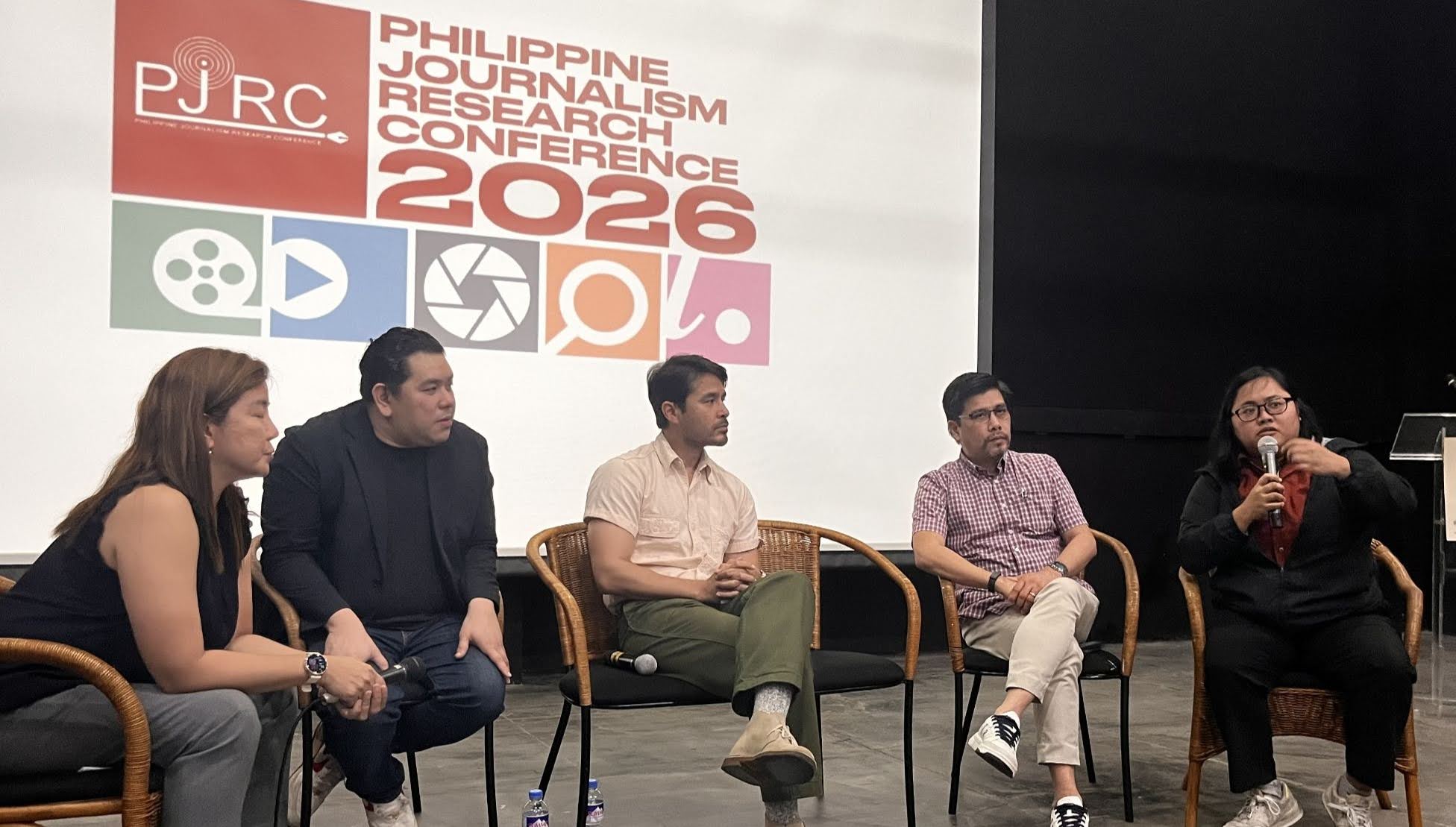
At the McLuhan Forum during the 2026 Philippine Journalism Research Conference (PJRC) at the University of the Philippines College of Media and Communication on Nov. 6, ABS-CBN News chief of reporters Jeff Canoy said audiences no longer actively seek out news through websites or television but increasingly encounter it while scrolling through social media.
In the Philippines chapter of the Reuters Institute’s Digital News Report 2026, UP Diliman associate professor Yvonne Chua observed that “social media remain the dominant sources of news in the Philippines, while television and print continue their long-term decline and online news use has plateaued.”
“Ngayon, it’s the algorithm that dictates everything,” said Canoy, who was also a recipient of the Marshall McLuhan fellowship in 2018. “If you don’t adapt, if you’re not there in platforms where your audiences are, then ano pang silbi mo bilang news organization? Para saan pa tayo nagkakalap ng balita kung walang makikinig?”
GMA News broadcast journalist and documentarist Atom Araullo likewise stressed the need for newsrooms to embrace innovation and learn “new tricks” in storytelling, warning that they risk falling behind if they fail to keep pace with changing audience habits.
“Now, it’s the medium that dictates the format, the message, and even sometimes the topic,” Araullo said.
He also cited the rise of the “clipping economy,” saying newsrooms should make podcasts, documentaries and other long-form content adaptable into shorter, bite-sized videos for digital platforms.
But Francis Allan Angelo, editor-in-chief of Iloilo-based newspaper Daily Guardian, cautioned against allowing the pursuit of online engagement to undermine the quality of journalism.
Describing short-form content as “sweet and addictive,” Angelo warned of what he called “sucrose syndrome,” in which easily consumed material provides little intellectual nourishment.
He recounted a two-month experiment managing his newspaper’s social media accounts, during which he used memes and viral soundbites to boost engagement. While the strategy increased audience interaction, it failed to generate meaningful discussions in the comment sections.
“If we really do the dark side of social media, yeah, the numbers are there. But as a journalist, it hit me na this is what I’m feeding the people—stupidity,” he said, adding that social media platforms are designed more for distribution than dialogue.
Rappler lead editorial researcher and 2023 McLuhan fellow Jodesz Gavilan, however, said journalists should not dismiss platforms such as TikTok despite their problematic aspects, as these can help bring stories to audiences who might otherwise miss them.
She said producing TikTok videos based on her investigative reports resulted in fewer attacks from viewers, who could see the journalist behind the stories and better understand the work involved.
“You bring your journalistic skills there, and then you will be able to bring your credibility there, and people will just come to you,” Gavilan said.
She also recalled receiving several investigative tips after posting her first short-form video on the platform.
Canoy said journalists could carve out a space on social media, despite its association with entertainment and humorous content, while maintaining depth in their reporting.
“Pinaka-important lang for any journalist now, it goes back to when we started, is to show up. Whether sa field when you’re covering, it’s about showing up. And it’s the same way for platforms. You have to be there,” he said.
Chit Estella Journalism Awards
The 2026 PJRC was organized by the UP Department of Journalism in partnership with the Journalism Studies Association of the Philippines, the Embassy of Canada in the Philippines, the University of Santo Tomas, VERA Files and the Simbulan family.
A major highlight was the presentation of the Chit Estella Journalism Awards, named after veteran journalist, former UP journalism professor and VERA Files trustee Chit Estella-Simbulan, who died in a vehicular crash in May 2011.
The awards drew 148 entries from 30 schools across five categories, including a newly introduced category for short-form video explainers.
The winners were:
* Journalism Research (Cluster 1):
Hybrid Ethics: A Case Study of Igorot Journalists Negotiating Global Journalism Codes and Local Values in Covering Indigenous Cordilleran Communities by Marc Andre Esguerra of UP Diliman
* Journalism Research (Cluster 2):
A Critical Discourse Analysis of Misogyny in Rape Reportage of Philippine Docudramas by Marianna Terese Castro, Angel Marie Samonte and Micah Pascua of the University of Santo Tomas
* Investigative Reporting:
UP Admissions Policy Worsens Wealth Gap in Student Body by Allyana Barquira, Margaret Ann Azucena, Marc Andre Esguerra and Elisha Beatrice Umali of UP Diliman
* Documentary:
Pakpak by Airon Sire Adan, Vienne Rio Schiely Telmo, Rachelle Lauren Cuyugan, Phoebe Gyele Ramos, Rio Belle Bauyon, Aian Charles Aldea, Caleb Gzryhxl Abdon, Edvin Lhance Espeleta, Christel Joy Ligutan, Jhun Andrei Liwag, Jewel Dinglasan, Zabdiel Suase, Archie Godoy and Raphael Reyes of Batangas State University
* Photo Essay:
Gintong Ani sa Lupang Tigang by John Albert Domingo of Nueva Ecija University of Science and Technology
* Short-form Video Explainer:
Sa Alon ng Kaunlaran: Mga Mangingisda sa Gitna ng Laguna Lakeshore Road Network by Danielle Anne Espinosa and Janna Patricia Cambri of UP Diliman