
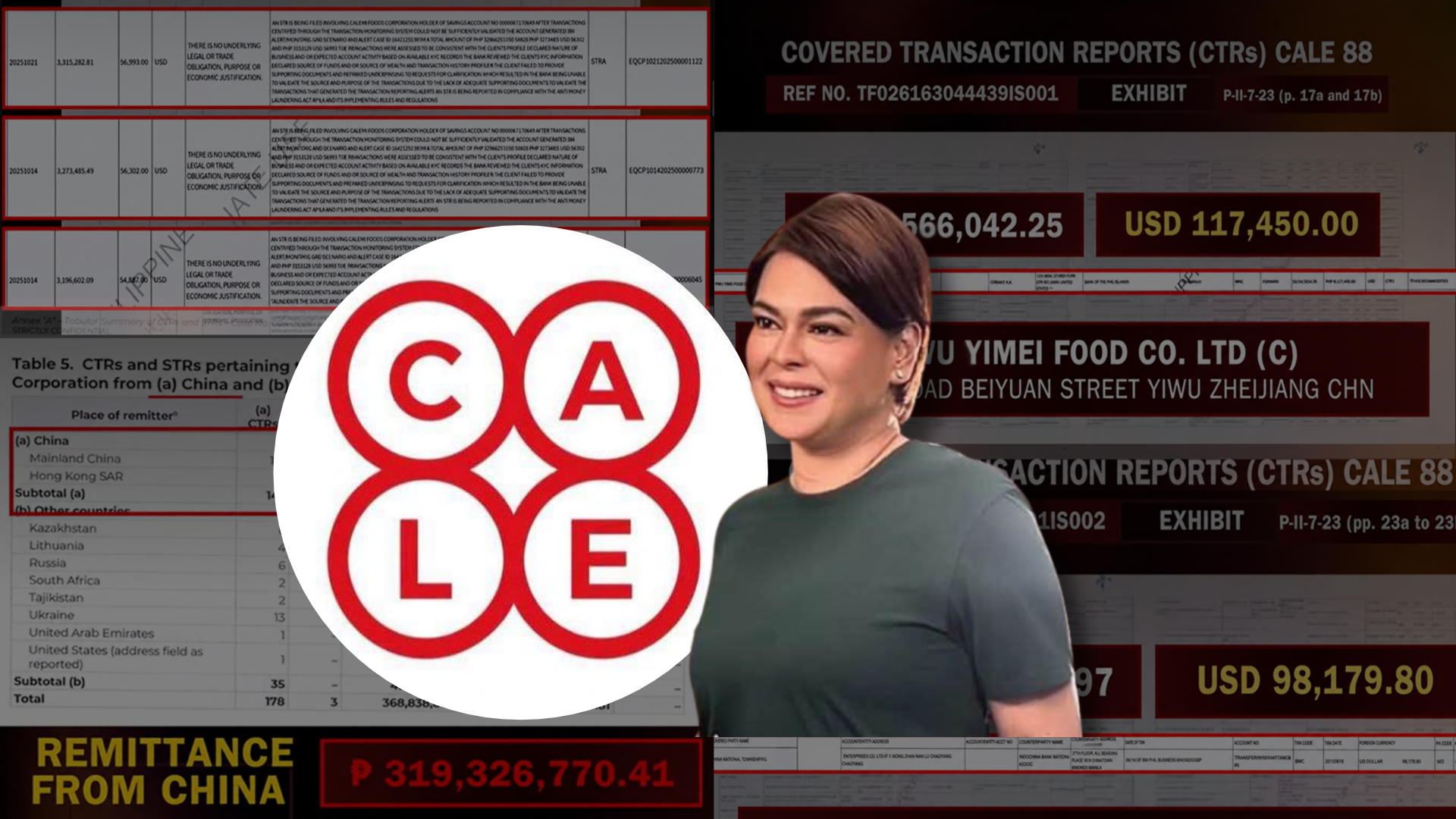
Five Chinese companies highlighted during the Senate impeachment trial as remitters to CALE88 Foods Corp., the banana chip exporter in which Vice President Sara Duterte’s husband, Manases Carpio, was a shareholder, reveal a striking contrast in corporate profiles.
Chinese government registry records show that one is a state-owned trading house and another is a nut processor backed by a state-controlled group, while two are small, privately held traders in Zhejiang province registered 20 days apart in 2021. One could not be matched to a registered company.
Presented by the House prosecution panel on Oct. 5, the five firms account for roughly 8%—or about P26.65 million—of the P319.33 million in total inward remittances from mainland China and Hong Kong to CALE88 recorded across 143 covered transaction reports and three suspicious transaction reports.
While Anti-Money Laundering Council (AMLC) Executive Director Ronel Buenaventura testified on Oct. 6 that the council’s records did not indicate that the funds originated from the Chinese government or that the entities were illegitimate, Sen. Risa Hontiveros told the court the same day that her office identified several senders as Chinese state-owned enterprises.
What follows is what Chinese official records, company statements, and trial exhibits show about each company. Registry details are from the National Enterprise Credit Information Publicity System, the corporate register run by China’s State Administration for Market Regulation.
China National Township Enterprises Co. Ltd. (中国乡镇企业有限公司) Chinese records and the company’s own statements identify China National Township Enterprises Co. Ltd. (CNTEC), a unit of China National Agricultural Development Group (CNADC), as state-owned. However, the direct institutional link to CNADC was not explicitly detailed at the Senate impeachment court.
The AMLC record presented at trial identified the counterparty as “China National Township,” with the remainder of the legal name overlapping into the address field: “Enterprises Co. Ltd 8F 5 Nong Zhan Nan Lu CN Beijing Chaoyang.” This matches the company’s registered address on the National Enterprise Credit Information Publicity System.
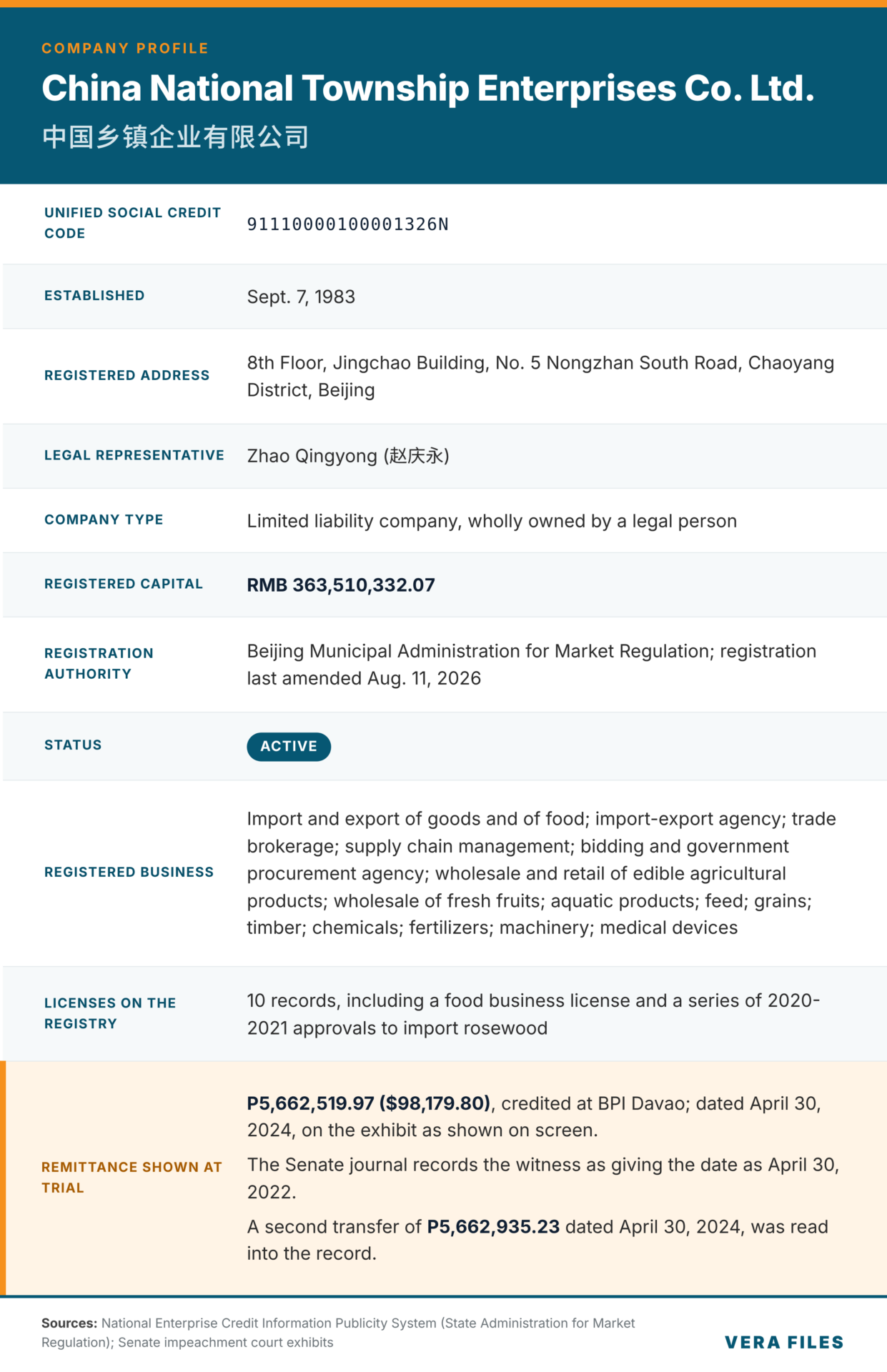
The company’s website states that it was founded in 1983 as China Township Enterprises Corp., an enterprise directly under the then Ministry of Agriculture, and “later merged into China National Agricultural Development Group Co. Ltd.”
A recruitment notice issued in the company’s name states that it became “a large-scale state-owned agricultural enterprise managed by the State-owned Assets Supervision and Administration Commission of the State Council,” that its main businesses are international trade in agricultural and aquatic products with more than 30 countries, government procurement agency, and foreign-aid services, and that it is “committed to serving the implementation of the national Belt and Road initiative and foreign policy.”
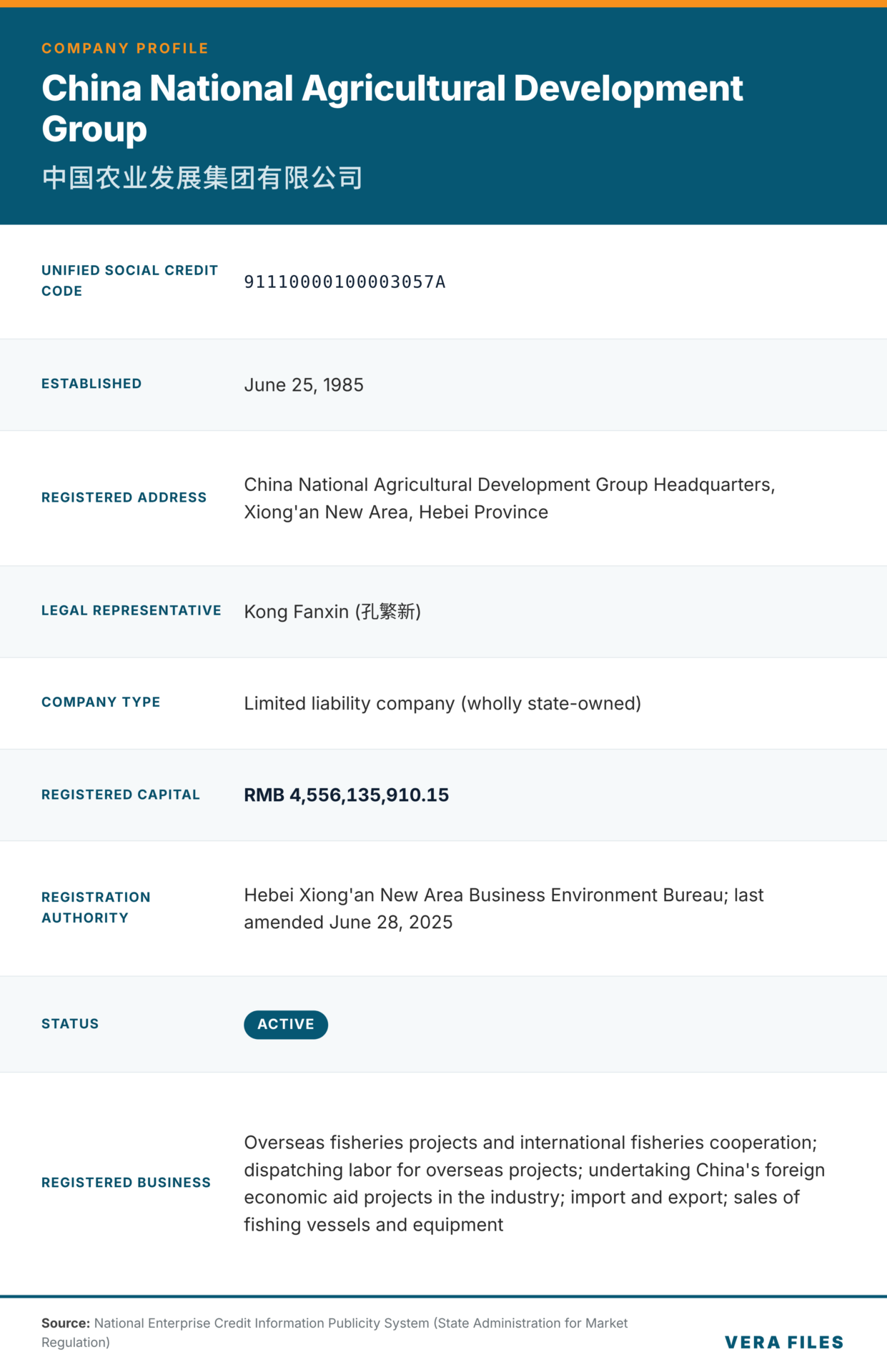
The state assets commission directly supervises CNADC. CNTEC sits beneath it.
Beijing Zhenweifang Food Co. Ltd. (北京臻味坊食品有限公司) The exhibit lists “Beijing Zhenweifang Food Co Ltd” with the address “Nanhanji Innovation Industrial China.” Nanhanji is an area in Fangshan district on Beijing’s southwestern outskirts, where the company operates its plant. Some reports have spelled the name “Jianweifang.”
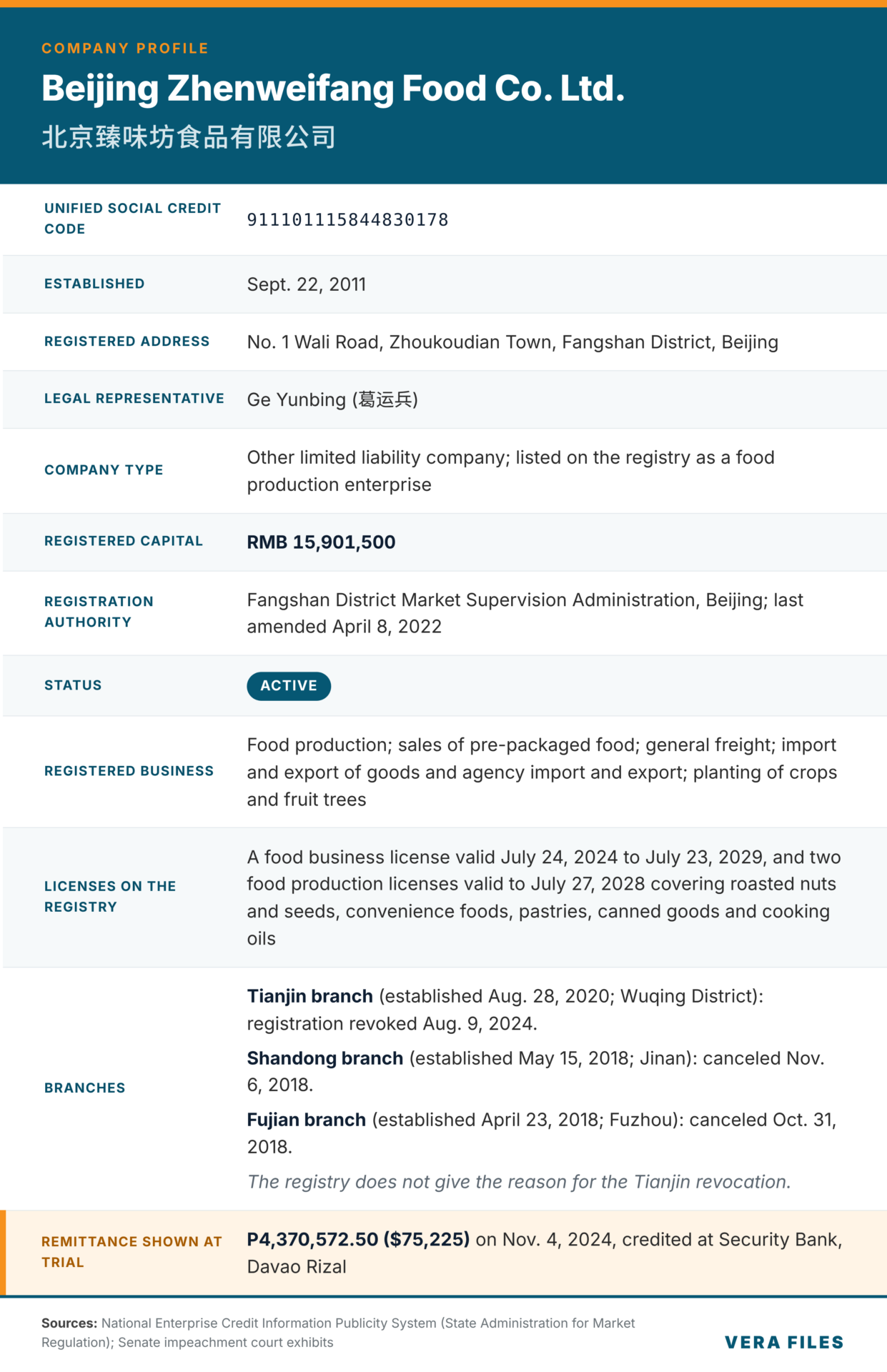
While public registry records do not classify Zhenweifang as a state-owned enterprise, its corporate history outlines a nut business founded by Ge Yunbing, selling under the Zhenwei and Xianpinwu brands, which later secured “Series A financing” from Xinjiang Fruit Industry Group.
At the trial, Hontiveros cited Xinjiang Fruit Industry Group as the owner of Zhenweifang. The company’s website records an investment by Xinjiang Fruit; the size of the stake and the degree of control could not be established.
In November 2022, the company reported to the Fangshan district market regulator that it had recalled a batch of Turkish pistachios after inspectors found the product had been irradiated without the required labeling.
Xinjiang Fruit Industry Group Co. Ltd. (新疆果业集团有限公司) was not shown at the trial as having remitted money to CALE88.
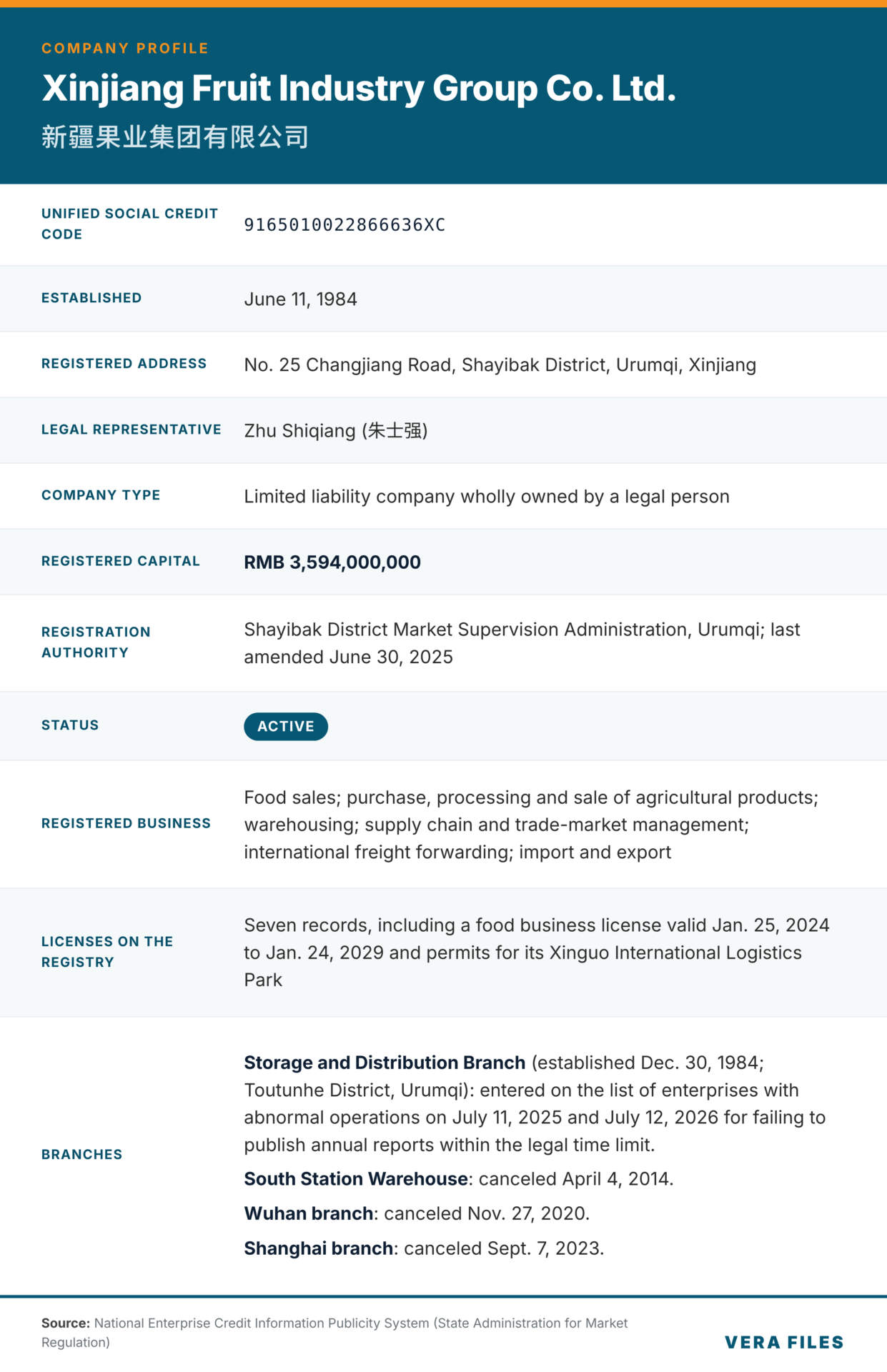
The website of China’s national federation of supply and marketing cooperatives describes Xinjiang Fruit as a mixed-ownership enterprise restructured from a regional native-produce company and controlled by the Xinjiang Supply and Marketing Cooperative. A news site run under the agriculture ministry describes it as a state-owned enterprise and refers to its deputy Communist Party secretary.
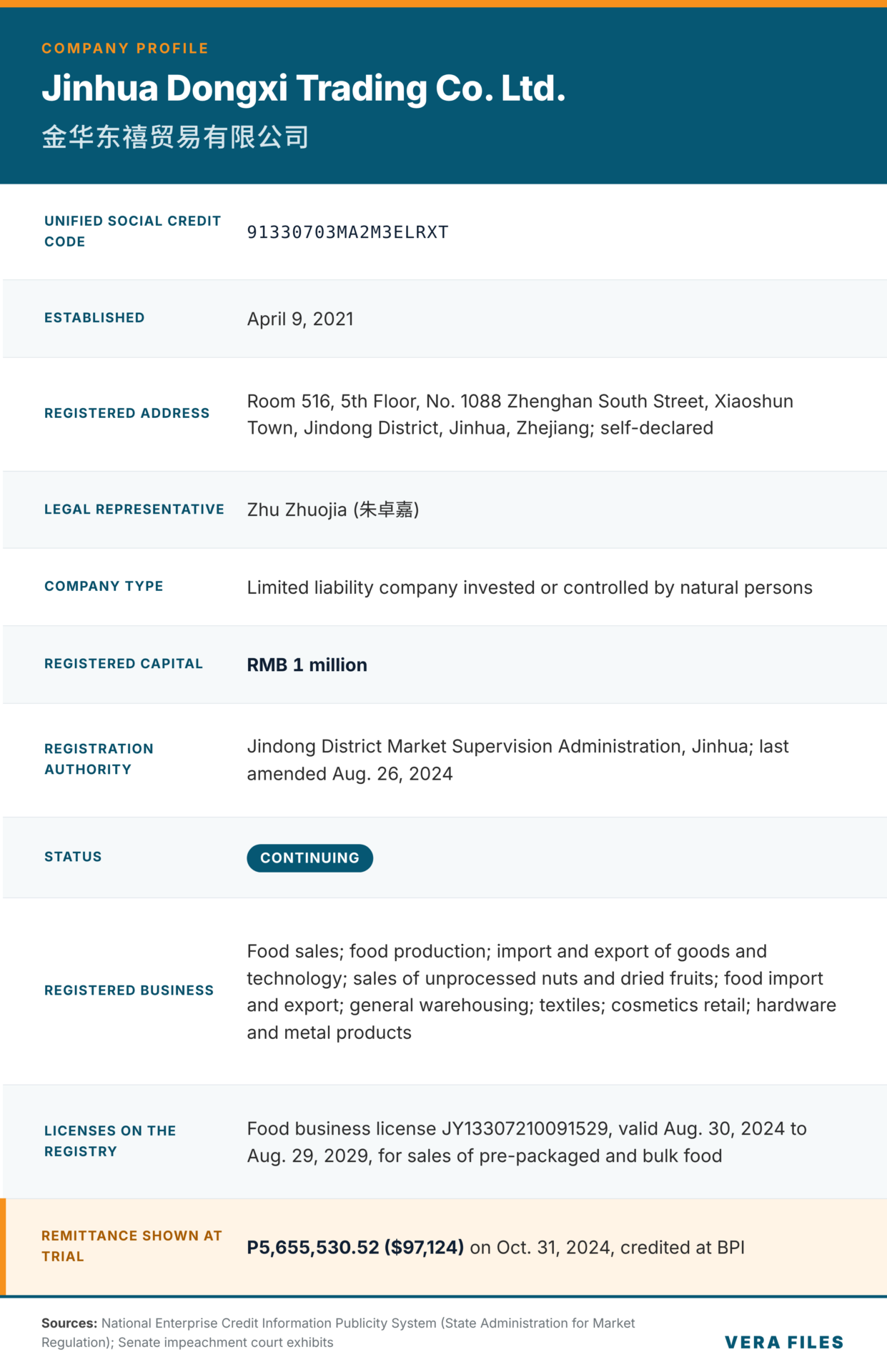
Jinhua Dongxi Trading Co. Ltd. (金华东禧贸易有限公司)
The address on the exhibit, “Room 516 5th Floor No. 1088 Zhenhan South Street Xiaoshun Jindong Jinhua,” for Jinhua Dongxi Trading Co. Ltd. matches China’s registry entry for 金华东禧贸易有限公司.
The company type shows it is privately held. Its food business license was issued two months before it remitted $97,124 to CALE88, as shown to the Senate impeachment court.
Yiwu Yimei Food Co. Ltd. (义乌市依美食品有限公司)
Yiwu Yimei Food Co. Ltd. appeared on a prosecution slide associated with the largest of the five transfers. The exhibit gives its address as “Wanda Road Beiyuan Street Yiwu Zhejiang.” The company’s international legal-entity record lists Room 630, 6th Floor, No. 9 Wanda Road, Beiyuan Street, Yiwu. The registry currently shows a different address in the city’s Chengxi subdistrict.
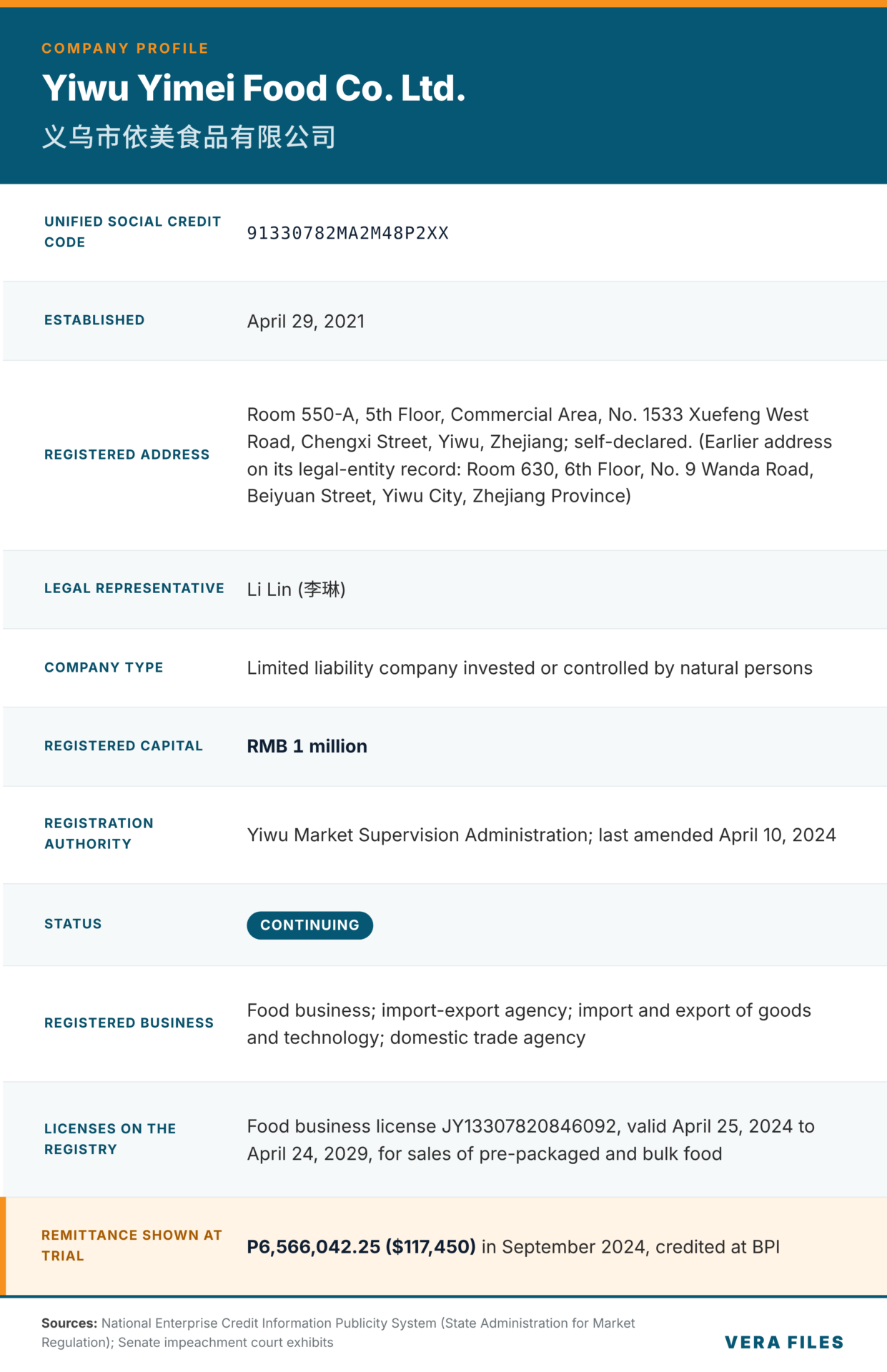
Yiwu Yimei and Jinhua Dongxi were registered 20 days apart in April 2021 with the same registered capital—months before CALE88 itself was established in September 2021.
Both Chinese companies obtained their food business licenses in 2024, coinciding with the timing of the inward remittances shown at trial. The records reviewed do not show a connection between the two companies beyond these dates.
Yiwu Yunnong Import and Export
The AMLC record names “Yiwu Yunnong Import and Export (C)” at “LTD RM8621 NO599 Huignag Rd Chengxi China” as having remitted P4,397,353.29 ($75,207) to CALE88 on Dec. 16, 2024, credited at Security Bank, Davao Rizal. (The road name is possibly a rendering of Huigang Road.)
Unlike the other four firms, Yiwu Yunnong presents a verification challenge: Official Chinese registry searches under similar names fail to match the exact entity or address listed in AMLC transaction records.
A search of China’s registry under the characters 云农, one possible rendering of “Yunnong,” returned two businesses in Yiwu. Neither fits the bank record.
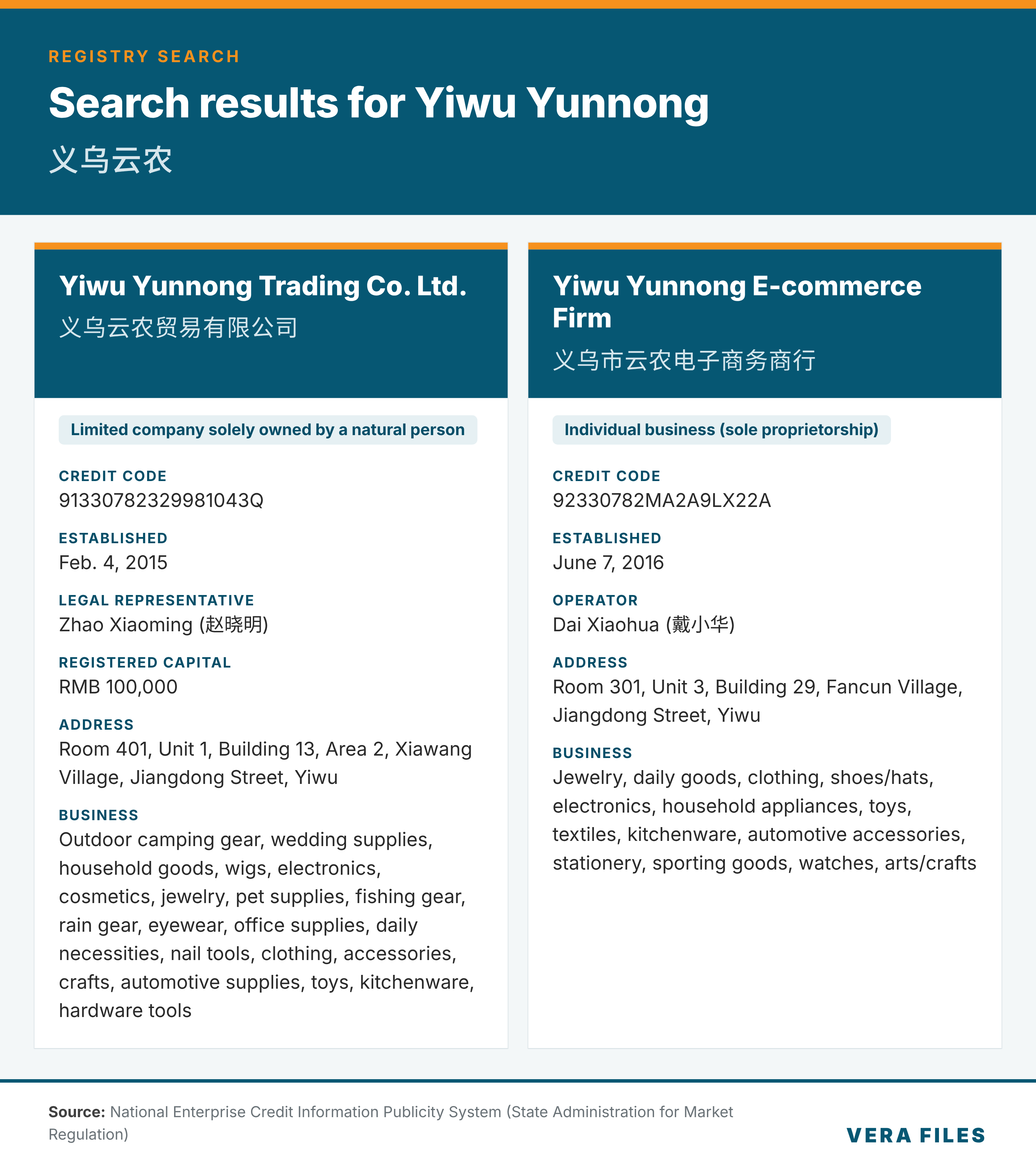
Both are in the Jiangdong subdistrict, not Chengxi. Neither is an import-export company, neither lists food in its business scope, and one is a sole proprietorship.
Wider searches on the English name and on other possible Chinese renderings turned up only unrelated firms with similar-sounding names, among them other Yiwu import-export companies and an irrigation-equipment supplier in Shandong province. Web searches did not turn up a company at Room 8621, No. 599 on a “Huigang” or similarly named road in Chengxi.
The name does appear in commercial trade-data services. Two such sites list “Yiwu Yunnong Import and Export” as a Chinese buyer of sweetened banana chips, one of them showing a shipment from CALE88 dated Dec. 27, 2024, and the other recording activity between July and December 2024. Neither provides a Chinese name, address or registration number.
Bilyonaryo News Channel, which reported on Bureau of Customs export records for CALE88, listed Yiwu Yunnong Import and Export Co. among the company’s buyers, but noted that its ownership could not be determined from available corporate records.
The name in the AMLC record is a romanization, and the abbreviation “LTD” spilling into the address field suggests it was truncated. The company may be registered under different Chinese characters.
Bilyonaryo News Channel reported on Oct. 6 that Bureau of Customs export records show CALE88 shipped banana chips to 13 Chinese companies between 2023 and 2026, with a combined customs value of about P217.3 million. It identified Beijing Zhenweifang as the largest buyer, with 10 transactions worth about P41.4 million, and listed China National Township Enterprises, Yiwu Yimei, Jinhua Dongxi and Yiwu Yunnong among the others.
All four identified senders hold food or import-export licenses, China’s official registry shows. ###