
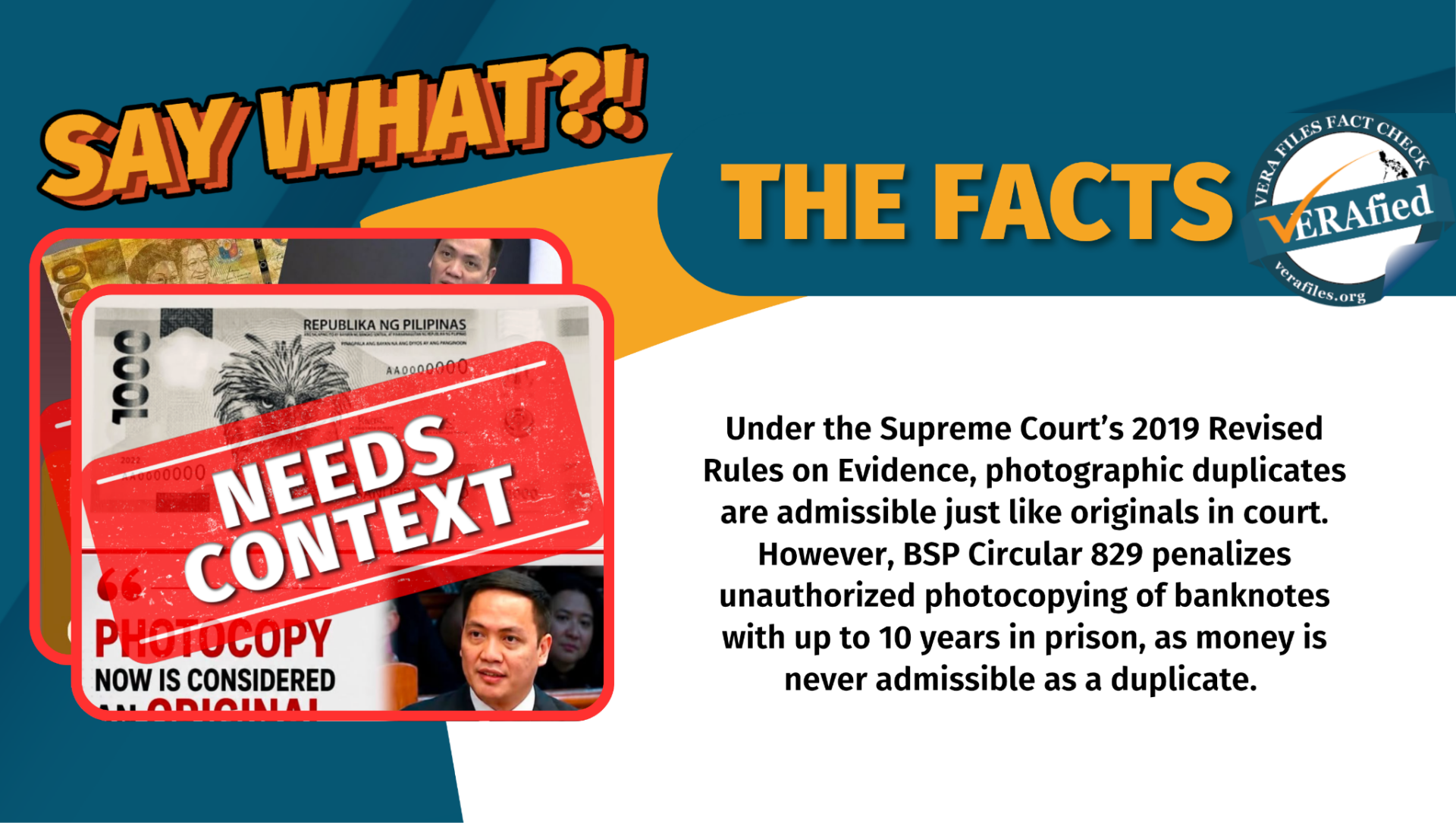

Facebook users posted a claim that a photocopied Philippine peso bill can be used as legal tender. This is after lawyer Amando Ligutan, prosecution counsel in the impeachment trial of Vice President Sara Duterte, said that photocopied documents are considered original and can be used as evidence in court. This needs context.
Published on July 7, one user posted it on a pro-Marcoleta FB group bearing a side-by-side photo of Ligutan and a P500 bill. The quote card is captioned:
“Fake money can be use (sic). Photocopy is considered original. ATTY BENDALLO”
The user even used the wrong name for the lawyer on the quote card.
Several Facebook users commented on the post, criticizing Ligutan for his claim.
Another FB user, with millions of followers, echoed Ligutan’s statement and posted photos of a photocopied P1,000 bill and a quote card bearing the lawyer’s photo. The post’s caption read:
“Siguraduhin mo yan Atty. kapag ito, hindi tinanggap ha (Better make sure, Atty., that it gets accepted).”
The comment section was filled with mixed reactions. Some users criticized the lawyer while others provided context and corrected the user’s claim in the post.
During the exchanges between the prosecution and the defense on the second day of Duterte’s impeachment trial at the Senate, Ligutan remarked that photocopied documents may be treated like the original copy. This was after the respondents’ counsel Carlo Joaquin Narvasa objected to their introduction and identification as evidence because they were not original certified true copies.
What Ligutan meant by photocopy of documents considered original pertains to evidence presented in court. The lawyer argued that the admissibility of photocopies is settled law.
“If it is a printout of an electronic document, the rules are clear that it is an original,” he told the court.
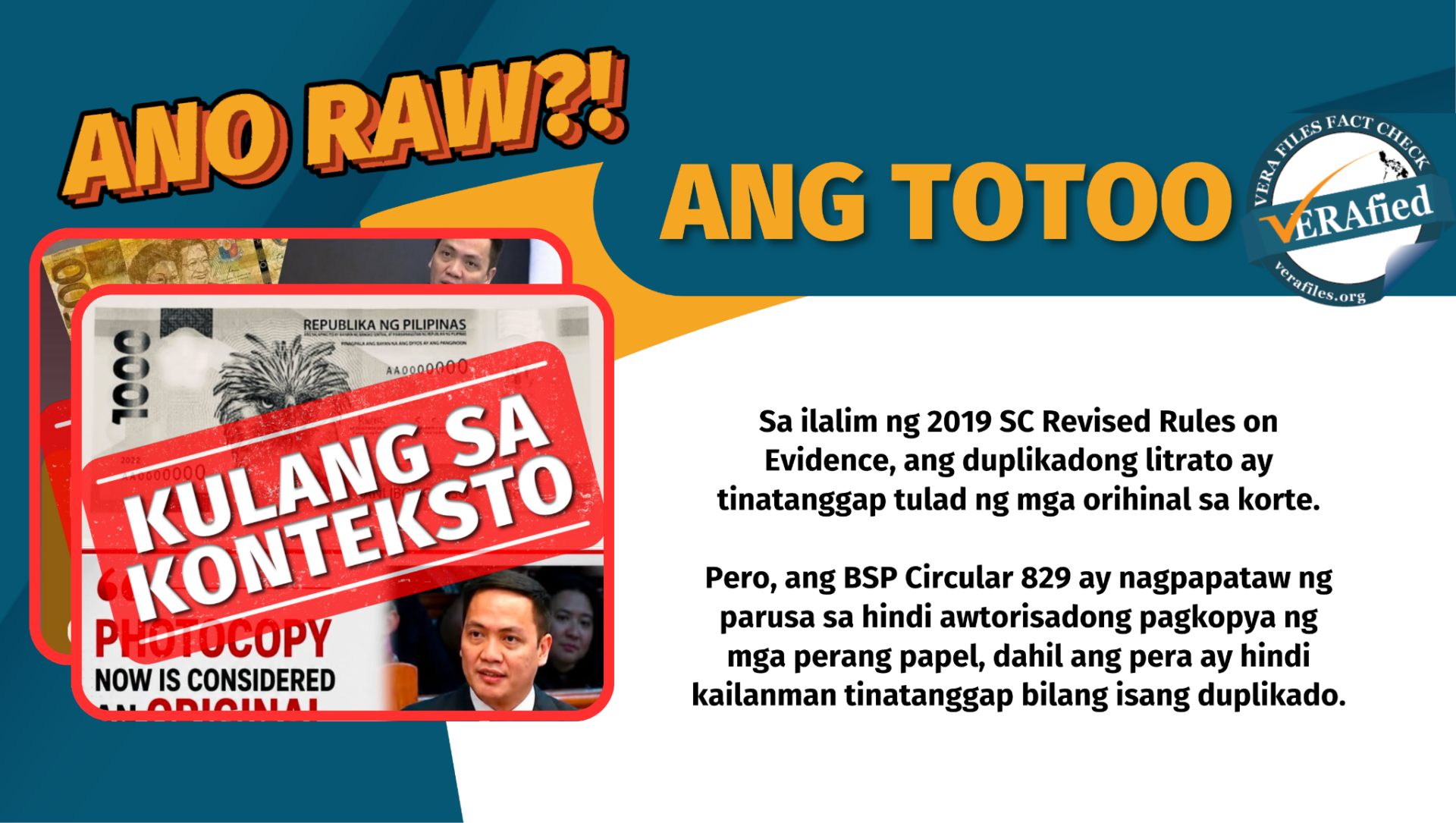
Ligutan’s argument rests on Section 4(c) of the 2019 Revised Rules on Evidence. The Supreme Court upheld this rule in the February 2025 case People v. Lastimosa, which ruled that a duplicate “produced by photography or other equivalent techniques that accurately reproduce the original” is admissible to the same extent as the original.
As per the use of photocopied bills, Bangko Sentral ng Pilipinas warned that reproducing images of Philippine banknotes without prior authorization is illegal and carries possible jail time.
BSP Circular No. 829, issued in 2014, sets out the rules and regulations on the possession, reproduction, and redistribution of Philippine currency.
Section 8 of the circular states that “no person or entity, whether public or private, may design, engrave, print, or otherwise produce, issue, distribute, circulate, or use any handbill, advertisement, placard, circular, card, or any other object bearing the facsimile, likeness, or similitude of any legal tender Philippine currency note, in whole or in part, in black and white or in any color or combination of colors, without first securing prior authority from the BSP Governor or a duly authorized representative.”
In addition, any person who violates this section shall be punished with imprisonment of not less than five years but not more than 10 years.
The viral posts appeared online after Ligutan argued against the defense’s objection to the presentation of photocopies of the prosecution’s evidence on July 7.
Published by FB users, the viral posts collectively garnered 124,900 reactions; 7,407 comments; 70,366 shares.