
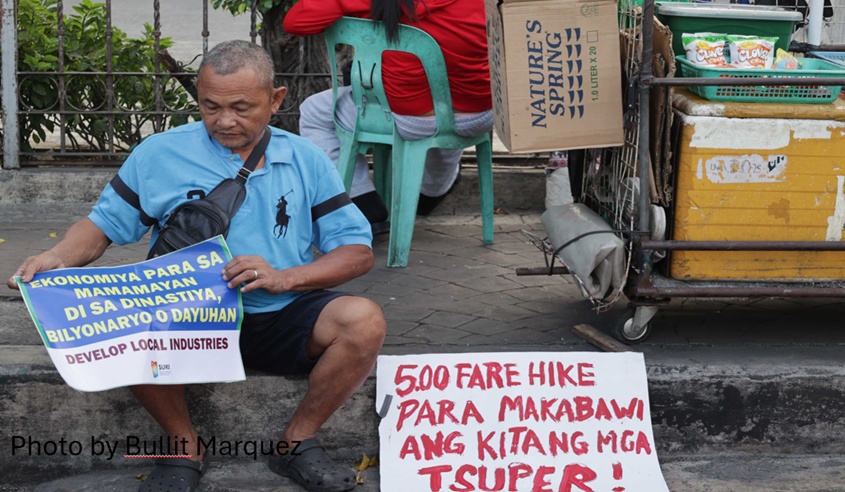

Stagflation—rising prices combined with sluggish economic growth and mounting unemployment—is one of the most punishing conditions an economy can face. Inflation erodes household purchasing power just as a slowing economy makes it harder for families to earn, businesses to expand, and government to generate the revenues needed to respond.
The numbers tell a troubling story. Inflation reached 7.8% in October 2026. Unemployment stood at 5.4% in September. And the economy grew by only 2.1% in the third quarter, its fifth consecutive quarter of deceleration. Whether or not we meet every technical definition of stagflation, we are unmistakably in its territory.
The immediate triggers are not difficult to identify. The conflict involving Iran and the resulting pressures on global oil prices have raised the cost of energy, transport, food, and other essentials. Fertilizer prices and agricultural production costs are also exposed. These external shocks are real, and the Philippines is hardly alone in confronting them.
But external shocks do not affect all economies equally. The more important question is why the Philippines appears particularly vulnerable—and why the same global pressures can inflict greater damage here than in other economies in the region.
The answer lies in our domestic weaknesses.
Household consumption accounts for roughly 75% of our economy. When inflation eats into household incomes, consumption weakens, businesses lose customers, investment slows, and the economic downturn feeds on itself. Private investment, both foreign and domestic, is also constrained by uncertainty: unpredictable policies, political conflict, and doubts about the government’s capacity to provide stable economic leadership. The continuing confrontation between the Marcos and Duterte camps, including the impeachment proceedings involving Vice President Sara Duterte, has further distracted the government and weakened confidence.
Public investment should help counter these pressures. But government spending has not consistently translated into productive infrastructure and development outcomes. Delays, questionable allocations, weak project implementation, and the diversion of resources from strategic programs have diminished the capacity of public spending to stimulate growth.
This is where the crisis becomes more than an economic problem. It becomes a crisis of governance and public financial management.
The Supreme Court’s recent decision on the national budget offers an important lesson. The Constitution requires a coherent national fiscal program, one in which the President’s proposed expenditures and sources of financing are considered as an integrated whole. Congress has the power to scrutinize and amend the budget, but it cannot use that power to expand the overall appropriations beyond the constitutional limit.
In striking down major increases in Unprogrammed Appropriations in the 2024 budget and the Special Road Fund in the 2025 budget, the Court exposed how the budget process had been distorted. Funds intended for strategic programs were shifted or displaced, while large amounts were placed in appropriations whose eventual use was less transparent and less subject to meaningful scrutiny. The Court made clear that Unprogrammed Appropriations have a legitimate but limited role: they must remain contingent, specific, and consistent with the national fiscal program—not become a convenient repository for spending priorities that have been removed from the regular budget.
The significance of the decision goes beyond the legality of particular budget provisions. It reminds us that the national budget is not merely a collection of spending items or a political settlement among competing interests. It is the government’s principal instrument for expressing its development priorities, allocating scarce resources, and advancing the country’s economic and social objectives. When that instrument is distorted, the consequences are not confined to the accounting books. They are felt in the classrooms not built, the health services not delivered, the agricultural investments not made, and the infrastructure that fails to raise productivity.
We see these consequences in the proposed 2027 budget. An analysis by budget expert Zyza Nadine Suzara points to a fiscal space—the resources available for new and priority programs after accounting for existing obligations—of only ₱1.15 trillion, or 16% of the proposed ₱7.2trillion budget. This is 12.1% lower than the fiscal space in the 2026 National Budget. Of that limited amount, ₱422.1 billion, or 36.7%, is allocated to programs identified in the analysis as patronage-driven assistance and local infrastructure projects. Only ₱728 billion remains for other development programs.
At the same time, the proposed budgets of key departments have been reduced: DepEd by ₱44 billion, DOH by ₱34 billion, DSWD by ₱29 billion, the Department of Agriculture by ₱15 billion, and state universities and colleges by ₱3 billion. These are the very sectors that build human capital, protect vulnerable households, improve health and education, and strengthen agricultural productivity. Cutting their capacity while preserving substantial allocations for politically attractive programs is a poor way to prepare the country for prolonged economic uncertainty.
The same budget analysis notes that actual disbursements exceeded the original government program by a cumulative ₱1.249 trillion from 2022 to 2025. These overruns, together with weak revenue performance and rising debt service, have contributed to a narrowing fiscal space. We are borrowing more, yet not necessarily investing more effectively in the productive capacity of the economy.
This is the contradiction at the heart of our present predicament: the economy needs more productive investment, but the government has less fiscal room to provide it. And the fiscal room that remains is not always directed to the priorities that can generate sustained growth.
BSP Governor Eli Remolona Jr. acknowledged as much when he warned in February that monetary policy could do only so much. Interest-rate adjustments can help contain inflation, but they cannot repair a dysfunctional budget process, restore investor confidence, improve public infrastructure, or make government agencies deliver better outcomes. These require fiscal, structural, and governance reforms.
The way out of stagflation, therefore, cannot be left to the Bangko Sentral alone. It requires a government willing to confront the causes of the crisis rather than merely manage its symptoms.
There are three imperatives.
First, restore accountability and the credibility of public institutions. The flood control scandal and the controversies surrounding the use of public funds have exposed serious weaknesses in oversight and implementation. The Supreme Court has reaffirmed important constitutional boundaries, but a judicial ruling cannot substitute for decisive executive action, legislative responsibility, and credible investigations. Those responsible for wrongdoing must be held accountable through due process. Equally important, government must demonstrate that the rules governing public money will be respected and enforced.
Second, restore fiscal discipline and redirect public spending toward productive development. Fiscal discipline does not mean indiscriminate austerity or simply spending less. It means spending better. It means protecting investments in education, health, agriculture, infrastructure, and other areas that expand the productive capacity of the economy. It means addressing weak absorptive capacity through better planning, procurement, project preparation, and implementation—not using it as an excuse to cut essential programs. And it means resisting the use of public funds as instruments of political patronage.
Third, rebuild confidence and encourage private investment. Businesses invest when they can anticipate policy, trust institutions, and see a government capable of carrying out its commitments. The country needs a credible economic direction, predictable rules, and a political leadership focused on the urgent work of economic recovery rather than prolonged political confrontation. Targeted assistance to households suffering from inflation is necessary, but it must be fiscally sustainable and accompanied by measures that improve productivity and create jobs.
With the 2028 elections approaching, the temptation to postpone difficult reforms in favor of politically attractive spending will be considerable. That would be a costly mistake. The country cannot afford another budget cycle in which political expediency takes precedence over economic recovery and long-term development.
The external shocks may have brought us to this point. But they do not fully explain why we are here. Our vulnerability has been magnified by years of weak fiscal discipline, misplaced priorities, poor public investment, and a failure of political leadership.
Stagflation is not simply a problem of rising prices and slowing growth. It is also a test of the government’s capacity to govern. Monetary policy can buy time. But only credible governance, disciplined public finance, and productive investment can turn that time into recovery.
*Atty Florencio “Butch” Abad is former Secretary of the Department of Budget and Management. He is currently Professor of Praxis at the Ateneo School of Government and Senior Professional Lecturer at the Tañada-Diokno School of Law, DLSU.