
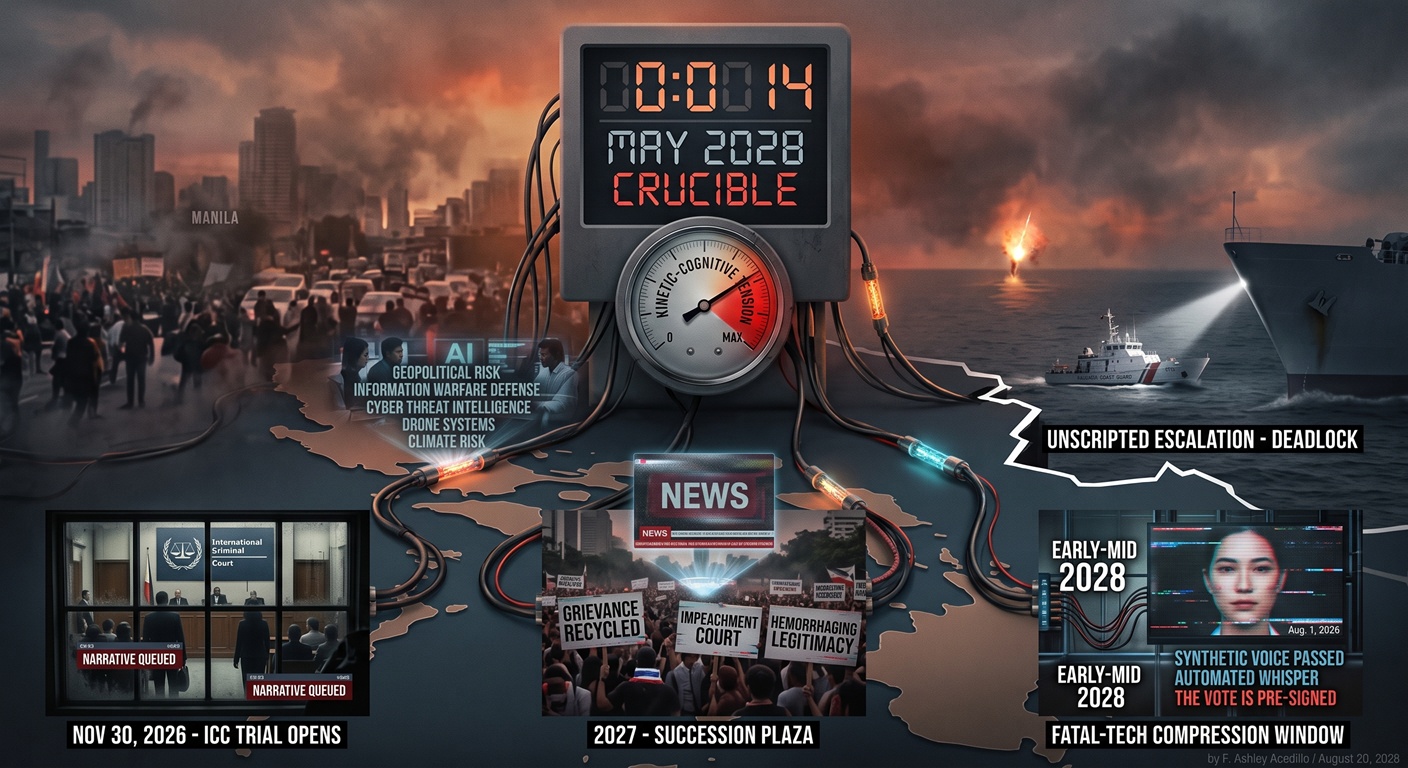
Editor’s note: In this intense commentary, Ashley Acedillo, a cyber intelligence expert, writes about the report of Bureau47 on the Philippines. The picture is concerning.
Let me dispense with the caveat first: none of what follows is a prediction about ballot boxes being stuffed. That would be a rather lazy fear. What troubles me more is something the usual campaign watcher misses altogether — that between now and May 2028 we are not walking toward an election at all. We are walking through a furnace that has already been lit, with the narratives stoked in advance and stashed in storage, waiting for real, actual dates to detonate them.
Set aside, for the moment, the heady business of debate calendars and the bristling press-conference of a campaign season that has not even properly begun. I have recently gotten my hands on six months’ worth of data and analysis from a private fusion-intelligence company, Bureau47.
Fusing geopolitical risk, information-warfare defense, cyber threat intelligence, drone and autonomous systems, climate risk into a single assessment backed by an AI engine fusion layer but with a battery of human analysts making the final vetting, the Bureau47 report reads like advanced full spectrum reconnaissance and red team report of what is currently happening in the Philippines and how this all leads to the May 2028 crucible. Whoever we meet on the hustings in 2028 will not create an information environment; he/she will inherit one. The campaign period is not where this is won or lost. It is where pre-set charges, already wired, are finally connected to a detonator.
Which brings me to the part that genuinely troubles me — the idea that a “timeline of triggers” is a list of things to be afraid of. It is not a list. It is a release schedule. Kinetic-cognitive tension – the mental strain you experience when you try to perform a complex physical task while your mind is preoccupied – is not an event you spot on a calendar; it is a fuse laid across one. The operator does not need to invent a single falsehood — I mean, let’s be honest, the grievance is real, the corruption is independently verified, the succession is genuinely contested. An adversary who need not fabricate is an adversary whose cost of doing business has fallen to almost nothing. It costs you nothing to ride a wave already provided.
So the question still stands: is this a prediction then? No. It is a statement about the obvious – what is happening under our very noses – that has been prepared in advance. The trigger is not manufactured because the material need not be manufactured; it’s material already built.
Now let me lay out the detonations themselves, in the order an operator has already arranged them. Call this instead a ledger of the awaited.
The timetable of the awaited
• November 30, 2026 — the ICC trial opens. Nothing else in the entire cycle carries the weight of this single dated afternoon. It is the one event that stands inside two contested stories at the same time — a legal reckoning and a succession crisis viewing each other across a courtroom aisle. Pay attention to the delivery more than the verdict: let them arrive pre-built, queued before the ruling lands, and you are not watching commentary; you are watching a rehearsal that has outlived its dress run. The media will call it coverage. For the operators on either side, it is a cue sheet.
• Through the whole of 2027 — the succession plaza. The impeachment court opened in July; whatever verdict or non-verdict follows it; a trial at the Hague; and the flood control and corruption theater that is the only economic floor left under a state hemorrhaging legitimacy. Do not mistake any single stumble for scandal. It is campaign material on a loop, recycled until the audience cannot tell where the grievance ends and the amplification begins.
• Early to mid-2028 — the compression window. After the filing of Certificates of Candidacy (CoCs), the cold start of campaigning, the vote itself. Here the attack changes clothes: it stops being bait and becomes injection — a synthetic voice that finally passes, an automated-election whisper that finds its footing, a framing so heavy with inevitability that the outcome is not contested but pre-signed. They will not rig the ballot box, might I add (but there won’t be a lack of trying). They do not need to. They only need to make you believe the result was already written, so that whatever is written arrives easier to swallow.
What unites these three is not malice — forget the melodrama of “destabilization plots” that administrations past love to invoke at press hour. What unites them is schedule. Each is a real, dated, un-dismissable event into which a prepared operator can pour content at zero marginal cost, because the content already exists and the crowd is already there and bored enough to take it. It is not a crisis that must be created; it is a platform, and the train runs on time, and it does not stop for the entreaties of the communications staff.
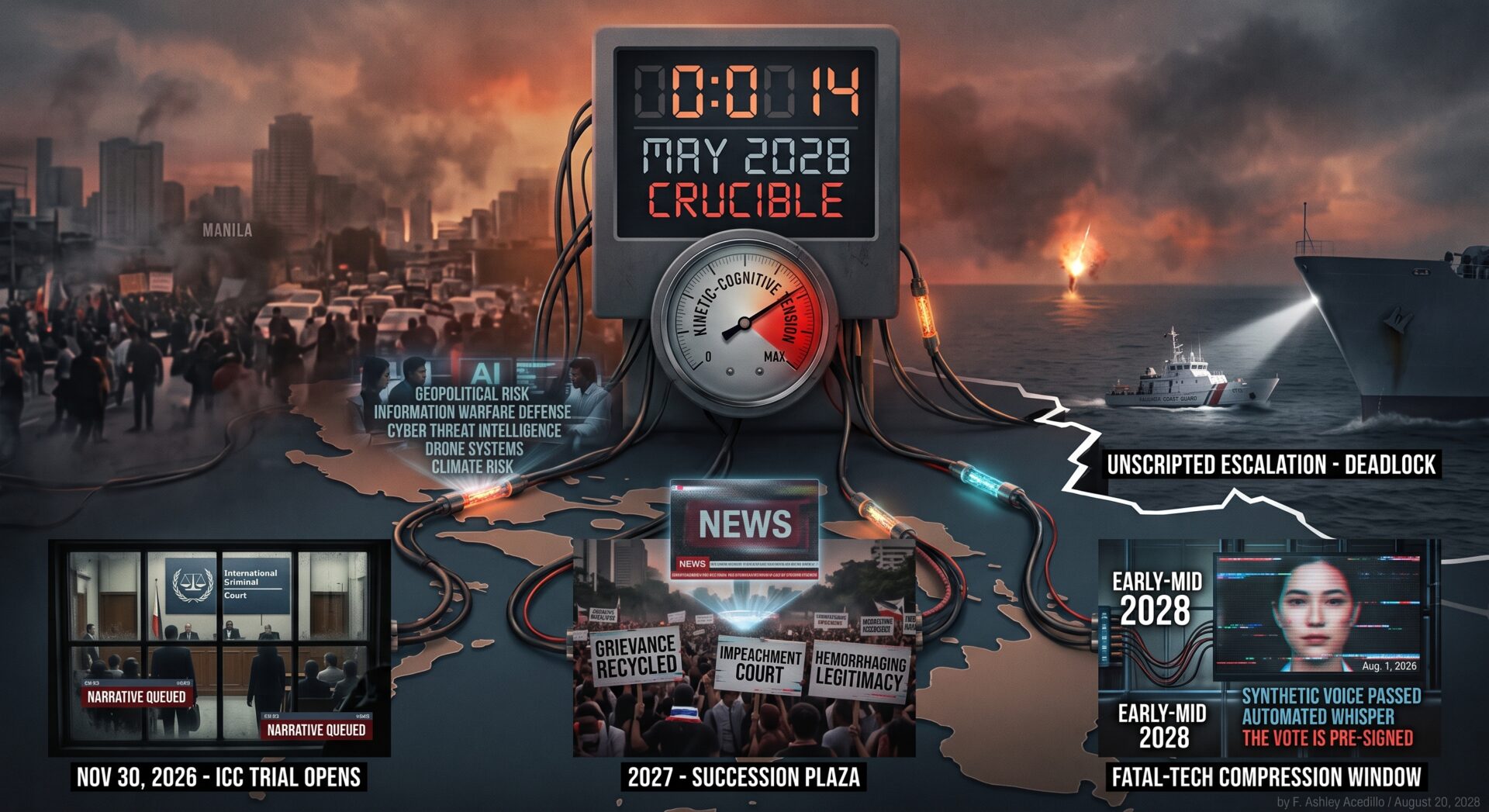
Now back to the ledger. The three windows that matter most — those that we need to keep a narrow eye on that, if mishandled, will take down not just a candidate but the institution:
1. The last fortnight of November 2026, which I will not stop nagging about because it is the only event in the cycle that is at once a legal fact and a political fork — it pokes both the persecution story and the collapse story in a single poke, and it needs no new scrap of force to do it. If you miss it, nothing else you catch will matter.
2. The 60–90 days before certification in 2028, when the furnace turns from baiting to injection — deepfakes that survive inspection, the quiet whisper that the automated system cannot be trusted, a leaking of the biometric database’s prospectus. One credible “was the vote real?” artifact in that window is the highest-leverage single event of the entire five-year arc since 2023, because it is planted on the decision itself, and the inevitability front needs only to soften your capacity to believe your own result.
3. The fatal-deck moment — low probability, catastrophic slope, the black swan every bloodied observer dreads — a real, unscripted escalation at a flashpoint that cannot be walked back. Its leverage is that it ends the argument: the restraint framing the Armed Forces and the Coast Guard did so carefully since it launched its transparency initiative is precisely the shield that loses all value the day a Filipino is killed at our maritime borders. While I do not believe it is impossible, I have seen enough to know that dismissing it on schedule is itself a schedule.
A word on what the institutional instruments will miss. The usual analytical stack — the PESTEL-and-DIME (Diplomatic, Informational, Military & Economic) menagerie — reads a trigger as a thing that happens on a date: an invasion, an announcement, an outrage. It will therefore miss almost everything in the analysis, because the operation is temporal, not calendar. Frames are pre-keyed and held in reserve, to be detonated not when the operator acts but in the decay after, when the media cycle has moved on and the fact-checkers have gone home. Looking only at dates misses the interval between them, and the interval is where the whole scheme lives. The stacks will also keep looking for a fabricated scandal, because that is a thing they know how to name and regret. The deeper truth of the Bureau47 report and this piece unpacking it isn’t that we have failed to look. It is that in the looking we have relied on the headline when the backstory was the more pivotal one.
For our institutions tasked with the duty of vigilance — I close on a warning dressed as a wish.
It is not governments we must fear in this cycle — it is our own habit of gratitude; our forgiving nature; the comfort we take in familiar institutions proving they still function. The Palace, the intelligence and security establishment, the fact-checking and verification consortia, the Comelec and the DICT — all the institutions we imagine will shepherd us to May 2028 in a straight, sober line. I respect them; I served the in some of them, a former officer’s nose to the wind. But institutions are not lamps; they are machines, and every machine on this board is being pricked and tested and preseeded at this very moment — while we are discussing at pleasant conversations over coffee whether the weather is fine.
Vigilance is not the memorandum, not the press conference, and not the electionrelated reassignment order issued after the fact. It is the unglamorous work of watchposts kept open at night around the tolerance of ordered moments and crawling the procuring layer and the payment rails and the profile vendors who rent the inventory by the hour, and of refusing to be astonished by the date that was on the calendar all along. The groundwork of 2028 has been laid and rehearsed — in a foreign room and in our own backyard alike.
The only remaining question is whether our watchmen will do their job before the detonations, or will spend a decade after them explaining how no one could have seen it coming. I know which habit this country has developed. I am asking — I am telling — that we break it now, while the train is still approaching, on schedule, with a hundred lights visible to anyone willing to keep watch and stop the run and put a single honest hand on the lever.
*The author was formerly an Air Force pilot, congressman, and national security consultant. Prior to rejoining the private sector in November of 2025, he was a senior intelligence official tasked with cyber intelligence and emerging threats.