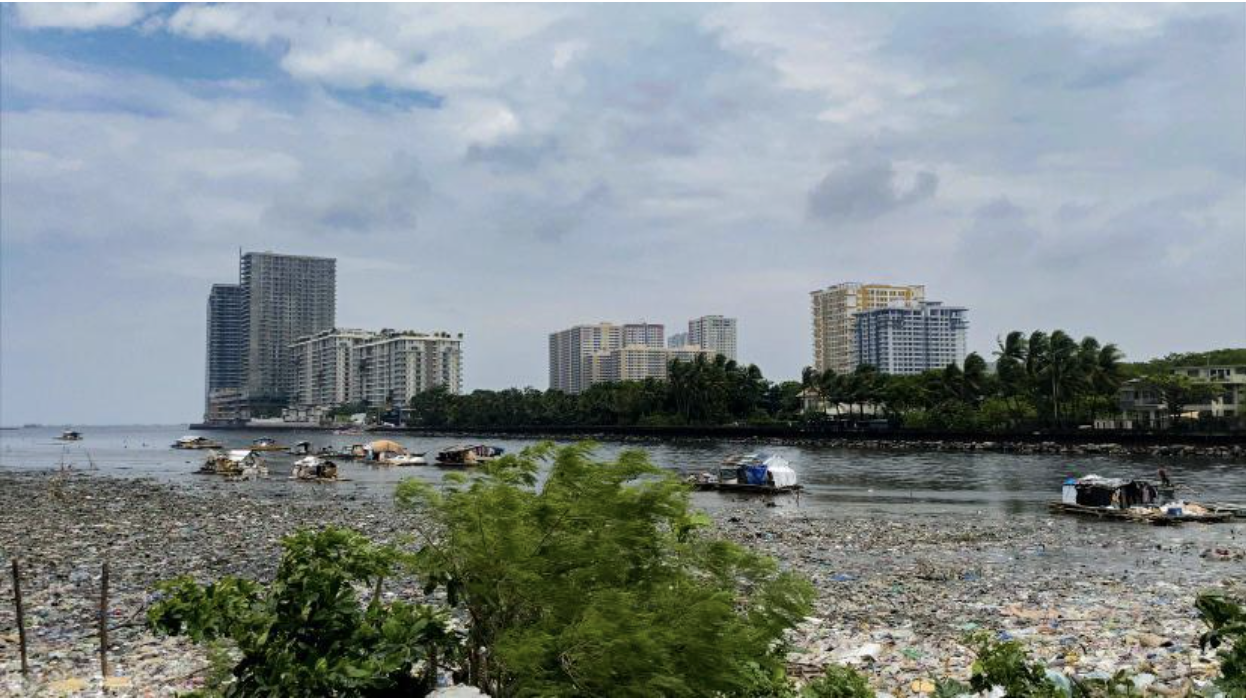
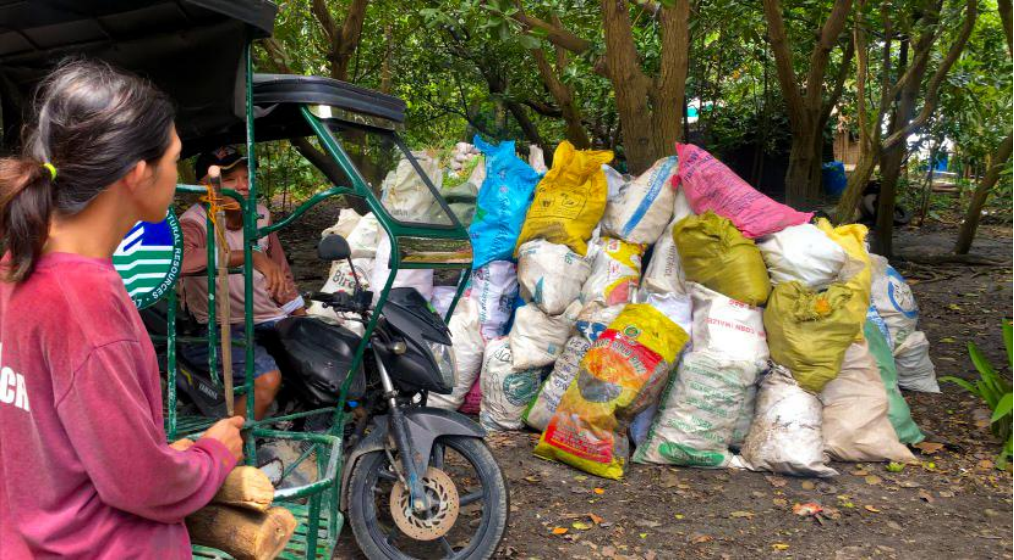
METRO MANILA, Philippines — Hauling waste surrounding the waters of the Las Piñas–Parañaque Wetland Park is nothing new to Ronnie Cafe. For over a decade, cleaning the area has become a routine for the 60-year-old trash boat operator.
“At first, the job was really difficult for me, especially because these trash are composed of a variety of wastes. There are chemicals, plastics, bottles, solid and liquid wastes. They are scattered everywhere,” he said.
Cafe began as a small-scale fisherfolk in the area in 2008 but in 2013, he decided to join the Department of Environmental and Natural Resources National Capital Region (DENR NCR) in maintaining the cleanliness of the LPPWP.
That was when the area was designated as an important wetland under the Ramsar Convention, an international treaty that aims to promote the conservation and sustainability of wetlands.
Alongside other Bakawan (Mangrove) Warriors, composed of nearby residents employed by the DENR to maintain the ecological health of the protected area, the team can collect almost 500 sacks of trash in just one day if they all work together.
The 181.63-hectare wetland park is made up of two inter-connected landmasses along Manila Bay: Long Island in the southwest (Last Pinas) and Freedom Island in the northeast (Paranaque).
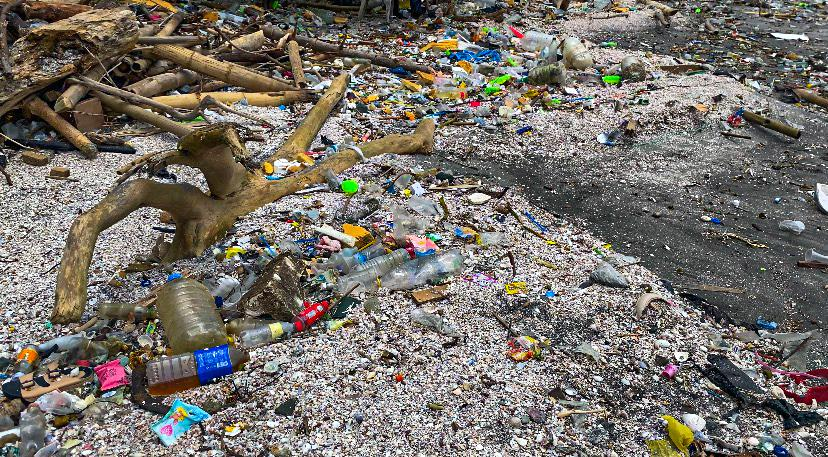
Beyond the island, there are continuing serious concerns —dense communities, floating houses, waterways, and human activity converging around LPPWP.
Amid all these, DENR Protected Area Superintendent Christopher Villarin, said the wetland has managed to survive, saying that resilience is one of the wetland’s defining characteristics.
“We could describe the LPPWP as a resilient coastal wetland ecosystem because it continues to survive despite the pressures of pollution coming from the urban areas,” he said in an interview with VERA Files.
Just last month, heavy rains brought by the southwest monsoon (Habagat) caused garbage and debris to accumulate in the Baclaran–Redemptorist Water Channel in Parañaque City, contributing to flooding in surrounding communities.
The Parañaque City government, together with the Metropolitan Manila Development Authority and the Department of Public Works and Highways, launched clearing operations after garbage was washed into and accumulated in the waterway.
President Ferdinand Marcos Jr. inspected the channel and blamed the damaged trash trap and heavy rainfall as factors behind the buildup. The following day, the city government reported the removal of 690.6 metric tons of waste and debris, equivalent to 2,071.8 cubic meters hauled in 188 truckloads in its three-day clean-up operation.
On August 13, DENR’s local government partners collected 8,000 kilograms of garbage from Freedom Island alone. The cleanup, however, did not immediately clear all of the waste remaining on the island.
Villarin noted that typhoons that hit the metropolis may have contributed to garbage reaching the protected area, and that this influx showcases how conditions beyond the park’s boundaries can add pressure to the wetland, where waste and debris accumulate along its islands, mudflats and coastal areas.
“I honestly can’t imagine where all that waste comes from,” added Cafe, the trash boat operator.
Waste and erosion
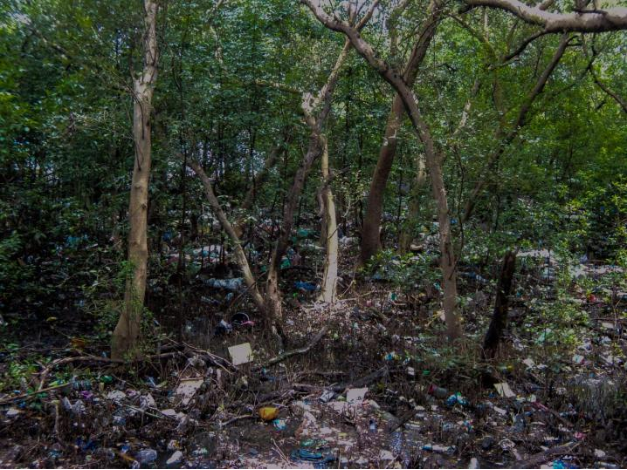
According to LPPWP’s 2025 Biodiversity Monitoring System (BMS), solid-waste accumulation near the Parañaque River increased during the monitoring period.
Villlarin noted that another emerging source of debris is waste associated with fish cages in saprahan, including floating plastics and discarded nets that eventually accumulate inside the wetland. While waste is not the park’s only external pressure, the wetland is also facing physical changes along its coastline.
Records also show fallen trees on both Long Island and Freedom Island, with some Ipil-ipil trees affected by recent typhoons, and 22 Bungalon mangrove trees were knocked down on Long Island by wave and tidal action.
“We do not know whether the displacement of water in Manila Bay has had an effect, but we are noticing it, especially on Long Island, where several of our Bungalon trees have been uprooted because of stronger waves,” Villarin said, citing coastal erosion as an emerging problem.
He said the park is exploring protective structures based on approaches observed in mangrove areas in the Visayas, particularly methods intended to reduce soil erosion and protect the park’s “frontline species.”
Troubling trends on the waterbird species’ behaviors
Villarin has observed a troubling trend in the area as the number of bird species appears to be increasing, but the number of individual birds are declining.
“Up to now, we do not yet have a study explaining why the numbers of individuals are declining… [and] as for the cause, we can only speculate. There may be many things happening within the Manila Bay area that are affecting them,” he said.
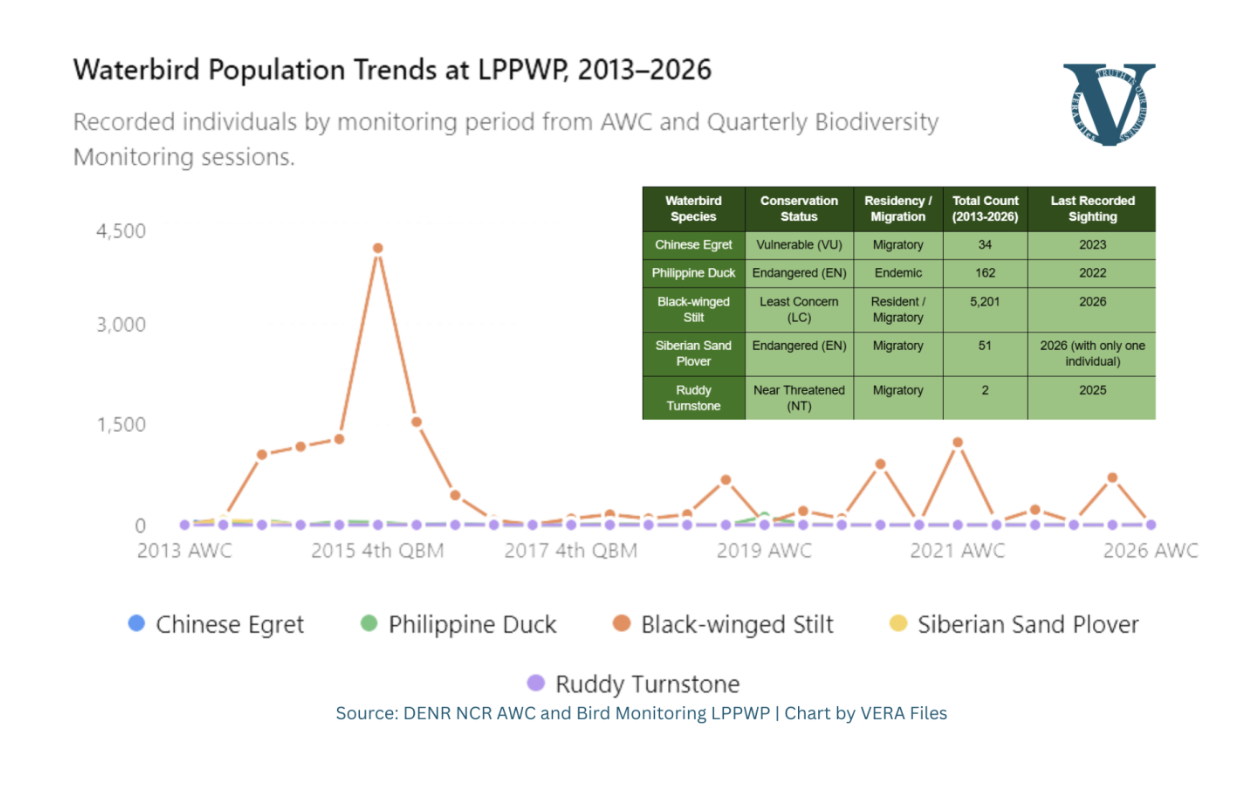
When Villarin first visited LPPWP in 2016, the Philippine Duck was recorded at 123 sightings of individuals during that year’s Asian Waterbird Census.
Recent AWC and DENR bird-monitoring records, however, show declining records of several waterbird species. Among them are Chinese Egret –– migratory species that was last seen in 2023; the endemic Philippine Duck in 2022; two migratory Ruddy Turnstone in 2025; the migratory Siberian Sand Plover, with only one individual recorded this year; and 707 sightings of resident and migratory Black-winged Stilt the same year.
“It is unfortunate that the Philippine Duck, which is supposedly the symbol of the LPPWP, and represents the species of the park, is sadly no longer being seen,” Villarin shared, adding that the park has heard reports that the ducks may have relocated to other parts of Manila Bay.
For a wetland whose international importance is closely tied to its waterbird populations, this distinction matters because at the time of Ramsar recognition, the park recorded at least 5,000 migratory and resident birds, including 47 migratory species, the endemic Philippine Duck (Anas luzonensis) and the Chinese Egret (Egretta eulophotes), and at least one pct of the estimated population of Black-winged Stilt (Himantopus himantopus).
These ecological values supported its designation as Ramsar Site No. 2124 in 2013, followed by its designation as a national protected area under Republic Act No. 11038 or the Expanded National Integrated Protected Areas System Act in 2018.
Moving towards 2030, and beyond
The Philippines’ commitment to the global 30×30 target provides a broader context for the protection of LPPWP. Under Target 3 of the Kunming-Montreal Global Biodiversity Framework, countries are called upon to ensure that at least 30 pct of terrestrial and inland-water areas as well as marine and coastal areas are effectively conserved and managed by 2030.
The framework also calls for these areas to be effectively and equitably governed and ecologically representative and connected.
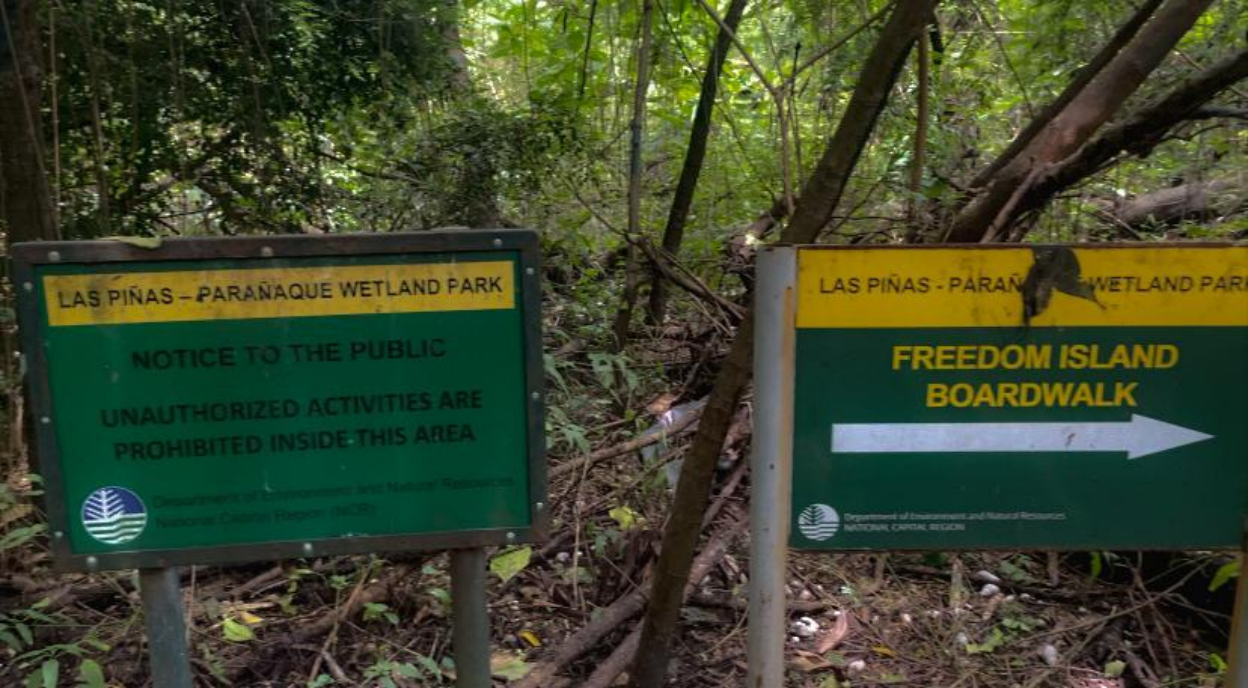
Within the LPPWP, enforcement is one of the measures used to sustain the protection and conservation of the area.
For park attendant Angelo Manlapaz, this includes confronting and apprehending people who enter the park and use its resources without authorization, in violation of the E-NIPAS Act of 2018. He recalled an incident involving a nearby resident who cut mangroves without a permit and used the wood as sticks for handling frozen meat at a market.
Park attendant Jay Mark Olvido also recalled an incident in 2025 involving an individual who was caught killing a bird within the protected area.
Alongside the work of the Bakawan Warriors in maintaining the park, LPPWP conducts regular biodiversity monitoring and other site assessments, and implements enforcement measures through its Coastal Law Enforcement Group.
The group brings together agencies including the PNP Maritime Group, Philippine Coast Guard and barangay enforcers to support law enforcement within the protected area.
For Villarin, the effective and sustainable actions require collaboration among these forces as DENR has “no police powers,” he said. “We have a mandate to protect the area, but we are not prevented from asking others for help in carrying out this mandate. We need the help of other agencies and institutions.”
(This story was produced under the Global 30X30 Initiative grant from Internews’ Earth Journalism Network).