
There is no doubt: Corruption in Philippine public works is a perennial systemic illness. There must also be no doubt: the current flood control corruption scandal reached unprecedented scales under Rodrigo Duterte. That is no political statement. The pertinent records are known in the public forum.
Beginning 2016, the Duterte presidency embarked on budget shifts that continued into the current administration. See the chart on Infrastructure outlays average per administration from Ramos to Duterte in the link just provided. The mess we are presently in either originated or were significantly expanded under the Duterte presidency.
Despite the high spending under Build, Build, Build, investigations have uncovered that many projects, particularly flood control, were “ghosts” (non-existent or never completed).
The UP Center for Integrative and Development Studies documented that in Duterte’s first year in 2016, his flood control appropriation was P79 billion. In 2021, before he stepped down from office, the appropriation had risen tremendously to P200 billion until his last year in office.
Of this, it is believed by senate blue ribbon committee estimates that P79 billion have been lost either to ghost projects or substandard ones since 2016.
It is also on record that the Duterte administration tried to sugarcoat its shortcomings by claiming credit for infrastructure projects approved by its predecessor administration. To name a few: Skyway stage 3 (approved 2014), LRT-2 Extension (approved 2012), NLEX-SLEX Connector Road (approved 2013), CALAX (approved 2015). Bearing false witness, its trademark, was one of its corrupt practices.
Why did it have to lie? What was it hiding then? Two secrets in particular.
The Duterte children were privileged with their own budget insertions.
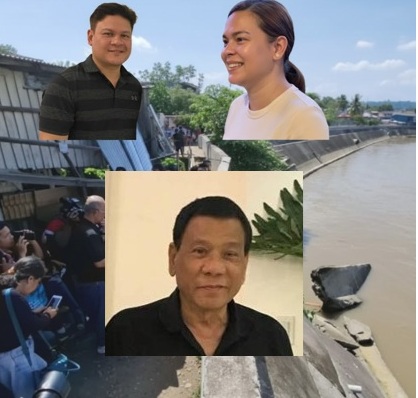
At the height of the Wuhan Virus pandemic, Paolo Duterte got P51 billion for flood control projects. Where did it go? Media posts tell a different story – Davao City easily floods during heavy rains. The P51 billion may have been washed away by the city’s murky canals that now rival Sitangkai, Tawitawi as the “Venice of the South.” Those who question where the P51 billion had gone get a brusque reply from Paolo: diversion. In Davao City, that is the end of discussion. Back to omerta.
But the most preposterous was yet to come. In the 2020 budget, Congress granted Sara Duterte her wish list. The problem was, she was only a city mayor and city mayors do not get budget insertions. But she was the president’s daughter. A Duterte family member must not be held accountable. She must get what she wants.
Discovered only this 2025, the so-called DPWH Leaks showed Sara receiving her own P1 billion for 16 road projects in Davao City.
As Sara’s next impeachment complaint comes this week her troll brigades are on the offensive. Their main fallacy is: why investigate her for her confidential funds when the Marcos Jr. government has billions to account for in flood control corruption?
Marcos Jr., no doubt, will be held accountable. But it is a false dichotomy to assume that there was no corruption under the Duterte regime and that Sara must not be investigated.
In fact, Rodrigo Duterte and his handpicked House speaker Pantaleon Alvarez knew the budget tricks so well as soon as it was their opportunity to propose the national budget in 2016.
Duterte was a failure in transparency. Rappler’s Dwight de Leon reviewed House journals of 2016. Alvarez put the 3rd reading of the national budget without providing copies to congressmen. And this was only Duterte’s first year in office. What did it hide? Budget insertions crafted by a small committee that had no plenary powers.
Only in its second year in 2017, the Commission on Audit (COA) flagged the Duterte administration that only a third of the public works’ massive P662.69 billion budget was used, and specifically on flood control and school building projects.
Did it “park” the rest of the money? It did. In 2018, Camarines Sur representative Rolando Andaya Jr. began an exposé in the House. Parked funds in the amount of P300 million for flood control projects in Bicol was facilitated by Duterte’s budget secretary Benjamin Diokno.
“Parking” refers to listing the money under the budget of a congressional district for later use on a different project and in a different congressional district.
Andaya also accused Diokno of inserting P75 billion in the proposed 2019 Department of Public Works and Highways budget and linked him to an alleged “shady” contractor in Bulacan.
Were there corroborations to the corruption bonanza under Duterte? In fact there was. The Armed Forces of the Philippines (AFP) uncovered last year that 252 ghost projects nationwide were constructed beginning 2016 to the present.
Favored contractors also flourished. One for instance was Davao City’s Genesis88 Construction owned by Glenn Escandor. He was a contributor to Sara’s 2022 campaign. His family also owns the Royal Mandayá Hotel, a favorite events venue of the Dutertes. Escandor’s government contracts increased significantly under Duterte, reaching an appropriation of P1.9 billion in the 2022 budget alone.
Then of course there were the windfall of contracts awarded to the construction companies of Duterte handyman Bong Go. CLTG Construction, named after him, partnered with major contractors involved in the flood control mess such as the Discayas.
Trolls use the polluted memory that the six years of Duterte was corruption-free. Duterte just happened to be a lucky man. Just before Rolando Andaya Jr. could expand his exposé, he was found lifeless inside his house with a bullet wound on his head.
The Duterte regime didn’t hate corruption. It was itself the indecorous and unrepentant corruptor of flood control projects.
Numbers do not lie.
The views in this column are those of the author and do not necessarily reflect the views of VERA Files.