
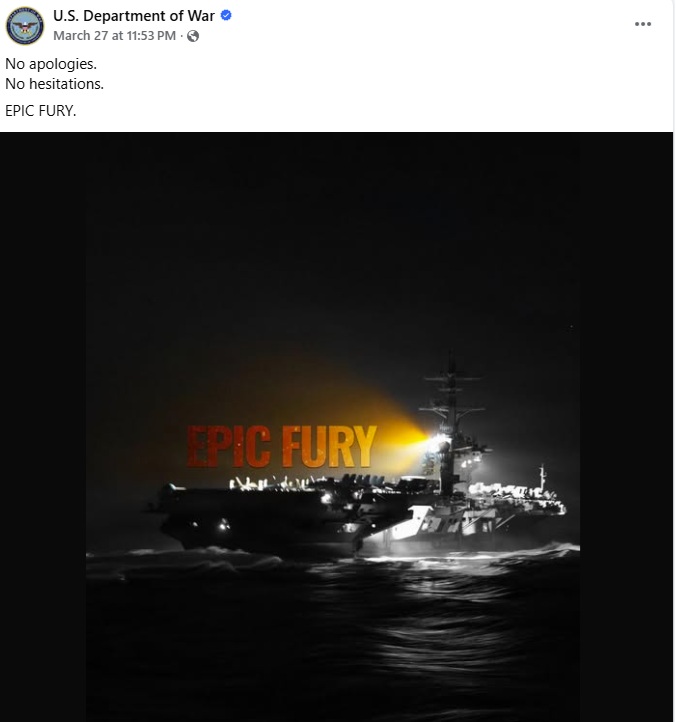

A month ago, the joint U.S. and Israeli operation had practically knocked out all key sectors upon which Iran would be able to conduct war. Operation Epic Fury and its Israeli counterpart Operation Roaring Lion practically destroyed the Iranian Air Force, Iranian Navy and achieved air dominance over the entire country of Iran. Much more significant than that was the complete elimination of the top tier of Iran’s political and military leadership. It was a totally one sided engagement with a handful of American servicemen killed in exchange for the complete disruption of Iran. Then the attacks were directed against ground elements of the Islamic Revolutionary Guards Corps in order to disrupt the capability of the regime to control the country. It was like a repeat of the hammer blows that demolished the Iraqi military a little more than a generation ago. Then for the general public which was expecting a quick victory against Iran, the momentum appeared to slow down and drag on.
The first indicator of that was the seeming inability of the U.S. military to clear out the Strait of Hormuz following the declaration of Iran that it would target vessels and disrupt the flow of oil. For a military that had swept everything in its path in the first weeks of Epic Fury, to see it suddenly appear unable to prevent Iran from enacting its threat was baffling. It was at that time that some U.S. legislators who had been briefed by the executive branch about the conflict revealed that there allegedly appeared to be no plan and strategy behind Operation Epic Fury. The question is that was this really indicative of the lack of any strategy, or were the legislators being kept in the dark as to what were the intentions of the Trump administration? Then Donald Trump who had spent most of his second administration deriding the North Atlantic Treaty Organization suddenly called for European participation to keep the strait open. Publicly, many European leaders have declared that they are either hesitant to participate in a proposed operation in the strait, or are totally opposed to it like Prime Minister Pedro Sanchez of Spain who has prohibited U.S. military aircraft from using Spanish bases to operate in Iran. However there are some European nations of which the most prominent is Ukraine who have extended military assistance to Gulf States under attack by Iran or allow U.S. aircraft operating in Iran to use their bases. Lastly, there have been these bizarre attempts at negotiations between the U.S. and Iran that while many hope peace would be the end result, the bickering and posturing among both sides that has been occurring sort of makes that hope grow dimmer by the day as the Americans have begun a build-up of their ground forces in the operational area.
In this phase of the conflict, the Iranian military managed to achieve success that resulted in some losses to the U.S. in drone and missile strikes against the Prince Sultan Air Base in Saudi Arabia. Naturally this was interpreted as a great victory for Iran by regime sympathizers around the world. It is to them, an alleged proof of Iran’s resiliency. As sensational as the news is about the U.S. losses of what appear to be several surveillance and tanker aircraft, the overall effect on the capability of the U.S to undertake operations in theater is minimal as replacement aircraft can be brought in. It also does not change the U.S. and Israel’s complete control of the skies over Iran. The Iranian offensive capability in the region has been reduced to using ballistic missiles and drones, as all its other power projection platforms have been destroyed or degraded to the point of ineffectiveness. With regard to Iran’s ballistic missile capability, this has the same impact as Nazi Germany’s V1 and V2 weapons had on Great Britain which is, yes these can still do damage and kill, no, these cannot win the war. That leaves the ground forces of the Iranians as the remaining combat effective force facing the combined U.S. and Israeli threat should an invasion of Iran occur.
This then puts into perspective the apparent dragging on of operations as this is actually the manner in which American forces shape the environment for battle. Prior to the ground invasion of Iraq during Operation Desert Storm in 1991, Iraqi forces were subjected to intense aerial assault for a month that ground them down. This made the Iraqi military brittle to the point that when the Coalition forces launched their ground operation, the Iraqi resistance was a mixture of some resisting fanatically while many others surrendered in droves. In 100 hours the Coalition managed to rout the Iraqi expeditionary forces in Kuwait while at the same time destroy any attempt by the Iraqi Republican Guards to interfere. During the 2003 invasion of Iraq, an attempt was made to decapitate the Iraqi leadership through air strikes which was not successful.
In almost 20 days of operations beginning on March 20, 2003, the Coalition of the Willing drove through Iraq and captured Baghdad on April 9, 2003. If an example of how an Iran ground operation might look like, Operation Iraqi Freedom (OIF) in 2003 would contain more similarities than Operation Desert Storm which was a traditional and conventional clash of militaries. OIF though had a mix of conventional and asymmetric warfare as Iraqi irregular fighters sought to disrupt the advance of Coalition forces.
With no Coalition troops fighting with the U.S. in any Iranian invasion, the challenges would be even more immense to American military commanders in how to utilize their limited forces in any ground operation. Israeli ground forces are too distant and themselves are heavily involved in their own operations in Gaza and Lebanon to be of any assistance in Iran.
This is why it is then suspected that the U.S. is planning to seize Kharg Island and attack oil installations to cripple Iran’s oil industry, bankrupt it, and to force the regime to capitulate. Given the physical separation between that island and the Iranian mainland, the ability of the Iranians to successfully defend it from a determined U.S. assault backed up by American and Israeli air power is impossible. The question is how much casualties can the Americans absorb to make the capture and holding on to the island acceptable? Though it is expected that the Iranians will try to throw everything they have against any invading force in any part of Iran, it will also be expected that American and Israeli air and drone operations will be so intense to neutralize such enemy action.
However, what if the regime in Teheran still refuses to capitulate even if it fails to recapture Kharg Island? What other military operation can be a reasonable option for the Americans and Israelis to defeat the regime short of deploying the bulk of the American military to invade Iran? The answer lies with the people of Iran themselves. During the invasion of Afghanistan in 2001 the U.S. enlisted the assistance of the Northern Alliance to defeat the Taliban. In OIF, the Kurds and other Iraqi opposition forces were utilized by the Coalition to defeat Saddam Hussein’s troops. Today, bereft of allies due to Trump’s hostility to NATO, the Americans will have to find a way to encourage and support the Iranian people in a rebellion as a tremendous force multiplier willing to take on the responsibility in the campaign to eliminate the regime of the Ayatollahs and keep American casualties very low. A massive popular revolt supported by American and Israeli airpower with limited ground forces stands a very good chance of fracturing the Iranian military, neutralizing its attack drone capability, and forcing it to either surrender or die in the process. During Desert Storm, demoralized Iraqi soldiers surrendered to American attack helicopters while there are instances that Russians have surrendered to Ukrainian drones.
If the Americans so wish to, even alone, given their capabilities, they can steamroll through Iran’s defenses and destroy the regime in the same amount of time it took the Coalition to defeat the Taliban in Afghanistan in 2001 and Iraq’s conventional forces in 2003.
Despite the doomsayers and pro regime propagandists warning about thousands of American dead, there is a good chance that many Iranian ground units will break in an invasion. This is because the moment they attempt to assemble to challenge an American advance they will be slaughtered by U.S. and Israeli aircraft and drones. Their only recourse is to resort to irregular and drone warfare which would be difficult to do if the population is rebelling against the regime at the same time. To use the Maoist tenet of fish in the sea with the former being irregulars and the sea being the people, an unsupportive population means the seas dried up leaving the fish exposed, vulnerable, and dying.
However, to achieve those prerequisites of weakening the regime forces and more importantly, making the Iranian population willing to stage an uprising, it requires the professionalism, intellect and sensitivities of statesmen and commanders. Given the manner in which the Trump administration has been derisive of allies and even dismissive of genuine offers of assistance, the Americans might just end up winning the battle and losing the peace in Iran. However would that matter for Trump? Probably not as he and his cronies would probably be making a killing on Iran’s oil industry because nowadays, U.S. national security is not just defined as the interests of the U.S. itself, but how best will it fill up Trump’s corrupt pockets.
The views in this column are those of the author and do not necessarily reflect the views of VERA Files.