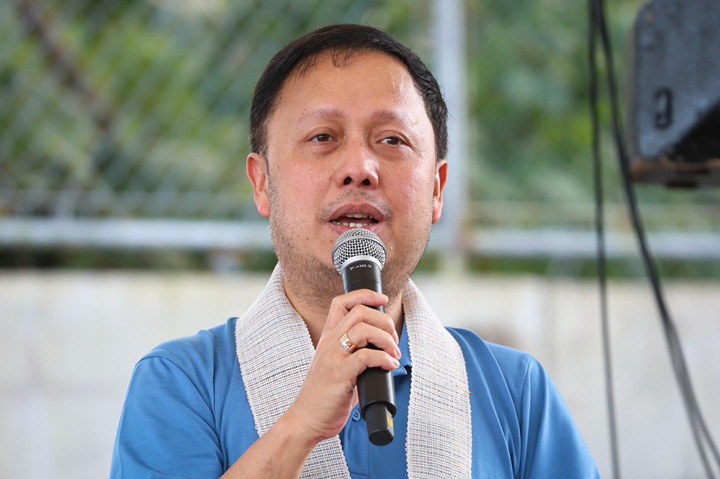

The long arm of the law has finally reached across the globe to the cobblestone streets of Prague. The arrest of fugitive ex-representative Elizaldy “Zaldy” Co in the Czech Republic, reportedly for lacking proper documentation while attempting to cross the German border, is a significant boost to the government’s pursuit of accountability. No less than President Ferdinand Marcos Jr. announced the development on Thursday night, April 16.
“The latest information confirms that Zaldy Co was stopped at the German border after entering from the Czech Republic,” Marcos wrote on his official X account. “He was denied entry and returned to Czech authorities, where he remains in custody.”
For Filipinos forced to watch their homes disappear under floodwaters each rainy season while billions, perhaps trillions, of pesos earmarked for flood control vanish, Co’s arrest should mark the beginning of a long-overdue reckoning.
For nearly a year, Co was the ghost of the Philippine legislature. Once among the most powerful members of Congress, the resigned Ako Bicol Party-list representative held the keys to the national budget as chairman of the House Committee on Appropriations. Yet when the investigation into the P545-billion flood control scandal intensified after the president’s State of the Nation Address last July, Co vanished.
He was said to have left for the United States for medical treatment, only to surface later in reports placing him in Portugal, where he allegedly had secured a passport and golden visa. He refused to return to the country after Congress and the Independent Commission for Infrastructure opened simultaneous investigations into anomalous flood control projects, including those constructed by Sunwest Corp. linked to Co and his family. Public works officials had also tagged him as among the high-ranking government officials who earned kickbacks from substandard or missing anti-flood infrastructures that amounted to hundreds of billions of pesos.
However, just as the public began to hope for a swift return to justice following his arrest in Prague, the narrative took a bewildering and frustrating turn. Unconfirmed reports suggest Co could be released as early as Sunday due to a staggering procedural lapse by Local Government Secretary Jonvic Remulla, who allegedly failed to request a red notice from Interpol despite prodding from the Department of Foreign Affairs.
Without this international “wanted” alert, Czech authorities may have little legal basis to hold Co beyond an immigration violation. If he walks free because the Department of the Interior and Local Government failed to act on a routine international request, the “long arm of the law” will look less like an instrument of justice and more like a limp handshake.
It would be a monumental failure of coordination. The timing of such a lapse is particularly troubling given the gravity of the charges. The Sandiganbayan issued a warrant for Co over an anomalous P289.5-million road dike project in Naujan, Oriental Mindoro, but that case may be only the tip of a much larger, murkier iceberg.
National Bureau of Investigation Director Melvin Matibag, however, clarified that Co was arrested for an immigration violation, which is not immediately related to an active Interpol red notice. He said that although the Department of Justice had requested in November a red notice, which has not been granted yet, and cancelled Co’s passport last December, his detention in the Czech Republic was based on border, not international, warrants.
Interviewed on radio over the weekend, Remulla said Co would be back in the country in one to three weeks. When that happens, he said he would be the arresting officer to bring him to the Sandiganbayan for his arraignment, after the procedural medical checks at Camp Crame.
Last week, state witness Henry Alcantara, a former assistant regional director of the Department of Public Works and Highways, testified that he had delivered as much as P800 million in cash to Co through a staff intermediary. The scale of alleged corruption is staggering and uniquely cruel.
When funds meant for dikes and pumping stations are pocketed, the cost is not just financial. It is measured in lives lost, crops destroyed and families forced onto rooftops to survive rising waters. Corruption in flood control is immediate, visible and devastating.
As of late 2025, at least 400 “ghost” flood control projects and around 60 high-priority projects are under scrutiny for being substandard or nonexistent. Allegations point to billions of pesos in misused funds and cartel-like behavior among contractors. Marcos himself revealed last August that just 15 contractors cornered roughly P100 billion of the P545.64-billion flood control budget, an extraordinary concentration that underscores what has been described as a deeply entrenched “insertion culture,” one Co allegedly mastered.
If Co is released because of a missing red notice, what message does that send? At best, it signals incompetence; at worst, complicity. Why would Remulla, widely rumored as a potential presidential contender in 2028, hesitate to trigger an Interpol alert for one of the country’s most high-profile fugitives?
The calendar of justice, it seems, has an uncanny tendency to align with the calendar of politics. In November, Co released a series of recorded video statements from an undisclosed location, accusing Marcos, first lady Liza Araneta-Marcos, House Majority Leader Sandro Marcos, former House speaker Martin Romualdez and other senior officials of corruption tied to alleged budget insertions.
In one video, Co claimed that he, along with his staff and security aides, personally delivered suitcases of money to the residences of Marcos and Romualdez.
He also said he had planned to return to the Philippines after Marcos’ 2025 SONA, but Romualdez allegedly stopped him and assured him he would be “taken care of.”
Malacañang dismissed Co’s accusations against the Marcoses as “pure hearsay” and urged him to return home and face the investigations. Romualdez likewise denied the allegations.
If the administration’s handling of his arrest appears half-hearted or deliberately bungled, it raises uncomfortable questions. Does Co possess information certain factions are not yet prepared to confront? Is he a fugitive to be prosecuted, or a liability better kept at a distance?
The danger is clear. If Co becomes merely a tool to purge political opponents while allies are shielded, the cycle of corruption will simply reset under a different name. The real test of the administration’s sincerity lies in whether the investigation follows the money wherever it leads, even to the doorstep of those currently in power.
Co’s return should have been the catalyst for a sweeping overhaul of how the national budget is crafted. A system that allows billions to be “inserted” at the eleventh hour into projects that exist only on paper is not merely flawed; it is engineered for abuse. Yet if he is allowed to slip away because of bureaucratic negligence, the P545 billion in question becomes a burden quietly transferred to every Filipino bracing for the next typhoon season.
The arrest in Prague offered a fleeting moment of hope. But an arrest without an Interpol red notice is little more than a temporary inconvenience for a determined fugitive. If Co walks free, the DILG and the Department of Justice will owe the public more than explanations; they will owe accountability.
This is not about securing a political trophy. It is about uncovering the truth. And right now, the truth looks like it’s being held back by those who should be clearing the way.
The views in this column are those of the author and do not necessarily reflect the views of VERA Files.
This column also appeared in The Manila Times.