
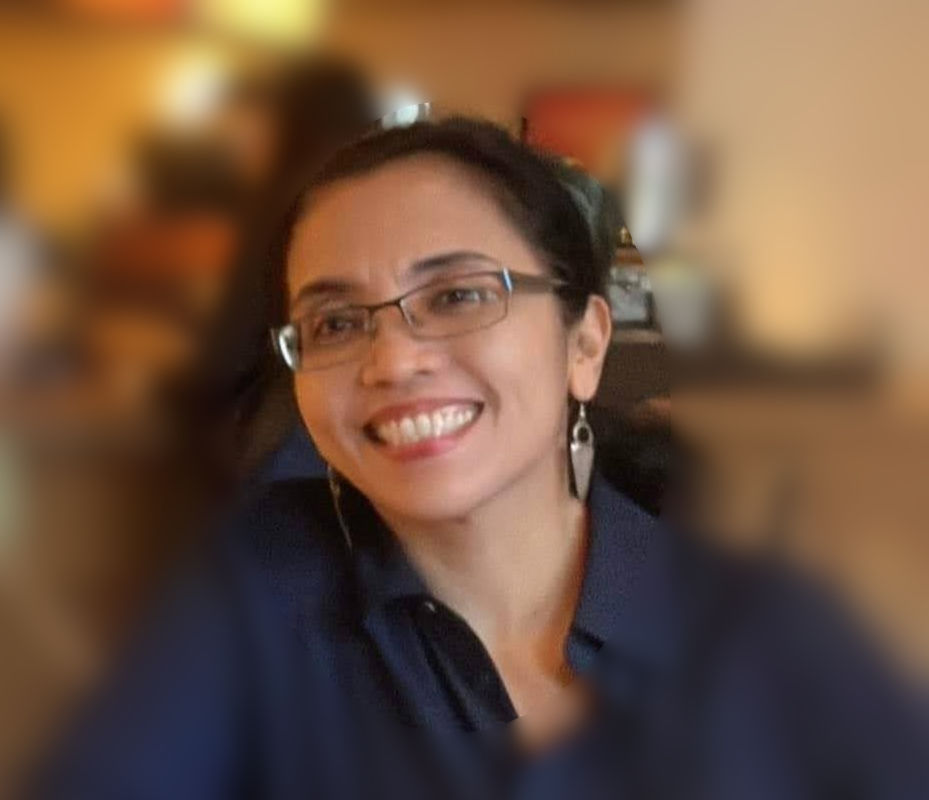
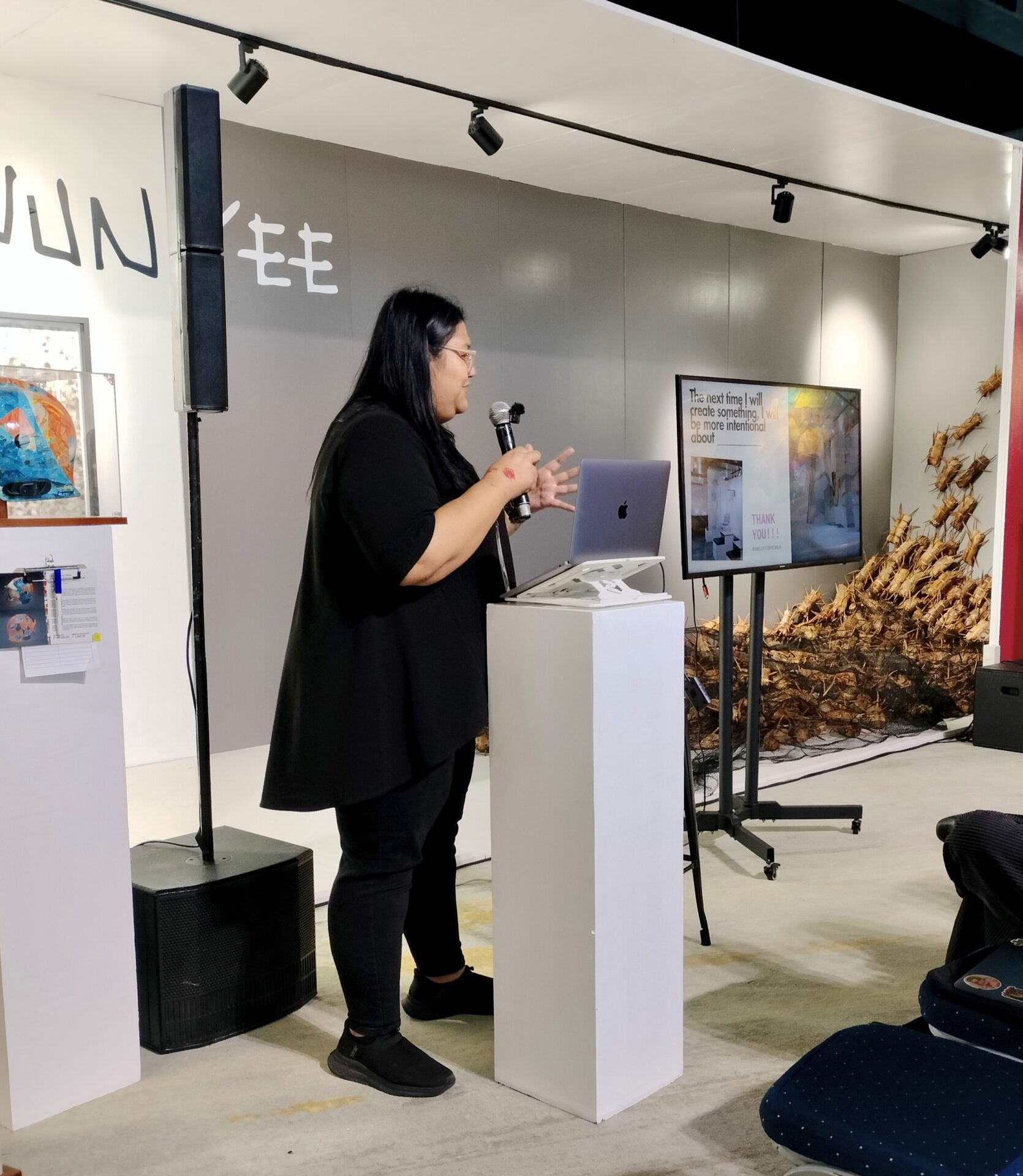
BUSAY, CEBU CITY — There was time for Carla Marie Adlawan to have a tête-à-tête with this reporter before her talk on “How to differentiate your art in the AI era” got underway on Oct. 23 at TOPS ArtFest 2026. Her lecture was one of the scheduled activities at the art festival that took place on Oct. 22-25, and that has been gathering artists yearly since 2024 at TOPS Cebu.
Adlawan said she is not an artist in the traditional sense but a copywriter, zine maker, and teacher of branding and copywriting at the University of San Carlos (USC) for 15 years. Previously, she worked at a Cebu-based ad agency handling Jollibee (the print ad won an award) and 7-11 (the excitement of the July 2011 launch prompted the US bosses to fly in for the opening). The offer to teach at USC came — her copywriting background sealed the deal — after she resigned from the agency.
“I love teaching, pushing the boundaries of education,” said Adlawan, who’s popularly known by her professional handle and creative alter-ego, copycarla.
Walking the talk
Like all creatives, Adlawan is confronted by AI, which she termed a “dirty word” that now can’t be avoided. What needs to be done, she said, is for creatives, artists, and “those still growing into their craft” to learn to navigate the landscape with AI in it.
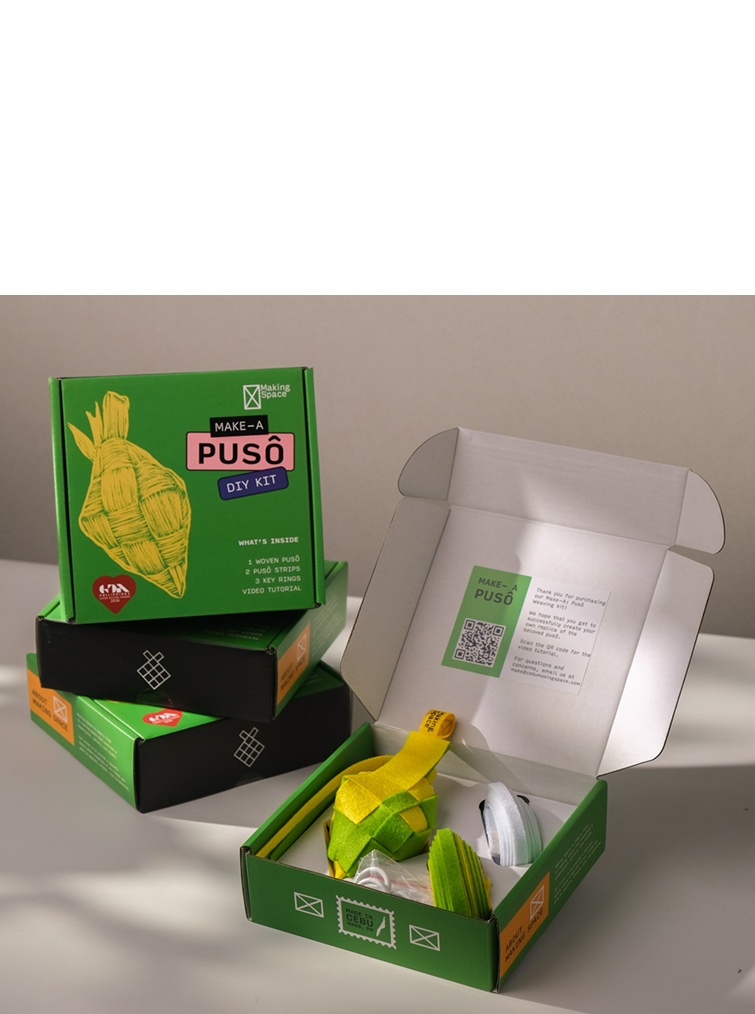
She said that at USC, she requires students to handwrite their classroom activities and assignments. Outside, she and friends run White Brick Creative Studio — “I can’t be a teacher without being a practitioner,” she quipped — where they make sets and typography from scratch. A milestone project of White Brick, which celebrated its ninth anniversary last August, is the Make-a-Pusó DIY kit, a box of pre-cut materials and visual aids on weaving the pouches of pusó (“hanging rice”), a popular companion to street food and lechon. It won in the Object Making Category at the Good Design Awards Philippines 2026 last June.
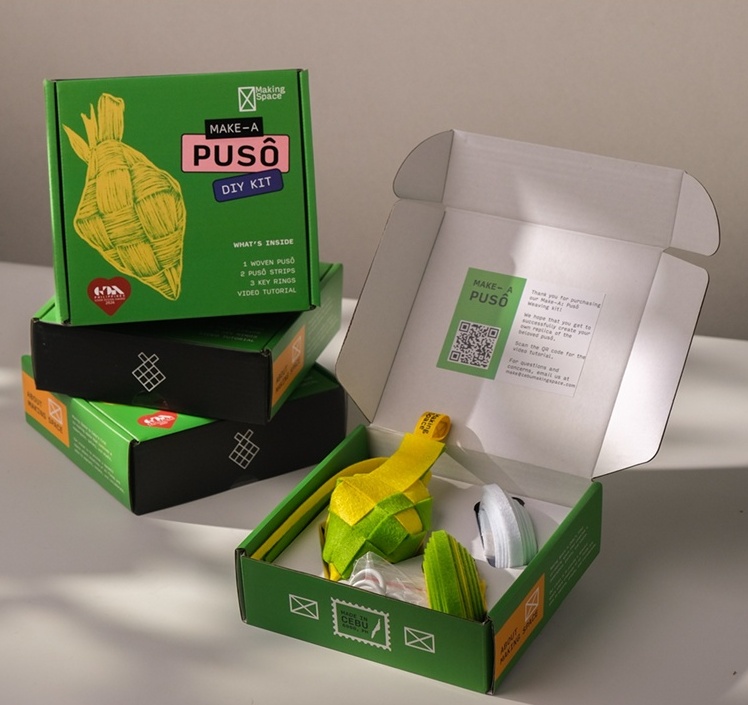
The kit is “a piece of our heritage” directly challenging AI, said Adlawan in a follow-up email, elaborating on how “we’re able to put down our phones, experience the process, the storytelling that comes with it, and personal conversations.” She added: “AI can never replicate these things.”
Apparently, the kit evolved from a pusó weaving workshop, which used lukay (palm leaves), for local and international tourists at Making Space, a co-making space combining a makerspace, gallery, studio and craft room, and White Brick’s initiative to support Cebu’s makers community.
The aim of the pusó workshop, continued Adlawan, was to preserve the art of weaving because most Cebuanos aren’t familiar with the craft despite pusó being a staple of Cebuano cuisine. The new generation of families making pusó since the 1950s aren’t interested in the business, she said.
Sisters and White Brick partners Stephanie and Angelica Tudtud came up with the kit in response to requests of making pusó a souvenir woven at home. The kit is available in Manila (National Museum of the Philippines) and Cebu (Casa Gorordo Cebu and The Kabilin Center).
Ironically, Adlawan said, keeping AI at bay had an AI checker declaring her a robot after “analyzing” her blog posts and zines. Likewise, people have been taunting her about being the first to be let go with AI around. But she’s not daunted, pointing out that “AI can’t generate cultural nuances and instructions.”
Living with AI
According to Adlawan, AI has made it easier to generate images, write styles, and produce creative outputs, but the immediacy has given rise to the problem of distinguishing art’s distinctiveness with everyone using the same tools. “Generative AI isn’t unique and original,” she pointed out. “It’s based on everything already existing on the Internet.”
She said AI has changed things by, first, lowering the entry barrier, allowing every dilettante to enter the creative field, and disregarding professionals with their training, expertise and experiences.
Second, she said, AI has made production faster and cheaper, making clients choose it over hiring artists. It’s a challenge faced by visual communication studios like White Brick and, Adlawan contended, an opportunity to “offer creative direction, original concepts, [and] cultural understanding.”
Last, she said, AI’s visual abundance has made differentiation crucial because an artist’s goal isn’t only making something visually appealing, highlighting the urgency for artists to use their human advantage.
“AI can generate numerous images but people bring the personal details that add depth,” she argued. “To an audience that can relate to you, nothing can beat those things.”
Before proceeding further, Adlawan made clear that she isn’t an AI skeptic and neither is she “rejecting work made with AI.” What she wants to do, she asserted, is to recognize “the things that make us human.” Thus, her lecture at TOPS ArtFest was aimed at fostering an understanding of the changing creative landscape; identifying the artists’ human qualities; and helping young artists “articulate their artistic identity beyond the medium.”
Human advantages
The human advantages as listed by Adlawan are: lived experiences, cultural context, taste and judgement, personal perspective, and intention and meaning. The young and veteran artists’ lived experiences are sources of original material, she said. For example, the task of painting a neighborhood, she said, would have one making “a gated subdivision with high gates and clean pathways, while another would have a noisy neighborhood with a sari-sari store, a basketball court, a barangay hall, and a person selling barbecue across five [others] selling it.”
She said lived experiences are influenced by cultural contexts which are replete with “references, symbols, practices, and history that can be interpreted within the Filipino perspective.” Filipinos, she said, have a penchant for relatable cultural objects such as the “Last Supper” portrait in the dining room, the huge decorative wooden cutlery on the wall, and even comedian Jokoy’s spiels in his shows about his mother’s fondness for Vicks Vaporub.
Other Filipino cultural practices of migration, family values, religious traditions, and childhood hometown also give artworks detail and perspective, she said.
Personal perspective is connected to cultural context, said Adlawan. “Personal perspective is how artists interpret the world, or what they notice more about it than others. This affects the kind of art and topics they want to explore and focus on,” she said, adding that personal perspective is influenced by an artist’s taste and judgment — i.e., “the people they hang out with, music they listen to, books they read.”
“When they come with a story is what would set them apart,” she said.
Finally, intentions and meanings give artists direction. Adlawan said, “Art is expressing what we feel,” she said. “It’s investigating what’s going on in society. It’s documentation of the memories that mean so much to us. It’s an act of protest: I want to show what the world is facing right now.”
Gazing at the audience, she added:“You determine what your work is exploring and why it needs to exist, so express something specific and meaningful.”
Distinguishing factor
Adlawan distributed a handout form titled “Finding your Human Advantage,” which, she said, would reveal, based on one’s answers, what would distinguish one from other artists. She emphasized that artistic differentiation is within one’s own framework or perspective.
There were three incomplete sentences to complete on the form: “I am interested in exploring _______”; “My perspective in this subject is ________”; and “Something I want to communicate or question is _________.” Meanwhile, the differentiation statement had blanks to be filled out: “I create __________ that explores _________ through _______ to __________.”
To illustrate her point, Adlawan cited visual artist Kaye Plasquita’s vivid interplay of artistic differentiation and perspective. Plasquita, a student at the University of the Philippines in Cebu, had a solo exhibition, “Soft bodies, tender creatures,” at The Tea + Gallery in Cebu on Sept. 10-Oct. 3.
According to Adlawan, Plasquita explored the experience of coming out as gay and her family learned of it at the exhibit opening. “It was a difficult project because when you come out, you also come into yourself. There are so many layers of human experiences,” she said, underscoring Plasquita’s personal or introspective perspective as something hard to create with an AI prompt.
“Look into yourself”
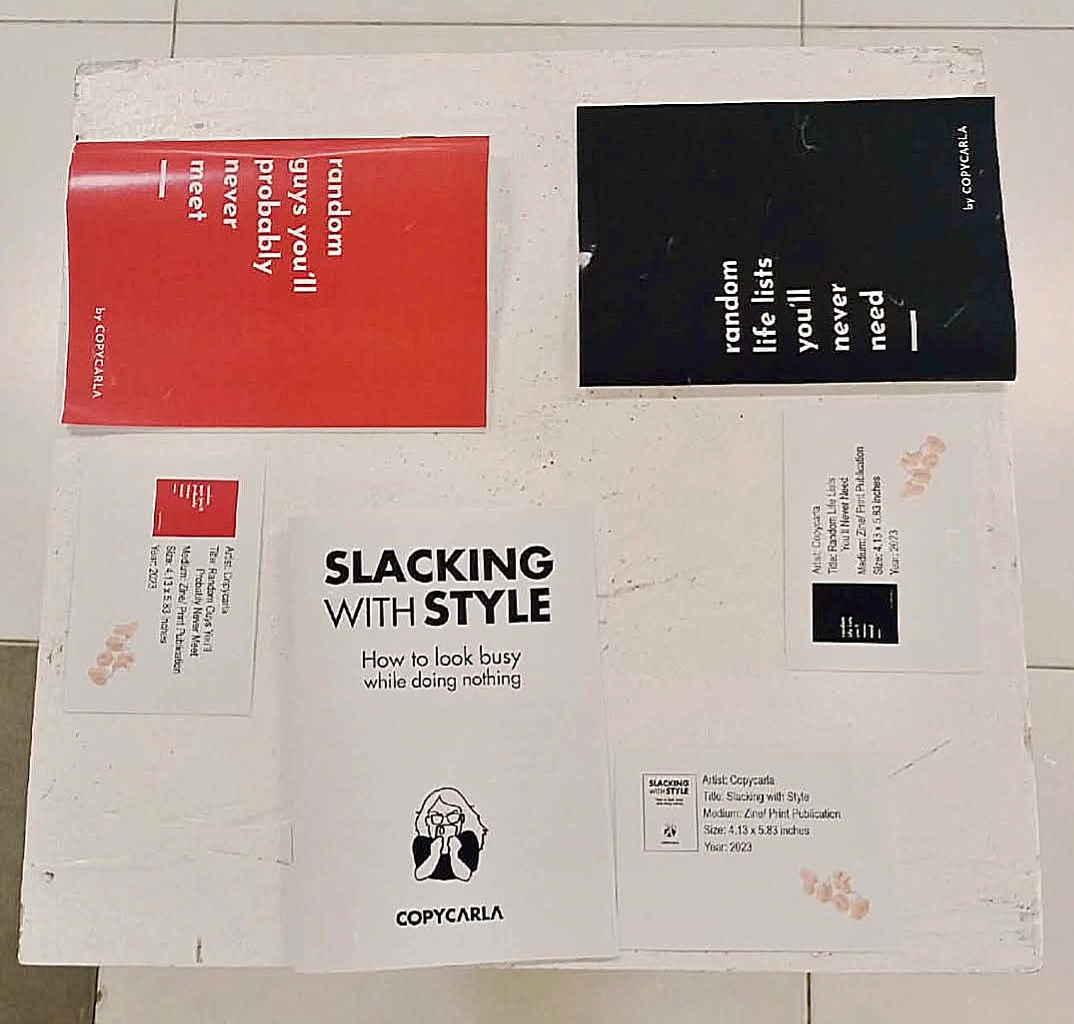
Nearing the end of her lecture, Adlawan shared her differentiation statement: “I create zines that explore mundane, awkward, and oddly specific experiences through lists because everything is easier to process when categorized to provide completely unnecessary yet strangely relatable material that helps us recognize our own and others’ stereotypes amidst the absurdity of everyday life.”
Highlighting the human advantage, she called attention to Numbers 4 (“my next creative experiment”) and 5 (“my seven-day commitment”) on the handout form. She said these were “homework” on introspection to help young artists “look into themselves and really think, because art is subjective.” She warned them strongly against using AI prompts in completing assignments, but conceded to prompts seeking references related to projects, i.e., how to start illustrations in the style of the 1990s Hanna-Barbera animation.
Adlawan concluded by advising students to read books (“they’re references”); compare these to life and the world they live in; open their eyes; and steer clear of social media.