
Year 2026 is just on its second month, yet despondency appears to hang over the country. Filipinos struggling to make ends meet have been confronting seven straight weeks of increases in fuel prices. The flood control corruption scandal has yet to be resolved. Elsewhere, in the West Philippine Sea, the Coast Guard struggles to uphold our sovereign rights, and the facts behind our Kalayaan Island Group need to be explained to the public at large, including certain senators.
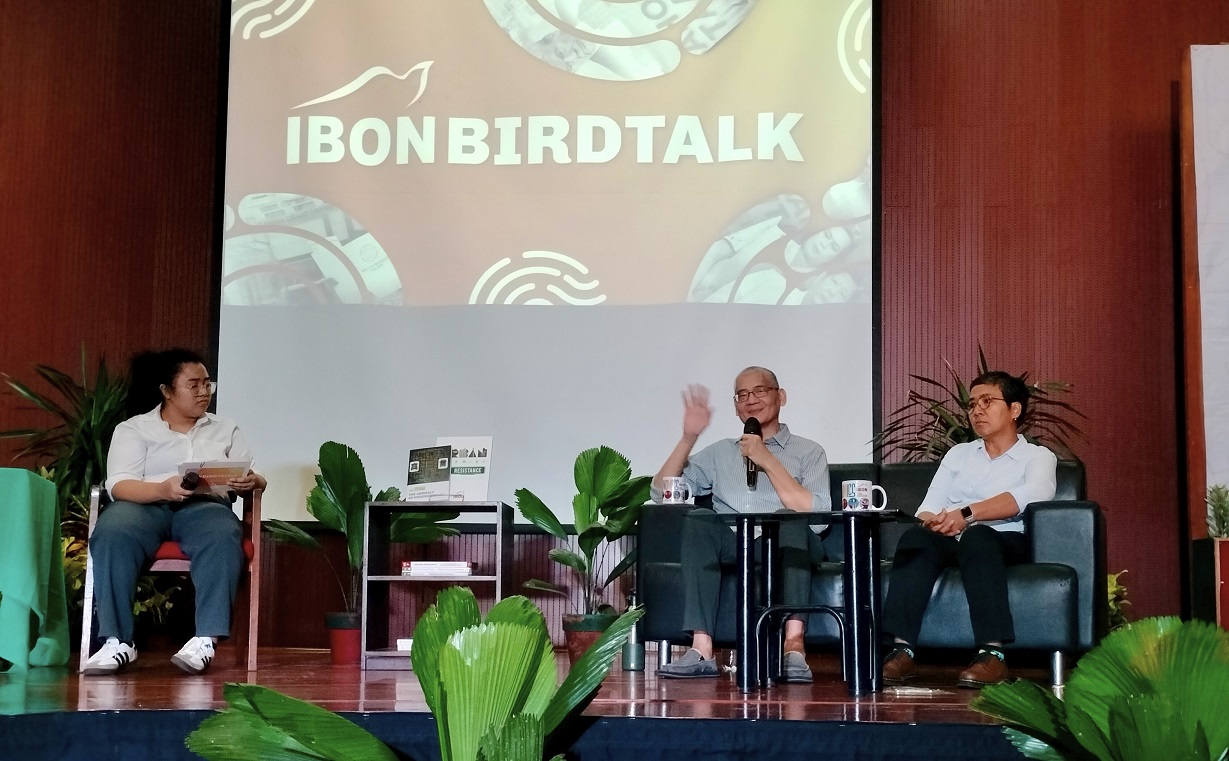
The prospects seem even grimmer after hearing the situationer of the Ibon Foundation’s Sonny Africa and Rosario Guzman at the 2026 Ibon BirdTalk held on Jan. 23 at the UP Statistics Auditorium. Titled “From Frustration to Action,” the first of the bi-annual talks had Africa and Guzman, Ibon executive director and research head, respectively, explaining how structural weaknesses have led to a bleak economy and a political crisis.
Unmet growth targets
“We don’t just want good governance…we want good economics,” Africa said. “The government isn’t good at achieving targets. Since 2016, it has failed to meet its growth targets for the coming year 90 percent of the time.”
His data analysis shows that economic growth fell even three years before the pandemic, with the growth for 2025 plunging to a low 5.7 percent. The high growth period of 2004-2016 — 6.6 percent in 2004 and 7.1 percent in 2016 — are long gone, he said, adding: “The economy was growing fast but the slowdown started in 2017 and is continuing up to now, which is contrary to the Marcos Jr. government’s claim of rapid growth.”
Africa’s slide presentation titled “Philippine economy after three years of Marcos Jr.” juxtaposed his findings on the growing number of poor and hungry Filipinos vis-á-vis the burgeoning wealth of a few. Figures for the former showed self-rated poor families reaching 14.3 million; involuntary hungry families totaling 5.7 million; and borderline poor and vulnerable families rising to 17.7 million.
Conversely, the three richest Filipinos became even richer. According to Africa, Enrique Razon’s wealth increased 115 percent or an additional ₱351 billion; Ramon Ang’s wealth rose by 62 percent or an additional ₱83 billion; and Manny Villar’s wealth grew by 48 percent or an additional ₱203 billion.
Africa said household spending was the biggest driver for economic growth because of the “additional 10 million [people] spending.” But household spending weakened after 2017, when wage increase stagnated, remittances from overseas dropped, and foreign direct investment inflows fell. Services filled the gap but they were not of high quality and could not compensate for the lost jobs in the agriculture and manufacturing sectors, he said.
He argued that external sources should not be driving growth, and pointed out that “the country needs state-driven agrarian development and Filipino industrialization with universal social services.”
‘Token tweaks’
The government’s solutions to slowing growth and joblessness are ayuda (aka social programs like 4Ps, Tupad, etc.) and the “Big Bold Reforms.” But, as Africa highlighted, the social programs are ineffective against deep poverty because they are low-targeted and patronage-prone.
What are the supposed big reforms? Africa described them as “tiny token tweaks that won’t fix the structural problems” because they do not improve the agricultural sector or provide for a progressive taxation system and universal health care.
These reforms include 14-day visa-free entry for the Chinese to boost tourism and trade, and ₱4.3-billion support for the auto industry’s Comprehensive Automotive Resurgence Strategy program.
‘Blunders’
Guzman said “the nation’s structure is collapsing” because of political instability and a fragile economy due to President Ferdinand Marcos Jr.’s “blunders.”
The first, she said, was adopting an anti-corruption stance in announcing the anomalous flood control projects while remaining silent on the pork barrel issue.
She said Marcos Jr.’s disclosure of the flood control projects was intended for him to gain public support. But it failed, she said, for these reasons: First, it enraged the public, especially the poor. Second, it created political fallout with the resignation of officials like Speaker Martin Romualdez and Ako Bicol Rep. Zaldy Co, who chaired the House committee on appropriations. Third, no “big fish” has yet to be formally charged or jailed.
The investigation initiated by the President appeared “only to whitewash corruption,” Guzman said, adding that corruption was not accidental or low-level but systemic, needing “approval from the highest level.”
Guzman said the President’s second error was “using the 2026 budget to shore up [his] position.” She said the budget still has pork barrel under new names — “allocables,” “unprogrammed appropriations,” “hard” and “soft” pork.
As well, she said, confidential and intelligence finds are high and intact, and funding is for debt servicing, not development.
Another aspect of the supposed second blunder is framing the 2026 budget as the true education budget, according to Guzman. She declared this a myth because, she said, education is second in priority vis-á-vis infrastructure development.
“Education receives a 31-percent increase in allocation while there is a 200-percent increase in construction of educational facilities…” she said. “The education budget is a redistribution of where infrastructure spending can be done.”
Guzman described the state of affairs as an example of bureaucrat capitalism marked by, among others, corruption of public funds; turnover of public utilities/assets and natural resources to foreign corporations and local oligarchs; and collusion with criminal syndicates.
Continuing crisis
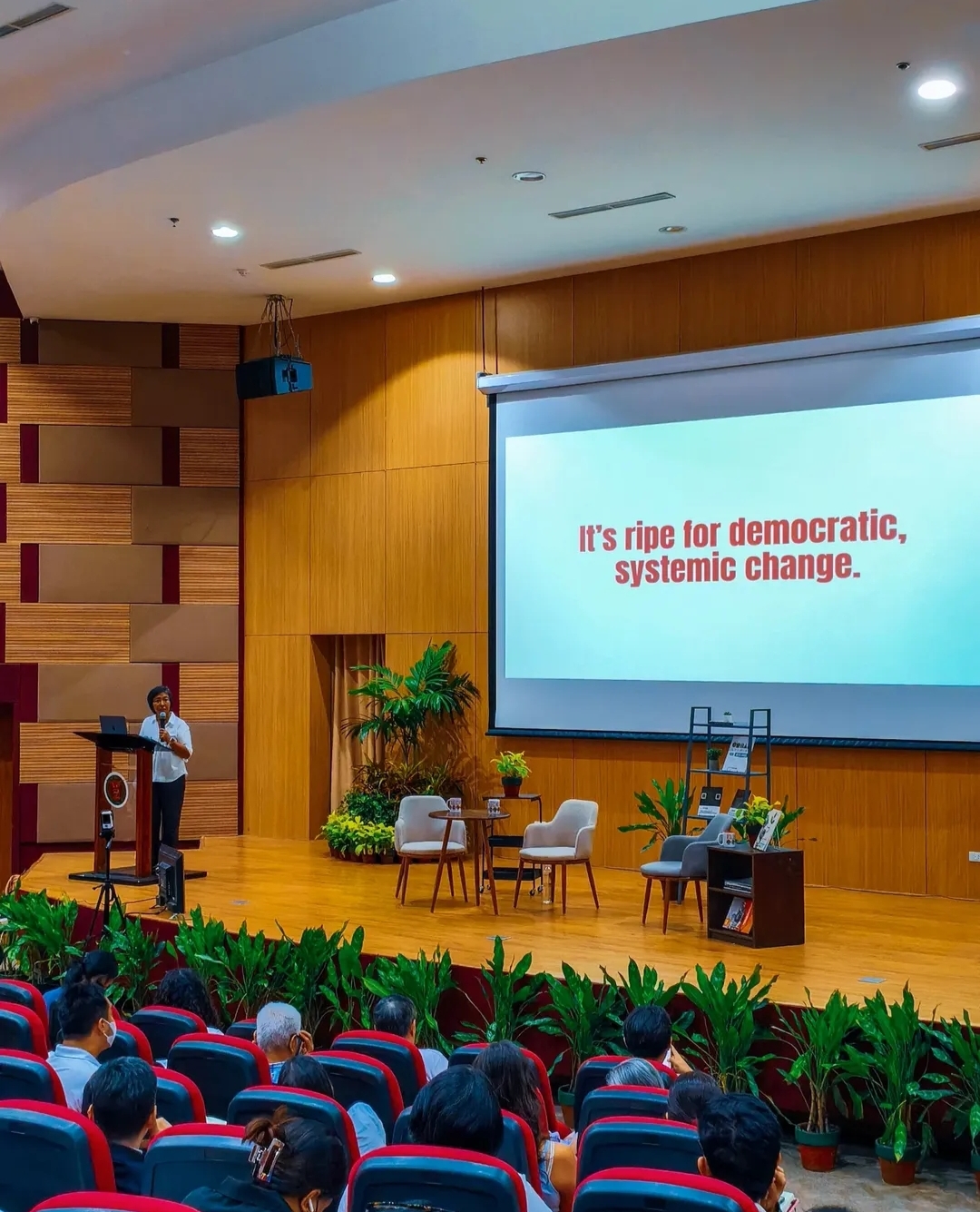
The political crisis continues, Guzman said, pointing out such identifying factors as intensifying intra-elite rivalry, economic oligarchs’ rule over political parties, and a military “more inclined to constitutional continuity than progressive democratic change.”
At the same time, civil society continues to be suppressed, she said, with the administration building up the infrastructure for repression — for example, trumped-up charges against activists — as protests gain momentum over the growing economic distress.
Forming part of the crisis is what Guzman termed the “US-subservient, neocolonial foreign policy” of the administration. She cited the Philippines’ military and security alliance with the United States and its serving as a cog in America’s regional defense industrial base.
“The US wants the Philippine elite to keep constitutional continuity and avoid sovereignty issues,” she said.
National industrialization
Despite the gloomy outlook, Africa and Guzman said the country’s economic and political woes can be ameliorated.
Guzman said this can be possible if a plan for industrialization is drawn up. If not, she warned, the country will be trapped in underdevelopment, with a budget that’s pro-elite, anti-poor, and anti-development; an educational system aligned to serve the demand for overseas labor; and repressed freedom.
Similarly, Africa raised the urgency of pursuing national industrialization. He admitted to its disruptiveness — “shaking up the status quo, and antagonizing the foreigners who are capitalizing on Filipinos” — but asserted that this long process towards progress has to be done.
His slide “Program for National Industrialization” sketched how a democratic, sustainable national industrialization can be drafted into a strategic policy for development. With a broad Filipino industrialization coalition bolstered by patriotism, scientific culture, and a strong mass movement, the policy will prioritize agrarian reform and rural development, advocate protectionism, provide financing for Filipino industrialization, and uplift people’s rights and welfare.
Africa declared: “The government shouldn’t be partial to the oligarchs. It must press for the people’s interest rather than the wants of the bureaucrat capitalists.”