
2025 brought a whirlwind of challenges to Southeast Asia. From the US tariffs and organised cybercrime threatening the region’s economy, to rising tensions along the Taiwan Strait and over half a million displaced people resulting from the Thai-Cambodian conflict, Malaysia’s chairship of ASEAN was defined by its response to a host of regional crises.
In the case of the Thai-Cambodian border conflict, the association’s divisive intervention tested the principle of non-intervention and showed that the region can engage, with influence, in major geopolitical debates alongside the U.S. and China. While Malaysia’s Foreign Minister, Datuk Seri Mohamad Hasan, stressed that ASEAN had not strayed into the domestic arena of either country, acting only as a neutral facilitator, this view was not universally accepted.
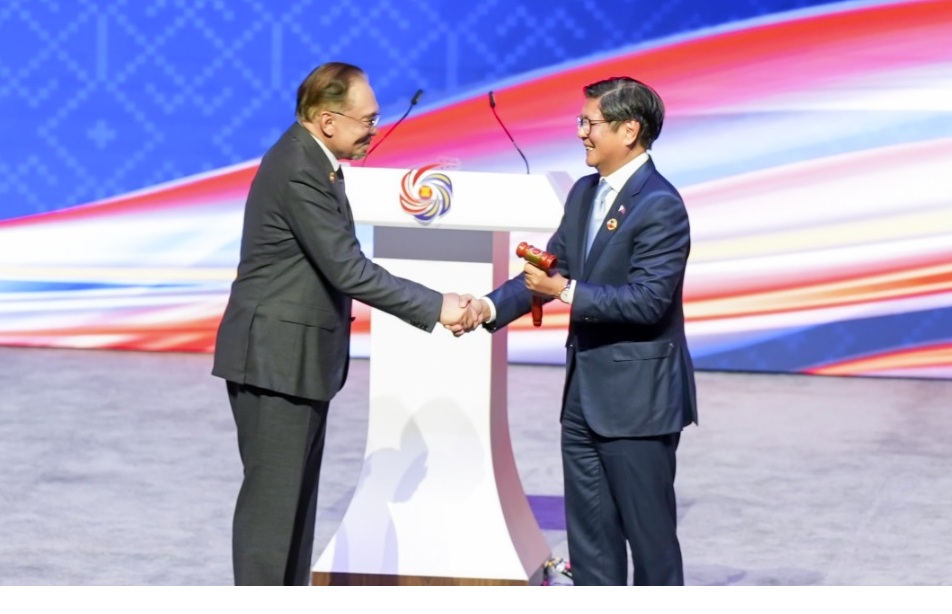
The shift in the association’s positioning has posed an awkward dilemma for the 2026 chair, the Philippines. Under the leadership of Ferdinand Marcos Jr., ASEAN will now need to make determination about its future purpose and whether it will seek to restore the established order or strike out in a new direction.
An immediate and defining challenge will be in its engagements with the world’s two superpowers, the U.S. and China. Filipino tensions with Beijing have grown in recent years, particularly around the South China Sea, and have resulted in a scaling up of military spending (including $2.5 billion in U.S. defence aid), Manila’s exit from the Belt and Road Initiative, and most recently a new defence pact with Japan to deepen military cooperation. As chair, the Philippines will need to carefully straddle its own tensions with Beijing with work that will be beneficial to the entire bloc.
Relations with the U.S., meanwhile, will also pose issues. Efforts by the bloc to negotiate a collective reduction in U.S. tariffs, last year, ultimately failed, forcing member states to pursue their own bilateral agreements. In the case of Cambodia and Thailand, a reduction was tied to their agreeing to a U.S. brokered ceasefire, in July. While the Philippines, historically a strong ally for the US in the region, negotiated a 19% tariff rate – a small reduction from the original 20% announced on “liberation day”.
The brazen capture of Venezuelan President, Nicolas Maduro, by US special forces will also have sharpened minds among regional leaders about Washington’s ambitions and expectations in Southeast Asia. Described by one voice in the bloc as a “dangerous precedent”, the method by which Maduro was extracted has shown that nothing is off-bounds when it comes to U.S. foreign policy. It may also explain why Cambodian authorities moved at pace to apprehend and extradite Chen Zhi, a key figure in Southeast Asia’s cyber-scam industry, at the beginning of January.
While, ostensibly, welcome news for the curbing of what is now a multi-billion dollar (US$40 billion in 2023) industry in the region, the decision to hand Chen to Chinese authorities, rather than Western agencies which had filed for his arrest in October, suggests that ASEAN’s struggles with cybercrime – and its positioning within the US-China power dynamic – could rumble on. A U.S. Commission report, published last year, found that China is “selectively cracking down” on scam centres that target Chinese victims. If this is the case, ASEAN countries – could still face grave risks to their economy and security. With AI – a technology increasingly exploited in scam operations – set to be a core pillar of its 2026 chairship, the Philippines must choose whether to steer ASEAN toward closer alignment with its US ally, or allow greater national autonomy in a space often shaped by Beijing’s influence. How Manila navigates this decision will test ASEAN’s commitment to tackling a rapidly growing threat in the year ahead.
Similarly, the bloc will have to make best-practice calls on regional security and its dedication to non-interference in perceived country-level disputes, including those around the Thai-Cambodian border and the ongoing civil war in Myanmar, a longstanding point of contention for critics of direct engagement. A visit to Naypyidaw earlier last month by the Philippines’ foreign minister underscored this diplomatic tightrope, highlighting how national-level engagement by a chairing member can be interpreted, rightly or wrongly, as wider ASEAN policy. In this case, critics were quick to raise concerns that the visit showed tacit support for a junta that has displaced 3.5 million citizens, and which recently staged “sham” elections that were neither “free nor fair”.
Although many of these issues are tied to individual ASEAN countries and the corruption of ruling elites, the consequences are felt across the region. The conflict between Thailand and Cambodia, for example, has caused widespread trade disruption to the tune of $5 billion in lost revenues while Myanmar’s civil war continues to both spill over into bordering nations and highlight ASEAN’s institutional weaknesses.
The year ahead promises to be defining for the future trajectory of ASEAN. Expectations are high, and many want to see the bloc be more decisive on key issues of regional stability and prosperity. Marcos Jr., like his Malaysian predecessor, will face a decision whether to remain a passive observer on potentially thorny issues within member countries, or strike out and give ASEAN a more pronounced role in both regional and global affairs. As 2025 showed, the success of chairship hinges on the ability to navigate the friction between traditional non-interference and the reality that internal crises rarely stay within borders.
To lead a unified ASEAN, Manila will need to prove that respect for sovereignty is not a mandate for regional silence.
*Samady Ou is a Cambodian youth activist, Human Rights Foundation Freedom Fellow, and Youth Ambassador for the Khmer Movement for Democracy.