
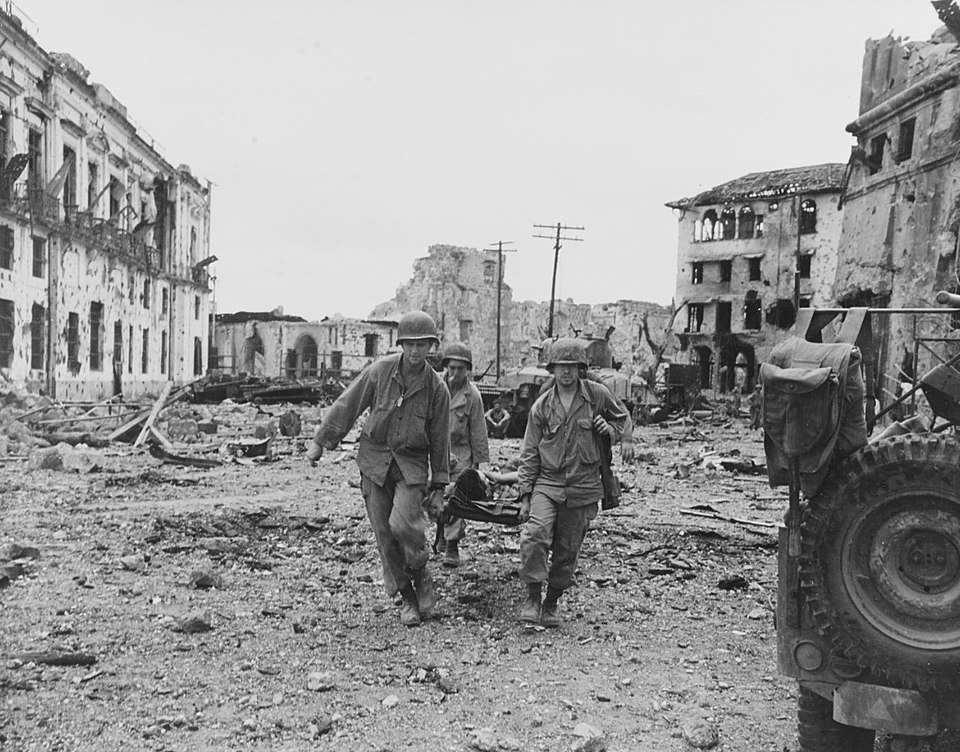

Eighty one years ago, on February 3, 1945, the Battle for the Liberation of Manila began. It was the only urban battle of the Pacific War and it raged for one month, ending on March 3, 1945. It left the southern half of the capital city completely devastated. Tens of thousands of civilians were killed of whom many were victims of massacres perpetrated by the Japanese. One thousand American soldiers were also killed together with an undetermined number of Filipino guerrillas. The Japanese garrison of 16,000 men was wiped out with a few managing to escape to the mountains east of Manila.
The battle remains controversial due to the excessive loss of civilian life as well as the destruction it caused. It made Manila the second most devastated Allied capital city after Warsaw in Poland during the Second World War. Intramuros, the huge government buildings adjacent to it, the districts of Malate, Ermita, and Paco, were places where most of the heavy fighting was concentrated in. The specific controversial issues surrounding the battle are the following:
- Was it a necessary battle?
- Could the city have been bypassed to save the residents from the horrors of urban fighting and massacres?
- Was the use of artillery by the Americans done in an indiscriminate manner?
- Did the strategy by the Americans of cutting off the Japanese from escape to the east result in the enemy choosing to fight to the death?
- Was the Japanese commander a deranged fanatic?
- Were the massacres a result of Japanese desperation?
- The number of civilian casualties.
To answer the first question of it being a necessary one has to understand the nature of the Pacific War and in the manner in which it was fought. It was an inherently amphibious style of warfare wherein the securing of islands and bases that would facilitate the next stage of the advance was its dominant feature. The thing with the Philippines was that it was going to be utilized by the Allied forces as the major staging area for the eventual invasion of Imperial Japan. To achieve that objective, facilities had to be secured in the Commonwealth and Manila was and still is host to the most developed port in the entire archipelago. In addition to that, a number of airfields were located at the approaches to Manila and around the city itself. The presence of the Port of Manila all but made the battle inevitable. That is why the Americans wanted Manila and why the Japanese heavily defended it to deny it from the Allies and to delay their enemy’s next advance.
The existence of the port and airfields also answers the second question if the city could be bypassed. It could not and if it remained in the hands of the Japanese, then the enemy could harass and interdict any Allied movements with the considerable artillery that they had within Manila. Furthermore, bypassing Manila meant the starvation of the almost a million residents there who were already as early as the latter half of 1944 already dying from hunger and malnutrition. It would also not spare the residents from massacres, because the Japanese would slaughter them to lessen competition for dwindling food and water resources.
On the third question regarding the use of artillery as being indiscriminate, the answer is that it was a case to case basis. Oftentimes, the Americans had spotter planes flying over the city looking for targets and once located, artillery would be brought to bear. If civilians were spotted, that might affect the directive to fire on the target. However, even if care was exercised, artillery in the 1940s was subjected to all the technical vagaries of that period which could be erratic trajectory, defective ordnance, and mistakes in calculation. Given the densely populated city and that the Japanese also took civilians as human shields, casualties would surely occur when artillery was used. Naturally, if care was not exercised then even larger civilian casualties would occur. Of all the churches in Intramuros, only that of San Agustin remained fairly intact precisely because it was being used by civilians as a refuge from the fighting and was spared from artillery strikes by the Americans. In connection with the controversy on the very heavy use of artillery, there is also the accusation that the Americans carpet bombed Manila. Usually the term carpet bombing is identified with bombardment by aircraft and on that matter, Field Marshal Douglas MacArthur forbade the use of aircraft in combat roles over the city. However, such was the heavy use of artillery that the devastation was the same as had aircraft been used. Lastly, the Japanese also were responsible for the destruction since early in the battle, they resorted to torching buildings and residential areas to slow the advance of the Filipino and American forces as well as to create clearer and unobstructed fields of fire.
Did the sealing off of the city cause the Japanese to become desperate as they were deprived of an avenue of escape? This fourth controversy does not have an easy answer because it assumes that the Japanese would withdraw. However when there were gaps in the enemy line, the Japanese troops also had a tendency to infiltrate reinforcements. Had the Americans provided an avenue of escape, then the Japanese may have prolonged the battle by infiltrating fresh troops at night into Manila while extricating the wounded. At the foothills and mountains east of the capital city lurked a Japanese force of an estimated 70,000 men which could have provided those very reinforcements to the garrison in Manila.
On the fifth controversy on the mental stability of the Japanese commander, there is a fundamental misreading done of the characteristics of the Imperial military in the decades following the battle. Rear Admiral Sanji Iwabuchi, the commander of the Manila garrison was not an insane individual but one who totally understood the assignment which was to deprive the use of the city and its facilities to the Americans. He was after all a naval commander and he understood the principles of amphibious warfare and the value of ports. He also harbored no illusions about his motley array of troops ranging from crack naval and regular army troops to miscellaneous military personnel of doubtful quality. Altogether, this force was ideally suited for fixed static defense and not for maneuver warfare. Iwabuchi was not a renegade commander because he answered directly to Lieutenant General Shizuo Yokoyama of the Imperial Japanese Army and commander of the Shimbu Army Group that was based east of Manila. Iwabuchi’s mission to defend the city was borne out of coordination with his army counterparts in numerous army/navy planning conferences prior to the battle. In fact, the army assigned to Iwabuchi several battalions that fought in different locations in the city.
The sixth issue which pertains to the massacres of civilians, as these were not the actions of a desperate and crazed Japanese garrison, but one that saw brutal and inhuman methods as an integral part of military operations. With regard to Manila, the elimination of civilians was seen by the Japanese as a way to secure their rear areas from guerrillas and their sympathizers and as had been already mentioned, to eliminate competition for dwindling food and water resources. For the Imperial Japanese military, there were no innocents. Everyone was suspected of being part of the resistance. Hence in the tallies of killings that appear in some Japanese reports, civilians are simply identified as guerrillas. After all, even before the battle began, the Japanese were already killing large numbers of Filipino residents of Manila that they suspected of being guerrillas.
On the matter of civilian deaths in the battle brought about by massacres or artillery and other causes, the number often quoted is 100,000 out of a population of approximately one million. It is a number that was cited after the war and widely supported by many survivors of the battle even though the accurate determination of the dead and missing were subject to the chaos of war and the confusion of the immediate postwar period. There was an attempt in the mid-1990s by survivors of the battle to compile a list of recorded civilian deaths that were sourced out of the Japanese War Crimes Trial records located at the Philippine National Archives and in personal testimonies. The list reached approximately 4,000 plus names of which majority were victims of massacres perpetrated by the Japanese. Some historians have reasonably questioned the accuracy of the 100,000 number not through any desire to besmirch the memory of the civilians who lost their lives, but as part of their scholarly responsibility that historical findings should as much as possible be determined by academic standards.
Every February, commemorations are held at the Memorare Manila Monument to the battle located at Intramuros by Filipinos and members of the diplomatic corps to remember the civilian victims of the battle as well as to announce the shared commitments to freedom and democracy. Unfortunately, eighty one years after the historical event, it appears that the world still has not taken to heart the tragedies experienced during the Battle for the Liberation of Manila or even the Second World War as a whole. As an example, Ukrainian cities are bombarded daily by Russia killing scores of innocents. Russian soldiers sadistically hunt down Ukrainian civilians with drones in violation of all conventions of warfare. Once again, fascism is rearing its ugly head, and this time around it is ironically making inroads into the United States of America. Meanwhile, Communist China has aped Imperial Japan and has introduced its own modern version of the Greater East Asia Co Prosperity Sphere through its First and Second Island Chain territorial ambitions. Is the world heading towards another global conflagration? Hopefully not, because if so, the one after that will be fought with sticks and stones.