

It was Sept. 19, a sunny Saturday morning, a rarity in this monsoon season, when Red Constantino talked about history at the Constantino Foundation before the start of Diktador!
History is everywhere, Constantino said, and raised the metaphor of a forest with the dead leaves “reincarnating” into a new forest. He went on to say that people never remember why there was opposition to martial law and why it’s important to remember, and that resistance doesn’t necessarily begin with “big organized forces” but with individuals from below.
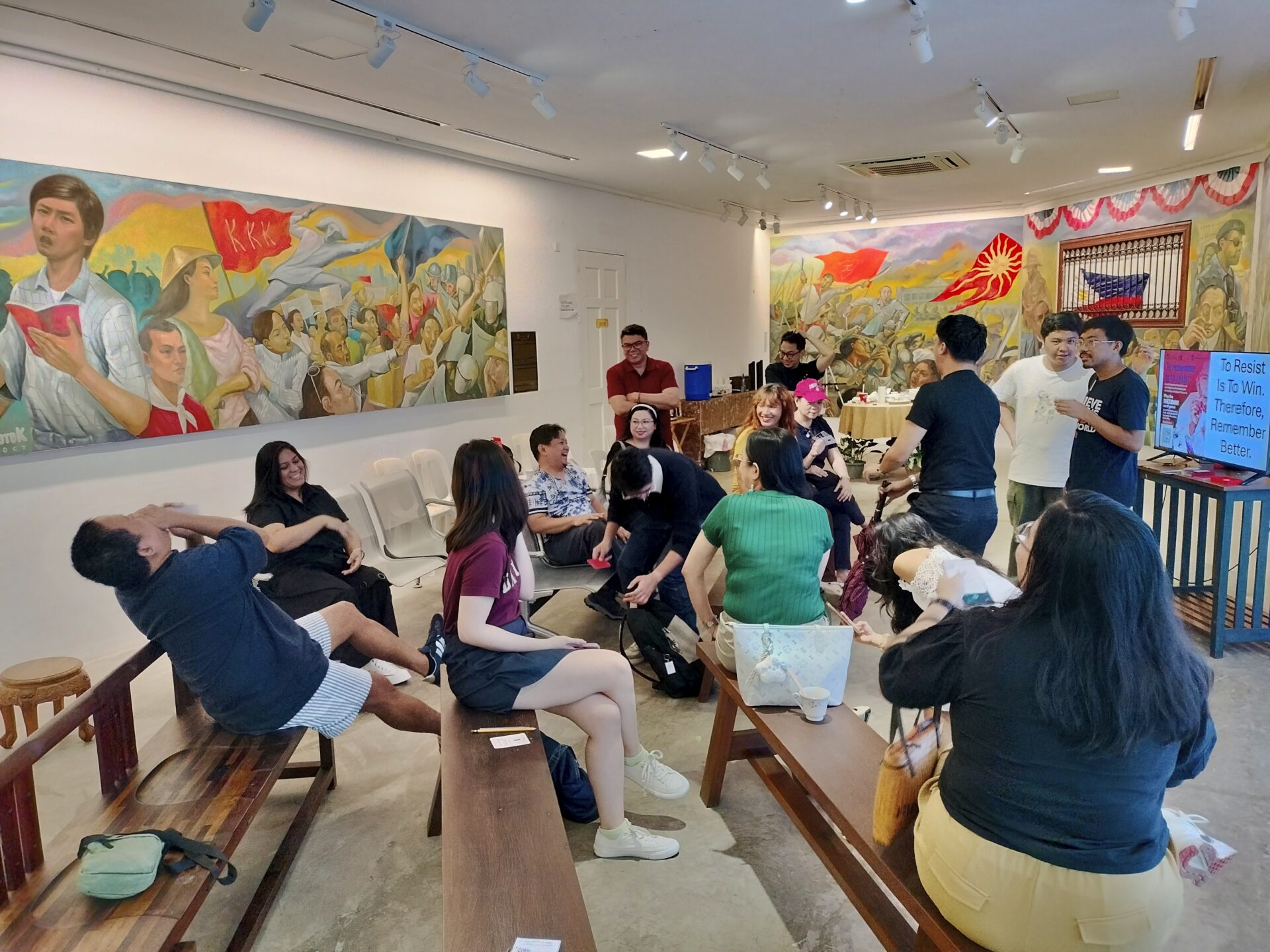
The scene was on Panay Avenue, Quezon City, where the Constantino Foundation (of which is the director) is headquartered. The members of his audience were to play the game of Diktador!; the match was organized by the foundation, Project Gunita, and Renacimiento Manila. The collaboration, on hindsight, portended a forest flourishing as newer trees grew along with remembrance and resistance.
Players of Diktador! impersonate characters who fought with the enemy, collaborated with it, or got caught in between during martial law. The game was developed by Project Gunita cofounder Josiah David Quising in collaboration with the Concerned Artists of the Philippines (CAP).
Group 2

Game master Quising told the players that Diktador! is a data-based recollection of Philippine history, and that the Sept. 19 game date was a serendipitous commemoration of the 39th anniversary of the killing of student leader and political activist Lean Alejandro.
“Lean was killed during the Cory Aquino administration [so] it’s a myth to say that martial law was finished after Edsa 1. Human rights violations still occurred after,” said Quising, who practices human rights and environmental law.
“Diktador! is focused on martial law because it isn’t discussed in schools. It fills the big educational gap, [as] it’s important to [make people] see that the oppression prevalent during the Spanish time continued,” he added.
Starting the game, Quising instructed the 16 players to count off from one to seven, resulting in two groups with three members each and the rest with two. I was in Group 2 with Kala Constantino, the Southeast Asia program director for the Tara Climate Foundation, and Clarice Adeva, a museum researcher at the Human Rights Violations Victims’ Memorial Commission (HRVVMC).
Before proceeding, Quising clarified his role as game master-dictator: “I’m not [Ferdinand] Marcos Sr.. I am martial law.”
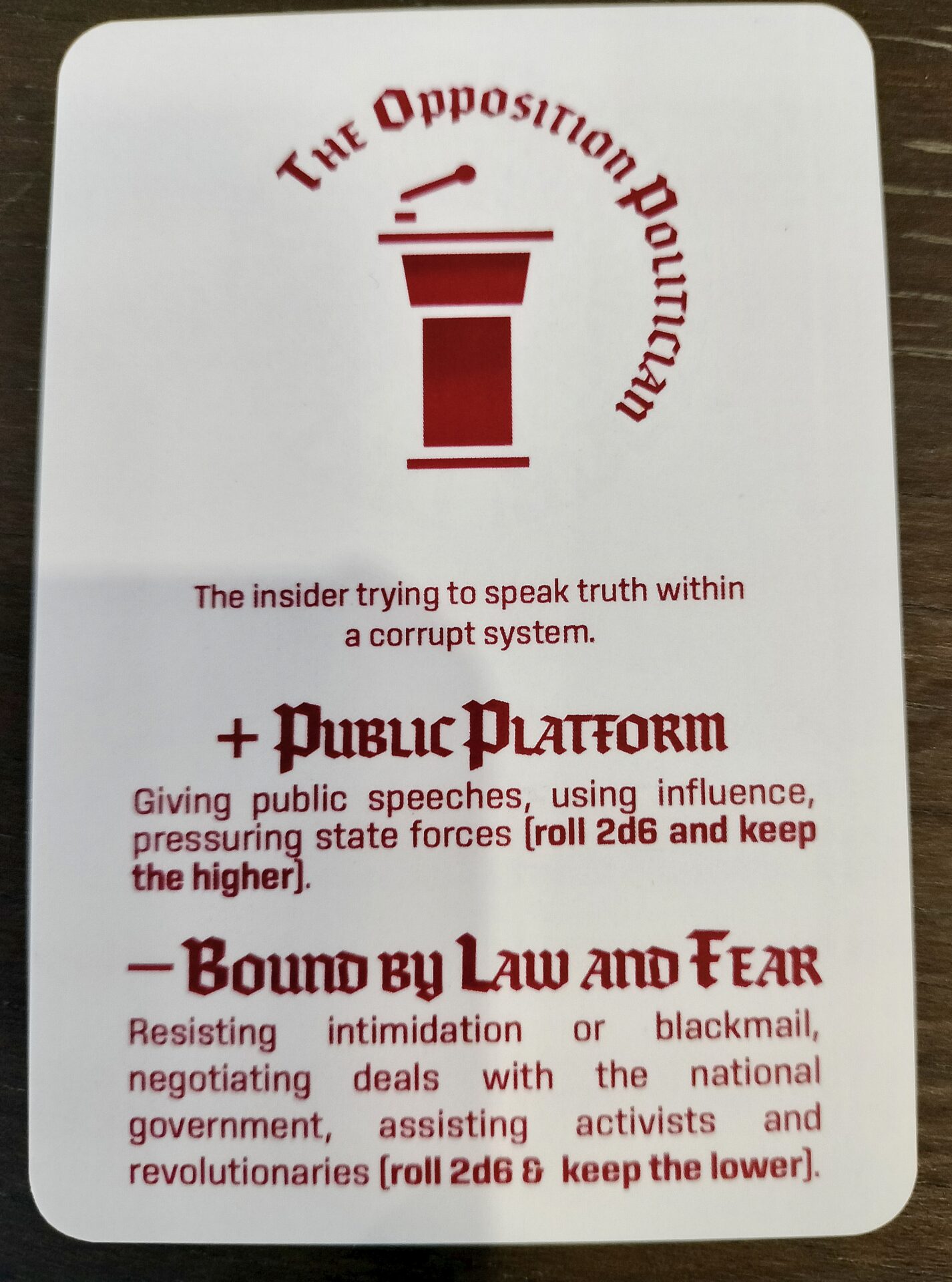
Each group drew an archetypal character card. My group got The Opposition Politician, speaker of truth within a corrupt system, and named her Sen. Lisa, who gives public speeches, uses her influence, and exerts pressure on state forces. The other groups became student journalists (Group 1); business owner (aka sugar baron) Abanseño (Group 3); revolutionaries Ka Usman, Ka Rodrigo, and Ka Pao of the National Christmas Party (Group 4); a group of workers led by Dominador Segundo Sr. (Group 5); religious leaders led by Sister Stella (Group 6); and lawyers (Group 7).
Game on
My group mates and I were first-time players prodded by curiosity. Kala wondered how a game on martial law could be done, and if it could be fun. She later wrote in Messenger: “I was also intrigued that it was inspired by Dungeons and Dragons [D&D], as Luna, [my daughter], is currently playing it with a group of friends, which was a pleasant surprise. I thought the new generation was not into D&D.”
Clarice had been keen on playing since learning of Diktador! “All of us in our division at [HRVVMC] were very curious,” she wrote in an email interview. “A few martial law survivors we engaged with had already mentioned it as well. [And] I wanted to see if we could incorporate the game into our office projects next year.”
We three balked at the thought of acting out a character in front of the others, but no one was against joining another round. The game wasn’t unnerving although Clarice said she was confused at the start after hearing the “dictator” say everyone would learn as they went along. The introvert in her didn’t like not knowing if she needed to prepare for anything: “I knew it was a role-playing game but I wasn’t sure if actual role-playing was required,” she said. Later, she found herself enjoying the game’s flexibility, strategizing, and hearing the other characters’ decisions and actions.
Kala pointed out how it brought out the participants’ playfulness and humor, which, for her, was a refreshing take on imagining and talking about martial law. “[But] Diktador! never lets you forget the seriousness of the situation as the different roles force you to think about implications and actions needed to address a specific context during the martial law years,” she said.
Eureka!
Quising’s idea for Diktador! came after playing D&D at last year’s Board Game Expo in Quezon City. In an email interview, he said he found D&D interesting, particularly how players immersed themselves in a different world through imagination and prompts. Taking notes from D&D, Cluedo, and Werewolf — the other game inspirations — he envisioned a game with people role-playing different characters during a dictatorship.
A martial law role-playing game isn’t a novelty. There’s Lipunan (another inspiration) by the Ateneo Martial Law Museum, but it’s a classroom-based activity and contrasted with Quising’s concept of a game played by anyone outside of a classroom and with a simpler gameplay.
Quising worked on Diktador! from August 2025 to February 2026, determined to launch it on the 40th anniversary of the People Power Revolution last Feb. 25. The six-month period included play-testing it among activists, martial law survivors, teachers, historians, students, and board game enthusiasts. The first private play test was done with activists in Iloilo in September 2025; the first public play test was in Baguio City with St. Louis University (SLU) students a month later
Collaboration with CAP came after play-testing with SLU, and Quising needed someone to do the game’s brand colors and art design. He turned to Toby Giongco, also from Project Gunita, for help with the website design and game development.Diktador! was launched last March. The first of the martial law survivors to play were Prof. Judy Taguiwalo and Adora Faye de Vera.
Highs and lows
Game designing sounds easy, but much work is required particularly to secure capable, reliable suppliers. Quising admitted in his email that this phase was very difficult: It took him two months to find a supplier with a “good deal for great quality” printing of the cards and tuck box.
Quising’s workload also included testing the game’s colors, font and size. The first players found the cards too small, the font difficult to read, and the color too dark, which sent him back to the drawing board. Adding to the pressure was his being the de facto game master, who, I noted, must be quick-witted. Quising said it was mentally exhausting, requiring him to actively think of responses to each of the scenarios that players come up with.
“It’s like doing an educational improv for one to two hours straight,” he said.
Not that Quising’s complaining. In fact, he’s thrilled that people of different backgrounds come together, enjoy the game, and learn from each other. He said the best game nights are those with martial law survivors, young professionals, and students because the former endeavor to tell their stories to the younger participants as they play.
Campaign rounds

The game’s foundation rests on the campaign card the “dictator” picks. For our session, Quising selected Negros famine and militarization, the game’s fourth campaign; the players mulled over resistance, survival, solidarity, and injustice when the enemy was hunger and fear. All the campaigns — i.e., declaration of martial law (#1), Chico River Dam project (#2), and burning of Jolo (#3) — are based on real-life events from the Philippine experience.
Quising read the facts from the campaign card: Thousands of people faced hunger, malnutrition, and death during the severe famine that plagued Negros island in the later years of martial law because of state neglect, land monopolies, and collapse of the sugar industry. The military responded with surveillance, arrests, and disappearances when farm workers and church groups, who were tagged as insurgents, organized relief kitchens and protests. And when the sugar workers and residents gathered at Escalante, Negros Occidental, to protest hunger, unemployment, and repression on Sept. 20, 1985, military forces opened fire on the crowd, resulting in the tragedy known as the Escalante Massacre.
Each campaign has five situations for players to go through. The game starts when the “dictator” asks each group what their response/action would be to the situations described on the card. Round 1 — Sweet Promises, Bitter Harvest detailed the sugar prices collapsing, plantation workers laid off, and hunger spreading across rural communities in Negros.
In Round 2 — Hunger and Organizing, farm workers and church groups organized relief kitchens and protests because thousands of Negrenses were suffering from severe malnutrition by the 1980s.
Kala, Clarice, and I said Sen. Lisa gave public speeches regularly to raise public awareness on the famine and militarization, and constantly called for the government’s accountability. Group 3’s sugar baron sent relief packages to the Negrenses.
In Round 3’s Guns Over Grain, the military started surveilling organizers they tagged as insurgents, and met mass protests and strikes with harassment and forced disappearances. Against this backdrop, Group 3 tried smuggling grains to the Negrenses, but failed.
In Round 4 — Breaking the Silence, journalists, church leaders, and international observers exposed the famine which the regime denied and blamed on “economic forces” and the rebels. For this round, with the game allowing mergers, Sen. Lisa joined the student journalists, revolutionaries, Sister Stella and her Muslim co-religious leader, and lawyers in bringing the famine to light while clamoring for the government’s liability.
The “dictator” skipped Round 5 — Fields of Memory due to lack of time. Decisions and actions would have centered on poverty becoming a weapon of repression.
‘Kasaysayan’
The success of a group’s action depends on the dice roll and the Kasaysayan cards drawn, which contain the Arrest/Surveillance card that makes or breaks a group or groups. To get the rounds described above started, each group picks a Kasaysayan card, but if a group gets an Arrest/Surveillance card, the game turns its focus on the card’s situation until its resolution. In that game-within-a-game, each group rolls the dice and, depending on the number the “dictator” sets to rate an action successful, a group’s turn can be forfeited for one round or totally eliminated from the game.
Arrest/Surveillance cards test the group’s moral fiber and principles. The National Christmas Party (Group 4) had everyone laughing because of their internal quibble: One member wanted another group arrested, which a group member countered, saying it was against the party’s scruples.
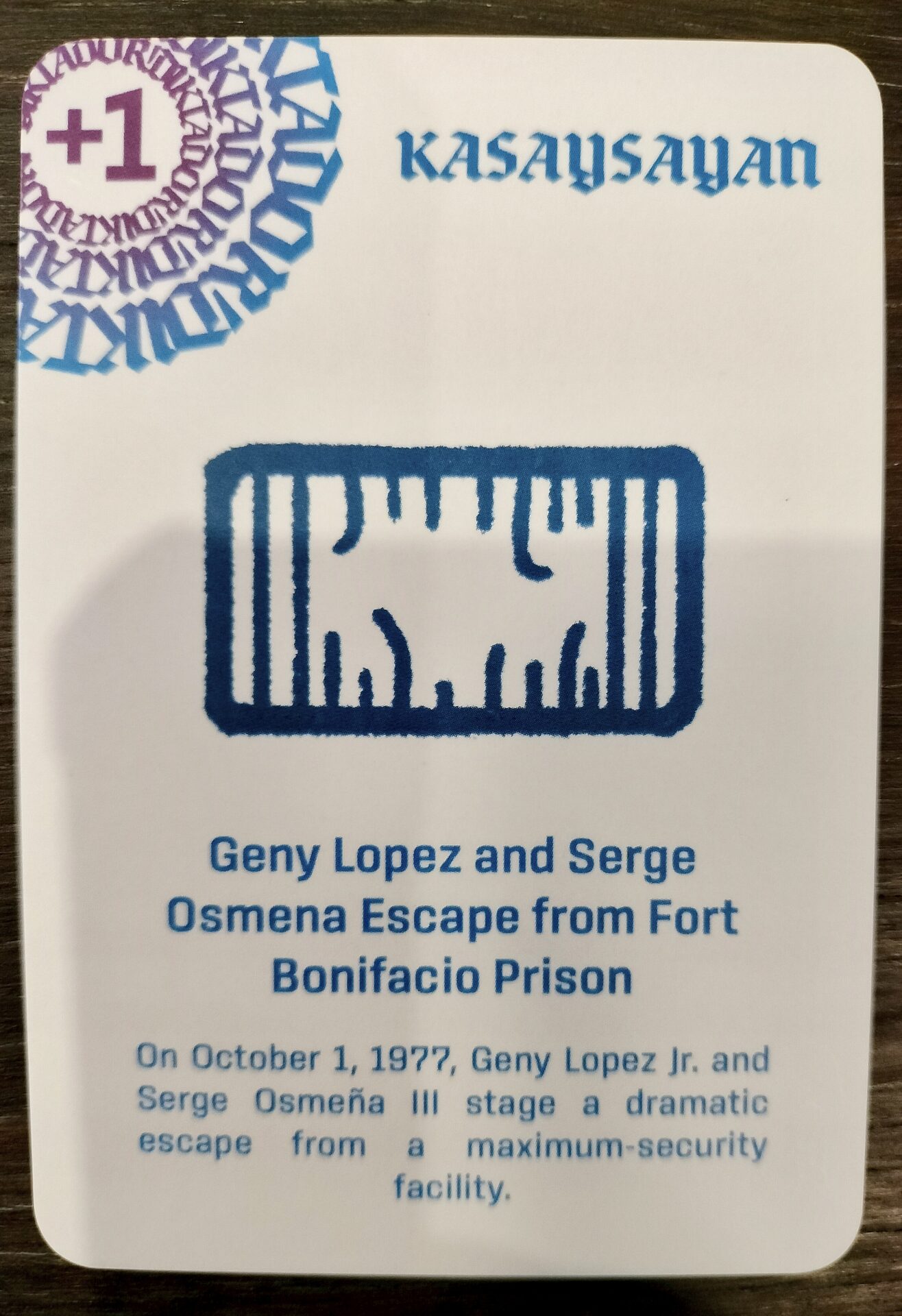
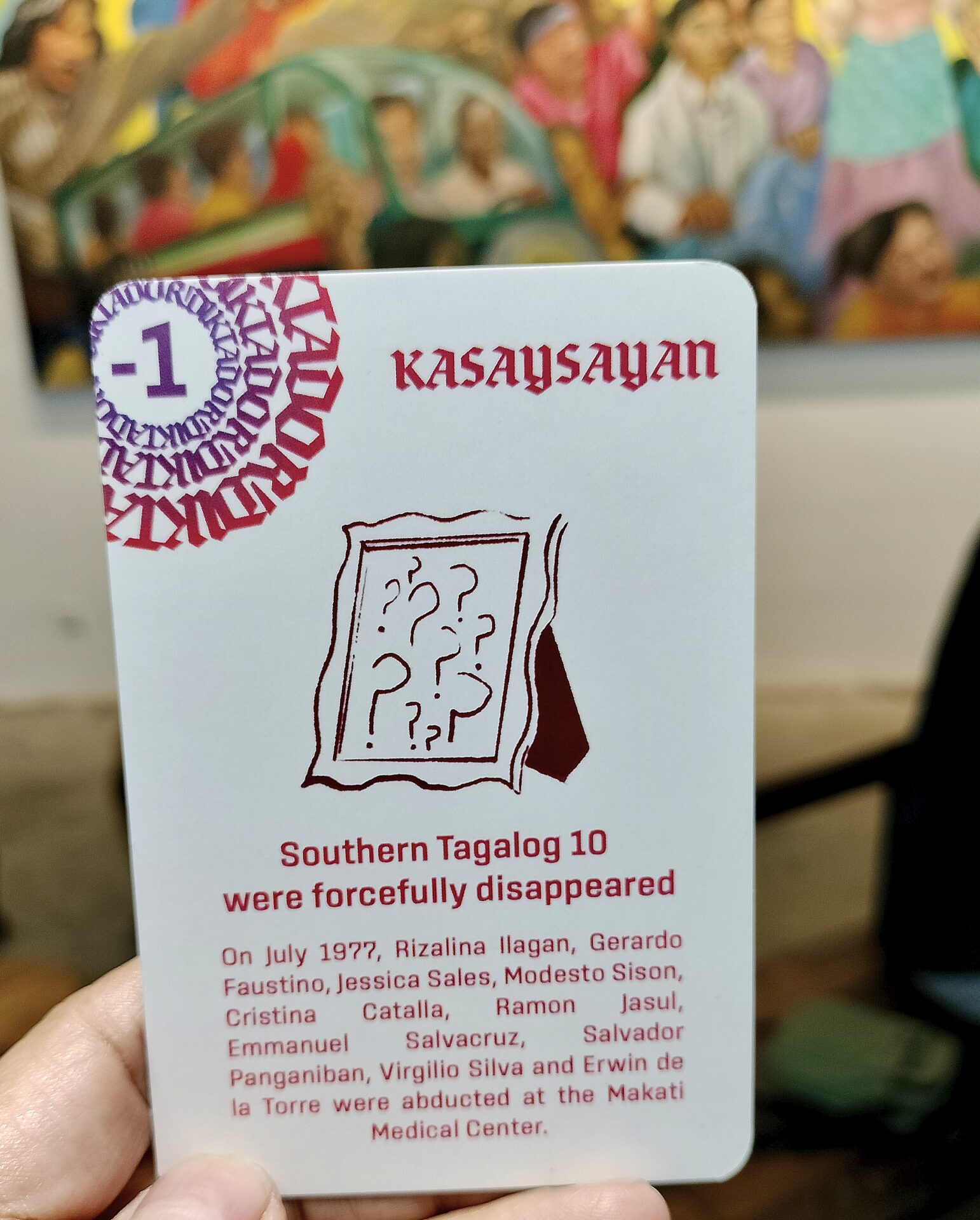
Apart from functioning as mini lessons on martial law, the Kasaysayan cards save groups by increasing the number — printed on the upper left-hand corner — when their dice roll is low. My group’s Kasaysayan cards were Geny Lopez and Serge Osmeña III’s escape from Fort Bonifacio prison on Oct. 1, 1977 (with +1); the 1975 strike of the workers of distillery and liquor producer La Tondeña (now Ginebra San Miguel, Inc.) (with +1); and the forced disappearance of the Southern Tagalog 10 from Makati Medical Center in July 1977 (with -1).
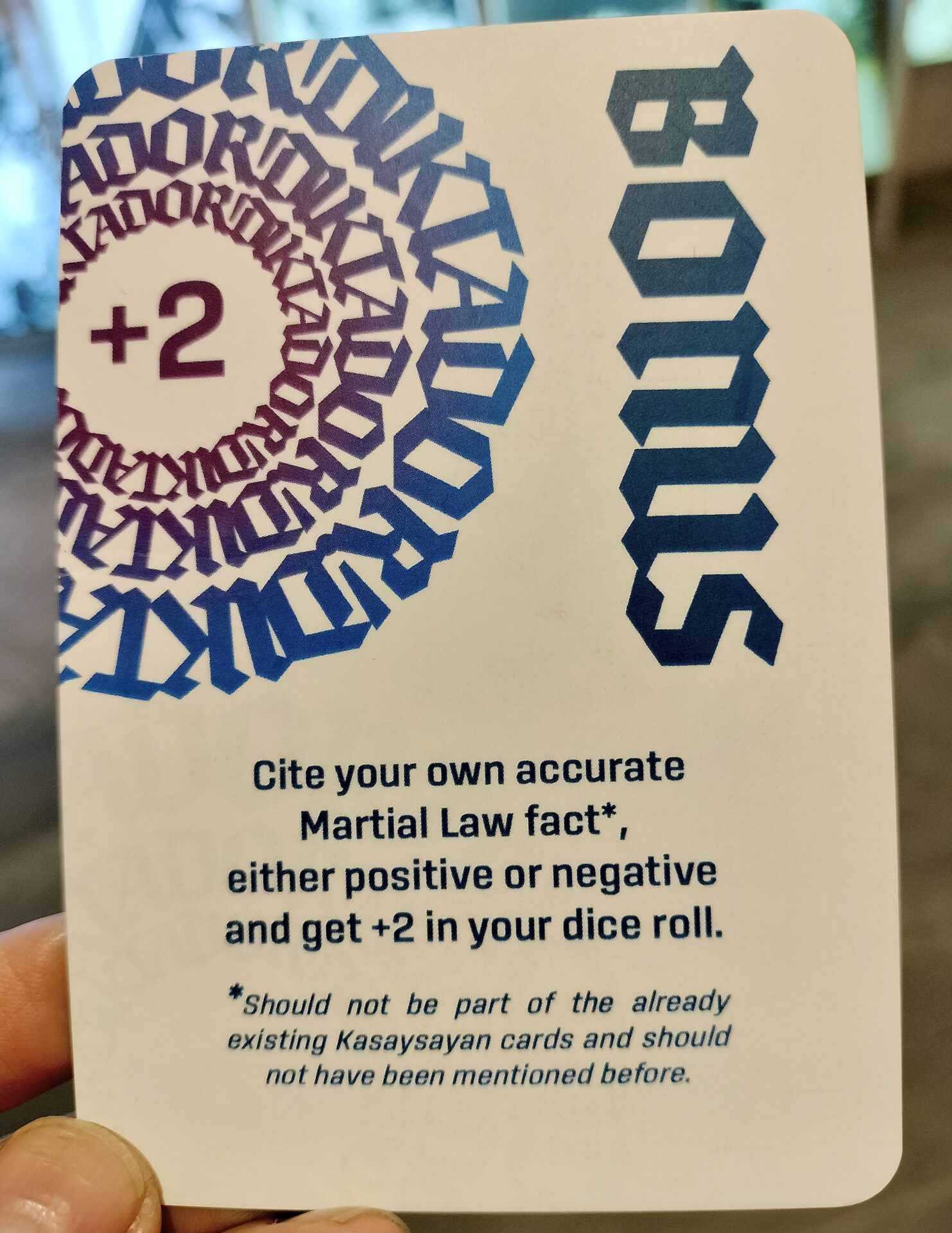
Group 3 got a bonus Kasaysayan card (with +2) and had to give an accurate (positive or negative) martial law fact not yet mentioned in the game or printed on any Kasaysayan card.
History lessons
Diktador! comes at an opportune time when historical revisionism in the Philippines continuously distorts established facts and atrocities. Grounded on Philippine reality, it challenges revisionism without being boring. It’s a fun, cerebral game encouraging discussion and learning of history that’s downplayed as irrelevant. It’s the missing history class coupled with critical thinking because players constantly react and respond to decisions and actions made.
Significantly, the game has become an indispensable tool in teaching Filipinos about our history. The Philippine Daily Inquirer reported that activists in Baguio City used Diktador! to revisit martial law and the indigenous resistance in the Cordillera. Former martial law detainee and survivor Joanna Cariño facilitated the session at Luisa’s café that focused on the game’s second campaign — the Chico River dam project and the assassination of Kalinga leader Macli-ing Dulag in April 1980. Dulag opposed the government-backed project that threatened to displace the indigenous communities.
Ultimately, Diktador! attempts to open Filipinos’ minds to what Jose Rizal wrote in the final chapter of El Filibusterismo: “There can be no tyrants where there are no slaves.”
Visit https://diktador.cards to preorder Diktador! and follow @diktadorcardgame2026 on Instagram for updates.