
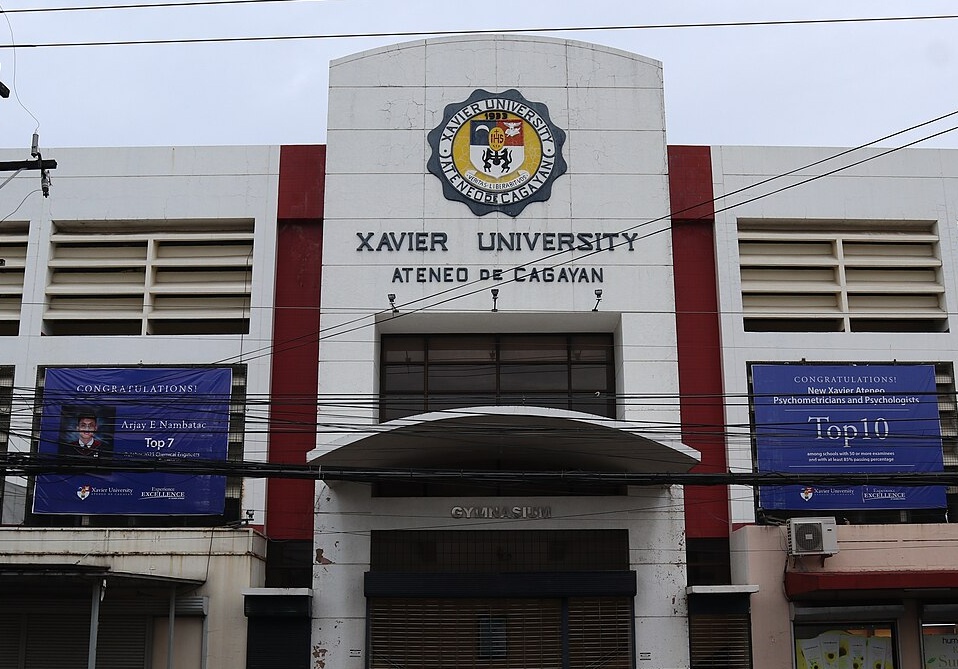
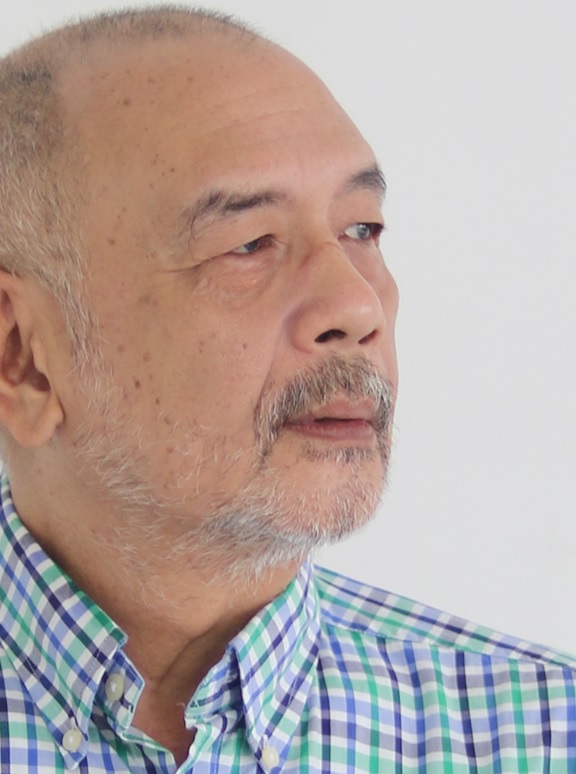
Let me begin with a disclaimer: The facts of this issue are first-hand to me as an active member since 2019 of the Cagayan de Oro Parents, Teachers, Alumni and Community (COPTAC) against the sale of two campuses of Xavier University Ateneo de Cagayan. I was also a professor in the university’s School of Graduate Studies until I left for Spain in 2018.
The historical prelude is essential.
The Ateneo de Cagayan was founded in 1933 by an American Jesuit missionary who became the first bishop of the Diocese of Cagayan, James T. G. Hayes SJ. It became a university in 1958 as the first of all Ateneos in the Philippines to become a university, the first university in all of Mindanao, and the first Catholic university in Mindanao. Those three distinctions will hopefully be honored in 2033 by the National Historical Commission of the Philippines with a national marker of fabricated steel to commemorate the university’s centenary.
In 1933, Bishop Hayes opened the Ateneo after the couple Zosimo and Conchita Roa Roa donated their 2-storey residence to the Diocese. At that time, the site was strategic. Across the Ateneo was the first bishop’s palace in old Cagayan de Misamis that Hayes had rented from the couple Pio Roa y Alcala and his wife Soledad Corrales Roa Roa (Mrs. Conchita Roa’s parents). When Hayes had finally built a more permanent bishop’s house beside the old 1845 coral stone church that had become a cathedral, the Ateneo had to find better lodgings. Thus the donated Roa Roa house was turned over to the sisters of the Religious of the Virgin Mary.
Hayes had wanted stability. On a nine-hectare lot acquired through donation and purchase, he transferred the Ateneo to a new downtown campus in 1935. Money for purchase was sourced from American alms donated to the Jesuit Seminary and Mission Bureau at 51 East 83rd Street in New York City. In June 1934, he had sent Fr. Joseph Lucas SJ, rector of the Ateneo, on a begging trip to the US. In 1939, the Diocese of Cagayan donated this property to the Society of Jesus. The Austrian Wlodimir Ledóchowski, the Jesuit General then, accepted the donation in 1940. The Ateneo de Cagayan was officially in Jesuit hands.
A huge complex of a building housing classrooms and administrative offices was also built from these donations and later renamed Lucas Hall in memory of its beggar and builder. This is the building pockmarked by Japanese bullet fire and survived World War II that still stands today. It was a Japanese concentration camp in World War II.
In the interregnum, there were leading events.
William Francis Masterson SJ
In 1953, a towering American Jesuit was assigned to the Ateneo de Cagayan. He had just completed his task of serving as rector of the Ateneo de Manila where he presided over the transfer of its campus from Padre Faura in Manila to a knoll overlooking the Marikina Valley in Quezon City. Prior to his Philippine assignment, William Francis Masterson SJ was charged with the Jesuit Philippine Bureau in New York to raise funds for the postwar rebuilding of educational facilities in the Philippines.
But for that transfer to Loyola Heights of the Ateneo de Manila, Masterson was heavily bashed (“A jungle fit only for the children of Tarzan!” cried many parents and some fellow Jesuits). It has been said that that was the reason why Masterson was banished to Cagayan de Oro.
The Masterson story continued to unfold.
First, Ateneo de Manila (a university since 1959, one year after Ateneo de Cagayan), made up for its misgivings against him. In 1967, it awarded him an honorary Doctor of Humane Letters. Masterson was to stand alongside later Doctors of Humane Letters: Jaime Cardinal Sin (1980), Lorenzo M. Tañada (1983), Cory Aquino (1983), Claudio Teehankee (1983), Bishop Antonio Fortich (1988), Ricardo Cardinal Vidal (1993), et al.
In Ateneo de Cagayan, Masterson opened the College of Agriculture. There were no local faculty to teach the course. He enticed graduates of the University of the Philippines at Los Baños to teach in Mindanao. Masterson’s first faculty imports would later establish roots in Cagayan de Oro as respectable leaders of industry.
Yet the Masterson vision mission was not over as yet.
In 1964, he opened the Southeast Asia Rural Social Leadership Institute (Searsolin) on the same rocky hill overlooking Cagayan de Oro. It was here in this 64 hectares that he had opened the Manresa Farm as field laboratory for the agriculture college. For Searsolin, the multi level edifice was built from funds of Misereor of the German Bishops Conference. What was his vision here? It was to teach Asian rural leaders to give back to their communities.
Each year, 50 rural leaders from Asia were given intensive training for eight months in applied agriculture and farmer organization. Each year they came from Indonesia, Cambodia, Laos, Korea, Malaysia, Macau, Sri Lanka, Micronesia, Oceania, Taiwan, Thailand and Vietnam.

It was for his achievement in international rural leadership that in 1974, Masterson was honored with the Ramon Magsaysay Award for International Understanding. The citation predicated why he deserved the accolade of Asia’s Nobel Prize:
Rapid urbanization, occurring on every land today in Asia, drains from the countryside many of the energetic, able and ambitious young. Even most graduates from agricultural colleges do not go back to live on the land and apply their talents to its problems and potential. Rather they seek employment in government bureaus and private business. Rural villages, meanwhile, seem to stagnate.
In electing Rev. Fr. WILLIAM FRANCIS MASTERSON to receive the 1974 Ramon Magsaysay Award for International Understanding, the Board of Trustees recognizes his multinational education and inspiration of rural leaders prompting their return to and love of the land.
The land that he had called Manresa – after the town in Catalunia, Spain where Ignatius of Loyola spent hours in prayer and penance in a rock shelter overlooking the river Cardoner – was all of 64 hectares and overlooked the city and the Cagayan River. Today, it faces an uptown mixed use business district called Pueblo de Oro and directly across it is SM City Cagayan de Oro.
The shocking news that can overturn all these histories was yet to come.
Purchase by Cebu Landmasters Inc.
About the last half of 2019, the then president of Xavier U Ateneo Fr. Roberto Yap SJ (the present president of Ateneo de Manila U), announced that the property development company Cebu Landmasters Inc. (CLI) will buy about 4 hectares of the downtown campus for the price of P3.5 billion. It will also buy 14.3 hectares of Manresa and develop it as Manresa Town, a mixed residential-commercial property of high-rise condominiums and hotels.
From the proceeds, Xavier U Ateneo will then develop 21 hectares of Manresa for the new Masterson Campus of the Future. It will then partially abandon the historical downtown campus in Plaza Divisoria.
But experts immediately saw through the ex-deal: it was a fire sale. XU sold the Manresa 14.3 for only 10,000 pesos per square meter when the prevailing market price in uptown Cagayan de Oro is 100,000 pesos per square meter.
COPTAC began its advocacy against the sale on September 18, 2019 when it sent a petition to the current Jesuit superior general in Rome, the Venezuelan Fr. Arturo Sosa Abascal.
Historical Preservation Zone
In September 2021, in my capacity as heritage activist, I wrote a letter to the then chair of the NHCP Board Dr. Rene Escalante. I requested heritage protection for XU Ateneo buildings in the downtown campus that had reached 50 years of age. The Archbishop Emeritus of Cagayan de Oro, Antonio J. Ledesma, himself a Jesuit, endorsed my letter. RA 10066, the National Cultural Heritage Act of 2009, safeguards cultural properties, artifacts, and structures, including historic buildings over 50 years old. The NHCP responded by visiting the campus.
In July 2022, there was a most unexpected announcement from XU:
Xavier University – Ateneo de Cagayan (XU) and the National Historical Commission of the Philippines (NHCP) have jointly agreed to establish a Historical Preservation Zone within the main campus of XU comprising school buildings with “exceptional and historical significance.”
It was enough warning from NHCP that historical buildings cannot be demolished. It also appears to have stopped the sale of the four hectares of the downtown campus to CLI. Until this writing, no sale has been consummated. Only the 14.3 hectares of uptown Manresa was consummated.
Meanwhile, this is how far Manresa Town has progressed as of this writing:
- Earthworks, road networks, and drainage groundwork are underway across the 14.3-hectare mixed-use township in Uptown Cagayan de Oro.
- Access Road Construction: A ₱120-million Manresa Access Road project broke ground in January 2026 and is targeted for completion by late 2027.
- Residential Launches: The first condominium, One Manresa Place, is nearly sold out, and Cebu Landmasters Inc. (CLI) announced the upcoming launch of its second phase/condominium, Two Manresa Place, during the mid-2026 briefing.
The smoking gun
At this point, COPTAC was in search of a crucial question: how did Fr. Masterson acquire the Manresa land for XU? COPTAC did not have the document. One impostor came forward saying his grandfather donated the property but did not have the papers to prove it. Until relentless research by COPTAC and its president, the former XU faculty Dr. Rachel Polestico, uncovered the exact document. Dr. Polestico had found the smoking gun.On May 22, 1956, the Ateneo de Cagayan applied for the Sales Patent of the 64-hectare Manresa property with the Bureau of Lands of the Department of Agriculture and Natural Resources (DANR).
A Sales Patent is an official government grant that gives ownership of a piece of public land to an entity who buys it through an approved sale. Sales Patents are issued under the Public Land Act (Commonwealth Act No. 141). Ateneo’s application was approved on March 26, 1958 by the Secretary of Agriculture and Natural Resources. It paid government the sum of P3,236.05 to acquire all of the 64 hectares comprised of two parcels (Lot No. 3086 15.3513 hectares and Lot No. 3087 49.3698 hectares, Cadastral 237). The DANR then issued an Original Certificate of Title (OCT No. 126) to Ateneo de Cagayan on December 9, 1959.
In the Order of Award and Issuance of Patent to Ateneo de Cagayan, the DANR was explicit on the condition: that the application was “for educational purposes,” and that the sale thereof to the applicant was “pursuant to the provisions of Section 70 of Commonwealth Act No. 141.” In the OCT, the same condition is repeated verbatim from Section 70.
Why did it cite Section 70? That was because previously in 1952, Republic Act 730 had amended that part of CA 141 pertaining to Sales Patents for residential lands. But it did not amend Section 70: a Sales Patent can be issued “for the purpose of founding a college, school, university or other institutions for educational purpose.”
And then it further states: “it shall be a condition that the purchaser or lessee or their successors shall not sell, transfer, encumber or lease the land for the purposes of speculation or use it for any purpose other than that contemplated in the application.” What was that purpose again? Educational.
The penalty for violating this is severe: immediate rescission of the sale or lease, and forfeiture to the Government of all existing improvements. Obviously, Xavier University, as a research institution of higher learning, did not do due diligence. The same can be said of Cebu Landmasters.
Case now with DENR
COPTAC’s counsel Ralph Angelo Metrillo has filed a case in the office of the Regional Executive Director (RED) of DENR Region 10, as advised by the Office of the Solicitor General.
The RED, Ronald D. Gadot, ruled in favor of XU Ateneo, saying that the transaction between XU Ateneo and CLI “upholds the educational purpose,” and that “the charge of speculation is without basis.” Condominiums and commercial buildings are not speculative? The RED’s decision is open to appealable interpretations. Gadot held no public hearings and his decision was solely office-initiated. For the most part, he was evasive of Section 70 that no subsequent laws have ever repealed.
COPTAC elevated the decision to the Secretary of the DENR on June 26, 2026.
The burning question: in the event the DENR will rescind the Original Certificate of Title – and therefore all improvements therein will be forfeited to government, including Manresa Town and the Masterson Campus of the Future – will Xavier University Ateneo de Cagayan follow the rule of law?
Or will it be, like many of our traditional politicians, a law bender?
The views in this column are those of the author and do not necessarily reflect the views of VERA Files.