

Half an apple, a handful of grapes and exactly six pieces of cookies.
These were what step-sisters Athena Reign Castro, 6, and Zelah Inah Sabas, 9, received from a donor and brought to school in an attempt to “eat healthy” for a day in July. They were to eat this at recess, as instructed by their teachers, in celebration of Nutrition Month.
On most days, however, the two girls each receive no more than a baon of P20 to buy a cup of sopas, champorado or lugaw from their school canteen. But with little remaining of that day’s spending, their mother, 28-year-old Catrina Sabas, believes the fruits-and-cookies snack should be enough.
When asked what they do when they find the food insufficient, Athena said, “Binibigyan po ako ng classmates ko [‘pag gutom pa ako] (My classmates share [food] with me when I’m still hungry).”

In any case, the snack is far from meeting the Food and Nutrition Research Institute’s (FNRI) Pinggang Pinoy framework, which recommends that school-aged children consume a balanced meal consisting of rice, meat, fruits and vegetables to meet their daily nutritional needs.
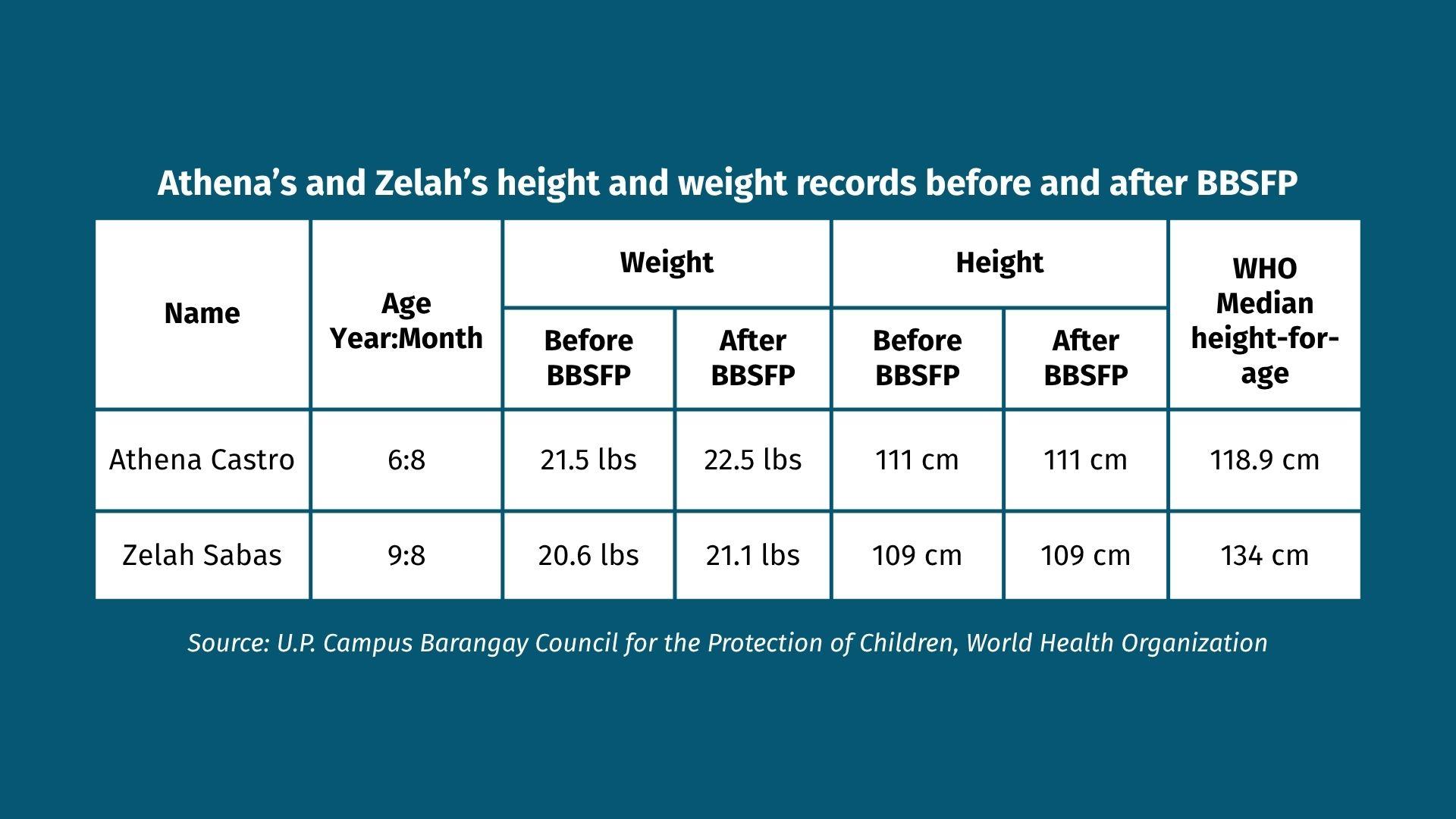
Athena and Zelah have heights of 111 cm and 109 cm, respectively — far below the World Health Organization’s median height-for-age standards, indicating that girls aged 6 and 9 years old should be 118.9 cm and 134 cm tall on average.
This puts them among the millions of Filipino children who suffer from stunting, a condition caused by chronic undernutrition that leaves children too short for their age and can have lifelong consequences on their health and development, according to the WHO.
In the Philippines, the stunting rate for children aged 5 and below had risen to 25.3 percent, marking its first recorded increase since 2015, according to the FNRI, and higher than the global average of 22.3 percent. Meanwhile, 18.9 percent of children between 5 and 10 years old are stunted.
Before the school year, Athena and Zelah had been recipients of the month-long barangay-based supplemental feeding program (BBSFP) at Brgy. U.P. Campus in Quezon City.
Mandated under Republic Act No. 11037 or the Masustansyang Pagkain para sa Batang Pilipino Act, the program provides supplementary meals to nutritionally-at-risk public school children aged 5 to 9. Its goal is to ensure that they are well-nourished during critical stages of growth to prevent issues such as stunting.
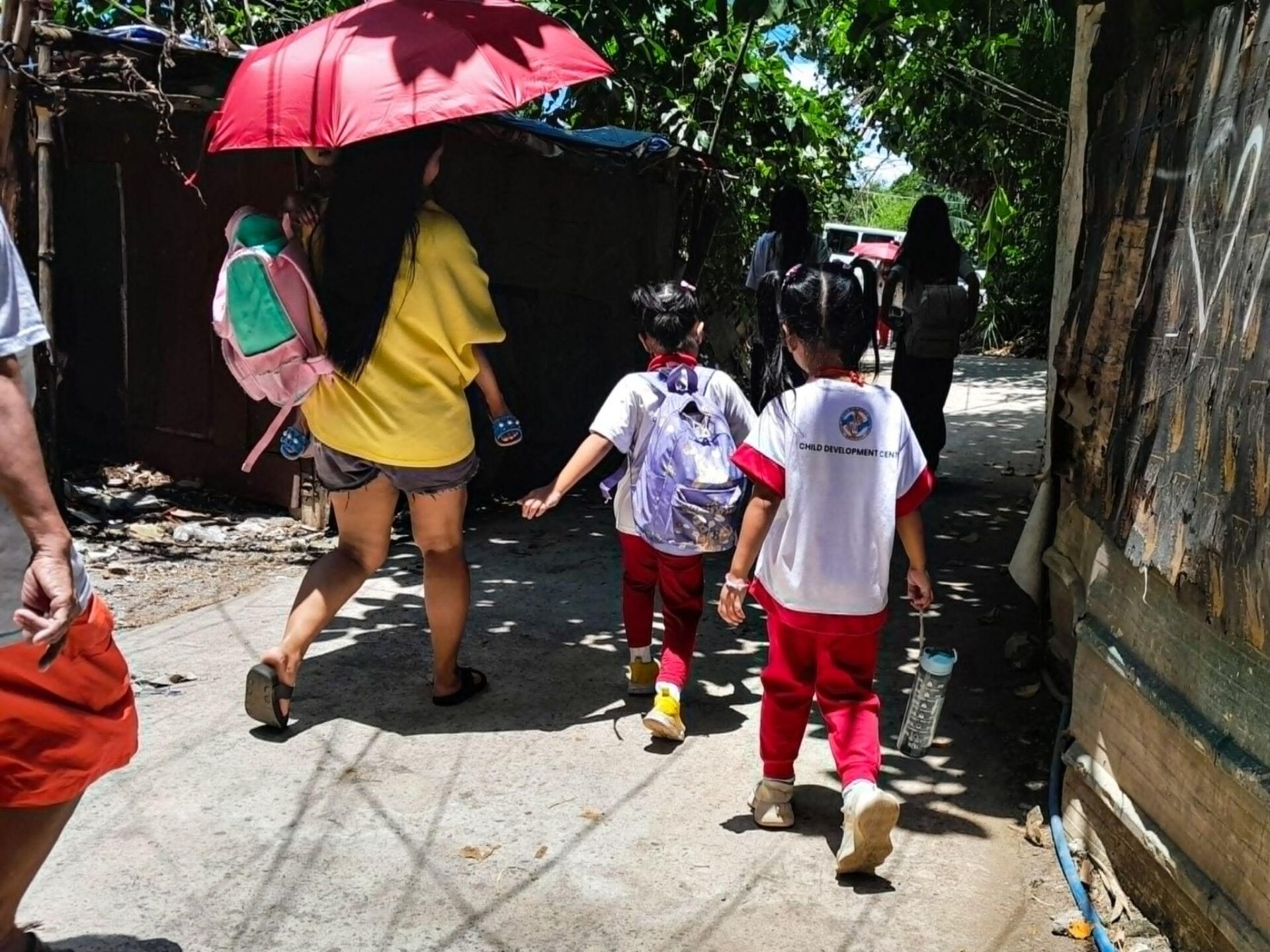
Every day during the program, the step-sisters walked to their barangay hall, where they were served hot meals by members of its nutrition committee.
For Athena and Zelah, it was often the only time in a day that they could eat what they considered a complete meal.
“Mas gusto ko po [‘yung pagkain] do’n. May chicken po pati spaghetti. Dito po, tuyo (I like the food there better. They have chicken and spaghetti. At home, we eat dried fish),” Zelah said.
With the children allowed to eat as much rice and viand as they could, the step-sisters bragged about asking for second, even third, helpings.
“Lahat po kinakain nila, kahit ampalaya. Hindi po sila mapili sa pagkain (They eat everything that’s served, even bitter melon. They aren’t picky eaters),” their mother Catrina said.
But the meals they are given during the feeding program are difficult to sustain once the children are back home.
In their household of nine, including four children, food expenses are stretched across multiple mouths. The family primarily relies on the irregular income of Catrina’s husband, a construction worker, and the financial support occasionally sent by their grandfather, who is estranged from their 60-year-old grandmother, who lives with them.
“Nakikita ko kasi minsan [binibigay ng stepfather nila] P1,500. Tapos iyan [ang] pambili nila ng pagkain sa kanila. Tapos ‘yung sa akin naman po, sa asawa ko, ibinibigay niya sa akin [‘yung] pambayad ng ilaw, tapos ito sa tubig. Pagkatapos ‘yung matitira ibibili ng pagkain nila. Ganoon.
(I see that sometimes their stepfather gives P1,500. That is what they use to buy their food. As for my husband, he gives me the money to pay for electricity and water. Then, whatever is left over is used to buy their food. That’s how it works),” Divina said.
“‘Pag wala pong perang padala ‘yung asawa ko, nangungutang po ako. Tapos binabayaran ko na lang po pag-uwi ng asawa ko (When my husband doesn’t send money, I borrow and pay it back when he comes home),” she added.
The difficulty of sustaining nutritious meals beyond feeding programs has been a recurring concern among low-income families.
VERA Files asked the National Nutrition Council (NNC) what measures they are taking to help nutritionally at-risk children from low-income households maintain healthy diets after school- or barangay-based feeding programs end. The agency had not responded as of press time.
An ‘education issue’
Teachers at the Krus na Ligas Elementary School, also in U.P. Campus, say beyond the apparent low height and weight, the effects of poor nutrition are also evident in education.
Athena’s homeroom teacher, 34-year-old Kathrina Mappala, and Zelah’s teacher, 40-year-old Joyce Saraza, are all too familiar with children arriving at school on empty stomachs.
Classes for Grade 1 students begin at 12:00 p.m., with recess scheduled at 2:30 p.m. Yet, Mappala said some children begin eating as early as an hour into the school day.
“Pagpasok nila sa classroom, una ko talagang tanong, ‘Kumain na ba kayo?’ […] Mayro’n akong batang ala-una pa lang, kumakain na siya. Kasi raw hindi siya gaanong nakakakain no’n mula umaga, eh pumasok na siya ng 12:00. Lunch ‘yan, oh. Kaya nagtataka ako [kung] ba’t nagugutom sila agad
(As soon as they enter the classroom, the first thing I ask is, ‘Have you eaten yet?’ I have one student who starts eating as early as 1 p.m. They told me they barely had anything to eat that morning, even though their classes only begin at noon. That’s already supposed to be their lunchtime, so I wonder why they’re hungry so soon),” she said.
Although Athena and Zelah belong to different sections, both Mappala and Saraza said the sisters exhibit many of the same characteristics they commonly observed among children enrolled in feeding programs.
Mappala described Athena as often appearing “matamlay (lethargic)” and less sociable than many of her classmates.
Saraza, who has been teaching Zelah for two consecutive years now after she was unable to advance to the second grade, said the girl was frequently absent during the previous school year. At times, Zelah told her she did not attend class because she had nothing to eat.
Meanwhile, Saraza has been teaching in the same school for seven years. During that time, she has referred an average of five students to feeding programs every school year, many of whom struggle to stay engaged in class.
“Sa academics, medyo hindi sila nakakasabay sa ngayon. At ang kanilang attention span, pansin ko, short. Mabilis silang ma-distract, ganyan. Tapos ‘pag nagtuturo ako, siyempre ‘di ba nasa harapan ako, makikita ko ‘yong batang tumitingin (at) hindi. Mahirap sila maka-pick-up ng simpleng instructions.
(They struggle to keep up in academics, at least right now. And their attention spans, I’ve noticed, are short. They get distracted easily. When I’m teaching, since I’m standing at the front, I can see kids looking away or not paying attention. They also struggle to pick up simple instructions),” Saraza said.
Citing nutrition experts, the Second Congressional Commission on Education (EDCOM 2) reiterated in its Year 3 report a finding it has consistently raised in 2023 that the connection between nutrition and cognitive function makes stunting an “education issue.”
According to the EDCOM 2 report, “The irreversible neurological damage occurring during the first 1,000 days — from conception through age two — directly impacts learning capacity, with children experiencing stunted growth at age two demonstrating significantly poorer educational outcomes throughout their academic trajectories.”
But teachers can only do so much to fix the issue. For Saraza and Mappala, this is something that must be addressed at home and hard to overstep at school.
“One time may tinanong ako sa kanila, ‘Nagugutom ka ba?’ Kasi minsan maaga ako magpa-recess eh, 2:00. Kasi ‘yung iba, sa gutom nila, natutulog. Ngayon tinatanong ko bakit hindi nakakain kasi panghapon naman ang class. Ang reason no’ng isa, late nagising. Ang reason naman po no’ng isa, walang makain sa bahay. Tas ‘yung isa naman, walang nag-asikaso.
(There was a time I asked them, ‘Are you hungry?’ Sometimes I let them have recess early, at 2 p.m., because some students fall asleep from hunger. So, I asked why they hadn’t eaten, given that their classes are in the afternoon. One child said they woke up late. Another said there was no food at home. Another said there was no one to prepare food for them),” Saraza shared.
“Ang nakakalungkot na reality, dito sa school may consistency, ‘di ba, once na nag-start na ‘yung feeding program. Pag-uwi naman sa bahay, hindi na siya na-a-address. Eh siyempre bahay na ‘yun. Nagkakaroon na rin kami ng limitation sa ganyan. Ang kaya ko lang din ma-handle sa ganyan is tanungin ‘yung bata, ‘di ba, paano na-oorganize ‘yun, paano nagagawan ng paraan ng magulang. Nalilimit talaga
(The sad reality is that once the feeding program starts, there’s consistency here at school. But when they go home, those needs are no longer addressed. At that point, they’re already at home, and we have our limitations. The most I can do is ask the child what’s happening and how their parents are coping, but beyond that, we’re limited),” she lamented.
With little they can do beyond the classroom, Mappala and Saraza said they encourage parents to ensure their children eat a heavy breakfast before leaving for school, hoping it will sustain them through the afternoon.
But even with government feeding programs in place, many families continue to face barriers to accessing nutrition services.
According to EDCOM 2 co-chairperson Rep. Roman Romulo (Lone District – Pasig City), one recurring issue raised to the commission is that parents often struggle to regularly bring their young children to barangay- or daycare-based feeding programs because of work, household responsibilities and the travel time.
In response, the commission is looking to strengthen the Early Childhood Care and Development (ECCD) law.
“‘Yung bagong ECCD law … what it will do is promote community-based action. Mayroon pa ring CDCs (child development centers), pero using the CDWs (child development workers), bababa na tayo sa kanila … para sa mga pamilyang hindi talaga kayang dalhin ang kanilang mga anak, tayo na ang pupunta sa kanila
(The new ECCD law will promote a more community-based approach. CDCs will remain, but through CDWs, we will bring services into communities so that families who are unable to bring their children to the program can instead be reached where they are),” Romulo said.
Lack of coordination
Beyond the challenges faced by families, EDCOM 2 also pointed to gaps in the implementation of government nutrition programs, saying responsibilities remain fragmented across multiple agencies.
“Kailangang umupo nang sama-sama ang DOH, NNC, DILG, DSWD, DEPED para talagang kumpunihin iyong iba’t ibang aspeto nito… Pero [kapag] kausap natin sila, marami pa ring confusion. Sino ba ang bibili? Sino ba ang gagastos? Sino ang magpo-procure? Sino ang magbibigay sa mga bata, mga magulang? Paano hahanapin iyong mga magulang? Marami pang question mark sa implementation ng batas
(The DOH, NNC, DILG, DSWD, and DepEd need to sit down together to address the different aspects of this. But even in our discussions with them, there is still a lot of confusion. Who is responsible for buying the food? Who will shoulder the costs? Who will handle procurement? Who will distribute the food to the children and their parents? How will the families be identified? There are still many unanswered questions about how the law should be implemented),” said EDCOM 2 Executive Director Karol Mark Yee.
Under Section 14 of RA 11148, the NNC, the highest policy-making and coordinating body on nutrition, is mandated to formulate national nutrition policies and serve as the focal point for implementing agencies, including coordinating, monitoring, and evaluating nutrition programs.
However, EDCOM 2 reported that the NNC has yet to fully carry out this mandate, citing gaps in coordinating nutrition systems, consolidating data, and ensuring that programs are properly targeted to intended beneficiaries.
Without clear coordination among implementing agencies, EDCOM 2 warned that nutrition programs risk becoming fragmented, leaving gaps in service delivery and interventions.
For Romulo, improving data governance is among the government’s most urgent priorities in addressing child malnutrition.
He said that despite the volume of nutrition and health data collected by different agencies, inconsistencies in data collection and reporting continue to raise questions about their accuracy and reliability.
These gaps, he said, make it difficult for the government to accurately identify nutritionally at-risk children, monitor their progress, and ensure that interventions reach those who need them most.
The lawmaker added that despite the implementation of the Universal Health Care Act, stronger systems for data governance and accountability have yet to be established, limiting the government’s ability to coordinate nutrition programs effectively.
Misplaced burdens
While nutrition programs are intended to be implemented through multiple government agencies, teachers often find themselves bearing responsibilities beyond the classroom.
In the same school, Saraza said limited manpower means many tasks related to the school’s feeding program fall on teachers and, at times, parent volunteers. However, she said volunteer support often dwindles as the school year progresses, leaving teachers to shoulder much of the work.
One of these responsibilities is collecting students’ nutrition data. Teachers are expected to record beneficiaries’ height and weight three times during the year — at baseline, midline, and endline — to monitor their progress throughout the feeding program.
But Saraza said measuring children’s nutritional status is not something she was trained to do.
Instead, she often asks parents to bring their children to the nearest barangay health center for proper height and weight measurements before submitting the results to the school, worried that inaccurate measurements could affect the children’s records.
“Talagang kaunti kami sa manpower, ‘yun ang kulang namin … Kailangan meron ding titingin sa mga pamilya, kakausapin iyong magulang. Kasi kung kami pa ang kakausap do’n, masyado nang burden. Ang dami nang trabaho ng mga teachers. Huwag naman sanang lahat iasa sa amin.
(We’re really lacking manpower, that’s what’s missing. There should also be people assigned to look after the families and speak with the parents. If teachers are expected to do that as well, it becomes too much of a burden. We already have so many responsibilities. I hope not everything is left to us),” Saraza said.
VERA Files also asked NNC how it ensures that schools and local government units have sufficient manpower and technical support to implement school-based feeding programs, but again, received no reply.
A daily luxury
Without these interventions in place, the burden of sustaining children’s nutrition falls back on the poorest households, already struggling to put food on the table.
For Athena and Zelah, even a small serving of fruit packed for school is already considered a special meal. But meeting the nutritional targets recommended for children their age remains beyond what their family can consistently afford.
Asked how she hopes feeding programs could be improved, their mother, Catrina, said she wished no child in need would be left out.
“Siguro po lahat na lang po ng bata, kahit po hindi gaano sa weight, basta nangangailangan ay isama rin po lahat. Dapat po hindi sila namimili, para lahat ng bata makakakain.
(I hope all children can be included, even those who may not be underweight but still need help. They shouldn’t have to choose. Every child who needs it should be able to eat),” she said.
Editor’s note: Aya Ancajas is a University of the Philippines student writing for VERA Files as part of her internship.