BANGKOK -It’s been over three months since the severe haze started from fires in Indonesia, polluted the air and gave its neighbours’ skies a Mad Max-type, orangey hue. In October, it sent political temperatures soaring among Southeast Asian countries, reflecting the sentiments of their fed-up publics.
What transpired was a variation from ASEAN’s ‘we are family’ tune. Indonesia and Singapore (and online users from both countries) traded barbs, some tinged with stereotypes and references to legacies of tense histories. Angry Malaysians faulted their government for being weak on Indonesia. (Some posts on the haze got more than 11,000 comments, many drenched in annoyance, anger, exasperation or all of these.)
The heated exchanges peaked after an Indonesian official’s ‘oxygen-filled’ remarks about the toxic haze, which comes from burning forest and plantation land, much of them peatlands in Kalimantan, Sumatra as well as Papua.
“We hope our neighbours understand that this is beyond human error; this is truly nature,” Syahganda Nainggolan, the head of Indonesia’s Government Communications Agency, said on 10 October. He continued: “(But) we’re not just sending over the haze. When there’s no haze, we send oxygen. The oxygen from Singapore and Malaysia is from our forests, right?”
Things went haywire after that. “Frankly, it is not right to say this, when this entire region is suffering as a result of the bad behaviour of companies breaching regulations in Indonesia, and the people suffering the most are Indonesians themselves,” Singapore Senior Minister K Shanmugam said on 19 October.
In Singapore, “the air smells like someone’s barbecuing something all the time,” said a good friend who was just in the city-state.
Singapore pulls out the law
But wait, the law, the law! Singapore protested. This has been its approach to demanding accountability and action, quite in keeping with its governance culture of tough laws and penalties that work – at home. It took these steps:
16 October: Using its Transboundary Haze Pollution Act, Singapore sent “preventive measure notices” to seven Indonesian companies suspected of being responsible for fires in Sumatra.
23 October: Singapore sought “documents and information” from 10 companies registered in the city-state about their connections to land concessions, such as those in oil palm, in Indonesia.
A reaction to past haze episodes, the Transboundary Haze Pollution Act came into force in 2014 and allows Singapore to take legal action against companies responsible for causing or contributing to haze felt in the city-state, even if they operate elsewhere.
But while legal action makes headlines and gets public support in Singapore, a country of 6.5 million people, its real impact is dependent on cooperation by Indonesia, ASEAN’s most populous country with 288 million people.
Indonesia bristled at the open criticism from its ASEAN sibling. It responded thus:
21 October: President Prabowo Subianto hit back at unnamed “countries that like to insult” Indonesia over the fires. “As for certain countries that like to insult the Indonesian nation, when the time comes, we will reveal the companies involved [in the fires],” Prabowo told a Cabinet meeting.
“Indonesia is a polite and patient nation. Our country is often insulted, but believe me, our nation does not want to be insulted all the time,” Prabowo said.
Indonesia’s Coordinating Minister for Downstreaming and Energy Transition Bahlil Lahadalia said: “I am also perhaps thinking of not extending gas exports to neighbouring countries, because we have to survive and meet domestic needs,” he told journalists.
22 October: Bahlil said: “I will not hesitate to consider stopping exports to countries that do not respect Indonesia.” He added, “Don’t come begging when you need something, but when there is another issue that can actually be discussed, behave like a relative who has no manners. This is what we do not want.”
24 October: Indonesia began cutting exports of gas through pipelines to Singapore by 9%, saying it needs to prioritize domestic demand at a time of fuel stress. Singapore, which relies on fossil gas for 95% of its electricity, said this cutback affected less than 2% of its total daily demand for gas.
Pak to pak approach
These October events highlighted the differing diplomatic styles and political cultures among the three neighbouring countries. The Singaporean way has been starkly different from the path taken by Malaysia.
On 8 October, Malaysia’s Prime Minister Anwar Ibrahim called Prabowo on the phone. “The haze situation is indeed worrying,” Anwar remarked, saying Prabowo had “agreed to take the necessary steps” to resolve the haze disaster. “We have done everything we can,” Anwar said in mid-October.
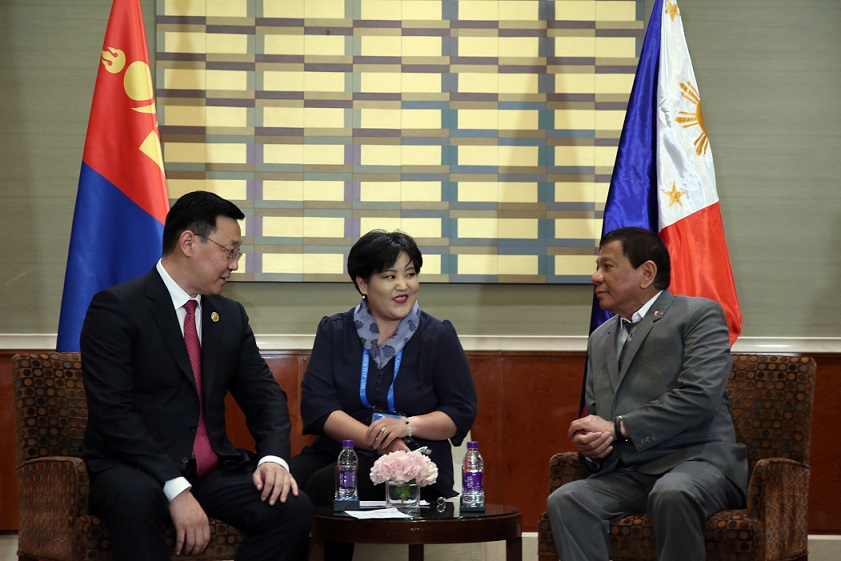
In a different approach from Malaysia’s ‘pak-to-pak’ approach (‘pak’ is an Malay honorific for older men), it was Singapore’s Foreign Minister Vivian Balakarishnan who went to Jakarta on 27-28 October for discussions with his counterpart, Foreign Minister Arrmanatha Nasir. The two announced a joint task force to prove errant companies across borders.
Some patch-up diplomacy took place. Balakrishnan requested a face-to-face meeting with Prabowo, who met him the next day, on 28 October.
Singapore’s Prime Minister Lawrence Wong communicated directly about bilateral challenges, which involved the haze and gas supplies under existing contracts, Balakrishnan said. “Communication has occurred at the highest level between my Prime Minister and with President Prabowo,” he said. “It sets the political commitment on both sides to do what is necessary, and now we will have to implement those plans, execute that commitment.”
The ASEAN way
So Singapore’s way is not Malaysia’s, but what about the ASEAN way?
ASEAN has been getting the usual brickbats about its failure to control the transboundary haze, not least because its ASEAN Agreement on Transboundary Haze Pollution is legally binding as an international environment treaty. (It entered into force in 2003.) It has had several roadmaps to a “haze-free ASEAN” by 2030, plus a peatland management strategy.
In fact, ASEAN diplomats like to call the haze agreement is among the biggest successes of the organisation. A whole structure of meetings, agencies and tools exists around the chronic haze, whose first documented episode was more than four decades ago in 1982-1983.
Since 1993, there has been an ASEAN Specialized Meteorological Centre (based in Singapore) – its website that features a haze situation map. In April this year, the secretariat of the ASEAN Coordinating Centre for Transboundary Haze Pollution Control was inaugurated in Jakarta.
In July, officials from 6 ASEAN countries attended a ministerial steering committee meeting on haze pollution.
As of end-October, ASEAN’s leaders or environment ministers have not issued an official statement about the haze crisis. One can imagine the tussles over language that would go into any consensus document. Internal issues, especially those tread on domestic actions, are tougher to handle than external ones – as political fires of October show.
There has been safe language in some meetings, though. In their statement after a regular meeting on 29 October, ASEAN ministers of agriculture and forestry mentioned “transboundary haze” in a list of challenges to crop yields.
The haze is also on the ASEAN Summit agenda in November, and the usual commitments to cooperation will make their way to ASEAN’s long-and-still-getting-longer outcome document. Then there are the strange-but-true challenges many have pointed out, like ASEAN countries’ different ways of measuring air quality.
One sensitive issue is Indonesia’s position of not officially declaring the haze a national disaster, a step that would allow it to receive external assistance. Malaysia and Singapore have offered help, but Indonesian officials are saying they can still handle the situation.
Indonesia’s position may appear as stubbornness to many, but there are nuances that explain its policy to tread carefully on declarations of a “national disaster” situation.
Since the Indian Ocean tsunami of 2004, it has been building a “nationally led disaster governance”. Among the countries with highest disaster risks, Indonesia has learned that it needs to drive assistance and response during crises instead of getting ‘lost’ in the deluge of international assistance, which may lack context or end up dominating what should be the role of Indonesian state’s and local actors. (A similar debate occurred after Cyclone Senyar in 2025.)
Multi-angled crisis – and the climate
While diplomatic tensions have hogged the headlines, there are other issues – Indonesian officials’ calling the haze an issue of “nature” – that are concerning. Calling it a matter of nature can make it sound like there is little one can do, but that is far from the case.
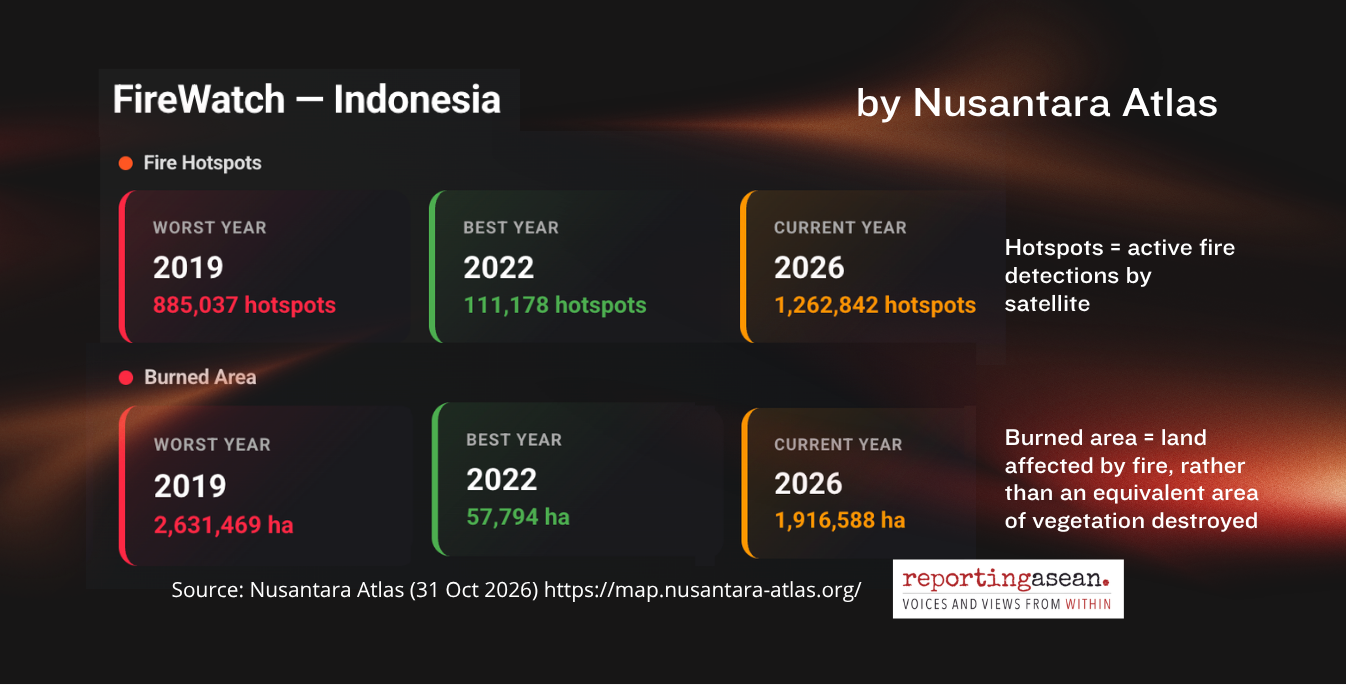
Far more than a political, legal problem or a firefighting issue (Indonesia has deployed 60,000 firefighters and they have been using water pumped from rivers or from backpack tanks), the haze is a symptom rather than the core cause of a chronic and multi-angled problem. It is also about humans’ degradation of the environment and peatlands, capitalism and profit incentives.
That the haze is a public health crisis is well known, but the full picture will emerge later on. The 2015 haze episode, the worst so far, is estimated to have caused over 100,000 premature deaths in Indonesia (91,600), Malaysia (6,500) and Singapore (2,200), according to a 2016 study by scientists from Harvard and Columbia universities.
The Centre for Research on Energy and Clean Air (CREA) has estimated that 3,560 people died from PM2.5 pollution from Indonesia’s fires in September.
Cutting through the tangled mix of politics, trade and business, health and environment, the current haze is also very much about the human-induced climate crisis. We cannot talk about this haze without talking about this very intense El Niño and we cannot talk about El Niño and the haze without talking about the destabilized climate, which is the operating system that sustains all life on this planet.
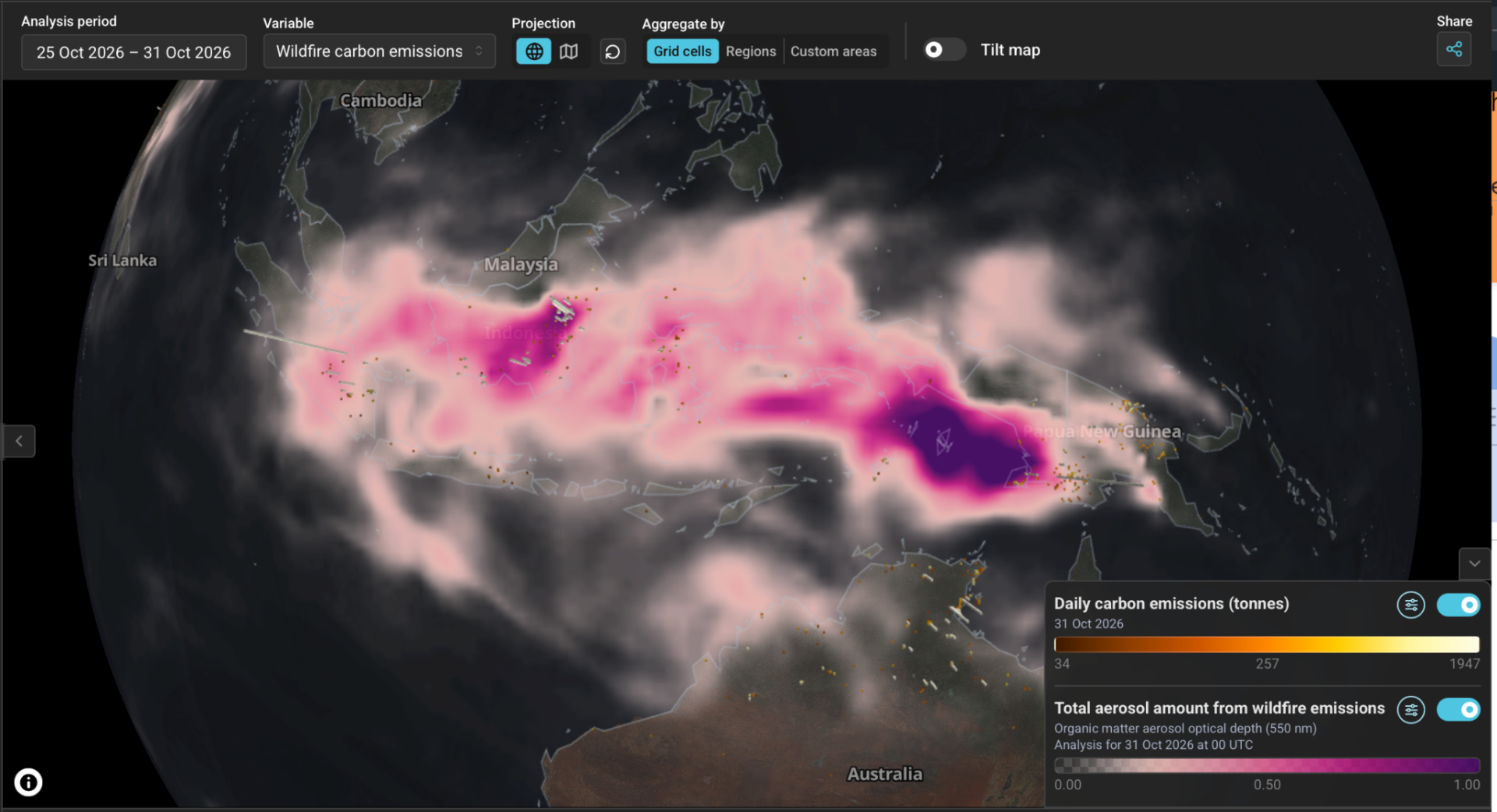
The fires in Indonesia are not just about Indonesia. Emissions from them have been accounting for nearly half of the world’s weekly wildfire carbon emissions, CREA says. Emissions in this year’s fire season have been greater than past intense episodes, but still behind those of the worst one in 2015, it adds.
The fires bring other climate harms. They wreck the peatlands that are one of the Earth’s most effective carbon sinks – when they are allowed to just be, and remain moist and healthy, not drained for plantations. Peatlands store ancient carbon, which cannot be reabsorbed by forests that grow after they are burned.
Indonesia is home to 36% of the world’s peatlands. In short, the fires are not just adding more heat to an overheated planet, but damaging a nature-based gift.
Rain! And the other haze to watch
Since last week, some rain has been come to haze-hit areas of Kalimantan and Sumatra, even as cloud-seeding operations continued. Exhausted firefighters cheered.
Although many hope that the rainy season, usually due in November, is not far off, Indonesia’s weather agency has said it will come later and be shorter due to the El Niño and a positive Indian Ocean Dipole.
And even as the haze in maritime Southeast Asia persists, it is time to watch out for the other haze that comes visiting toward the yearend, which is the dry season in the region’s mainland. This makes for the smoky skies across Thailand, Laos, Myanmar around December and into the next year.
*Johanna Son, who has covered Southeast Asia through decades, is editor and founder of the Reporting ASEAN series. https://reportingasean.substack.com/