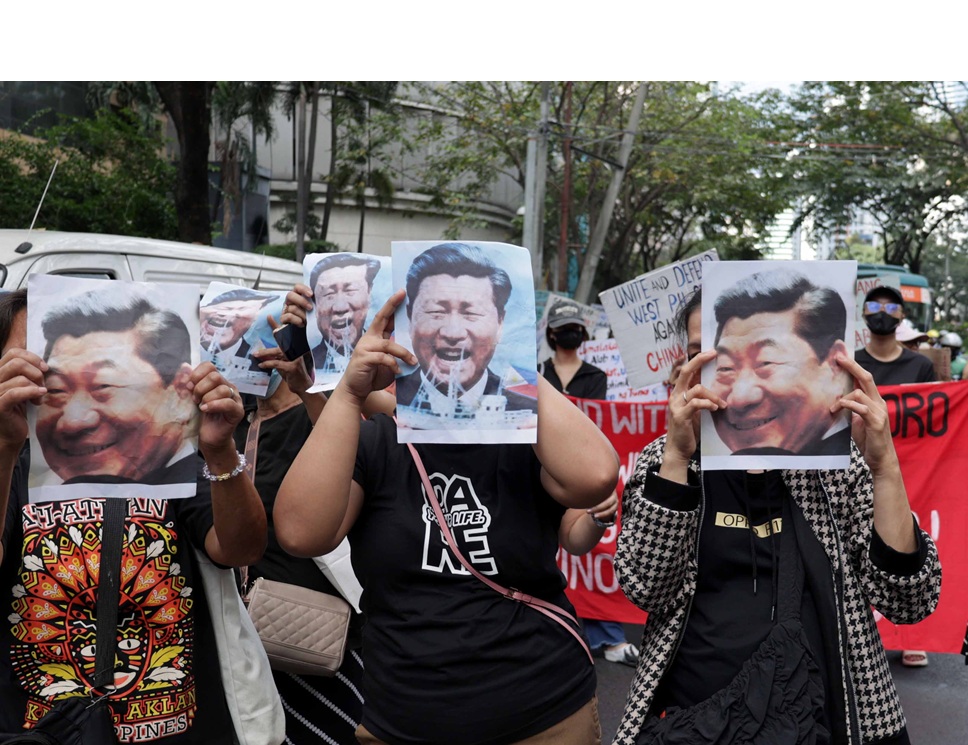


Thumbnail photo Bayan Muna protest rally Jan. 28, 2026 by Bulllit Marquez
It takes a mere child to start a geopolitical conflagration, and a statesman to put it out. The recent flare-up between members of Congress, Philippine Coast Guard officials, and the Chinese Embassy over caricatures of President Xi Jinping shows how easily a serious maritime dispute can be dragged into spectacle, and how quickly hard law can be displaced by noise.
The facts are plain. On Jan. 14, Commodore Jay Tarriela, speaking at De La Salle University, displayed caricatures of President Xi while discussing China’s conduct in the West Philippine Sea. Two days later, the Chinese Embassy protested, calling the depictions an affront to China’s political dignity and asking whether Tarriela spoke for the Philippine government. Tarriela invoked the Vienna Convention and accused the Embassy of interference. Legislators soon joined the exchange. China responded with its familiar rebuttals, including its rejection of the 2016 arbitral award.
Legally, none of this should be dramatic. Tarriela’s remarks, delivered to a Filipino audience on Philippine soil, do not constitute interference in China’s internal affairs. Chinese embassy statements disputing Philippine claims are likewise not automatically unlawful diplomatic conduct. In territorial and maritime disputes, sharp exchanges are routine. The question worth asking is not whether speech crossed some imagined red line. It is whether it served Philippine interests, advanced Philippine strategy, or merely satisfied domestic appetites for confrontation.
That question matters because the Philippines is not arguing from weakness. The 2016 Arbitral Award settled our entitlements in the area of Spratly Islands to an exclusive economic zone and continental shelf measured up to 200 nm from the archipelagic baselines but beyond the various high-tide elevations and their 12 nm enclaved territorial seas. It rejected China’s claim based on the preposterous nine-dash line. This is a right won not by press release but by international adjudication.
The challenge lies in translating the right won into sustained, disciplined state conduct. The Award reduced subsisting competing claims to the granular level of individual high-tide elevations and their enclaved territorial seas. Addressing them demands specificity in domestic law, mapping, and enforcement.
Transparency draws authority only when it reflects that specificity: clearly defined baselines of Philippine-claimed features, with established coordinates, and maritime zones treated as legally differentiated spaces. In a word: strategic firmness builds on the legal force of the award to reach strategic goals.
This urgent task in 2016 remains incomplete ten years hence, letting domestic politics and geopolitical realities distort the right already won beyond recognition. Propaganda has now replaced law; cult of personalities, the inherent merit of the award.
China has chosen non-participation and non-compliance. Its continuing coercive actions in areas under Philippine maritime jurisdiction remains unlawful. Faced with this reality, the Philippines’ most effective responses would be strategic resolve by means of transparency and restraint. Documenting incidents at sea, releasing verified footage, and refusing to escalate will strengthen Philippine credibility not only with allies, but with other coastal and Southeast Asian states quietly watching how law is defended under pressure. Transparency and restraint will entrench our position.
However, recent events warn that we are at risk of letting go of our strategic advantage as public communication has deteriorated into caricature and symbolic provocation. The legal dispute is now recast as a contest of pride rather than reason. China invented the personalization of inter-state disputes, and we seem to be mimicking it by shifting focus aways from unlawful conduct to personality conflict, from logic to noise.
Rather than maintaining strategic discipline confident in our legal advantage, we have shunned statesmanship and descended to mudslinging and character assassinations.
The National Maritime Council bears particular responsibility. Created precisely to ensure coherence across agencies, it cannot function as a passive clearinghouse for parallel statements. If the Council does not actively align public messaging, operational posture, and legal framing around a single strategy grounded in the arbitral award, fragmentation becomes policy by default.
Diplomacy is an element of constitutional executive power. The conduct of external relations, especially in disputes carrying escalation risks, must be led by the Department of Foreign Affairs. A multi-agency approach is necessary, but convergence without leadership is fragmentation. Public messaging by maritime and security agencies must reinforce a coherent diplomatic line, not generate parallel narratives that complicate it.
Together they can restore restraint in conduct and transparency in language. They can let the law do the talking.
*The authors are independent Filipino scholars of international law