
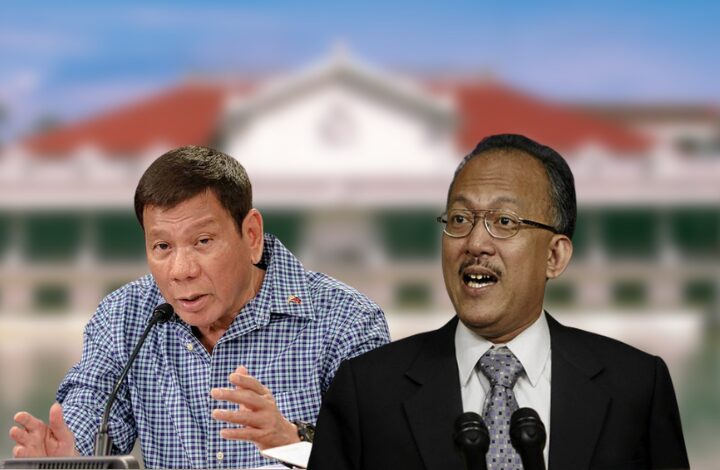
There is this famous Spiderman meme where three different spidermen point fingers at each other — except we can’t tell who’s at fault because everyone’s finger pointing and everyone is both victim and suspect. And while all of them are distinctly different beneath the costume, on the surface, there is no telling who is who, and no sense at all how one is different from the other.
We are at this point in our discursive polarization, one wrought by six years of Rodrigo Duterte and the massive propaganda strategy that propped up a governance that undid all that we know about democracy, rights, and justice. This strategy has continued despite his being held accountable at the International Criminal Court (ICC) in the Hague for crimes against humanity, because expectedly for all political dynasties, he has a daughter already a presidential candidate for 2028.
It would be easy to dismiss this as just political noise, but it is a propaganda strategy that is so consistent, and so obviously funded, that it continues to affect our political discourse whether we admit it or not. And it’s not because their number is growing (few people at rallies, surveys that say they want the impeachment trial of the Vice President to happen say otherwise), but because they have perfected this strategy and redefined political communications where soundbites are key, repetition is necessary, and content is all.
Yes, we would rather not give them anything. But it seems important to call it what it is: a success.
Cultural change
The primary advantage of Duterte propaganda is that it was our normal for six years. This is good for them because they’re thousands of steps ahead in nurturing their algorithmic base and playing with disinformation. This is (ideally) good for us because familiarity should tell us best how to respond in the most productive ways.
But here we are in 2026, a full decade since Duterte became President, and four years under a new leadership, and we are still reeling from the kind of mess he has left behind. And while economists and scientists will look at the numbers, I will insist that just as important is what is beyond numbers: culture. It is in fact in the arena of the cultural that the success of populists like Duterte can be measured.
Duterte changed us culturally in many ways, though the most palpable has been in the kind of language and rhetoric that we now use, from government officials to public leaders, from vloggers to pundits, whether on social media or in other public articulations. This, I think is the most insidious of Duterte’s legacies: the violent, disrespectful, thoughtless use, of language — and the shamelessness with which we use it.
Case in point, it is now normal for us to hear anyone across the political spectrum — from those who support populist-dictators like Duterte to those on the side of democracy and freedom, justice and rights — it is now normal for us to describe people as bobo, tanga, gago, inutil. And we’re not just talking about an angry public critiquing public officials which, to an extent, is defensible. We’re talking about the way we use these words to engage with each other as citizens, in the public spaces we share as part of civil society, including social media.
We have a man problem
The shift in the language and rhetoric of our public discursive spaces, both on mainstream and social media, is also palpable in how it has become shamelessly dominated by male voices.
The most self-centered of all might be PNoy man Ronald Llamas, who seems to like taking up space and listening to the sound of his own voice, on repeat, every day. Thing is, there is absolutely no reason for anyone to say yes to every goddamn news / talk show that he gets invited to, while keeping a daily TV gig on TV5, and appearing on the network’s other shows, plus a Saturday blocktimer show, plus sitting with Lovely Granada (who can certainly stand on her own) in another show, plus another one with Chris Tan.
To make matters worse, Llamas’s voice is one that worsens polarization instead of trying to bridge its yawning gap — Llamas’s voice is very elitist and reminiscent of the PNoy years. But what might be worse is that it is a voice that is horrifyingly male and arrogant. The framing is that Llamas is the person who is in-the-know politically, and to counteract the yabang, he periodically throws in a humble brag and some false self-deprecation, in the midst of tambay banter and Tito jokes, making it seem like serious political discussions are a laughing matter — very reminiscent of Duterte years.
It isn’t clear how Llamas has suddenly come to dominate our democratic political discourse, but it is reason enough to ask: what or whose self-interests is he protecting, which presidential candidate is he pushing for in 2028? The grapevine has been rife with news that it isn’t Risa Hontiveros, but (still) Leni Robredo. This would be consistent: the worst of male chauvinists will refuse to listen to a woman having publicly made a decision not to run, as Leni has.
While Llamas and those who enable him might believe they can count followers and think themselves a success; I think what they need to realize is that this all reeks of Duterte. The bad jokes, the constant purportedly ironic laughter, the sarcasm, the informal male banter, the tenor of conversations that should really stay in locker rooms and man caves — all of these use the same playbook as Duterte himself, except that this time it’s in English. This includes, and is not limited at all, to the fact that Duterte championed machismo, tapang and kamay na bakal, which is really what anyone at all — man and woman — even on the democracy side repeat every time they insist that BBM needs to “grow some balls” because “dinaga” na naman.
But Duterte had all balls and not much else (as do Senators like Padilla and all those men on the Duterte side). And look at where it has gotten us.
Context is everything
The dominant male voice is also in our activists, across the Left variants, and while they will always say the right things based on a more sound assessment of nation that is grounded in its real conditions, there is always something disconcerting about seeing an all-male discursive battle between Teddy Casiño and Mike Defensor, both with all-male back-up teams.
It doesn’t help that the tone and tenor is the same — it is maleness on overdrive, not at all the hinahon of say, Chel Diokno speak, or Erin Tañada. Or even, Neri Colmares and Kaloi Zarate. Instead, it is this militant male, grim and determined voice, one that was slowly and deliberately, and now has been fully appropriated, by the Duterte side.
Here is where it is instructive to be listening to their propaganda, beyond the hate and vitriol, what the Duterte side has done is to use the language of the militant Left and make it their own to suit their political stance. For example, they talk about true sovereignty and fix it upon two things: the refusal to let any Filipino be arrested or tried by a foreign court, the bias for China when it comes to the West Philippine Sea. The former sustains their narrative that Duterte was “kidnapped”, and that Bato dela Rosa’s escape (and all those who enabled it) is a pro-nation stance; the latter sustains not just pro-China propaganda (paid and otherwise), but also an anti-US narrative.
Now of course it is easy to agree with them with regards their anti-US stance. But that would be to fail to contextualize it properly in the larger narrative that really and simply only seeks to keep the Dutertes in power.
These intersections between the militant Left and the DDS is not a coincidence. It is deliberate. Old man Duterte fashioned himself a militant, until he decided he was going to draw a distinction between himself and those who believe in armed struggle. This is something that DDS propaganda has sustained since 2019 (when Duterte ended the peace talks), and from which they have created a whole communications strategy where activist actuations (raised fist, lighting rallies, rage and anger etc.) and rhetoric (para sa bayan, ibagsak, baguhin ang sistema, etc.) have been used at scale to further Duterte propaganda.
This has been most useful for them in the BBM era, as it is now the language of their opposition, one that completely and absolutely rooted in Duterte loyalty and not much else. This, I think, is what we need to get a handle on. Even when we might agree with what Duterte propaganda says, even when we might think valid INC’s call for accountability — it does us no good to publicly agree because it simply feeds polarization in their favor.
That this language is a male one is of course precisely why it works. It is considered as matapang, if not militante. That Duterte propaganda is using it as much as the militant Left is where we are at this point: given the scale of DDS propaganda, it seems important for the militant Left to start reconfiguring its language, refining it, rethinking it, if only so it doesn’t feed polarization further and get simply absorbed into the Duterte side.
Ways forward
Lest I be told that I am again giving feminism a bad name (Lingao, 2026), let it be made clear that this maleness across our language and rhetoric is being perpetuated by women, too. Which is why it’s even scarier: because one senses that we have stopped hearing ourselves speak, we have stopped reading what we write before we publish it online. It seems like we have taken on the practices that feed this kind of quick and easy and macho takedowns.
It was in the undeserved and baseless takedown of Risa Hontiveros, for example, when people put words in her mouth and decided that she had called for the ban on online games. She did not, but the men were not going to take any conversation about their games sitting down — never mind that a google search would’ve shown them otherwise.
It was in the rhetoric that sought to have EDSA “cleaned” after the “terrorists” that are apparently the INC leave, which also called for BBM to “grow some balls”. This, from the side of democracy that’s supposed to be called civil society.
Maybe the first step in cleaning up our acts is to clean our mouths and rethink and reimagine our language. Especially with Sara Duterte’s impeachment starting this week, against whom the worst of male chauvinist rhetoric has been levelled. We know we’re in deep sh*t when the democracy side outdoes the Duterte side with misogynistic statements and anti-woman rhetoric.
And really now, we lost 2022 on exactly this language and rhetoric, too, that was elitist and discriminatory, dominated as even Leni’s campaign was by male-led strategy.
Then again, it would be very male not to have learned our lessons and keep repeating our mistakes.
The views in this column are those of the author and do not necessarily reflect the views of VERA Files.