


Protecting Filipino children from cyberbullying, online sexual exploitation and harmful content should not come at the expense of their privacy, digital rights and access to opportunities, legal experts and industry representatives said, as lawmakers consider proposed measures to regulate children’s use of online platforms.
The challenge is to craft legislation that shields young users from digital threats without imposing blanket restrictions that are difficult to enforce, compromise personal data or shut children out of the benefits of technology, participants in a recent policy dialogue said.
“We should not have to choose between protecting our children and protecting their rights,” said lawyer Mark S. Gorriceta, chairman and managing partner of Gorriceta Africa Cauton & Saavedra. “Good legislation must accomplish both.”
The law firm, in collaboration with GoDigital Philippines, convened government officials, legal practitioners, media industry representatives and civil society groups for Safe Kids, Smart Policies: A Dialogue on Children’s Online Safety and Digital Rights.
The discussion focused on the Senate and House versions of a pending legislative proposal: House Bill No. 11566, or the proposed SAFE Kids Act, and Senate Bill No. 2424, or the proposed SMART Kids Act.
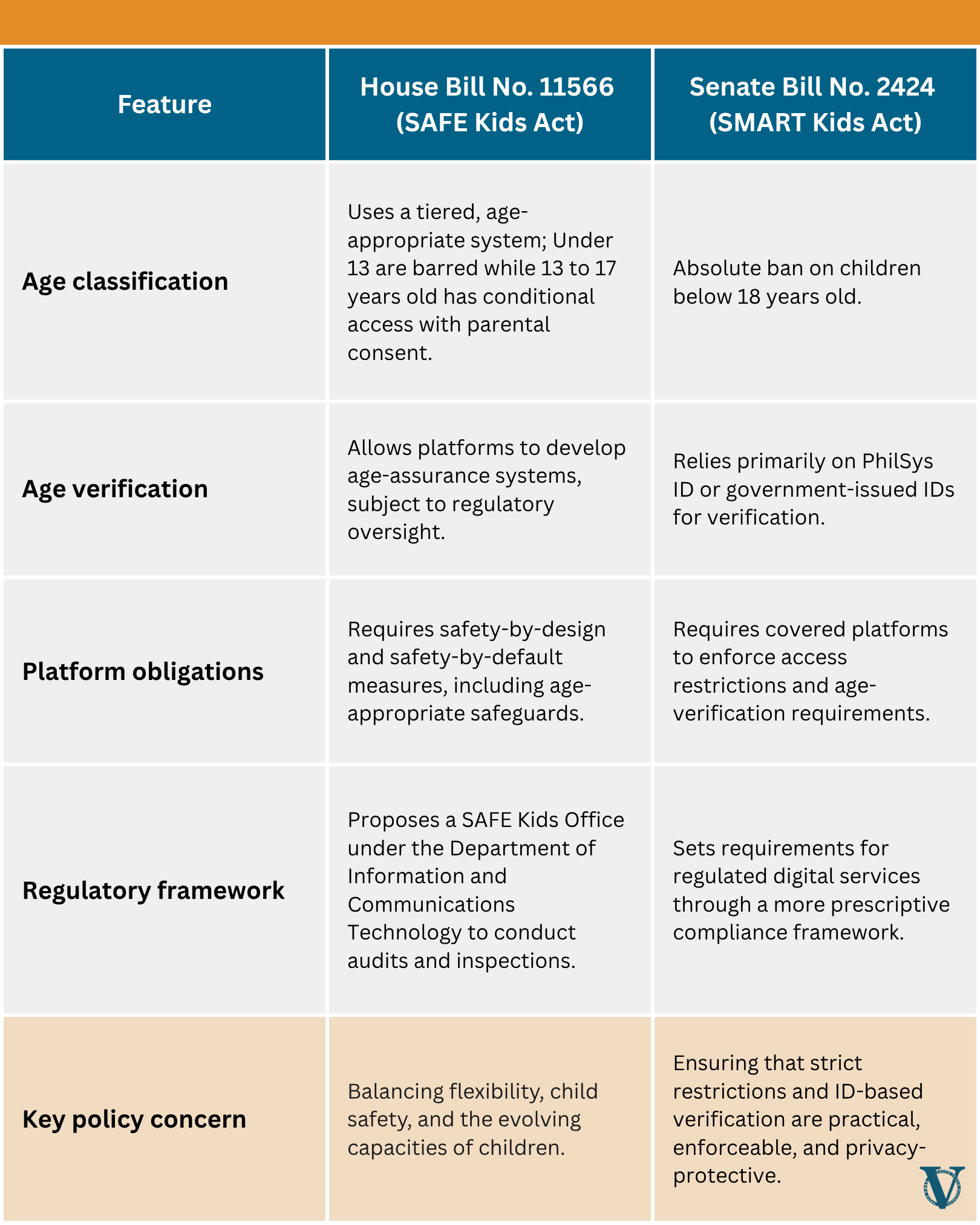
The measure seeks to address growing concerns over the dangers children face on social media, online games and communication platforms.
But the speakers stressed that effective regulation must account for the internet’s increasingly central role in young people’s education, social lives and personal development.
“For many young people, the internet is their classroom, playground, marketplace, and social community all at once,” Gorriceta said.
“This new reality requires thoughtful, balanced, and future-ready policies that protect children from online harms while safeguarding their rights, opportunities, and access to technology.”
Undersecretary Renato “Aboy” Paraiso, executive director of the Cybercrime Investigation and Coordinating Center, emphasized the real-world consequences of online abuse for Filipino children and their families.
Official reports, he noted, capture only part of the problem, as many incidents remain unreported because victims fear coming forward, are unaware of available assistance or lack access to reporting and support mechanisms.
Social media and online games are not inherently dangerous, Paraiso said, but inadequate safeguards can expose children to grooming, exploitation, cyberbullying and inappropriate content.
The challenge for policymakers is to address these risks without treating all online services, users and activities as equally dangerous.

Protection must not mean exclusion
Kankan Ramos, chief operating officer of Invictus Philippines, said child protection and children’s participation in the digital world should not be treated as competing goals.
“Child protection is not optional, and so are the opportunities they can get and learn online,” Ramos said.
Drawing from her experience in marketing and advertising, she urged platforms and brands to put child safety alongside brand safety, including by assessing the potential effects of digital campaigns on children.
She also warned that age-verification systems must be designed to protect personal information, while children and young people should have a voice in shaping policies that will affect their online lives.
“Protection must not become exclusion,” Ramos said.
Gorriceta cautioned that a blanket ban on children’s access to particular platforms could prove difficult to enforce and encourage young users to circumvent restrictions rather than make them safer.
Regulation, he argued, should focus on actual risks and distinguish between the needs of younger children and those of teenagers, whose maturity, online activities and capacity to make decisions differ.
“Protecting children is only half of the challenge,” he said. “The other half is ensuring that the law remains workable, enforceable, and respectful of fundamental rights.”
He outlined six principles for lawmakers: adopt risk-based and age-appropriate rules; protect privacy in age-assurance systems; regulate high-risk features rather than relying solely on platform labels; narrowly tailor restrictions; avoid unnecessary barriers to innovation and investment; and allow sufficient time for implementation.
Age verification: the biggest hurdle
Age assurance emerged as a major challenge in the discussion, with Gorriceta describing it as a make-or-break consideration for restrictions on children’s online access.
Even carefully drafted rules could fall short if platforms and authorities lacked reliable ways to determine a user’s age, he said.
Yet the tools used to verify age could create new privacy vulnerabilities.
During a panel discussion, Gorriceta, lawyer Micaela Kristina Galvez and managing associate Luis Teodoro B. Pascua examined the risks of requiring users to establish their ages through government-issued identification, facial scans or behavioral analytics.
Such systems could expose sensitive personal information to data breaches, misuse and social-engineering attacks.
Government IDs, in particular, carry risks when information is collected or retained without adequate safeguards.
The discussion raised a fundamental question: How can authorities enforce age-based restrictions without creating another avenue for compromising the privacy of children and other internet users?
It also highlighted the government’s capacity to implement and monitor such requirements.
“Are we ready to impose those restrictions that will allow enforcement?” was the question raised during the discussion, underscoring the need to assess the country’s readiness before imposing rules that depend on reliable age verification.
Without the necessary technical capacity, safeguards and enforcement mechanisms, restrictions could be ineffective while imposing additional costs and privacy risks on legitimate users.

Safer spaces, preserved rights
As the proposed measures move through the legislative process, the dialogue underscored the need to assess not only the protections they promise but also their practical consequences.
Rules that are too broad could be circumvented, while poorly designed verification systems could expose users to new threats.
At the same time, inadequate safeguards could leave children vulnerable to abuse on platforms they use daily.
They must also preserve privacy, ensure meaningful access to digital opportunities and avoid unnecessarily burdening technology providers.
The task is particularly important in a digital environment where the same platforms that expose children to abuse can also provide access to education, creative expression, information and community.
The challenge for lawmakers is to build protections that work in practice, not merely impose restrictions that are difficult to enforce or easy to evade.
The test of effective legislation, the resource persons stressed, is whether it can make digital spaces safer in practice without compromising the rights and opportunities of the children it seeks to protect.