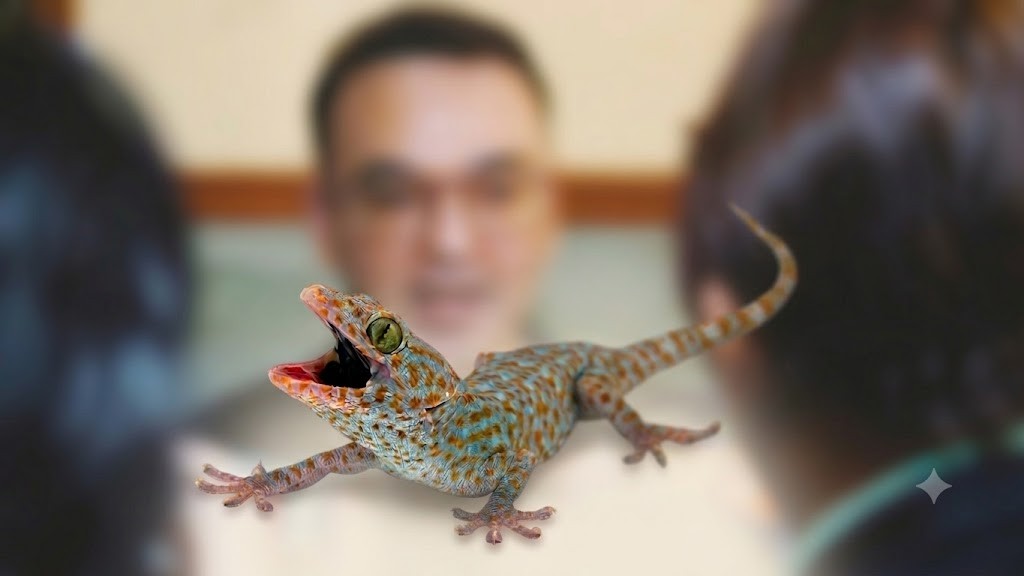
This is written with apologies to gecko lizards which are incredibly useful to our ecosystem. Geckos act as natural, chemical-free pest control by hunting down mosquitoes, flies and cockroaches.
The toes of a gecko are thought to have adhesive capacities that make them scale smooth vertical surfaces. That is made possible by millions of microscopic hairs (setae) on their toes that do not leave sticky footprints.
In human life, however, to stick like an adhesive has negative connotations.
Kapit-tuko is a term notoriously used in Tagalog culture. To “hold on like a gecko” carries a social stigma of being overly clingy out of despair, in the process manipulating things just to hold on to a person or position.
The implications of why a person attaches to others or to a position are the gist of what makes it a social stigma. In all cases, it is because of selfish motives such as financial gains or simply political survival by any means foul or foolish. Foul means signify achieving a goal through dishonest, unethical or illegal tactics.
It is considered a social stigma because the one clinging is seen as suffocating and lacking in social conventions. The motivator is deep insecurity. To quell that insecurity, the person becomes controlling. In the process, those around the person are not given space for individual or communal growth.
The stigma becomes even greater when the situation is applied to professional and political settings. The label means that someone is an opportunist who refuses to vacate a position of power for the purpose of securing personal benefits or job security. This is where dictators come in. The moment they manipulate constitutional term limits to extend their hold on power is already a red flag. In recent history we saw Xi Jin Ping and Vladimir Putin become dictators for life.
Simply said, your time is up but you refuse to let go of your power and authority.
Whether in the realm of the personal or the political, it denotes an individual who is parasitic. A parasite is always burdensome.
At times we use the term kapit-tuko in a humorous way. But there is really no humor in it. The act diminishes the dignity of persons disenfranchised by one’s clinging to power, usurpation, and entrenchment.
The political kapit-tuko is the most abusive. It clings to public office defying legal and constitutional boundaries. It goes without saying that the public office is bankrolled by state funds. Not only that, the office contains facilities that are the property of the state. That these instead go to a monopoly of power by foul means is overtly scandalous.
For example, electric power, air-conditioning and WiFi in the office are part of state properties because the bills that pay for such utilities come from state coffers. To cut these so that political foes cannot use the facility is gross dishonesty. It may even entice legal charges filed against the usurper.
Most experts say that what sabotages political power held in a public office is deep-seated insecurity. The person clinging on to power has psychological vulnerabilities such as a fear of irrelevance and fear of failure. By being controlling of power, they mask their insecurities of self- doubt. They see power as the validation that they may have lacked in childhood.
There is something in that person’s childhood that was left uncontrolled and untreated. The person remains that frightful child who never grew up to overcome the sources of childhood insecurities.
What ails us is not just insecure power usurpers. Dynasties are an extension of kapit-tuko. Concentration of power is deliberately funneled to only one family, otherwise they will lose their political validation and family worth.
Readers do you think I am describing someone? Who?
The views in this column are those of the author and do not necessarily reflect the views of VERA Files.
(Editor’s Note: The photo of the gecko used in the thumbnail, which was done with the help of Google Gemini, came from https://www.sandspice.com/philippines-tokay-gecko/.