
In February 2026, the Sandatahang Dahas monitor of the University of the Philippines Third World Studies Center recorded flare ups of an ingrained strain of violence among the country’s arms-bearing state agents that made them turn on each other.
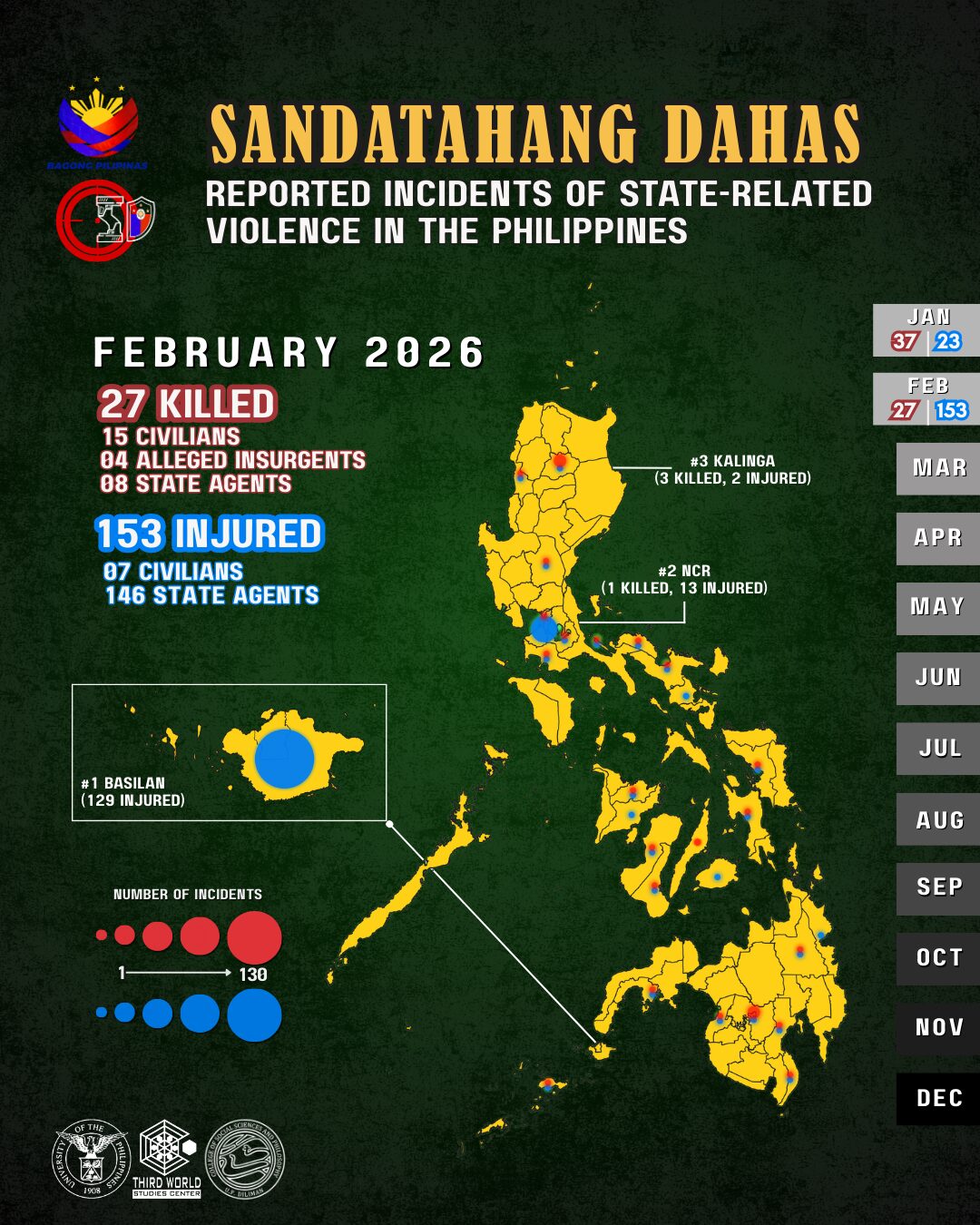
Of the 27 killed in state-related violence that Sandatahang Dahas recorded in February 2026, four were cases of members of the armed forces turning on each other. This equals that of January 2026 when a drunk policeman, after he was arrested for killing a civilian in a bar, killed his own chief and two other officers in Sibulan, Negros Oriental. The fourth fatality in that month was an assistant detachment commander of Philippine Army in Rodriguez, Rizal shot by members of the Citizen Armed Force Geographical Unit Active Auxiliary under his command. The army officer had earlier reprimanded the CAFGU members for drinking inside the camp.
In one of the four cases in February, drinking inside the camp was also what led to a killing. On Feb. 9, Private First Class (PFC) Wencel Jay Puntuan and PFC Rosarjoe Manajero of the Army’s 3rd Infantry Division (3ID) had a drinking bout that ran from morning ‘til night at the mess hall of Camp General Macario Peralta in Barangay Jaena Norte, Jamindan, Capiz. When they stopped drinking, they had a brief altercation that led Manajero to shoot Puntuan in the head.
On Feb. 17, in Allangigan Patrol Base in Apatan, Pinukpuk, Kalinga, bullying turned fatal when a CAFGU member, using his M16 rifle, strafed five of his comrades. Three died, two were wounded.
Hazing
Bullying—or its more vicious and institutional form, hazing—is also behind the unusually high number of reported injuries in February. Of the 153 cases of reported injuries, 129 involved police recruits who were slapped, punched, and beaten with a stick in a “welcome rites” by 57 officers of the Regional Mobile Force Battalion 14-B of the Police Regional Office Bangsamoro Autonomous Region (PRO BAR) in Barangay Ubit, Lamitan City, Basilan on Feb. 5. Thirteen of those hazed were Moro Islamic Liberation Front (MILF) combatants who were part of an integration program that allowed qualified members of the MILF and the Moro National Liberation Front (MNLF) to serve in the police force. This program is part of the normalization process provided for in the 2014 peace agreement that the government and the MILF entered into. All 129 police recruits filed complaints against the 57 officers for violating Republic Act No. 11053 or the Anti-Hazing Act.
There are laws against hazing and the police have their own prohibition against it. But these strictures are more honored in the breach than in observance. Just a year after the founding of the PNP, in January 1992, 150 PNP recruits in Fort Bonifacio complained of being bodily harmed by their training officers. In April 1994, the same complaint was raised by 50 trainees undergoing the PNP Special Action Force Operations Course (SAFOC) in Camp Bagong Diwa in Taguig. In November 2008, 51 police officers undergoing the Special Counter-Insurgency Course Training in Victorias City “had hematoma and contusions on their legs, buttocks and thighs” due to hazing. Female police trainees in the Special Counter-Insurgency Operations Unit Training (SCOUT) in Cebu in 2012 also complained of hazing. Before the Lamitan City hazing incident, there was also the case of Pat. Jeremy Matthew Padilla who was welcomed to his new assignment at the Regional Mobile Force Batallion in Angadanan, Isabela with a mauling on May 24, 2024.
Hazing combined with the PNP’s strenuous training for its recruits have led to deaths: Jose Castro and Julsadri Abdurajak in Zamboanga City (1995), Andrew Gladdis A. Milla also in Zamboanga City (2004), and Jaypee De Guzman Ramores in Masbate City (2022).
In some cases of PNP hazing, the intent is quite clear to humiliate and dehumanize the victims. In October 2000, the Philippine Daily Inquirer reported that “three trainees of the Philippine National Police Special Action Force have accused their instructors in Fort Sto. Domingo in Sta. Rosa, Laguna of forcing them to have sex with each other and making them undergo water torture as part of their hazing.” In 2010, PNP trainees, also in Laguna, were made to “drink chili-laced water and hot pepper [was rubbed] on their genitals.”
The police’s predilection for hazing may have had to do with how their officers have been trained at the Philippine National Police Academy. PNPA cadets Dominante Tunac (2000), Geoffrey Andawi (2003), and George Karl Magsayo (2021) were all killed in hazing in the academy. Beside these deaths, there are also a number of PNPA hazing cases that led to the cadets sustaining egregious bodily injuries, like those suffered by Gilbert Remo and Roberto Marigsa (2000) and John Rafael Desiderio (2019). Inflicting bodily harm on each other has become a “tradition” associated with milestones in the academy. In March 2018, the Inquirer reported that “six fresh graduates took a beating from around 40 PNPA cadets, supposedly as part of the school’s send-off ‘tradition’.” In October of the same year, the Inquirer carried a more troubling story: “three upperclassmen ordered two younger cadets to perform oral sex on each other” as part of their hazing.
Time and again, the leadership of the Philippine National Police has sworn to never allow hazing and maltreatment of its PNPA cadets. And yet, like a habitual offender, each vow of “never again” is quickly rent asunder by the next hazing case, the most recent of which happened just this Good Friday, April 3.
Besides internecine violence, the other killings and injuries in February follow the now established pattern of the police and the military harming mainly civilians in the course of law enforcement operations.
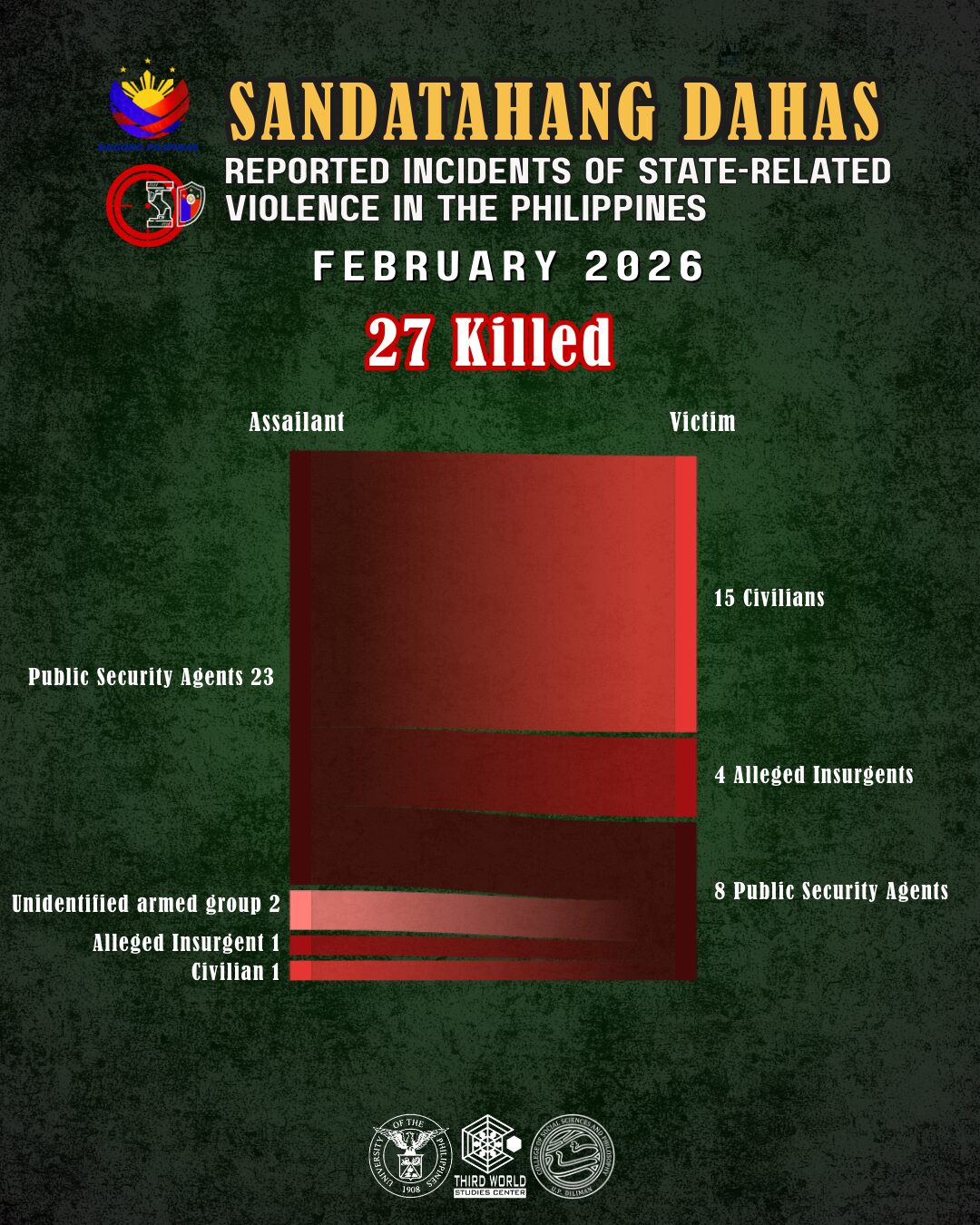
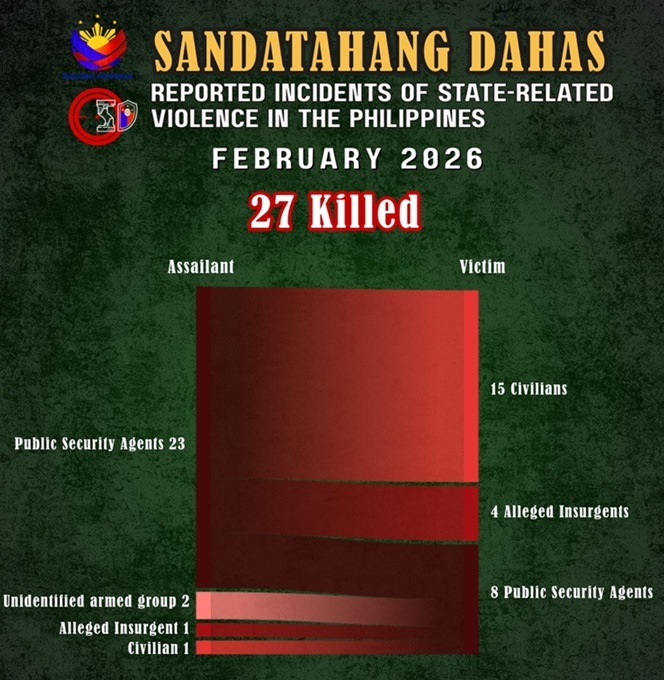
The 27 state-related killings include 15 civilians killed mostly by the police (in three cases, the police and the military), four alleged insurgents killed mainly by the armed forces (in one case, the armed forces and the police), four members of the police and the military killed by members of the police and the military (as previously discussed), two members of the armed forces killed by unidentified armed groups, another one killed by an alleged insurgent, and another one killed by a civilian.
Six of the 15 civilians killed in law enforcement operations were killed in anti-illegal drugs operations. This is one case less than in January, since in January a police officer was killed due to his anti-narcotics work. In February, no police or members of the military were killed in any anti-illegal drugs operations.
The bloodiest drug-related killings happened in Kilada, Matalam, Cotabato on Feb. 19. Ian Unsil Manial, the subject of an arrest warrant for crimes of theft and drug trafficking, opened fire on the arresting officers from the Cotabato Provincial Police Office and the 40th Infantry Battalion of the Army’s 602nd Infantry Brigade. In the ensuing firefight, Manial was killed along with two of his accomplices.
The exception to those killed in law enforcement operations were those killed or have died under suspicious circumstances while already in police custody. There were two such cases in February. The first one was in Lobo, Batangas. On Feb. 1, a suspect in a robbery with homicide and qualified carjacking cases was reported to have been found “inside the bathroom [of the custodial facility], sitting on the floor with a white drawstring around his neck, believed to have come from his shorts.” The second case involved a prisoner’s supposed attempt to escape while in transport from Pasig City to Catanduanes on Feb. 6. The vehicle carrying four police officers from Catanduanes and two prisoners stopped along Rolando Andaya Highway in Del Gallego, Camarines Sur as one of detainees asked to urinate. As the detainee was led out of the car, he was said to have “elbowed one police officer, grabbed the cop’s rifle, pointed it toward the operatives, and pulled the trigger. But the firearm did not discharge as it was not loaded so the detainee fled from the scene.” The cops ran after him. About a kilometer away from the transport vehicle, the detainee was shot three times in the shoulder and chest area. The four Catanduanes police were detained by the Del Gallego police and are now facing homicide charges.
The armed forces’s anti-insurgency operations continue to take its toll on the New People’s Army. Four NPA members were killed in February. On Feb. 5, a corpse of an alleged NPA was unearthed in San Sebastian, Lagonoy, Camarines Sur. According to the military, he may have been killed in a December 2025 encounter in nearby Barangay Burabod. (Though this may be the case, Sandatahang Dahas records it in February 2026, when the body was found confirming the killing.) Five days later, on Feb. 10, another NPA member was killed in Sitio Malunay, Colasi, Mercedes, Camarines Norte. On Feb. 15, the military claimed that Bonifacio Lutawan, alias “Ka Tado,” the commanding officer of the NPA’s North Central Mindanao Regional Committee was killed in Kasapa II, La Paz, Agusan del Sur. Another NPA member was killed by the military in Cabalagnan, Hinabangan, Samar on Feb. 25.
The military, in turn, had its own casualties. Two members of the armed forces were killed on Feb. 1. Early in the day, Sgt. Earl Andrew G. Baguioro of the Army’s 35th Infantry Battalion (35IB) was killed in an encounter with an unidentified armed group in Sitio Nangka, Latih, Patikul, Sulu. Later in the evening, a CAFGU member was stabbed to death by his own brother-in-law in Buda, Marilog District, Davao City, Davao del Sur. Another CAFGU member was shot to death by a riding-in-tandem in Panay Norte, Magsingal, Ilocos Sur on Feb. 8. On Feb. 15, members of the NPA killed Cpl. Reynold Gardose of the Army’s 11th Infantry (Lapu-Lapu) Battalion in an encounter in Sto. Niño, Tanjay City, Negros Oriental.
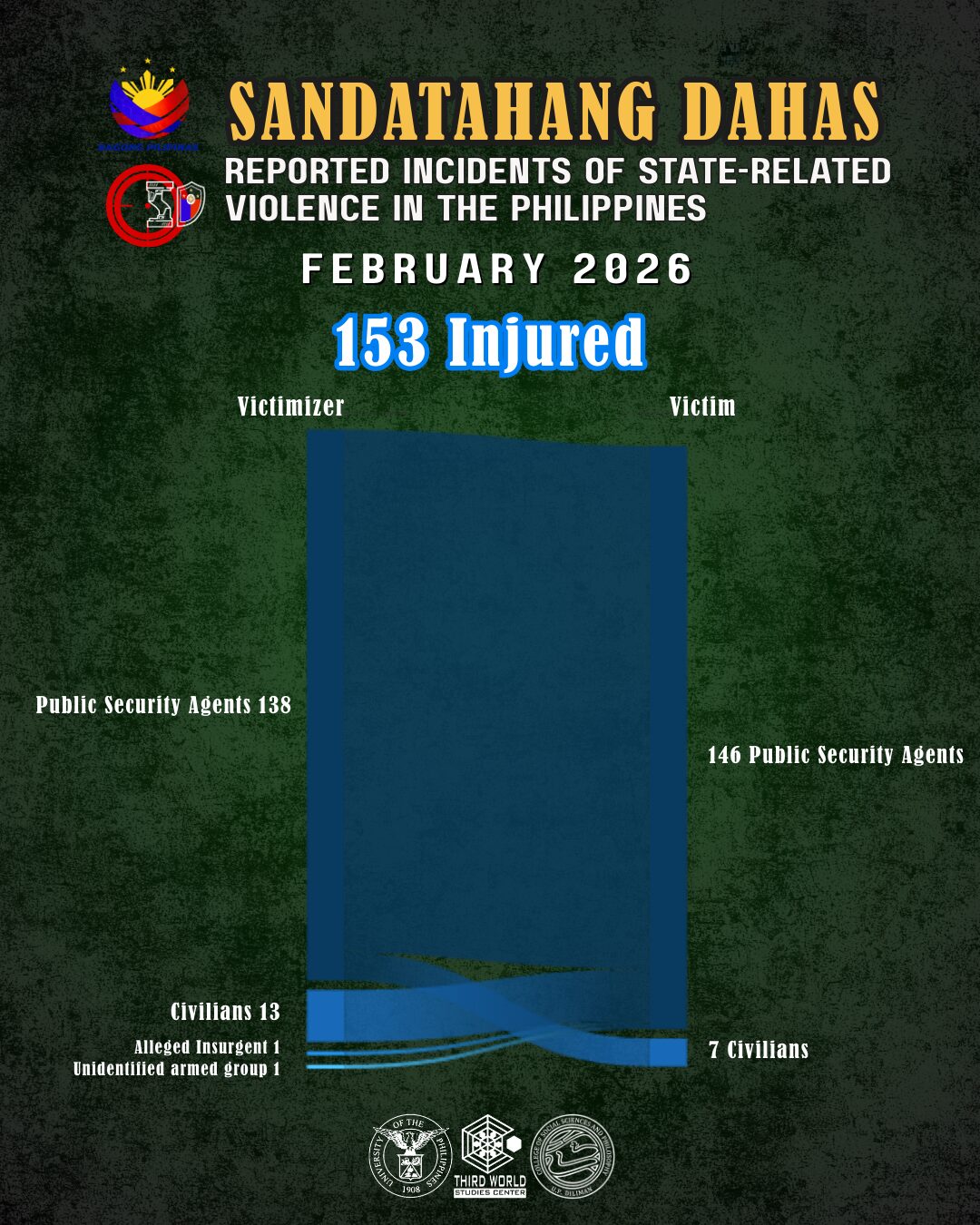
Excluding the hazing incident in Lamitan, the cases of reported injuries, caused by or inflicted on armed police and military, follow the patterns from the previous months.
There were 13 cases of civilians inflicting bodily harm on the police during law enforcement operations. Seven of such cases happened during protest events during the 40th anniversary of the EDSA People Power Revolution on Feb. 25.
Police officers, in turn, have harmed civilians, also in seven instances, of which, save for one, were all also committed during law enforcement operations. The exception was the case of alias “Elmo.” On Feb. 22, nearing the 10:00 p.m. curfew for minors in Sampaloc, Manila, a police officer and his brother accosted a 14-year old boy in front of their residence whom they thought to be behaving menacingly towards another teen as he was wielding an iron strip. As seen on the CCTV recording, the brothers were immediately hostile to the teen. At one point, one of the brothers, who is a police officer, drew his gun on the teen. The brothers also took turns kicking the boy in the stomach. The National Police Commission has already taken interest in the case.
And even in law enforcement operations, there is one case of alleged police brutality. Eric Gumanoy, a barangay councillor in Guinob-an, Sevilla, Bohol was the subject of a drug buy-bust operation around midnight of Feb. 10 in his own residence. In the course of the operation, as caught in a CCTV footage, four police officers assaulted Gumanoy. In the medical certificate issued to Gumanoy by the municipal health office, as reported by Bohol Island News, he “sustained 12 injuries, including a broken finger and severe bruising on his chest that may indicate a cracked rib.” Gumanoy has filed both criminal and administrative charges against the police officers.
The other cases of injuries were committed against members of the police and the military include two cases of a CAFGU member wounding two other comrades in Kalinga (as mentioned above, he killed three of his fellow CAFGU members), one case of unidentified armed group injuring a police escort of a local politician in an ambush in Dughan, Barobo, Surigao del Sur, and an army personnel getting wounded in an encounter with the NPA in Sto. Niño, Tanjay City, Negros Oriental, the same encounter where Cpl. Reynold Gardose was killed.
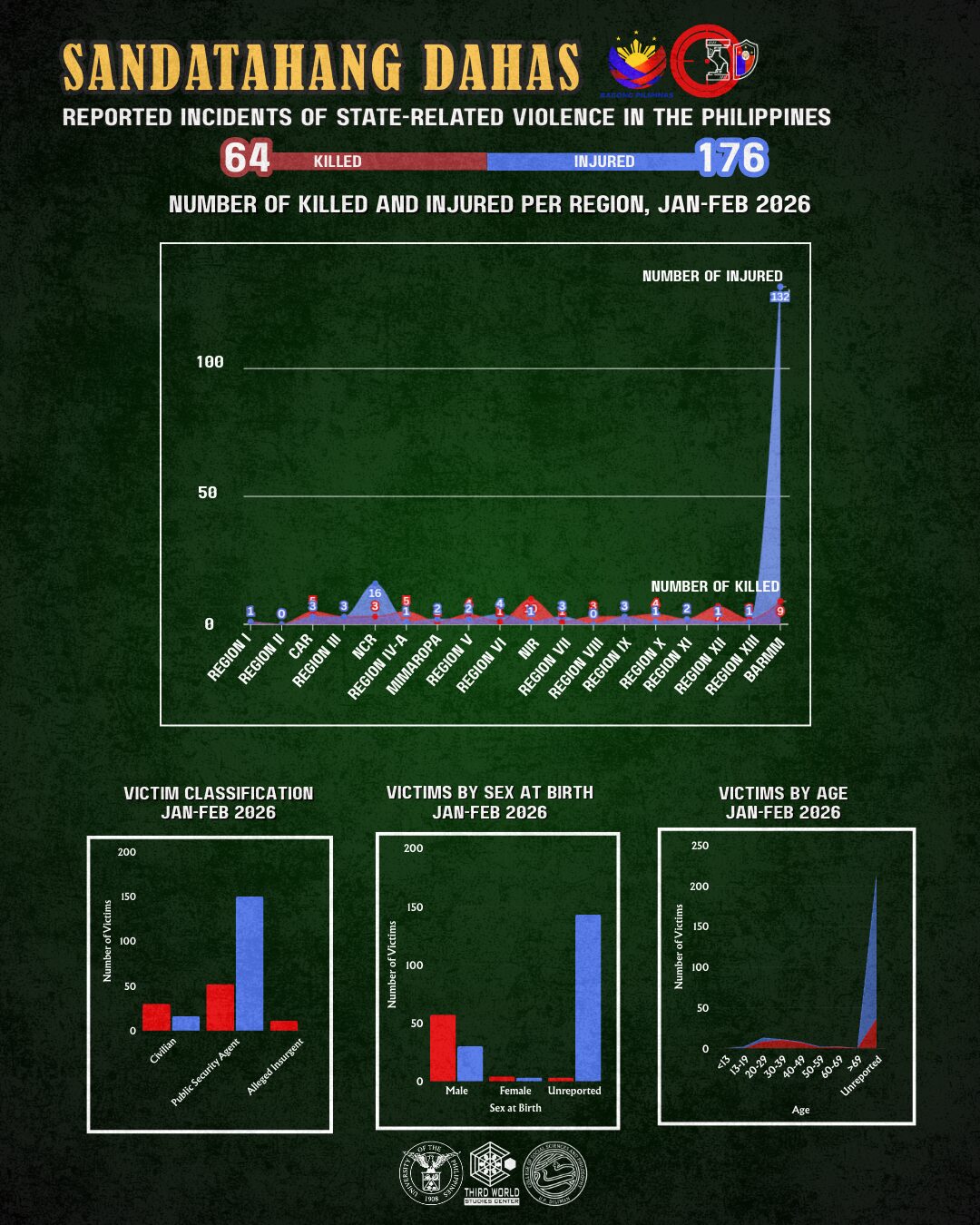
The hazing incident in Lamitan, Basilan involving 129 police recruits has unduly spiked the number of reported state-related violence in Mindanao to 141 incidents: 9 killings and 132 injuries. As mentioned above, Cotabato, with three killings had the most, with Sulu, Davao del Sur, Agusan del Sur, Davao Occidental, Maguindanao del Norte, and Zamboanga del Sur had one each. As for injuries, Davao del Sur had two; Surigao del Sur, one; and those injured in Basilan.
Protest events related to the 40th EDSA commemoration account for most of the state-related violence in Luzon, most of which were injuries, 17 in total and 12 killings. Metro Manila had only one state-related killing, with 13 cases of injuries, 10 of which, as mentioned, were due to the EDSA protests. The CAFGU member who ran amok in Kalinga, with three killed and two wounded, placed Kalinga next to Metro Manila in the provinces of Luzon with most state-related violence. Camarines Sur and Nueva Ecija had two incidents each, two killings in the former and in the latter, one killed and one injured. The following provinces had one state-related killing each: Batangas, Ilocos Sur, Camarines Norte, Quezon, and Laguna. Albay had one case of injury.
Visayas had the least number of cases of state-related violence, 10 in total (six killings, four injuries). In Negros Oriental, one killed, one injured. In Iloilo, two people were injured. The following provinces each had one incident of killing: Leyte, Capiz, Samar, Negros Occidental, and Cebu. In Bohol, one was injured.
The hazing in Lamitan, Basilan is the only intense concentration of state-related violence in one area due to a single incident. Injuries due to state-related violence, as they are often due to law enforcement operations, are not concentrated in one province or region nor have they occurred repeatedly in one area over a period of time.
However, the killings committed by the state tell a different story. The government’s anti-insurgency operation killed four insurgents in the Camarines provinces, in Agusan del Sur, and in Samar, while its drug war killed six in Cotabato, Negros Occidental, Zamboanga del Sur, and Cebu. These numbers may not yet be alarming as such, but these killings happened as there was a regular visitation of death in particular areas of the country, areas truly marked by a history of violence inflicted by the state.
[Joel F. Ariate Jr. is a university researcher at the Third World Studies Center (TWSC), College of Social Sciences and Philosophy, University of the Philippines Diliman. He leads both the Dahas Project and the Sandatahang Dahas. Aidrielle Raymundo did the graphics accompanying this report. She also organized the data for this monthly monitor which were compiled with the assistance of TWSC student assistants Louise Juliana Meriño and Aaliyah Nicole Ybera. Miguel Reyes with Nadine Castillo and Arrianne Fajardo provided additional research materials on hazing cases involving the police. To learn more about Sandatahang Dahas, visit its website and for the latest updates, follow the Sandatahang Dahas in these social media platforms: social media platforms: X (formerly Twitter), Instagram, Threads, and Bluesky.]