
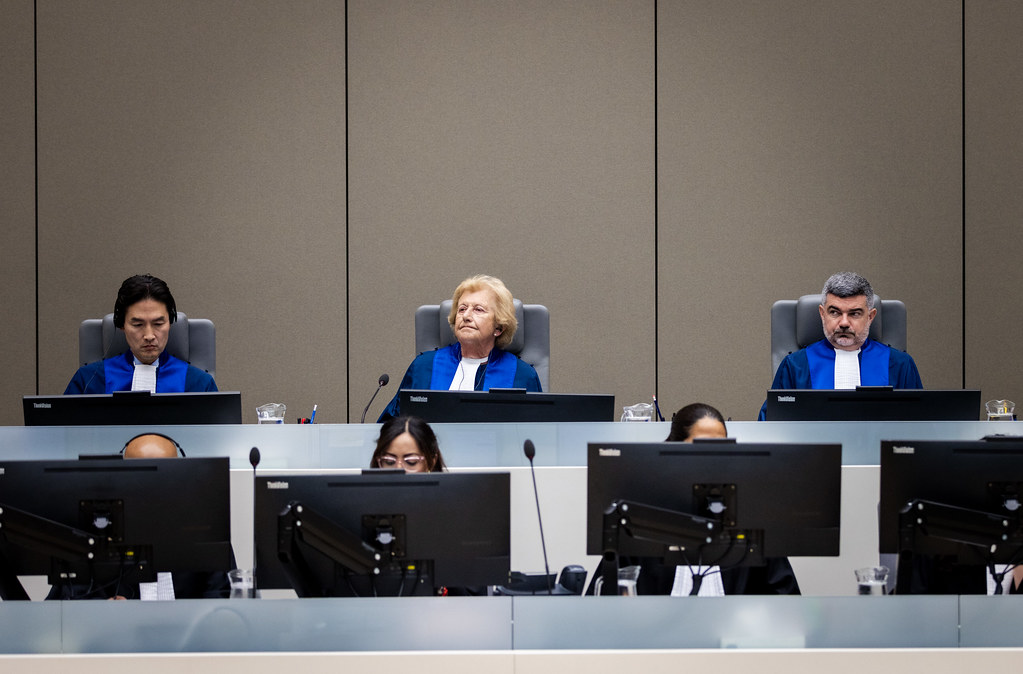
In the Philippines and in the world, the arbiter for that issue is most certainly not the Duterte Diehard Supporter unthinker Greco Belgica. He said after Donald Trump’s remarks at the APEC Summit: The International Criminal Court is “finished.” Goodbye ICC.
Belgica’s wishful thinking means of course: Welcome home Rodrigo Duterte.
But not in a thousand years. If the US sanctions are a “cause of concern” as opined by former ICC judge Raul Pangalangan of the Philippines, the arguments that favor ICC’s survival are actually significant and persuasive.
Pangalangan ticks off the first. The sanctions are triggered off not by the Duterte case but by the arrest warrants for Benjamin Netanyahu and Vladimir Putin. Both are yet on the investigation phases. In contrast, the Duterte full trial is about to commence this November 30. In Pangalangan’s opinion, it is unlikely to be affected.
In US-PH diplomatese, the Duterte case in the ICC was never a source of contention. Try other rational reasons, Mr. Belgica.
Despite its financial and banking tentacles worldwide, the US is actually dealing with a blind spot. The ICC is a judicial court independent of the US. The US is not a State Party to the Rome Statute that created the court. The US has absolutely zero power to legally dissolve the tribunal.
There are 126 States Parties in the ICC. Many of these are wealthy nations that certainly have the wherewithal to fund ICC operations. One of them, Japan – the ICC’s top contributor – has already advanced its 2027 dues to cover staff salaries. Japan prime minister Sanae Takaichi announced this only last Tuesday November 24. Suffice it to say – not a single cent for ICC operations come from the US.
The most formidable blind spot for the US is the powerhouse European Union. Analysts at the UK’s Chatham House have noted only this previous October that ICC member states have began to plan for support mechanisms and legal countermeasures. One of these is for the EU to activate its Blocking Statute.
The EU Blocking Statute is a unified action of all EU member states to protect EU operators such as banks and financial institutions from the extra-territorial application of a third party sanction. It can invoke regulations that could penalize European companies that comply with Donald Trump. With Trump’s current lameduck image internationally, which institutions would openly side with a laughing stock narcissist? It would be a kiss of death for that company.
Will the US persist with its sanctions now that Netanyahu and former Israeli defense minister Yoav Gallant will soon leave office? Analysts say that the US will extend its sanctions beyond Netanyahu, and for that matter beyond a Putin ousted by a coup d’etat. With Netanyahu out of office, the arrest warrant stays. Ergo, the US sanctions will also remain.
The main gist of Trump’s unilateral Executive Order 14203 that he signed on February 6, 2025 is its rejection of ICC jurisdiction over non-member states such as the US, Russia and Israel, the argument being that the ICC has no legitimate authority over citizens of non-member states. For these three states (rogues?), national sovereignty and state consent are its defense. Note to Belgica and the DDS: national sovereignty is the non-issue in the Duterte case which covers the period of our ICC membership.
The US’s concern is that allowing the court to sanction Israel may set a precedent that could target US troops and officials accused of human rights abuses.
Under the new Israeli government though, it could deprioritize lobbying Washington to punish the court that we can ideate Netanyahu did. That could loosen the US’s fixation on the ICC.
In the US, the new House with 259 Democrats and the new Senate with 56 Democrats will not be able to revoke the sanctions because these were not promulgated by an act of Congress. A succeeding president antithetical to the Trump legacy can revoke the EO.
Both houses are free to introduce legislation that will override the Trump EO. But that is about all –Trump can easily veto the bill. Overriding a presidential veto requires a ⅔ supermajority in both chambers (290 in the House, 67 in the Senate). It will be hard sell.
There actually is a way to challenge Trump. These are judicial challenges. Only this week, a US federal judge issued a permanent injunction barring the Trump administration from punishing Americans for advocating with the ICC on First Amendment grounds. It opens the door to other alternative judicial recourse.
The net effect is there remains much hope for the ICC. A despotic state like Putin-ally Tajikistan withdrawing from it has not even created any ripple at all. Who else have withdrawn? Chad, Naoero (Nauru) and Venezuela. Bring in the laugh emojis, send in the clowns.
The views in this column are those of the author and do not necessarily reflect the views of VERA Files.