
Photos by Elizabeth Lolarga
This on-and-off again theater-goer never expected, during the unfolding of BJ Crisostomo’s Saglit Lang at the Mirror Studio Theater, to hear Rachmaninoff’s haunting song “Vocalise” as background music in one of the scenes. Although wordless, it serves to counterpoint the loud verbal exchange between the Mentor/Maestro, played by Ron Capinding, and the Actor (Rico del Rosario).
This play of contrasts goes onstage again on April 25 and 26, with two stagings at 2 p.m. and 8 p.m. on the fifth floor of SJG Building at 8463 Kalayaan Avenue corner Don Pedro Street, Makati. On May 11, it goes to Bacolod City.
The contrast is between the newbie actor who is introduced being literally born, is wet behind the ears, eager to learn and to please from the seasoned, sometimes cynical and critical Maestro—youth versus age. Early on, the Maestro’s voice of experience warns the Actor about the heartbreaks ahead of him, if he were to pursue a life on the stage.
This brought to mind the still unpublished novel of Saglit Lang’s designer-director Anton Juan wherein one of the crucial characters, a drama professor, tells his students in no uncertain terms:
“Well, listen, everyone, for this class we shall wear black t-shirts or tops and black pants or tights you can stretch in. Seeing you all in your fashionable outfits, it simply means not all of you read the announcement on the bulletin board. As it is known in the theater community, in my classes you will roll on the floor, climb trees, run around the university oval, dance in the streets, express your assigned monologues in embodied expressions. And in the process of learning you will sweat as you understand that sacrifice shapes beauty. And there will be days for immersion. We will visit communities, slum areas, people living by canals and esteros, talk to displaced people in the streets, in remote areas. We will create texts from their narratives. You will have to bleed belief to learn. Do you understand? Now if you cannot explore and sacrifice, the door is open.
“The class was quiet, trying to process what the professor had said.
“Well? Do you understand?” he repeated. “If you think this class is just fun, you may please change your mind. In this class I want you to experience the source of drama —reality and its conflicts. Understand?”
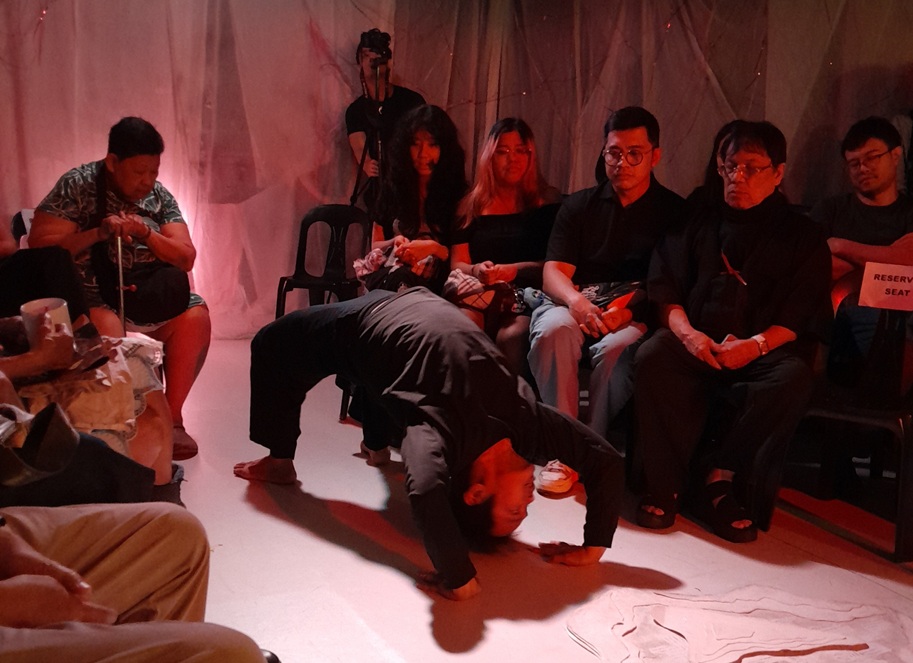
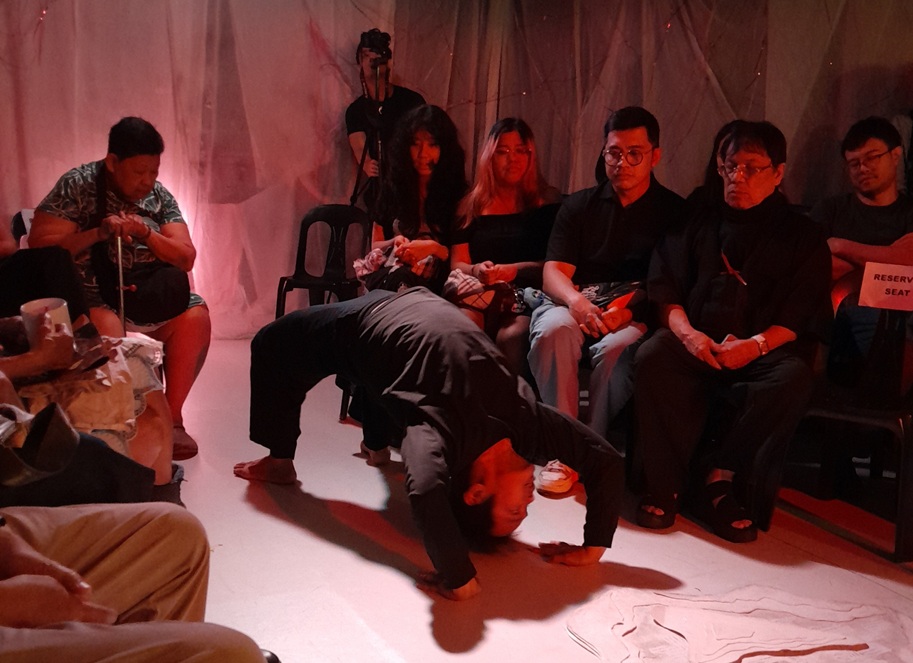
And indeed the two male protagonists roll on the floor, climb blocks and orate, dance, move and run the course of human emotions from anger to sadness to grief to peace and happiness. The space of the makeshift Mirror Studio Theater is limited, but trust Anton Juan not to be constricted by this. He covers the mirrors with white gauze or muslin curtains on which various images are projected from the night galaxy to a distorted mien of former President Rodrigo Duterte with his disembodied voice uttering coarse words.
We’ve seen those versatile curtains similarly used in a much earlier production, still of director Juan, of Shakespeare’s Macbeth at the University of the Philippines Diliman. From behind those curtains came the shadows and voices of the witches.
Another stage device Juan utilized was Velcro strips attached to some materials on the floor—they could have been cardboard. Every time a scene is finished, the Actor strips the material from the floor. We advise the viewer to count those materials to predict how many scenes the play has.
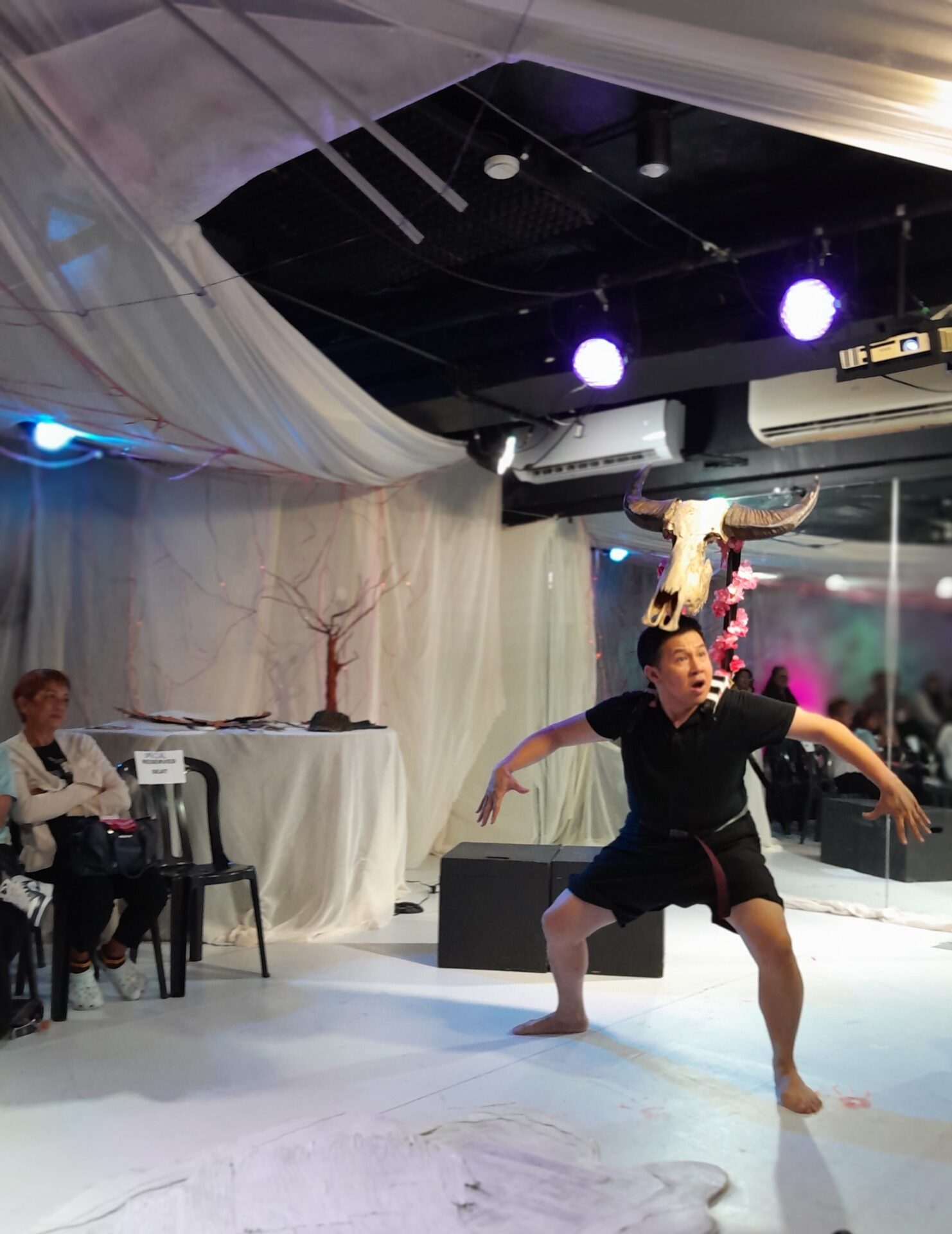
What we most appreciate is the back and forth between the two actors on the subject of the play being the thing. They even work with wayang kulit puppets.
For the tribute to another Shakepeare play, the comedy Midsummer Night’s Dream, four members of the audience are plucked randomly to form a bed for Titania. Maestro doubles as Puck and Bottom and provides some comic relief.
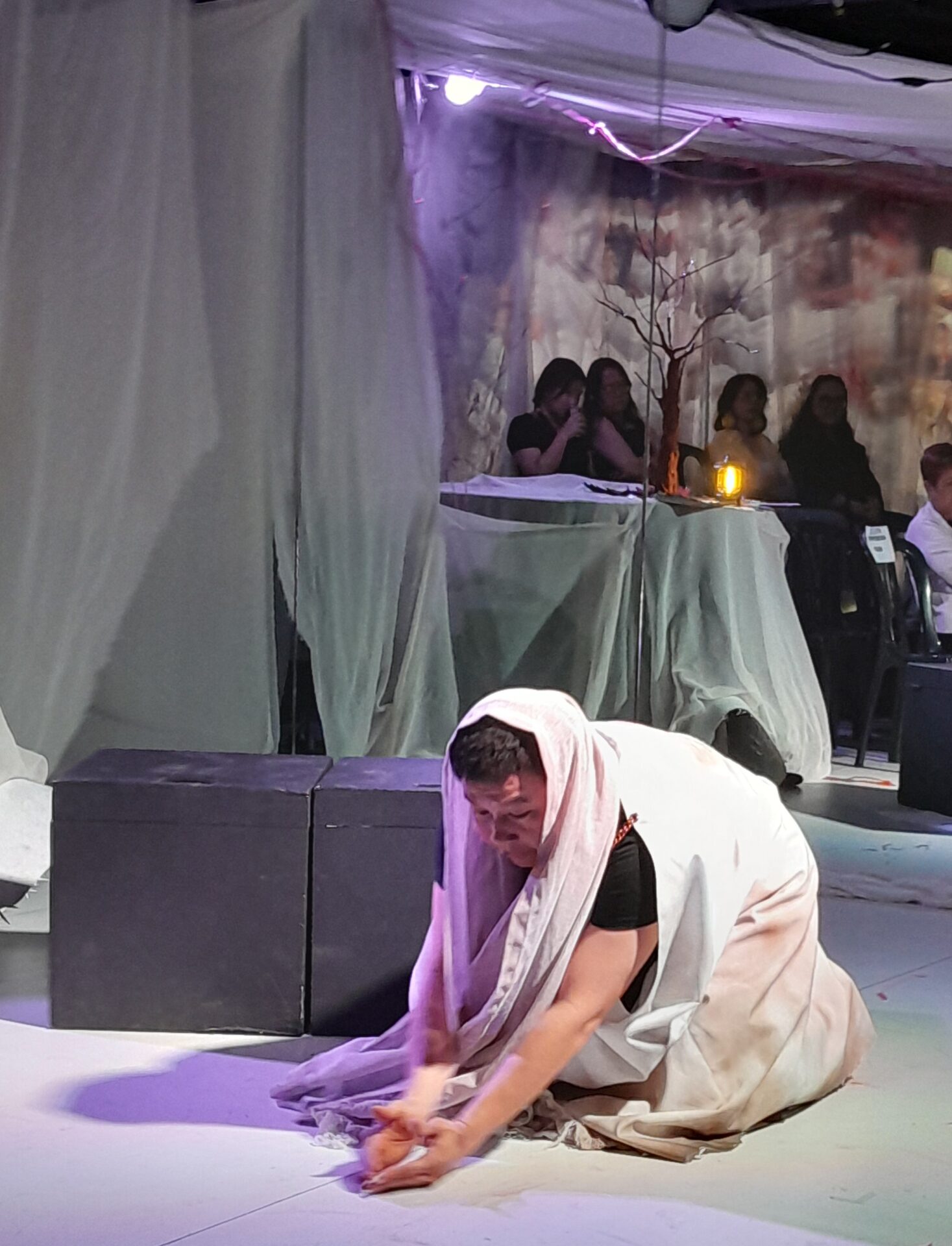
Gut-wrenching is the backhanded compliment to Sophocles’ tragedy Antigone with Maestro’s tour de force performance of the title role. Antigone is depicted as maddened by grief for her slain brother Polynices. She insists on a proper burial for him before the usurper to the throne, her uncle Creon (haughtily played by the Actor). By this time, the Actor has acquired more confidence and is indeed kingly, if not dictatorial, in his behavior.
Saglit Lang sometimes feels like a revisit, a throwback to our English and advanced English (classics of world literature) classes. There is also a short portion on the Theater of the Absurd wherein the Actor speaks from within a white water barrel, his whole body encased in it. Occasionally, his hands appear along with a stick with a drawing of an all-seeing eye attached to the end of it. The name of Godot is mentioned towards the end, and one realizes it is also a tribute to Samuel Beckett’s existentialist Waiting for Godot.
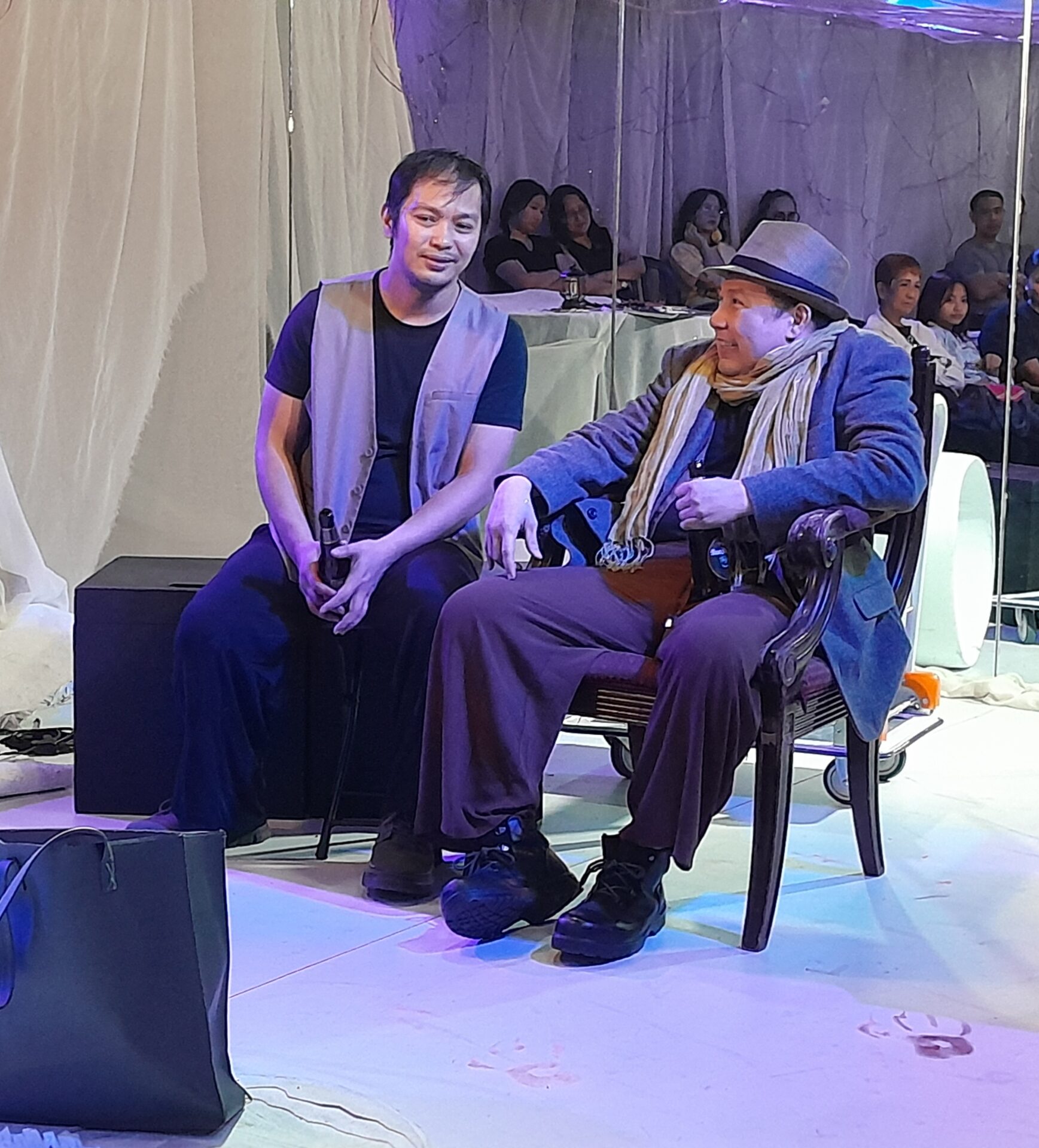
Towards the end of the play, the Actor visits his Maestro to celebrate his triumph. The latter character is so weak, sickly and consumed by a guilt that he may not have amounted to much in the world. The two’s reunion is marked with celebratory drink and smoking of cigarettes before the Maestro fades away and dies while the Actor goes on a monologue of mourning and denial.
At the curtain call, it was inevitable that Capinding would call on the true Maestro, director Juan, who drew out these stellar performances in a setting so intimate that we sometimes feared an actor might trip on our foot or brush past our shoulder.

What is notable in the souvenir program is how these theater stalwarts pay homage to another Maestro, the late Ricardo Abad who believed in theater as a weapon for change. He is quoted as once writing, “And the better the students become, the more effective they will be in liberating people (including themselves) from oppressive systems, intellectual rigidity and moral backwardness.”
There is a whole page of cameo photographs of the mentors of Philippine theater from Lamberto Avellana, Naty Crame Rogers to Rolando Tinio, Juan, Behn Cervantes, Nonon Padilla, even Tanya Lopez of Eastern Visayas.
Hats off to this Infinite Cantina production for this paean to theater and the necessary mentors who keep it alive!