
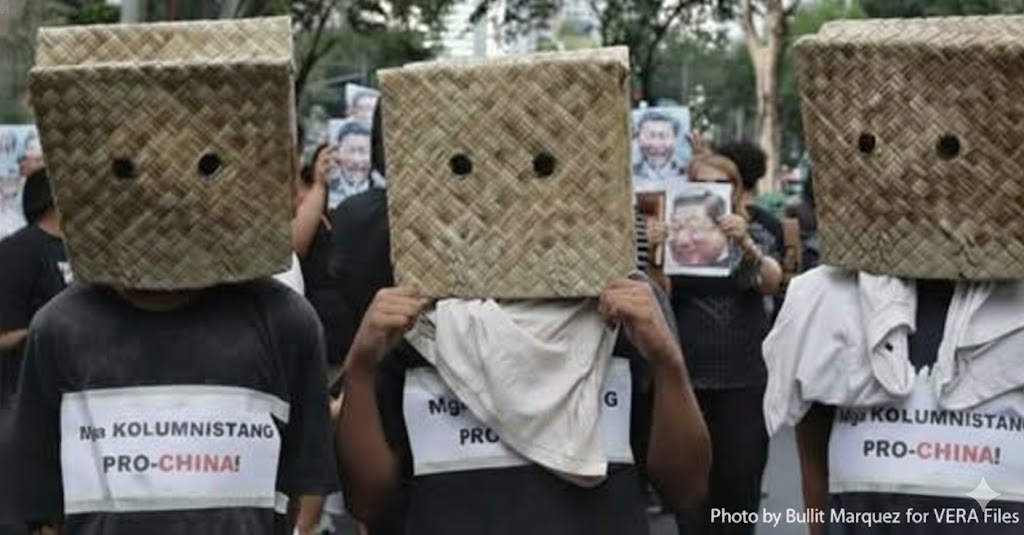
By this time, the word MAKAPILI is once again a household term given the state of politics in the country. The word is derived from the World War Two organization set up by pro Japanese Filipinos named Makabayan Katipunan ng mga Pilipino hence its acronym MAKAPILI.
The wartime MAKAPILI gained notoriety for being involved in some of the worst Japanese atrocities in the Philippines despite the fact that its members were Filipinos. Members of the MAKAPILI were involved in the dreaded zona operations by the Japanese where civilians were rounded up and sent to Fort Santiago or to Kempeitai detachments and were never seen again. They were even involved in the burning of the city of Manila in 1945. In popular culture they are usually depicted as having a bayong on their heads to hide their identity as they pointed out who among the population were allegedly involved in the guerrilla movement. The fact that they abused their power by even including innocent people who they had grudges against furthermore increased the hatred for the MAKAPILI among the Filipinos.
Consider them similar to today’s ICE agents in the USA, as in all masked, roving in gangs in communities, and indiscriminately kidnapping anyone who they profiled as being an undocumented migrant, even though many of them have documentation and are going through the legal process. Fortunately in the Philippines, we have not reached that level again given the number of pro-China elements in the country, but then again, why wait for that to happen?
Long history of treason
So as can be seen, treason in the Philippines already reaches back towards the Second World War, although any student of history knows that it goes even way further back. The Philippines did not have the privilege of being founded as a unified geographical political entity by its indigenous population. It is a creation of Spain as a colonial possession of that European state.
Prior to that, it was a motley collection of separate political groupings from sultanates all the way down to tiny self-ruling communities that oftentimes had disputes with its neighbors. They would mostly be easy pickings for a colonial power and during Ferdinand Magellan’s voyage to the islands, we can see the very first example of that when he took sides with Humabon against Lapu Lapu. Although that ended badly for Magellan, it set the pattern upon which the Spaniards ended up subjugating most of the islands that they then named the Philippines. Subsequent Spanish officials kept the population divided by pitting the people of one region against the other in order to control the colony. In fact for almost 400 years, the bulk of the Spanish colonial forces that kept the Philippines firmly in Spain’s grip happened to be composed of native troops. The Spaniards also did something insidious which was to coopt the native elite to serve them which created a situation which persists up to this day in that the Philippine political elite generally do not identify with the masses they are supposed to work for. Instead, they have been programmed to serve a foreign entity and if lacking that, will serve only themselves at the expense of the Filipino people. It is this situation that has always frustrated Philippine attempts to chart a truly independent path since its greatest enemy has not been an external force but always from within. Many Filipino heroes who rose against a foreign occupier were undone by traitors and or opportunists. Diego Silang, Andres Bonifacio, Gregorio del Pilar, Antonio Luna, Emilio Aguinaldo, and Vicente Lim are just some among so many who were sold out or killed by their own people.
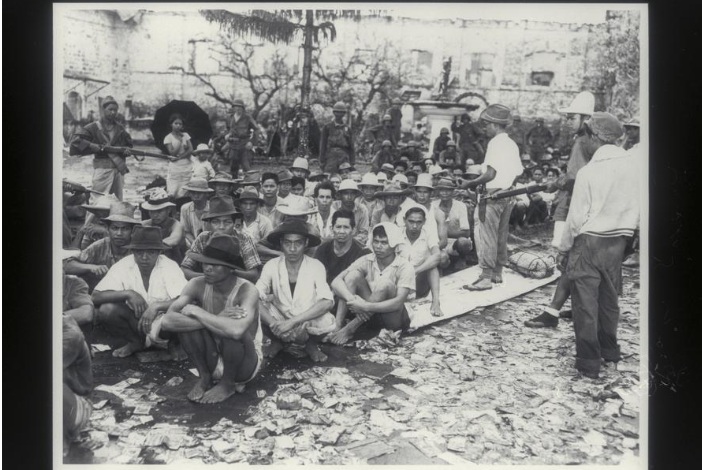
The experience of the Second World War was significant in the Philippines because it produced a term that has forever been identified with treason. That is the already mentioned acronym MAKAPILI. However, despite the derision associated with the term, the fact remains that those wartime traitors only continued what many Filipinos and natives had already done during the American period, and of course the Spanish period. MAKAPILIS were at that time, the latest versions of the Philippine Scouts and Philippine Constabulary who hunted down Filipino revolutionaries during the American period, or those native troops who kept the Philippines for Spain for four centuries. The Japanese merely tapped into that cesspool of disunity that already existed in the Philippines.
Political opportunism
Following the war, and having secured again its independence, the Philippines embarked on rebuilding the nation that had been devastated by the fighting. Within the span of two decades it found itself rocked by rebellion and the vagaries of the feudal politics that are a byproduct of colonial rule. A characteristic of Philippine politics is the issue of turncoatism. Political parties in the Philippines only superficially ape those of Western liberal democracies that they are patterned after. In reality, the parties are just the vehicle upon which a politician would utilize to advance his personal ambition. Once the party fails in doing so, he would just jump to another one which did. Hence, the political landscape in the country has seldom been governed by principles but frequently by personal self- interest. The EDSA Revolution of 1986 was supposed to fix that and usher in a new era of democracy into the Philippines. What instead happened was that the country backslid with a vengeance into the pre-Martial Law politics of turncoatism and political opportunism. Thus, by the mid-1990s, when the Chinese emerged as the newest existential threat to the Philippines through its actions at the Panganiban/Mischief Reef, they, just like all imperialist powers throughout history with grand designs in this region, tapped again into the cesspool of disunity and opportunism that make up the Filipino body politic.
In other countries, treason is seen as something done by outliers at the fringes of society. They are seen as someone to be shamed and to be despised. It would take a traumatic upheaval to cause treason to dominate a nation’s existence. Consider the cases of France and Norway wherein it took the physical invasion by the Germans to allow traitors to tread into the corridors of power of these subjugated countries as puppets of the Nazis.
In contrast, the Philippines did not even encounter a traumatic situation equal to those European countries and yet it managed to elect a president who unabashedly sided with China over the national security interests of his own country. Without firing a shot, the Chinese managed to coopt state power in the Philippines unlike the Spaniards, Americans and Japanese who committed sizable forces engaged in combat to do so. Although the Chinese did partially lose it after six years due to infighting between the Marcos and Duterte camps that followed the Duterte administration, it was more than enough for them to entrench themselves further into the country through the spread of pro-China Filipino mouthpieces.
It can then be argued that based on historical cases in the Philippines, the tendency to be treasonous is not in the fringes of Filipino society, but is actually in the mainstream of it. Filipinos may deny it but any imperialist power that has dealt with the country knows that all too well. That the readiness to cooperate with a malevolent foreign entity is easily found among Filipinos regardless of social status. Each succeeding colonial power just refined what the previous one had started when it came to exploiting the regional, social, and ethnic divisions in the archipelago. In a sense, the Chinese can thank the Spaniards for initiating the policy of divide and conquer; the Americans for perfecting it and making many Filipinos pine for colonial rule and be little brown Americans; and the Japanese for showing that no matter how brutal an occupation policy is, one could still find a lot of collaborators among Filipinos.
Vulnerability to China’s lure
Now in the present, what makes the Philippines a low hanging fruit for China when it comes to treason? It is found in the social ills prevailing in the country. The handmaidens of treason are corruption and opportunism that are committed by the political and economic elite of the country. The high incidence of corruption in governance will have a positive correlation towards a high incidence of treason among those in power. A politician and business leader or even an ordinary Filipino who thrives in corruption and opportunism only thinks of himself or herself and cares not for the wellbeing of society and the country as a whole. This makes the individual easily targeted by foreign entities like China to advance its agenda through that coopted Filipino. Corruption is the icing on the cake of regionalism, social disparities, colonial mentality, and indifference that are factors that creates a society ripe for treason. Hence, it is no coincidence that in the midst of one of the country’s largest corruption scandals involving flood control projects beginning in 2016, pro-China treasonous actions and statements have increased as well in the Philippines among politicians, individuals in the private sector, and by influencers in social media.
It takes a lot of political will for the BBM administration to push back against this as it is now the target of these treasonous pro-China elements in the Philippines that are engaged in a deliberate attempt to sabotage the country’s territorial and sovereign interests in the Kalayaan Island Group and the West Philippine Sea.
Even though it is in possession of all the instruments of national power such as the coercive capability of the state, its massive intelligence apparatus, its extensive legal capabilities, its investigative and police powers, its ability to influence the other branches of government, among many others, without the accompanying strategic vision and political will, all these assets will be wasted. The result of which will see the pro-China camp increase its influence in the country until it ultimately recaptures state power.
If that happens, then there will be dire repercussions for Ferdinand Marcos Jr., his family, and his allies, because a pro-China administration will most likely be led by a president keen on exacting vengeance for what was done to Rodrigo Duterte. By 2028, the BBM administration will either be remembered in history as the one that decisively stopped and defeated China’s cooptation of the Philippines, or as one that was too weak, indecisive and powerless to do anything about it.
The views in this column are those of the author and do not necessarily reflect the views of VERA Files.