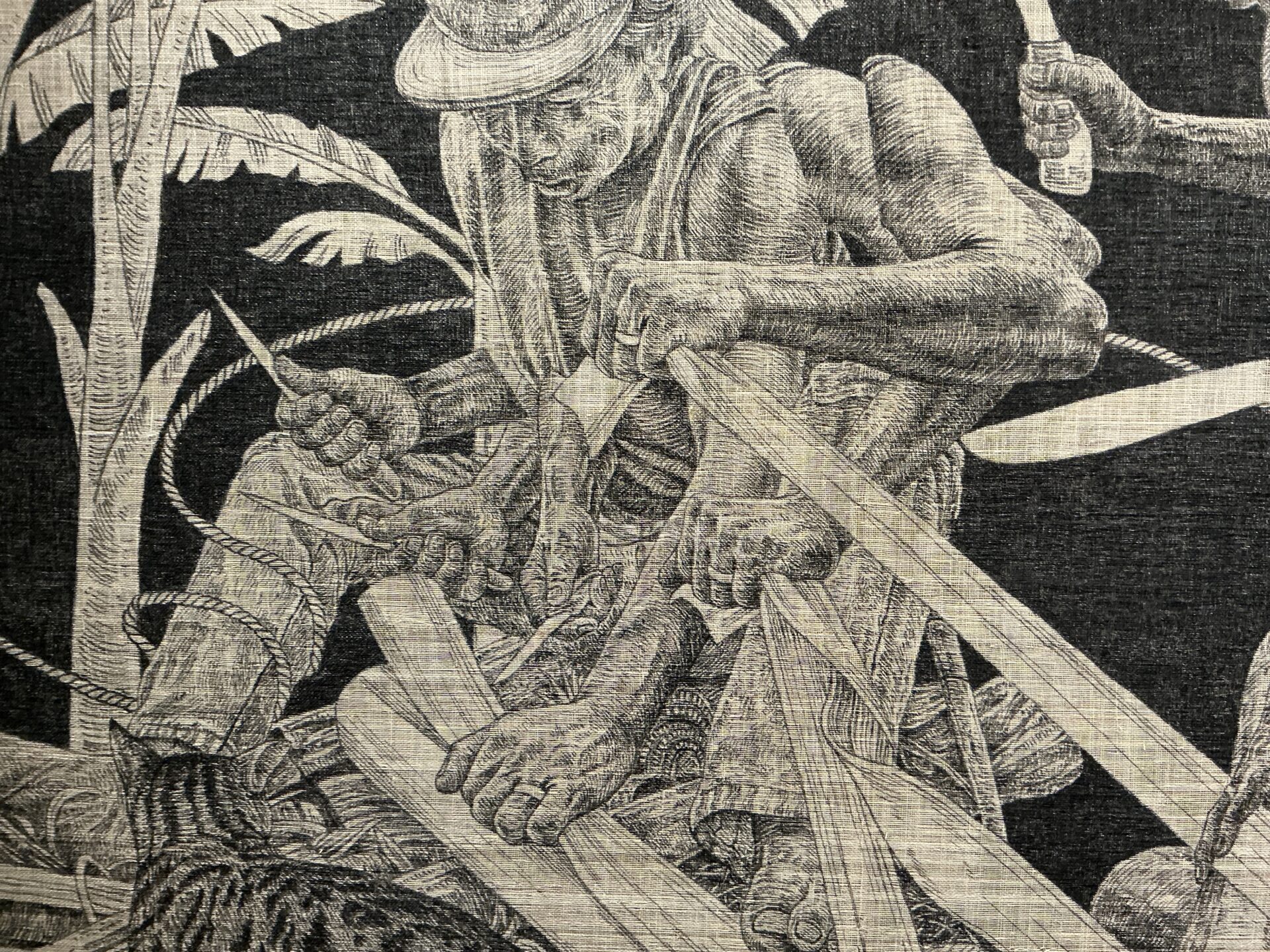
Archie Oclos presents 20 works of oil-based ink on handmade abaca and installations in his exhibition Sa Katiyakan ng Pagsikat ng Araw, Art Cube Gallery, Makati. It runs until October 31.
It is a tribute to his father, an abaca farmer, and the farming community of Brgy Tinago, Catanduanes where Oclos grew up witnessing farmers toil in growing abaca, from one generation to the next, without any significant improvement to their lives. Dubbed as the country’s “abaca capital,” Catanduanes was the top producer of abaca fiber in 2025.
Known for his murals and site-specific work, Oclos’art practice confronts labor, history, memory, migration, and portray the experiences of ordinary Filipinos based on his community immersion across the country.
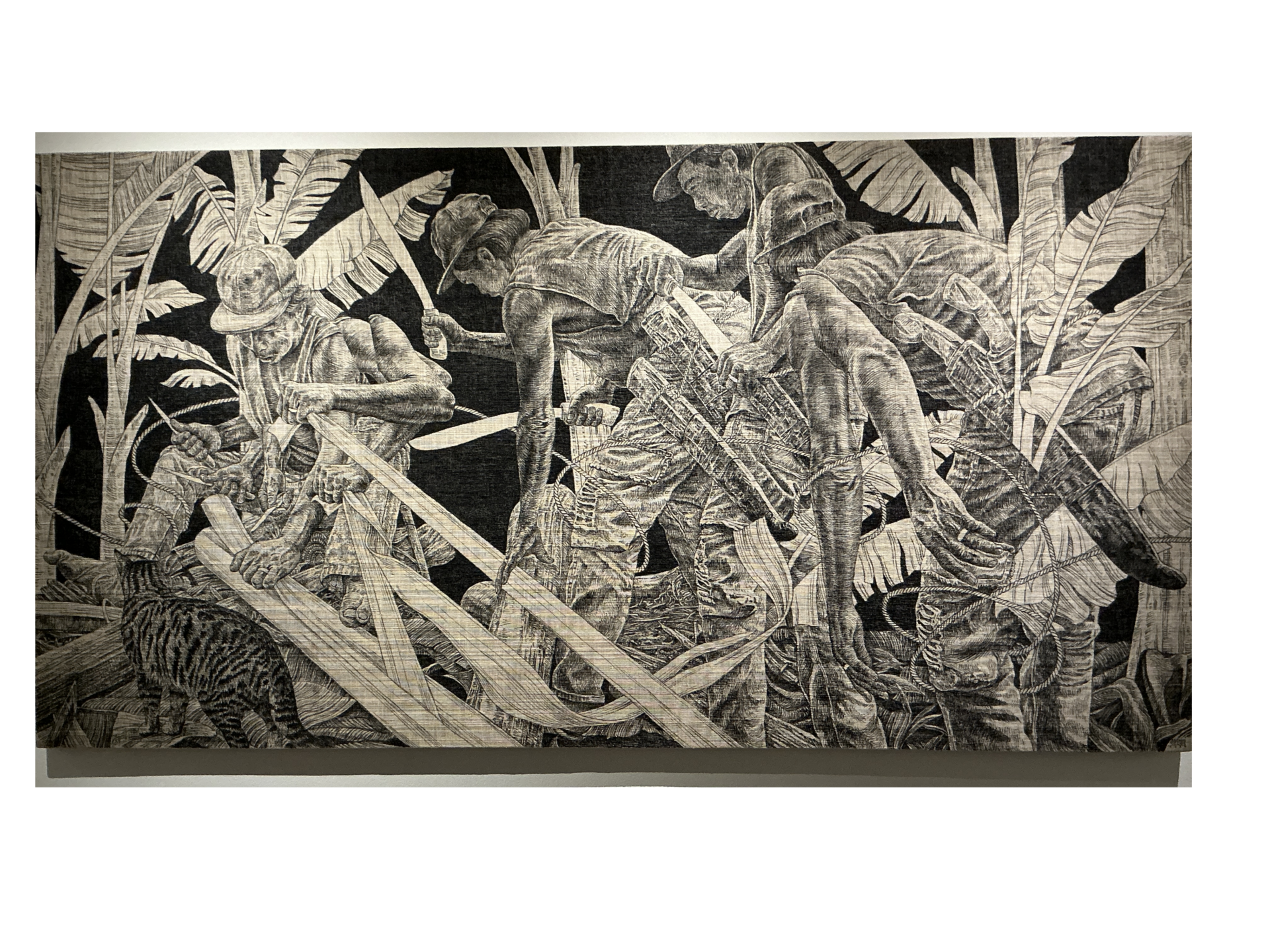
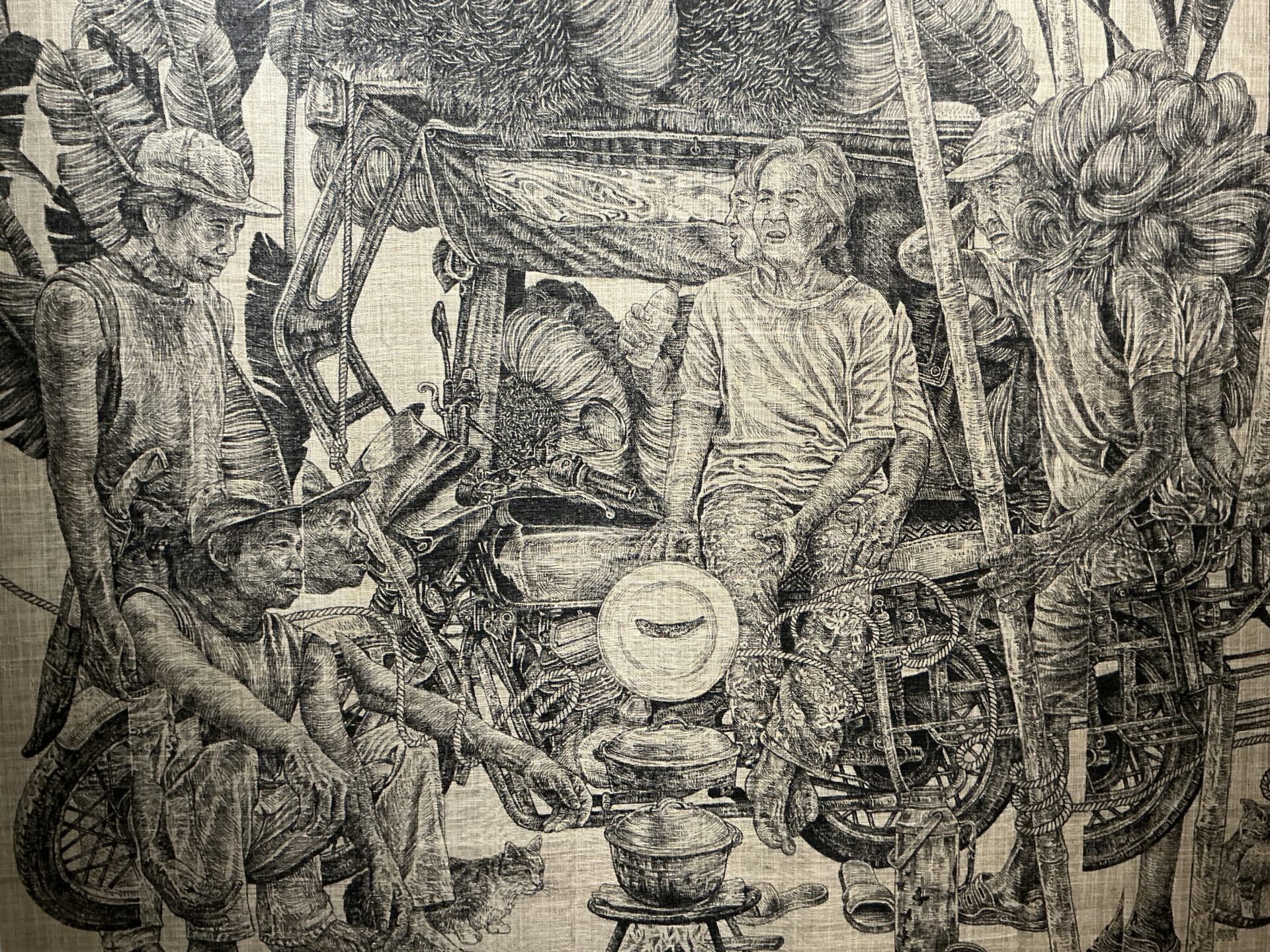
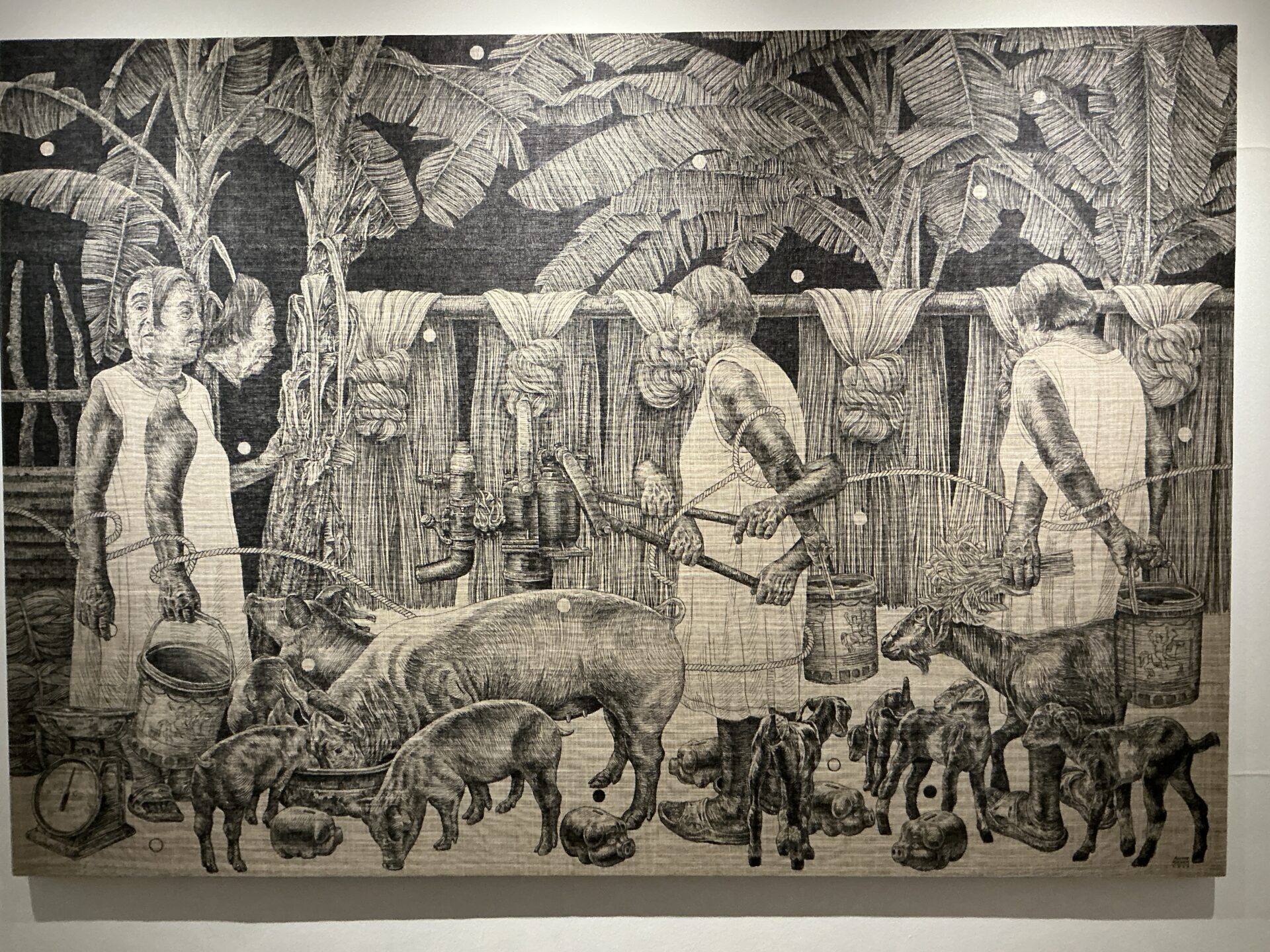
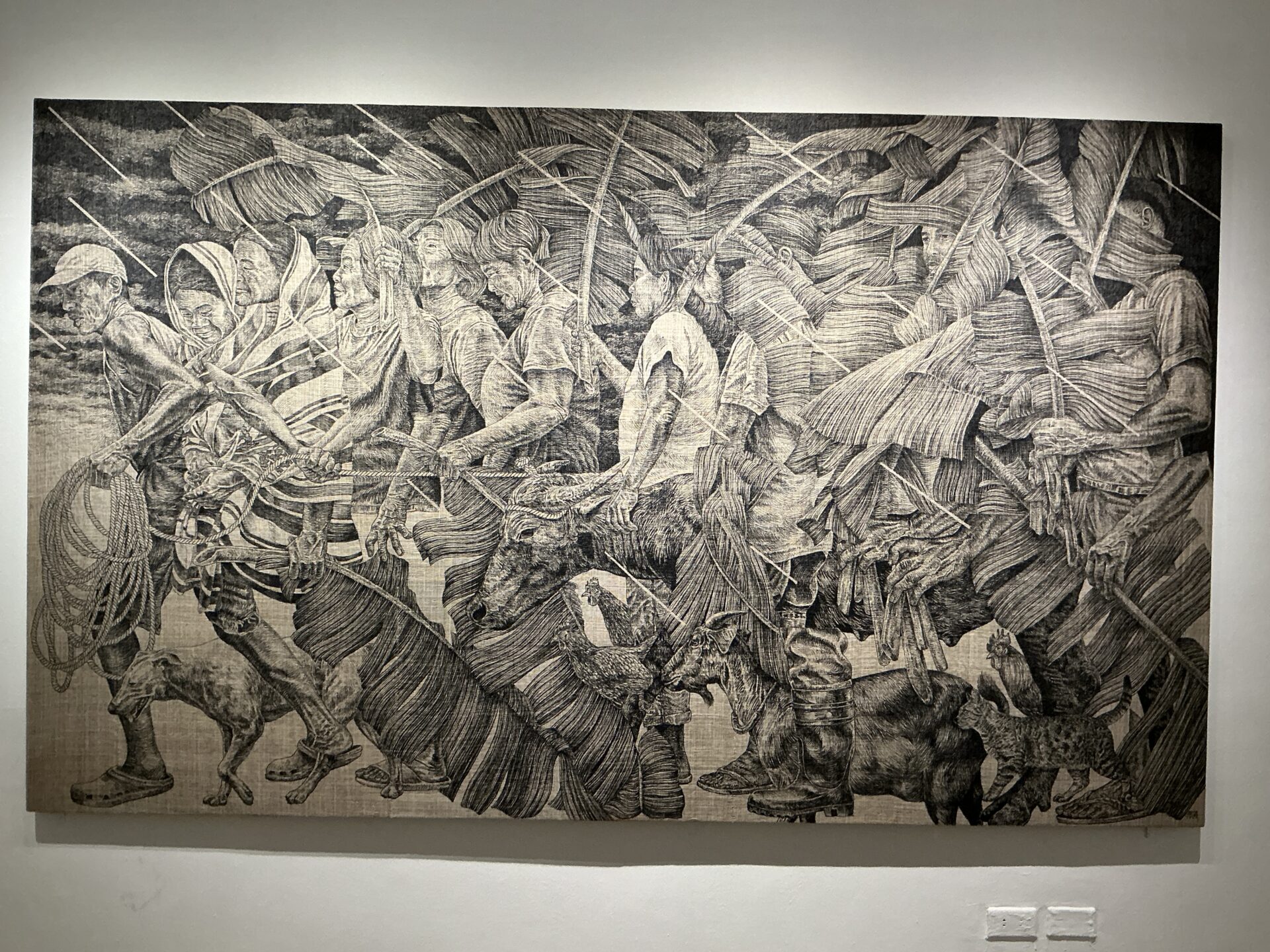
In this exhibition, Oclos reveals his mastery of figuration with meticulous details in ink in gradient shades of black, white, and grey.
In freeze-frame style, he depicts multiple heads, faces, or arms or hands of the same person, like a time-motion study, to signify the physicality of movements in harvesting abaca. In all the works, abaca ropes slither, slide, and wrap itself on people’s legs, arms, and bodies, marking the continuity of abaca farming in the lives of Filipino farmers.
Sa Katiyakan ng Pagsikat ng Araw S2026:
Mga Rosas sa Hardin Series 1-10: A series of farmers’ hands: dark brown, wrinkled, gnarled, and calloused by a lifetime of exposure to the elements in working the land.
Mga Palad: The hands that work ceaselessly until old age, illness, and death take them away from the life of abaca farming.
Katanghalian: Eating salt and fresh chili with rice is common; even a single fish is luxury.
Sa Tahanan at Tahanan Pa Rin: A group of farmers, carrying abaca bundles on their heads and shoulders, boarding a public bus.
Gantimpala: Feeding the farm animals, the pigs and goats that are literally their piggy banks, and supplement their meager income from abaca.
Ang Mga May Akda: Moving forward, a group of farmers, men and women, walking or riding a carabao, carrying their wooden strippers, and surrounded by abaca fibers.
Philippine abaca: Abaca (Musa textilis) is indigenous to the Philippines and belongs to the banana family.It grows to four to seven meters and harvested for its fiber, considered as the strongest natural fiber.
Central to local livelihoods and culture, abaca-producing areas include the Bicol Region and Mindoro; Leyte, Samar, Negros Oriental, Iloilo and Aklan in the Visayas; and Mindanao. In 2025, total abaca production in the Philippines was estimated at 55.8 metric tons, according to Philippine Statistics Authority.
Abaca is mostly grown in small family farms around 1.5-2 hectares. Labor-intensive, abaca stalks are cut and collected, its fibers pulled and scraped by able-bodied men known for their mastery and technique, using a sharp blade and a wooden tool. After freeing the fiber strands, the pulpy material is scraped away. Fiber strands are washed, pounded, and dried in the sun.
For many indigenous and rural communities, abaca is not just any crop, it is part of their cultural identity embedded in traditional abaca weaving (sinamay, undyed abaca fabric, t’nalak of the Tiboli, and dagmay of the Bagobo with sacred motifs) and other abaca-related crafts and techniques handed down through generations.
Abaca in Philippine history: Abaca fibers have been woven into textiles and clothing since precolonial times; ropes and cords for fishing, hunting, and building; mats and baskets for sleeping, storage, ritual use, and for trade with neighboring countries. Under Spanish colonial rule, abaca was the second most important export after tobacco in the Manila-Acapulco galleon trade.
Known as “Manila hemp” (it is not true hemp), abaca was a vital material for ropes, sails and rigging for Spanish ships. By the 1920s, the Philippines supplied over 90% of abaca to the U.S. During World War 2, the Japanese destroyed abaca plantations in Davao to disrupt U.S. supply for naval and army equipment.
Historically, abaca’s main use was marine cordage such as ship ropes, cables, and fishing lines due to its strength and saltwater resistance, until the emergence of nylon. Today, abaca has become a key material in specialty paper: tea bags and coffee filters, banknotes and security paper, filter and industrial paper. Abaca is used as a replacement for glass fiber in automotive composites; abaca-based composites include car interior panels, reinforced plastics, and construction panels and boards.
The Philippines is the world’s largest exporter of abaca, supplying about 87% of global demand.
Archie Oclos (b. 1989): A BFA painting graduate of UP Diliman, he is a recipient of the Thirteen Artists Awards, Cultural Center of the Philippines, 2018 and a winner of the Ateneo Art Awards, 2019 and the People’s Choice Award for his work, Lupang Hinirang, 2018. It references social injustices and extrajudicial killings under former president Rodrigo Duterte.
Honored as one of the “Forbes 30 under 30 Asia” list in 2018, Oclos has been a recipient of the Asian Cultural Council Grant 2024 in New York and the Koganecho Area Management Grant, 2025 in Yokohama, Japan where his exhibit on abaca explores labor and maritime histories of the Philippines and Japan.