
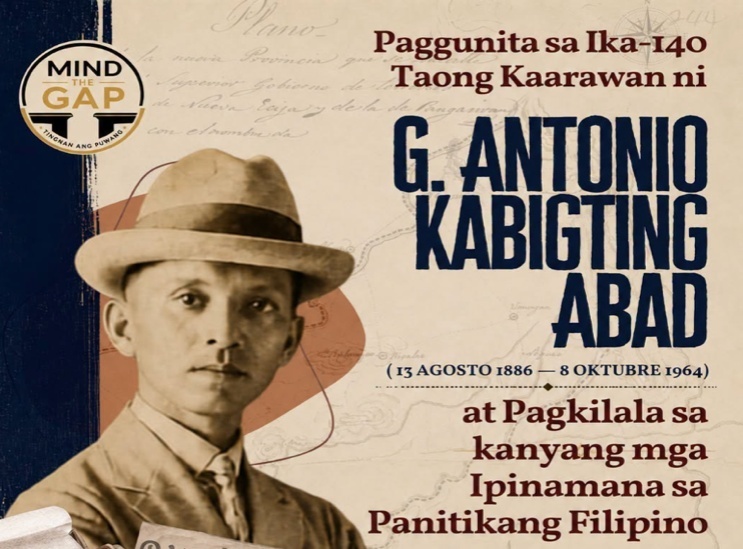
Antonio Kabigting Abad (1886-1964) is a forgotten Tagalog writer whose works deserve a second look. This is made more urgent by his 140th birth anniversary this August 2026 — fittingly, Buwan ng Wika and Buwan ng Kasaysayan, the country’s’ National Language and History Month.
Tellingly, only a few scholars at Polytechnic University of the Philippines (PUP) know that Abad had studied there in the late 1920s, when it was still known as the Philippine School of Commerce (PSC). Around that time, he was already working in government service and exposed to the political controversies of his time.
Three studies map the landscape of PUP’s institutional and cultural history. In 2004, Isang Pagdiriwang ng Sandaang Taong Sosyo-Politikal na Pakikibaka ng PUP Mga Piraso ng Kasaysayan at Edukasyon, 1904-2004 (A Celebration of PUP’s Centennial: Years of Socio-Political Struggle: Pieces of Histories and Education, 1904-2004) by Ave Perez Jacob was published. It was the first comprehensive attempt to write PUP’s institutional and social history in Filipino. In 2015, Mark Joseph N. Rafal edited a poetry anthology, 111 Pylon: Isang Daang Labing Isang Mga Tula ng mga Makata ng PUP with a critical introduction and literary history that would later become the foundation of his graduate thesis, Pylon: Pagmamapa ng Kasaysayang Pampanitikan ng Politeknikong Unibersidad ng Pilipinas (Pylon: Mapping the PUP Literary History), defended in 2018.
Rafal’s primary data was thin, with almost no archival work, and several authors, cultural organizations, and literary publications affiliated with PUP were also omitted from the study. In 2022, another essay, Ang Paghahanap sa mga Putol-Putol na Naratibo, o Kung Bakit Mahalagang Buuin ang Mumunting Kasaysayan (The Search for Unfinished Narratives, or Why It Is Important to Construct Little Histories), by Dr. Pedro Jun Cruz Reyes, was published in Entrada Journal. Reyes’s central problem concerns technological revolution and history from the concept of unintended effects, which he attributes to Adam Smith’s The Wealth of Nations. His work was meant to highlight the university’s role in constructing “little histories” amid what he called an age of historical silencing.
Yet Reyes makes no mention of Abad’s work, even though he discusses Aves de Rapina in El Renacimiento/Muling Pagsilang. The omission is ironic: Reyes set out to highlight PUP’s role in knowledge production and to counter historical silencing and misinformation — but overlooked one of the university’s own.
I believe the blind spot in all three studies stems from two factors. First, they are heavily invested in the Cold War era, as if PUP’s intellectuals and writers emerged only during Dr. Nemesio Prudente’s term as president of the university. Second, they lack primary archival data, especially for the American colonial period, 1898-1941.
Last year, 2025, PUP marked its 120th founding anniversary; none of the festivities recognized Abad’s legacy as a Tagalog fictionist and essayist shaped by “Sintang Paaralan, “as it is fondly called by alumni.
This is why commemoration and memorialization remain relevant today. It may be a first step toward a counter-narrative to a historiography that has favored intellectual hegemons in knowledge production. To memorialize is to study the data that already exists. In Paulo Freire’s words, “to study is not to consume ideas, but to create and re-create them.”
In 1904, the Manila Business School once located in Calle Gunao in Quiapo — also called the Manila School of Commerce — was founded two years after US President Theodore Roosevelt declared the Filipino “insurrection” at an end. It aimed to train personnel for the colonial government’s civil service and to provide skills for private-sector work. It offered technical courses like typing, bookkeeping, stenography, and telegraphy. In 1908, it was renamed the PSC, to reflect the widely dispersed provincial origins of many of its students.
Abad was one of the bright minds who enrolled at the school during the advent of US imperialism in the Philippines. In 1928, he moved to Manila and enrolled in PSC. The paucity in his academic records does not allow us to identify which course he took or whether he was able to complete his studies there.
He was born in San Isidro, Nueva Ecija, one of the sons of Anastacio Santiano Abad and Hermogena Y. Kabigting of Arayat, Pampanga.
He was already ten years old when the Katipuneros declared their anti-colonial revolt against Spanish rule. In 1905, Abad passed third grade civil service examination, then he held various government positions, among them chief clerk of the District Engineer’s Office in the provinces of Rizal and Nueva Ecija from 1911 to 1920, then ventured into business from 1921 to 1935, and became a special investigator in the Department of Labor. In 1922, he was linked to the opposition and became part of the Partido Democrata Nacional (Democratic Party) in Nueva Ecija. Because he was active in electoral politics, he later became a leader of a coalition that was a fervent follower of the Partido Nacionalista (Nacionalista Party) and of the renowned leaders of the Buencamino faction in Nueva Ecija. His last government post was Chief of the Disbursement and Property Division of the Philippine Senate, after the Japanese Occupation, until his retirement on September 30, 1952.
Abad’s writings are dispersed across several periodicals such as Muling Pagsilang, Ang Democracia, Ang Bayan, Taliba, Renacimiento Filipino, and Ang Mithi. On 7 September1907, Abad’s Unang Paghihimagsik sa Nueva Ecija Septiembre ng 1896 (The First Revolt in Nueva Ecija in September 1896) began publication as a serialized piece in Muling Pagsilang. He used pen names such as Abakada, Batang Katipunan, Matang-Pusa, and Akasia. On 30 October 1908, the editorial Aves de Rapina, authored by Fidel Reyes, was published in El Renacimiento; the case US v. Martin Ocampo (G.R. No. L-5527, 22 December 1910) would become the basis of a defamation and libel case against Filipino journalists and anti-imperialists at the height of American imperialism in the Philippines. It was part of the American colonial government’s repression under the Sedition Law of 1901. During those years, Abad was already a contributor to Muling Pagsilang, the Tagalog section of the El Renacimiento, from September 1907 to 1912. He was conscious of the political climate and the El Renacimiento/Muling Pagsilang being critical to the imposed repressive policy such as of the US colonial government on the country.
In 1910, he won the first place on literary contest organized by Kapisanang Sulong sa Ikalalaya (March for Freedom Organization) in Pasig. He wrote a novellete, Bakas ng Himagsikan (Traces of Revolution) under the nom de plume Batang-Katipunan. The story is about Katipuneros who fought in the Battle of Aliaga, Nueva Ecija in 1897 against Spanish colonizers. The piece was meant to encourage the revolutionary spirit and continue resistance against American imperialist forces amidst the implementation of Brigandage Act 1902, The Reconcentration Act of 1903, and the Flag Law of 1907, laws that sought to suppress the anti-imperialist movement. It also highlighted women leadership of a revolutionary force and the memory of revolutionary martyrs. In the same year, Ang Sumpa ko under the name of Akasia and Wakas ng Palad was also published.
Abad had a special interest in the leaders of the anti-imperialist resistance. He wrote books about them. In 1919, his “Ang Pagkanulo kay Heneral Aguinaldo (The Betrayal against Aguinaldo) was released. In 1926, Ang Mahiwagang Pagkamatay ni Heneral Luna (The Mysterious Death of General Luna) was published as a pioneering study of the cause of death of the Filipino general. In 1955, he published, Gen. Macario L. Sakay (the only President of the Tagalog Republic) was he a bandit or a patriot?
He was also a member of Aklatang-Bayan, an organization of writers writing in Tagalog, Spanish, English, and other languages. Its uniting principles were once published in the Renacimiento Filipino that sought “to struggle against vices, evil-doing, and beliefs, in politics, religion, and in everyday life, inasmuch as these are supposed to be the foundation of everything…”
Among the honors he received was the Rizal Pro Patria Award, conferred on the centenary celebration of Dr. Jose Rizal on 19 June 1961. The Award, created by Executive Order No. 429, of President Carlos P. Garcia on 2 June 1961, was given to outstanding individuals, Filipinos or foreigners alike, whose professional, civic, or artistic achievements echoed the national hero’s ideals.
Receiving this presidential honor reflects an outstanding character — that of a patriotic and responsible Filipino citizen — worth remembering amid moral decay and threats to State security. It recalls the spirit of Republic Act 1425, the Rizal Law, which also happens to mark its 70th anniversary this year.
Abad’s life and legacy remind us that the failure to critically examine the record of the past creates opportunities for false accusations. This is precisely what is happening now, as history demands an explanation, one that we owe to future generations.
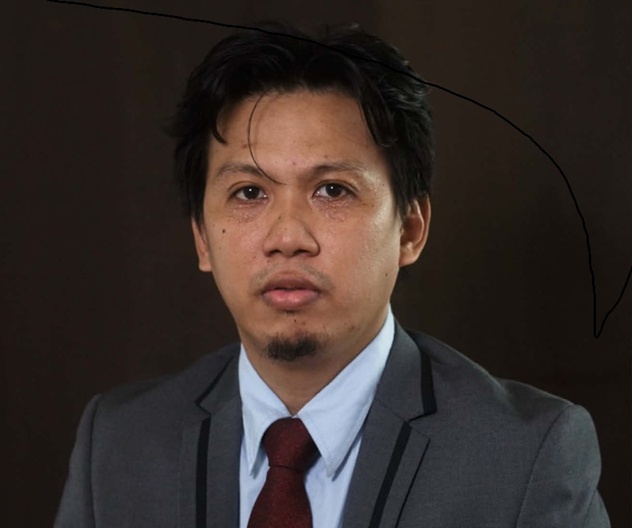
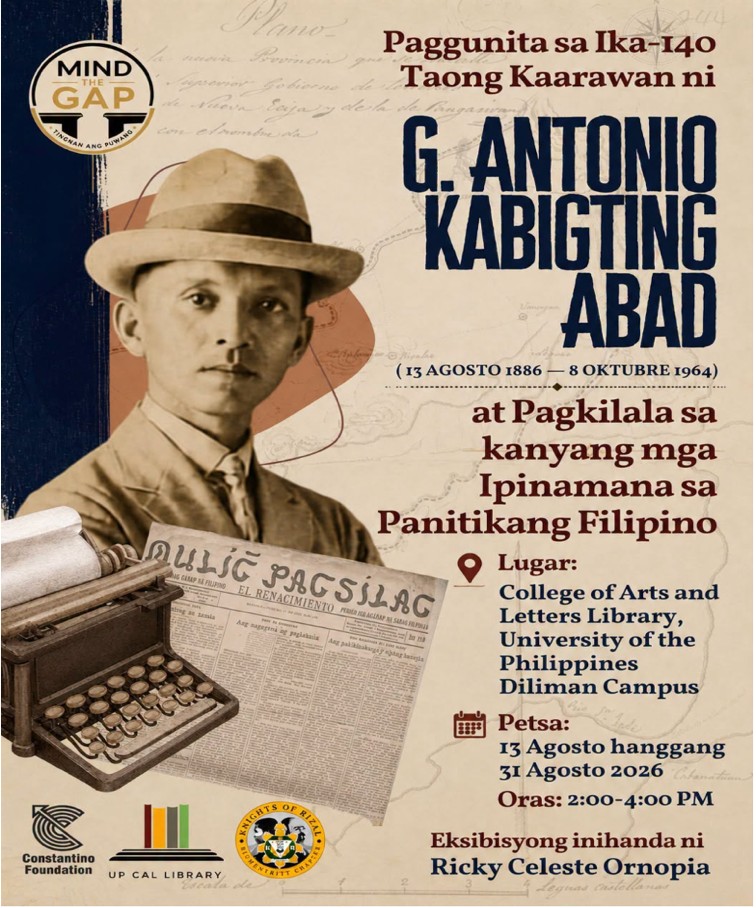
*The author studies German language and literature at the University of the Philippines. He is curator of an exhibit on Antonio Kabigting Abad’s legacy at the UP College of Arts and Letters (CAL) Library, running from 13 August-30 August 2026, under the auspices of the Constantino Foundation, the Knights of Rizal, and the CAL library.