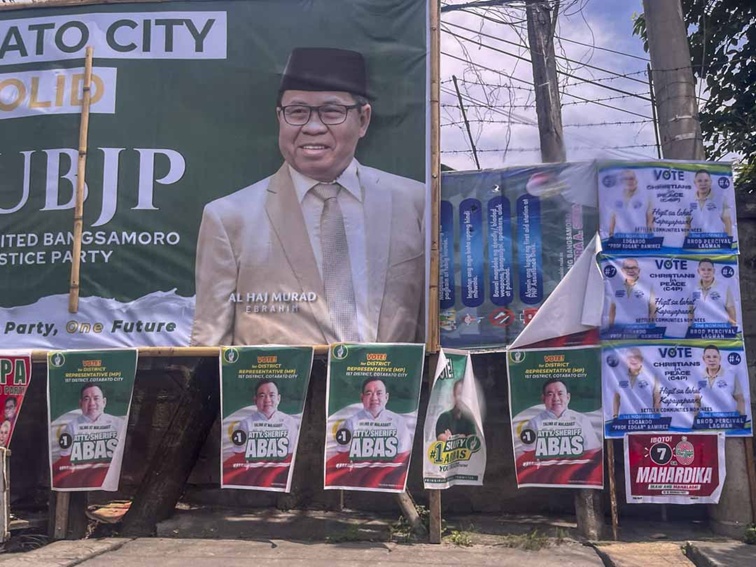

BARMM is slated to have its first parliamentary elections on September 14 after four postponements, the earliest being in May 2022.
An estimated 2.393 million registered voters will participate in the election across the region’s five provinces and Special Geographic Areas. In preparation, President Ferdinand Marcos Jr. signed Memorandum Order No. 48 s. 2026, green-lighting the deputation of law enforcement agencies, including the Armed Forces of the Philippines (AFP), to ensure a “free, orderly, honest, peaceful, and credible elections.”
Philippine National Police (PNP) chief Jose Melencio Nartatez has followed suit, stating, “We will not allow violence or the proliferation of loose firearms to undermine the upcoming elections.”
Despite these pronouncements, which also includes a ban on firearms from July 16 to September 29, violent incidents remain consistent. The Critical Events Monitoring System (CEMS) of the Climate Conflict Action reported that gun violence actually increased after the ban was enforced. From July 16 until the end of August, 39 deaths due to gun violence have been recorded by CEMS. During the same period, the Sandatahang Dahas Monitor of the UP Third World Studies Center recorded six killed in incidents of state-related violence, defined here as killings and injuries caused by or inflicted on state agents of the Philippines.
Two days after the ban took effect, two soldiers and three civilians were injured in a grenade explosion in Shariff Aguak, Maguindanao del Sur. Two men riding a motorcycle tossed a grenade at a KM 450 military vehicle. The incident left Cpl. Jessie Jay Bulanay and Cpl. Arnel Calapan wounded from the shrapnel. The blast also injured John Dave Usman Santiago, Bassir Amban Batong, and Pamiya Upam Bulingkig.
While an investigation is still ongoing to identify the suspects, the intelligence unit of the 6th Infantry Division have relayed that Dawlah Islamiyah may be behind the attack, allegedly in retaliation for their fallen members. From January 2025 to August 2026, 33 alleged members of the Dawlah Islamiyah have been killed in BARMM. Outside the region, an additional eight have been killed in neighboring provinces in Northern Mindanao and SOCCSKARGEN during the same period.
Nevertheless, President Marcos Jr., through Palace Press Officer Claire Castro, has denied that these incidents are election-related, instead classifying them as personal disputes.
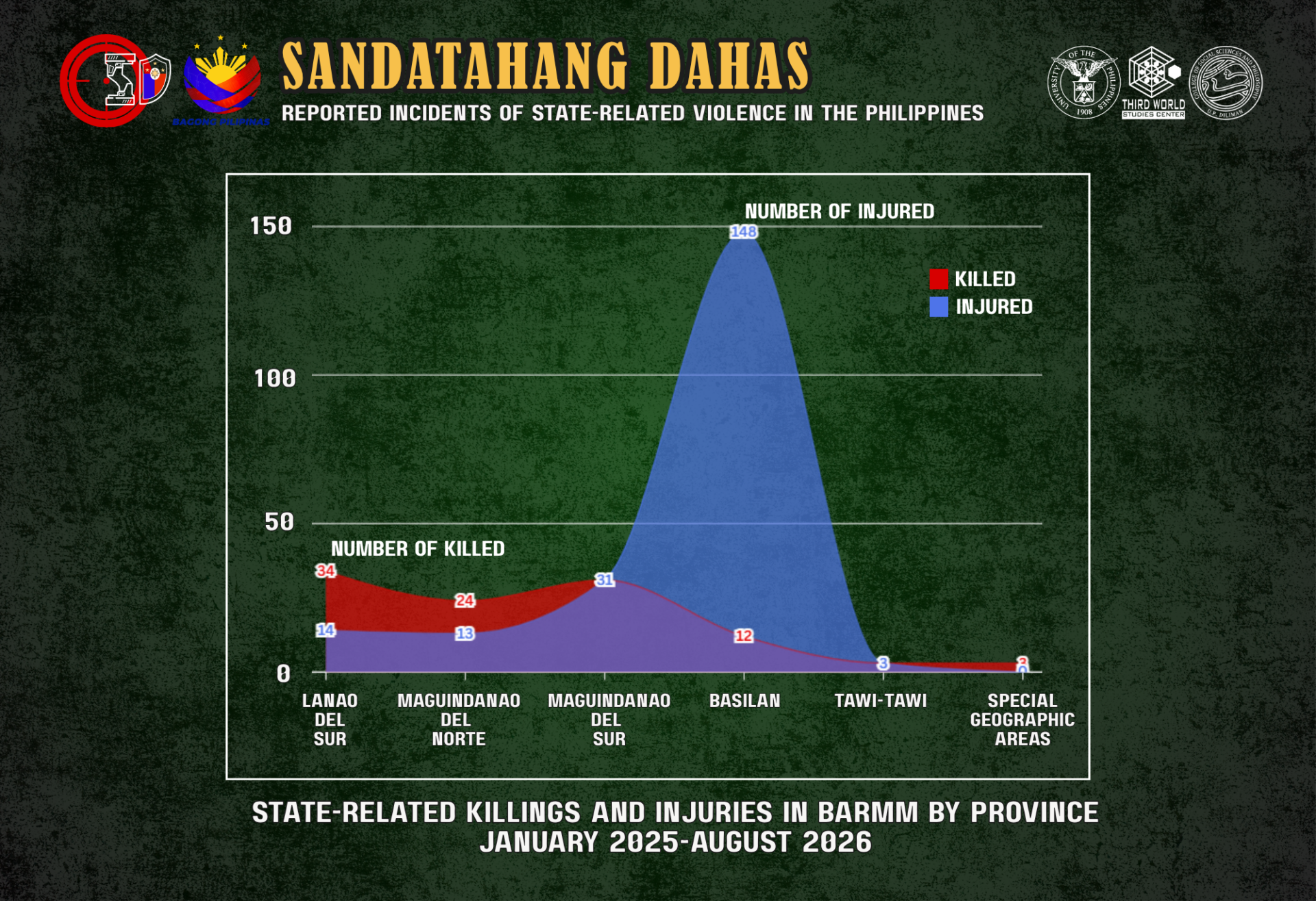
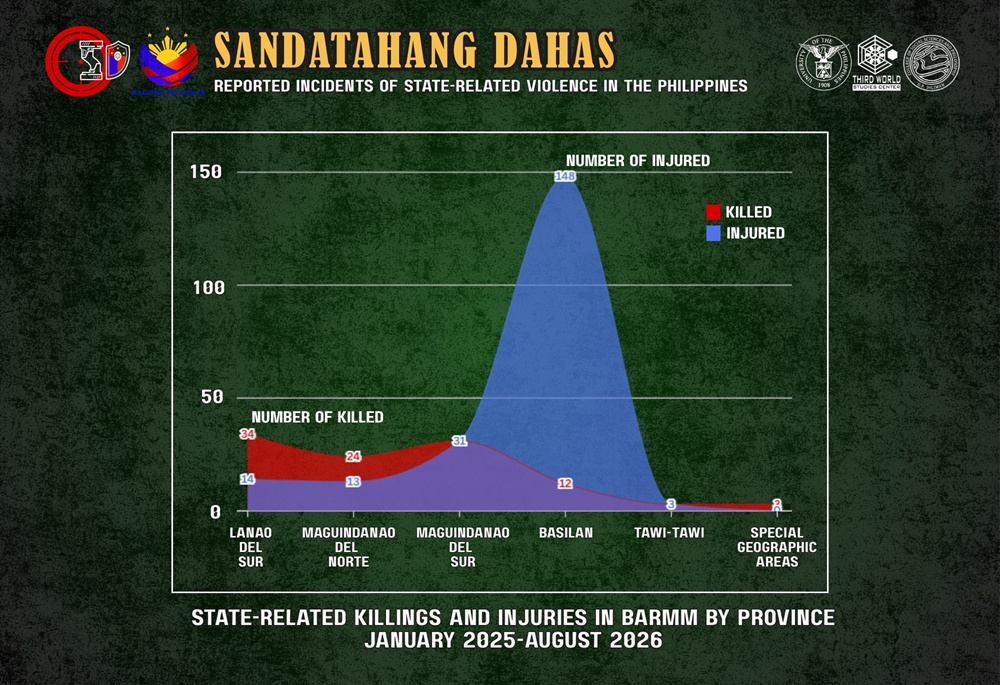
BARMM is a consistent hotspot of state-related violence, according to the Sandatahang Dahas Monitor of the UP Third World Studies Center.
In 2025, BARMM had the highest number of state-related killings in the country: 56. Almost half of these (25) were civilians, while alleged insurgents made up 35 per cent (20 of 56). The remaining 11 individuals were state agents killed–either in the line of duty or during personal altercations.
This number may soon be surpassed in 2026. From January to August, there have already been 51 monitored killings in the region: 19 civilians, 17 alleged insurgents, and 15 state agents.
Dawlah Islamiyah is said to be behind the killings of 10 state agents. Half of these were on March 28, 2026, when a group of police officers were ambushed in Shariff Aguak, Maguindanao del Sur as they were on their way back to their headquarters at Camp Datu Akilan. The incident left five policemen dead and critically wounded three others.
A month later, on April 26, three Dawlah Islamiyah members were killed in an encounter with the AFP in Datu Hoffer, Maguindanao del Sur. Rasul Moksim, Salik Bona, and Mohammad Sendig were said to be involved in the March 28 ambush. On June 6, another one of the alleged suspects, Nickson Gayak Kamangon alias “Nexon,” was arrested.
From the start of the year until August 2026, BARMM has also been the center of killings in drug operations by the police, the Philippine Drug Enforcement Agency (PDEA), as well as the military and the navy. Out of the 65 recorded in 2026 so far, 23 such killings have been documented in the region: 12 civilians, 10 alleged Dawlah Islamiyah members involved in the drug trade, and one state agent, a PDEA intelligence officer.
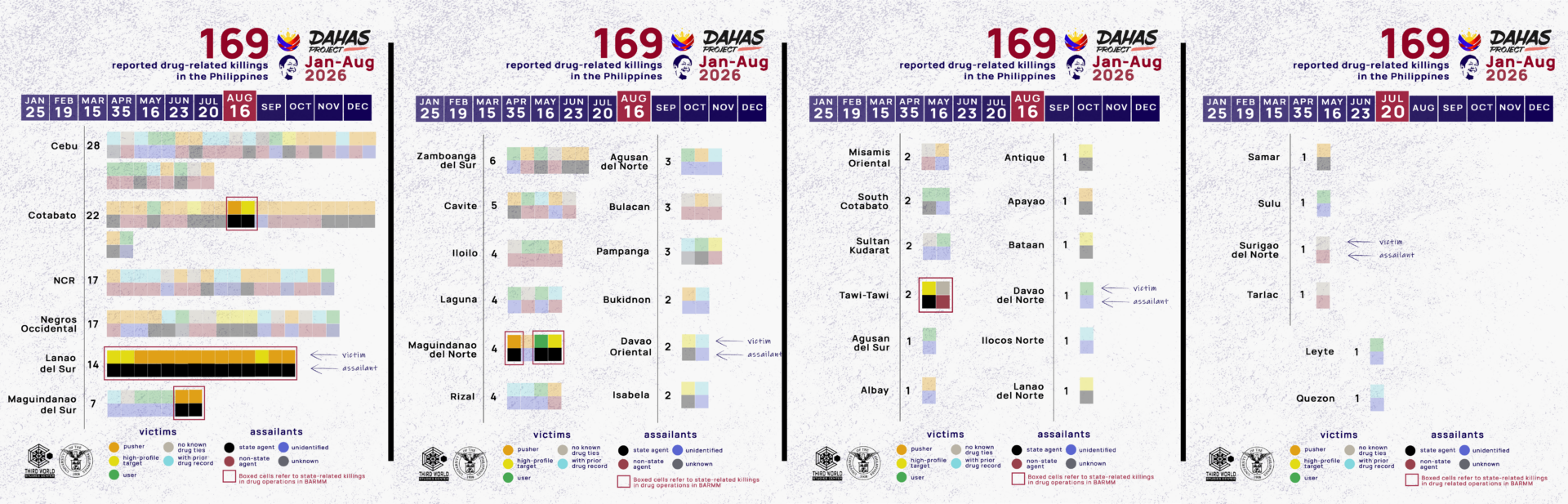
On April 17, police and military forces served a warrant against Amerol Mangoranca alias “Usman” in Marantao, Lanao del Sur. The operation turned violent, resulting in 10 dead, including Mangoranca: six men and four women. They were reportedly members of Dawlah Islamiyah and behind a number of crimes in the region, including drug trafficking and an ambush against soldiers in Munai, Lanao del Norte last January 23. A one-year-old infant was also wounded during the April 17 encounter.
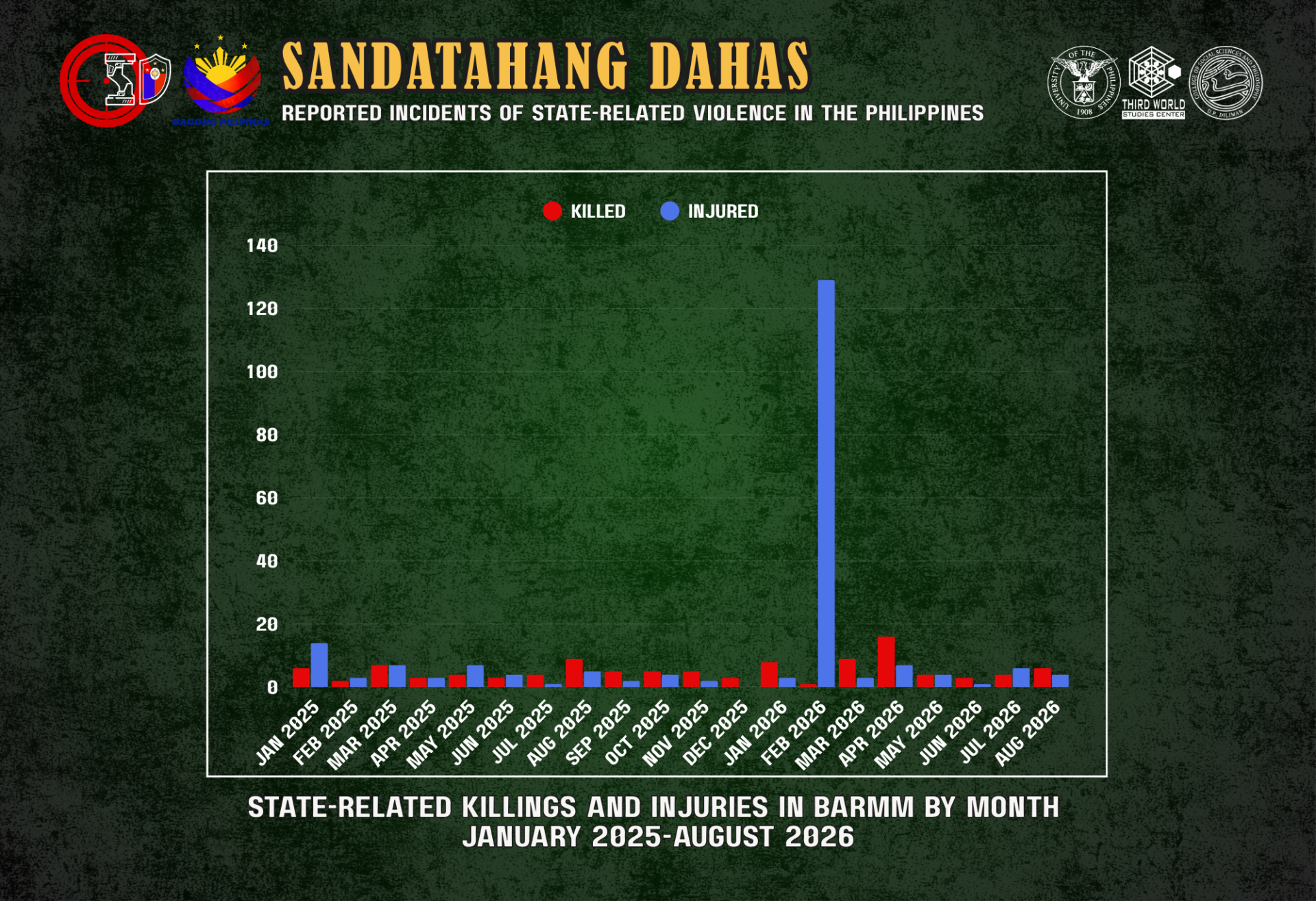
It was not only civilians and alleged insurgents that state agents harmed; violence among state agents accounts for the most number of injuries in BARMM from 2025 to August 2026.
On February 5, 2026, 129 newly recruited policemen to the Regional Mobile Force Battalion (RMFB) 14-B of the PRO BAR filed complaints against 57 of their superiors who brazenly hazed them during a “welcome rites” ceremony in Lamitan, Basilan. Incidents of the superiors punching, kicking, and hitting the new recruits with arnis were even filmed. PNP spokesperson Brig. Gen. Randulf Tuaño reported that 96% of the complainants had hematomas and contusions on their lower extremities while 4% had the same on their upper extremities. Two of the victims lost consciousness after being repeatedly struck with wooden sticks.
As a result, the entire RMFB 14-B were administratively relieved.
Most of the victims were police integrees from the Moro Islamic Liberation Front (MILF) and the Moro National Liberation Front (MNLF) who were recruited into the Police Regional Office of the Bangsamoro Autonomous Region (PRO BAR) as agreed upon by MILF’s peace pact with the national government.
MNLF chair Muslimin Sema condemned the incident, calling it a “criminal offense” and a “clear violation of the country’s Anti-Hazing Act of 2018.” Criminal charges have been filed against 12 of the policemen involved in the abuse, including RMFB 14 chief, Col. Joel Estaris.
Sometimes, hazing between state agents turned lethal. On July 30, 2025, Pvt. Charlie Patigayon collapsed during a welcoming ceremony for new recruits of the 6th Infantry Battalion in Datu Piang, Maguindanao del Sur. He died the next day, which initial reports state was due to kidney failure. However, an ongoing investigation suspects that he may have been hazed. 21 army personnel were relieved to give way to the investigation.
As BARMM enters its historic first parliamentary elections, thousands of police and military forces have been deployed across the region in order to ensure a “safe” election season. However, public safety may not be so easily achieved since, as Sandatahang Dahas data has shown, state agents themselves are often the perpetrators of violence–even against their own.
Aidrielle Raymundo is a university research associate at the Third World Studies Center (TWSC), College of Social Sciences and Philosophy, University of the Philippines Diliman. She also did the graphics accompanying this report, with the help of Arrianne Louisse Fajardo. The data for this was compiled with the assistance of past and current student assistants of Sandatahang Dahas.