
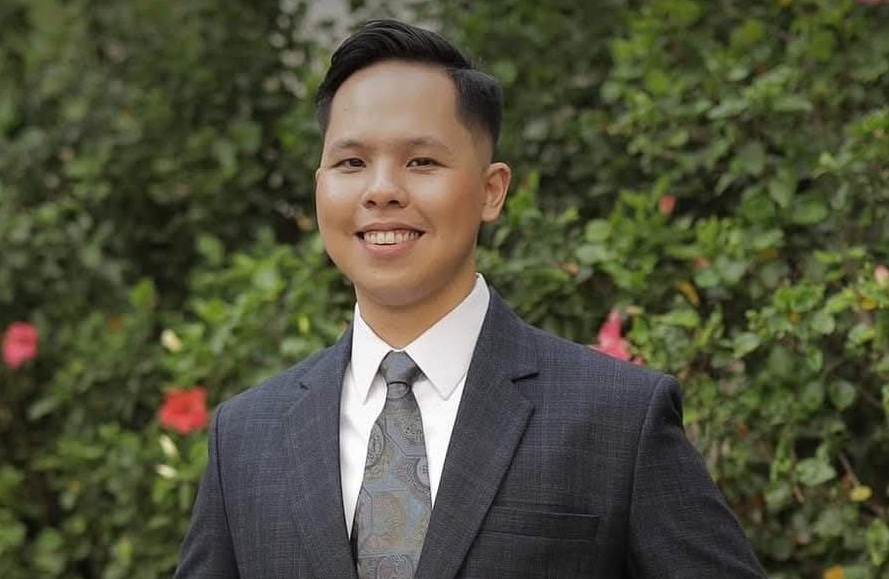
It just seems part of nature’s course that a boy’s falsetto lowers as he moves out of puberty. But some retain or choose to keep that voice the way countertenor Paul Ryan Arcolas does. In his case, he experienced an identity crisis with his voice post-puberty.
He recalled, “From singing soprano, my modal voice landed between the baritone and tenor ranges. Without proper guidance, I didn’t know how to navigate the male vocal sound. What was clear to me though was I was still able to use my falsetto easily. I have a more established relationship with this vocal register so I chose to pursue honing it more with the help of teachers, reading tons of material and staying curious. With this exploration, I felt freer and more secure about who I am and what I aspire to be as an artist.”
On March 28, Arcolas will regale his audience with a program of Handel, Faure, Elgar, Clara Schumann, Moore, Abelardo and Buenaventura at 7 p.m. at Varlez Piano, LGI Bldg. on Ortigas Ave. Greenhills, San Juan City. Accompanying him on the piano is Gabriel Allan Ferros Paguirigan. This is part of the Manila Chamber Orchestra Foundation’s Young Artists Series, made possible by Varlez Piano and DZFE.FM 98.7 The Master’s Touch.
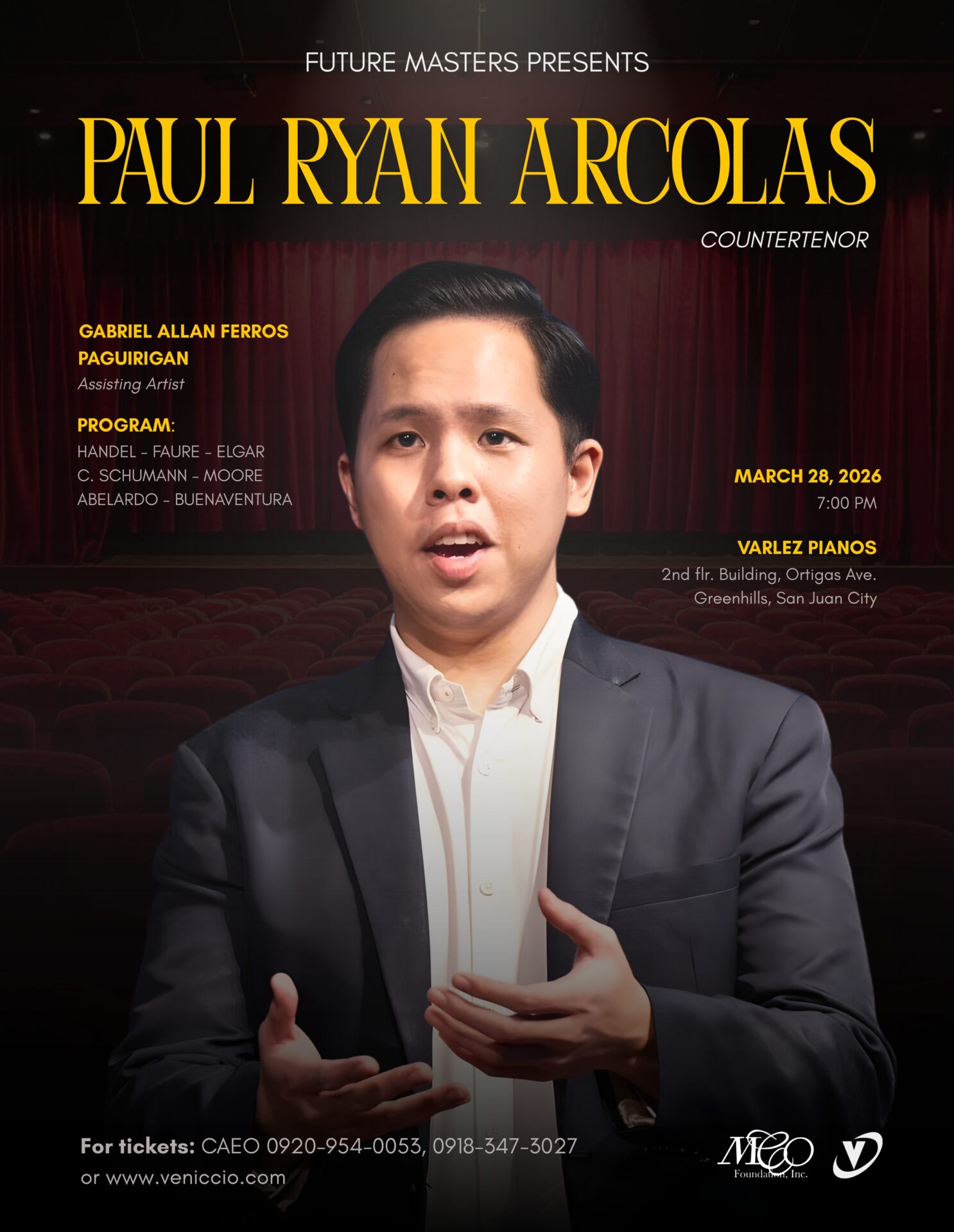
The second prize winner of the 2023 National Music Competitions for Young Artists (NAMCYA) and a member of the internationally acclaimed all-male choir Aleron, Arcolas credited teachers like baritone Christopher Arceo for awakening his “love for learning the voice as an instrument” and soprano Camille Lopez Molina of Viva Voces who “made me focus on simplicity, clarity, and efficiency of using the instrument.
He said Arceo gave lots of importance on building the singer’s own instrument, then combining and utilizing the strength of these instruments, instead of focusing only on creating one homogeneous sound. “I took lessons with him and saw that even if he was my teacher, he kept on asking me questions like ‘What did you feel about that? What was the difference between this and how you did it earlier? Why did that feel good? Why is this approach inefficient?’ These made me fully commit to the process and ultimately, I became my own voice teacher. He made a tremendous impact on who I am as artist.”
Arcolas also had premier tenor Arthur Espiritu as vocal coach, saying that it was “a tremendous experience! Since he is active and quite big in the classical music scene today, I found that his teaching methods were practical, straightforward and exploratory. Coupled with the brilliance and sensitivity of pianist Najib Ismail, my collaboration with them was nothing short of extraordinary. They challenged the ideas I brought, affirmed my artistic decisions and carved out a greater path to where I can take the music further.”
He dispelled misconceptions that the countertenor is a woman’s voice. He said, “Thankfully, I never got discriminated for the register I choose to mainly sing in. But I feel the significance of making it clear to people if ever they have any questions about it. Vocal registers—chest, falsetto and head—are built-in in all functioning voices. These are natural functions of the human larynx through manipulation of the vocal cords. Inability to access these registers are often caused by tension or lack of coordination.”
He continued, “The registers we choose to sing in do not make us lean more towards a specific gender—countertenors wanting to sound like women or contraltos wanting to sound like men. What we choose to cultivate in our instruments and which direction we take it are what makes us unique as singers.”
Asked more of the history of his voice, he explained that the countertenor repertoire was mainly built on compositions during the time of castrati singers (mid-16th to early 20th century). “Countertenors are mostly associated with Baroque composers like Handel, Vivaldi, Gluck, Monteverdi and Pergolesi to name a few. Mozart and Rossini also wrote for castrati singers and are now often shared by both countertenors and female singers dressed up as men or what’s called trouser roles.”
In the contemporary world, he said there have been composers who have written for countertenors such as Benjamin Britten, Philip Glass, Jake Heggie and Matthew Aucoin.
Arcolas favors the music of Claude Debussy, Reynaldo Hahn, Henri Duparc, Manuel de Falla, Ricky Ian Gordon, the Boulanger sisters, Rebecca Clarke, Clara Schumann, Francis Poulenc and Filipino composers like Abelardo, Cuenco and Santiago.
Of his memorable performances, he mentioned being selected by Dr. Beverly Shangkuan Cheng to be one of 16 soloists for a performance of “Serenade to Music” by Ralph Vaughan Williams. The event also served as Dr. Cheng’s conducting debut with the Philippine Philharmonic Orchestra and Arcolas’s first time to perform at The Metropolitan Theater. He said, “To be surrounded by such an enormously talented group of singers and instrumentalists was amazing.”
He also remembered what a nervous wreck he was backstage before the finals for the 2023 NAMCYA Senior Voice. Nevertheless, when he stood at center stage, “I was filled with passion, gratitude and excitement for the fruition of my months-long hard work. I sang my heart out. Hearing the applause and support of the audience made me feel like whatever the results were, I was triumphant.”
After the March 28 concert, Arcolas will be busy with Aleron Voice Studio’s first opera production of Stravinsky’s Oedipus Rex scheduled on June 20 and 21. He will be its artistic head and vocal coach.
As to his favorite tenors and countertenors, he said, “I am deeply inspired by the artistry of tenor Enrico Caruso whose remarkable talent made an impact on the opera art form comparable to that of Maria Callas. Other top picks are Jerry Hadley, Franco Corelli and Luciano Pavarotti. For countertenors, I learned a lot listening to Russell Oberlin whose voice had a lot of clarity, nuance and simplicity. I am also an avid listener of Iestyn Davies, Keymon Murrah, and Michael Maniaci.”
His favorite aria is “Amour, viens rendre à mon âme” from Gluck’s Orfeo ed Euridice. He said, “I studied this French aria for almost a year before joining NAMCYA. I eventually sang it in the competition. Aside from its bravura nature, it is filled with hope and desire that perfectly depicts Orpheus’s yearning to take back Eurydice from the underworld. I built a solid relationship with this piece and worked through its most challenging parts, and the experience captured the very essence of what it means to be an artist: not knowing where your art takes you and doing it anyway. As philosopher and musicologist Theodor Adorno wrote, ‘All of opera is Orpheus.’
For tickets, contact the Cultural Arts Events Organizers at 0920-954-0053 or 0918-347-3027, or email josephuy2004@yahoo.com. Tickets are also available at www.veniccio.com.