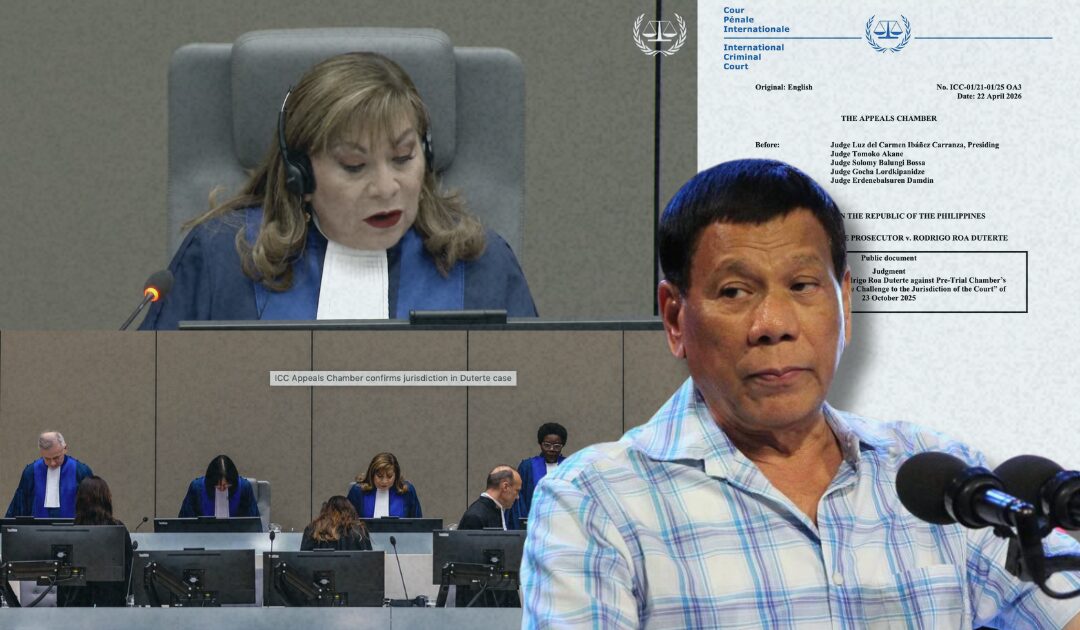

Former president Rodrigo Duterte will stay in detention in The Hague, Netherlands.
This follows the International Criminal Court’s decision to reject his appeal challenging the tribunal’s jurisdiction over charges of human rights violation against him, clearing a major roadblock to a trial if the allegations are confirmed.
The ICC’s Appeals Chamber, composed of five judges, affirmed by majority vote the Oct. 23 decision of its Pre-Trial Chamber I that the court has legal power over drug war killings committed when the Philippines was still a member of the Rome Statute, the treaty that established the ICC.
“The appeal chamber, by majority…has rejected all four grounds of appeal. Having rejected the entire appeal, the appeals chamber considers that the defense request for the immediate and unconditional release of Mr. Duterte is moot,” Judge Luz del Carmen Ibáñez Carranza read the summary judgment in an open court hearing on April 22.
Duterte was not present at the hearing as he waived his right to appear, but was represented by his defense team led by Nicholas Kaufman.
One of the grounds raised by the defense was that the pre-trial judges erred in their interpretation of the state withdrawal provision in Article 127 of the Rome Statute in relation to the conditions of jurisdiction in Article 12.
The Appeals Chamber, however, ruled that these provisions must be interpreted in a manner that aligns with the object and purpose of the statute, which is to “put an end to impunity for the perpetrators of the most serious crimes of concern to the international community as a whole, and thus to contribute to the prevention of such crimes.”
“It would be incompatible with this object and purpose to enable a State Party to evade its responsibilities under the Statute by depositing a written notice of withdrawal once it discovers that alleged crimes committed on its territory or by its nationals are being examined by the Prosecution,” Carranza said.
Contrary to the defense’s argument, the chamber also found no error in the conclusion of the pre-trial judges that Duterte’s case was already “under consideration” when the withdrawal of the Philippines took effect in 2019. Judge Gocha Lordkipanidze partially dissented with the majority.
Under the Rome Statute, a country’s withdrawal shall not “prejudice in any way the continued consideration of any matter which was already under consideration by the Court prior to the date on which the withdrawal became effective.”
The pre-trial judges ruled that the preliminary examination opened by then prosecutor Fatou Bensouda in 2018 constitutes a “matter under consideration.”
The appeals chamber also rejected the third ground of appeal, in which the defense argued that the term “court” does not include the Office of the Prosecutor and therefore the Prosecutor’s preliminary examination alone cannot satisfy the condition for continued consideration of the case.
“The appeals chamber considers that the defense has failed to show how the Pre-Trial Chamber erred in finding that the term ‘the court’ includes the Office of the Prosecutor for the purposes of Article 127 (2),” Carranza said.
The fourth ground of appeal, which contends that the PTC made an error of law when it permitted the opening of an investigation even after the effective withdrawal of the Philippines from the Statute, was also dismissed.
Rights to truth and justice
For the relatives of extra-judicial killing victims, the decision was a victory of their right to truth and justice.
“The victims also view the Appeals Chamber Decision as the triumph of their right, under international law, to truth and justice for their loved ones murdered under Mr. Duterte’s anti-drug campaign. The Appeal Decision effectively affirms that the ICC proceedings are also victim centered,” lawyers Joel Butuyan and Gilbert Andres, common legal representatives of victims in the case, said in a statement.
“The Appeals Chamber decision sends a strong message to the international community of states that mere withdrawal from the Rome Statute does not protect responsible state officials from criminal accountability for international crimes such as crimes against humanity,” they added.
Meanwhile, the National Union of Peoples’ Lawyers said the former president cannot hide from the consequences of his actions.
“You [Duterte] must accept the reality that you have to be accountable & that your imagined invincibility for the longest time has been shattered not by disingenuous populism nor fleeting power but by inevitable perdition,” a statement from NUPL Chairperson Edre U. Olalia read.
Romel Bagares, former counsel of the Coalition for the ICC hailed the What he describes as “an historic and far-reaching ruling.”
“From now on, no member state may evade accountability for atrocity crimes by simply being allowed to withdraw from its Rome Statute obligation.” he said.
Defense not surprised
Kaufman, however, said the defense is not surprised by the decision.
He added that his camp is looking forward to the ruling on the confirmation of charges hearing held last February, expressing hope that his client would be acquitted and allowed to return home.
Duterte, who has been detained in the Scheveningen prison in the Netherlands since March 2025, faces three counts of murder tied to his anti-drug war campaign as Davao City mayor and president.
The Pre-Trial Chamber I is expected to issue a separate ruling by the end of the month on whether to confirm the charges, seek additional evidence, or dismiss the case.
Neri Colmenares, counsel for a number of EJK victims, said he is “confident that the charges will be confirmed now that the jurisdiction has been affirmed and trial will eventually follow. “We don’t know what the result of the trial will be but at least the victims will have the opportunity to present their side of the story pf how heir loved one were mercilessly killed during Duterte’s drug war,” he said.