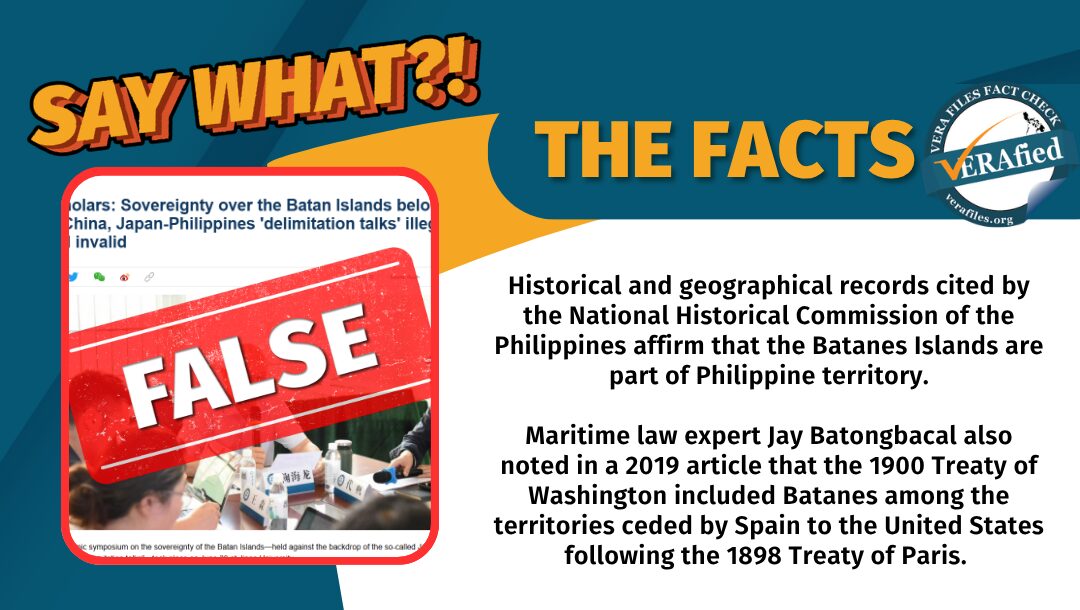


Ahead of the 10th anniversary of the landmark 2016 arbitral ruling, Chinese state media reported a claim that the Philippines’ northernmost Batanes Islands belong to China through Taiwan, citing the conclusions by some academics during a purported symposium on June 30. This is not true, based on the local evidence and international treaties.
Published on July 2 by Guangdong-based news outlet Newsgd, also known as South, the exclusive report said the Chinese scholars who attended the event “unanimously concluded that the Batan Islands constitute a natural geographical extension of Taiwan, with sovereignty belonging to China, and that so-called Japan-Philippines maritime delimitation negotiations in the area hold no legal validity.”
A week later, China’s national state media, Global Times, reported on the symposium, noting that “[s]everal scholars said that China’s sovereignty over the Batanes Islands is supported by ample historical evidence and a solid foundation in international law.”
PH’s geographical, historical records
In a July 10 statement, the National Historical Commission of the Philippines, the government agency mandated to promote the country’s history and preserve cultural heritage, refuted the “so-called” scholars’ assertion that Batanes is a “natural geographic extension of Taiwan.”
“Current satellite and oceanographic data by the Philippines and other nations clearly show a continuous shelf extending from Northern Luzon through the Babuyan & Batanes Islands, and into parts of the Taiwan archipelago,” the NHCP said.
“The Philippines claims a greater right over the subject territories from this perspective,” the commission added.
A university dean in the academic symposium also claimed that the Batanes Islands were “under the jurisdiction of Taiwan Prefecture during the Ming and Qing Dynasties,” which existed from roughly the 1360s up to the 1900s.
But a brief timeline provided by the NHCP within that historical period indicated otherwise:
- 1687: British explorer William Dampier produced the “earliest known extensive documentation” of Batanes, which showed “no trace of Chinese governance.”
- 1783: Batanes was formally annexed by Spain into Cagayan province, noting that successive Philippine governments have exercised “continuous and undisputed sovereignty” over the islands since then.
- 1896: The islands were “already recognized as an integral part of our country’s territory” during the Philippine Revolution and the First Philippine Republic, with an elected government and a representation in the Malolos Congress.
Likewise countering the claim that Batanes should have been returned by Japan to China post-World War II, the commission said “Japan cannot give to China what clearly belongs to the Philippines,” noting that the people of Batanes had already liberated themselves from Japanese rule by early 1945.
“This only proves beyond any doubt that Batanes has always been Filipino,” the NHCP said.
Backed by int’l treaties
Under the 1935 Constitution, the Philippine national territory was legally defined as being comprised of all territories ceded to the United States by Spain in the 1898 Treaty of Paris, together with all the islands embraced in the 1900 Treaty of Washington and the 1930 Convention between the US and the United Kingdom.
“The territorial lines drawn by the first and third agreements, combined and appearing as an irregular ‘box,’ have comprised a technical description of our territorial boundaries,” according to maritime law expert Jay Batongbacal in his 2019 article published on the University of the Philippines website.
Such description, Batongbacal said, “[created] anomalies because the Treaty of Paris left some features (e.g., the Batanes Islands, the Turtle Islands, one-half of Sibutu Island and Scarborough Shoal) outside the box.”
However, he noted that “the Treaty of Washington states that such islands also deemed to have been subject to the cession are part of Philippine territory.”
In particular, the sole provision under this treaty reads:
“Spain relinquishes to the United States all title and claim of title, which she may have had at the time of the conclusion of the Treaty of Peace of Paris, to any and all islands belonging to the Philippine Archipelago, lying outside the lines described in Article III of that Treaty and particularly to the islands of Cagayan, Sum and Sibutu and their dependencies, and agrees that all such islands shall be comprehended in the cession of the Archipelago as fully as if they had been expressly included within those lines.”
‘Lawfare’ tactic, ‘implied threat’
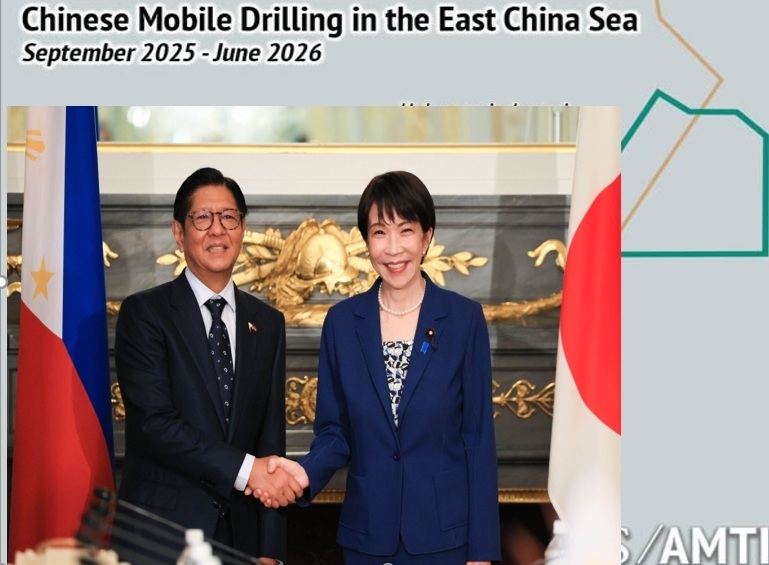
The supposed sovereignty claim over Batanes came following the meeting between Japanese Prime Minister Sanae Takaichi and Philippine President Ferdinand Marcos Jr in Tokyo in late May, when they agreed to begin negotiations “to delimit the maritime boundary of the exclusive economic zone (EEZ) and the continental shelf between the two countries, in accordance with international law,” particularly the relevant provisions of the United Nations Convention on the Law of the Sea. The Chinese scholars reportedly invalidated this move.
In a May 29 statement, China’s Foreign Ministry Spokesperson Mao Ning likewise described the negotiations between Tokyo and Manila as “completely illegal, null and void,” adding that the delimitation covers an area east of Taiwan where Beijing allegedly maintains an EEZ and continental shelf.
While there have been no official declarations from the Chinese government claiming Batanes, SeaLight Executive Director Raymond Powell said the assembly of the scholars was the beginning of Beijing’s “lawfare” strategy to build the legal narrative for future actions.
Describing the Philippine-Japan maritime delimitation talks as an “opportunity” for China, Powell said the latter “then assembled the scholars to give them the legal overlay, the veneer to be able to justify what they wanted to do anyway.”
“So we call this a pretext to escalate. If the pretext was the talks, the escalation now is underway,” he noted during the National West Philippine Sea Summit in Manila on July 9.
Meanwhile, Batongbacal said the “latest preposterous declaration by purported academics” is an “implied threat” that Beijing will consider taking the Batanes Islands from the Philippines.
“This is an implied threat (the equivalent of “nagpaparamdam” in an international setting) that Beijing will consider taking the Batanes Islands should the Philippines and Japan continue the improvement of their relations, which from Beijing’s perspective runs against their interest in forcefully taking Taiwan,” the UP Law professor said in a July 9 social media post.
Reuters earlier reported that Batanes sits around 160 km south of Taiwan along the Luzon Strait, a key passage linking the South China Sea and the Pacific Ocean. The Philippine province “has become increasingly important in security planning and has hosted joint military exercises involving the Philippines and allied US forces,” the report noted.