
Part 2
Prelude to the revolution
When I returned to Manila as a university student, I had difficulty reconciling the happy memories of my youth in Iran and the country depicted in news reports that were coming out after the Shah had fallen two years after I had left Tehran.
Last time I visited the Iranian capital was in the summer of 1978 after I completed my freshman year in UP and headed for vacation in Tehran where my parents and sister were still living. I was completely ignorant of the growing turmoil sweeping across the country.
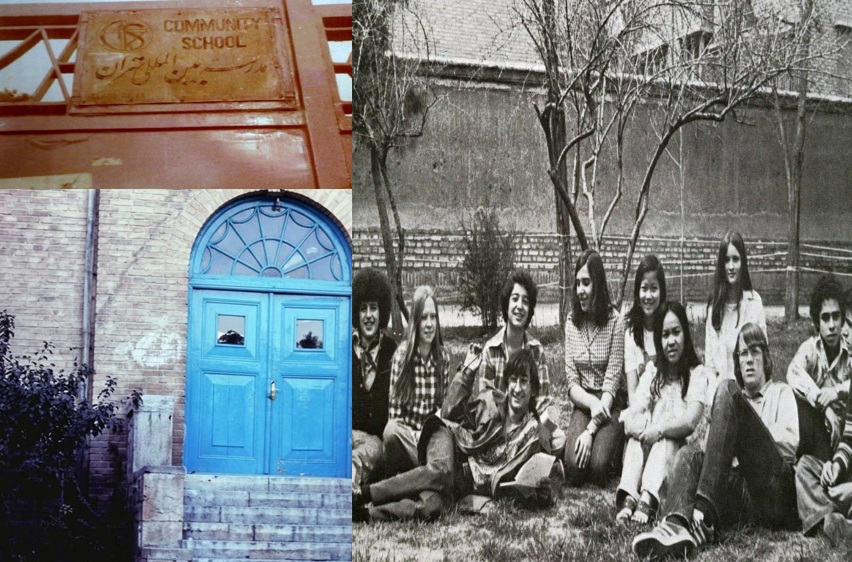
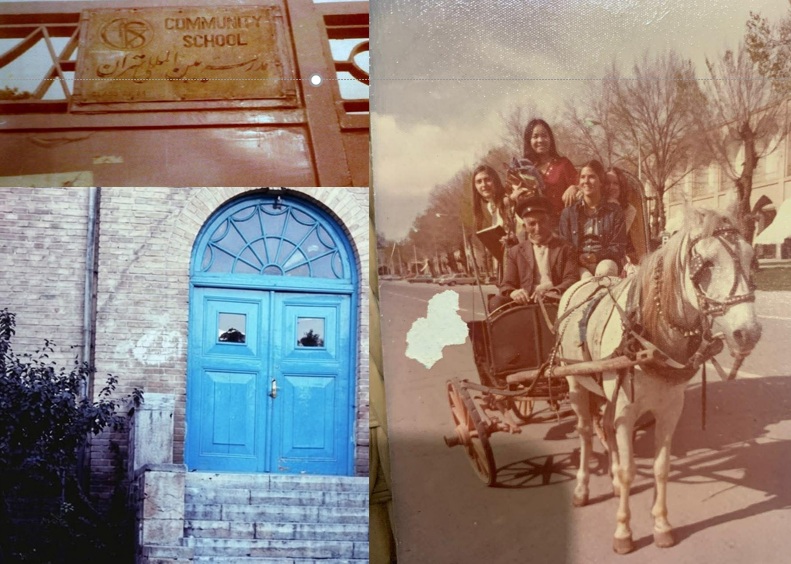
I took on a summer job as a teacher’s aide in a class for special children and a substitute teacher at my old school, the Community School. In one middle school class, the Iranian students questioned my credentials and expressed resentment at the presence of foreigners in their country. They were spouting political rhetoric beyond their years which they must have picked up from activists opposed to the Shah, reflecting the growing discontent in the country.


Community School campus
By the end of that year, the revolution had peaked and in January 1979, the Shah left Iran with his family to go on self-exile in Egypt without the Crown Prince, then a 19-year-old student undergoing pilot training in Texas. With the Shahanshah gone and the monarchy toppled, Khomeini returned to Tehran from exile in France and established the Islamic Republic of Iran.
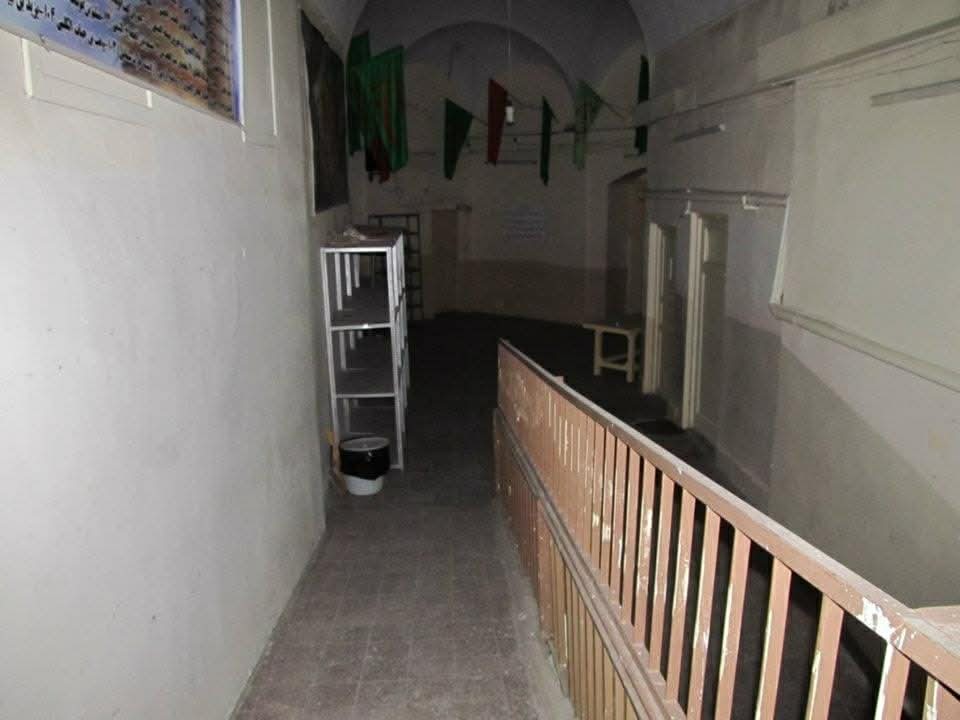
The new government shut down Community School, burned all the books in the library. The teachers hurriedly fled the country even as student rebels stormed the U.S. Embassy, taking hostage 66 of the American staff. They eventually held 52 of the hostages for 444 days until 1981, demanding the return of the Shah and his wealth to Iran from the U.S. where he was undergoing cancer treatment.
The Islamic Republic and the Iranian diaspora
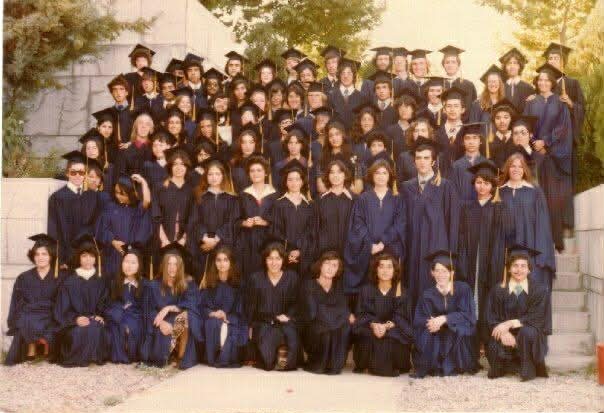
Like me at this time, my former classmates were in university, mostly in the U.S. The Iranians studying abroad were worried sick as they had no information about their families still languishing in their homeland. They could not risk flying back to Tehran for fear they would be prevented from leaving again. Bank remittances were restricted so some had to get odd jobs to tide them over.
An American classmate happened to be in Tehran on vacation and was working part time at the U.S. Embassy as the revolution was unfolding. At a reunion in Washington D.C. in 2003, he said that he tried to hand out as many visas as he could to the crowd outside the embassy that included one of our teachers who was from India.
One of the lucky ones granted a visa early on was my sister who was a high school senior when the revolution broke out. Our parents wanted to send her to the U.S. so she could graduate in an American school and not have to struggle with Filipino subjects.
My sister was on board one of the last flights out of Tehran’s Mehrabad International Airport which was then teeming with passengers desperately trying to leave the country. She was headed to New York where an aunt was waiting for her. In the melee, she somehow managed to get on a plane to Paris.
At the Charles de Gaulle Airport, all the passengers simply had to say, “from Tehran!” (yes, with the exclamation point) and immigration would let them through to a connecting flight to wherever, she recounted.
The Iranian diaspora had begun.
Families of my former classmates sought political asylum, primarily in the U.S. and England as the Khomeini government went on a killing rampage, targeting former government and military officials and dissidents. Those who escaped to Europe were in grave danger as the exiled Crown Prince revealed in a recent podcast interview that 66 members of the Iranian diaspora in that continent, a number of them former members of the Shah’s cabinet and his own cousin, were assassinated.
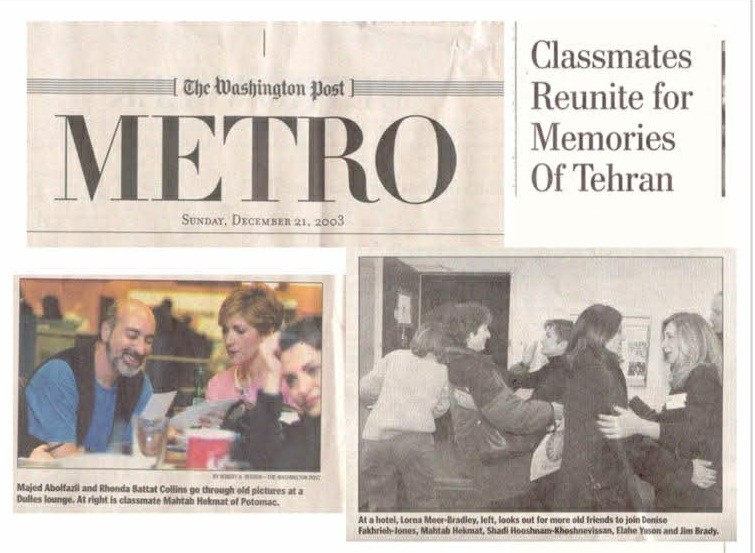
In class reunions and other conversations, hair-raising stories of fleeing Tehran with practically nothing would inevitably be recounted. The father of one classmate, a tea merchant, escaped on horseback through the desert; the brother of another was shot trying to leave. A female classmate from Israel who had stayed in Iran and was studying at Tehran University finally left when rebels started throwing acid at the faces of known Jews. Another father who was a U.S.-trained military doctor assigned to the Shah was hunted down and had to bribe his way out of the country. Many suffered mental breakdowns or went into depression after their escape.
As they started life in exile, some parents were forced to accept modest jobs. A former high-ranking general in the Iranian military ended up driving a cab in New York City, his daughter told me.
The Pahlavi family was not spared the agony of losing one’s homeland. Two of the Shah’s five children were unable to make the adjustment from their privileged royal life in Iran and their ordinary existence in a foreign land. Leyla, the youngest, was found dead of drug overdose in her London apartment in 2001; Ali Reza, the youngest son, committed suicide in the U.S. ten years later. Both were just 8 and 11, respectively, when they fled Iran and are now buried with their father in a Paris cemetery.
The 87-year-old Shabanu (Farah Diba Pahlavi) reportedly now shuttles between Paris and Washington D.C. and the eldest daughter, Farahnaz, lives a quiet private life in New York.
The Crown Prince, now 65, continues to live with his own family in the U.S. but remains active in politics in his homeland and in contact with the Iranian diaspora. In an episode of the American television program 60 Minutes, he called the slain former Supreme Leader Ali Khaminei a “monster” who slaughtered his own people who dared to cross him.
Both my parents lived through the upheaval and stayed in Tehran for another three years during which my mother experienced lining up to get kerosene for the heaters in our house. When Iran Air canceled the separation pay for employees, my father – who had been with the company for 15 years – finally called it quits. He and my mother left the country and the people we had so loved in 1982, never to return.
In Manila, I was shocked when student activists showed me pictures of the torture victims of the SAVAK and read about the misrule, abuses and corruption of the Shah’s government. It shattered the youthful memories of the idyllic life I led in Tehran.
The Protests and Iran’s uncertain future
In the subsequent years after the Shah was toppled, reports would surface on the repressive rule and human rights violations of the Islamic Republic such as torture of political prisoners and the mistreatment of women with the mandatory wearing of the hijab and inequality in laws on divorce, inheritance, and court testimony.
Soon, the government would vow to wipe Israel off the face of the Earth and spend precious petrodollars to support Hezbollah and Hamas, the Islamic militant and political organizations fighting Israel from Lebanon and the Gaza Strip, respectively. Both are considered terrorist groups by the U.S., the European Union, and other countries.
For 47 years now, international organizations have criticized the Iranian government for its restrictive policies against the political opposition (with rampant arrests of dissidents, journalists, activists, and lawyers) and control over elections that require the approval of candidates by the morality police, known as the Guardian Council.
With one of the highest execution rates in the world, Iran imposes the death penalty for murder, drug trafficking, and on those charged with political or national-security violations. Freedom of speech and the press is non-existent; access to the internet and social media is restricted.
Many of these allegations have predictably been rejected by the Islamic Republic, insisting that its policies are based on Muslim law, the Sharia, and national sovereignty. It describes the criticisms as politically-motivated thrown by Western governments.
I thought the suffering of the people of Iran had finally come to a head in 2022 when news emerged about the arrest by the morality police of Mahsa Amini, a woman from Kurdistan, for not properly wearing her hijab. Amini’s death under detention sparked protests and led to the rise of the Zan, Zendegi, Azadi (Women, Life, Freedom) movement. I was convinced this would lead to the downfall of the Islamic Republic.
It didn’t.
But dissatisfaction and discontent with Khaminei’s rule had taken hold. Media coverage of the current protests shows thousands of citizens marching in the streets not only in Tehran but in other cities amid the grinding poverty and economic decline of the oil-rich country.
Iran is once again at a crossroads caught in a complex and violent web of competing political and economic interests that have plagued the Middle East for decades. Iranian society is divided among Muslim fundamentalists and those who long to break free of the Islamic regime and want to restore democracy in their land.
My friends in the Iranian diaspora are also split with some favoring the return of Crown Prince Pahlavi as a “transition leader” prior to a national election where he vows not to be a candidate; others espouse the return of the monarchy, while still others reject the Pahlavi dynasty and liberation through foreign interference in Iran’s affairs.
A close girlfriend since elementary school, a Jew now a British citizen living in London, vows she will never ever go back to Iran. Her parents who have both passed away never got over the trauma of their escape from Tehran.
In a forum with school alumni, there is one rule: no politics. Too controversial. But this war, the lives lost, the cost have just been too heartbreaking and painful to ignore. With members coming from all over the world, opinions expectedly clashed. Comments were getting too hot to handle such as this one: “Can’t say I would celebrate U.S. President Donald Trump in Iran. He’s not exactly a believer in democratic change.”
But cooler heads prevailed and the heat of the moment died down when a Croatian participant said: “In fear of the obstacles on the course to freedom, we may have different perspectives of the dangers that lie ahead. That doesn’t alter the fact that we all wish the same for Iran.”
Followed by this comment from a U.S.-based Iranian: “My only hope (is) that Iran will stand by itself for itself with dignity and grace.”
In the past two weeks after the initial airstrikes, hopes were high that the people of Iran would finally be free with the death of Khaminei, never mind that Trump neglected to get congressional approval when he ordered the attack on Iran.
But the prospect dimmed when Iran hit back, unleashing hundreds of missiles and drones into Israel as well as U.S. bases and facilities in the Gulf Arab states and closing the Strait of Hormuz to block the passage of oil tankers. As the war quickly escalated, some analysts have warned it could soon spill out into even more countries outside the Middle East and eventually involve Russia and China.
With Trump threatening “severe retaliation” if Iran continues its attacks and keeps the Strait of Hormuz off limits, as well as the rise of a new Supreme Leader in Mojtaba Khaminei, the war is now on its third week.
With no clear direction, the end of the bloody conflict remains uncertain.
I can only sympathize with the people caught in the crossfire, especially the Iranians who have suffered for over a century under both the Pahlavi dynasty and the Islamic Republic. Someday within my lifetime, I still hope to revisit an unshackled and prosperous Iran where citizens can enjoy the beautiful poetry of Rumi and Hafez in peace; where the women are allowed to read, go to school, speak their minds without fear – and wear their hijabs and chadors by choice.
(Read Part 1 here)