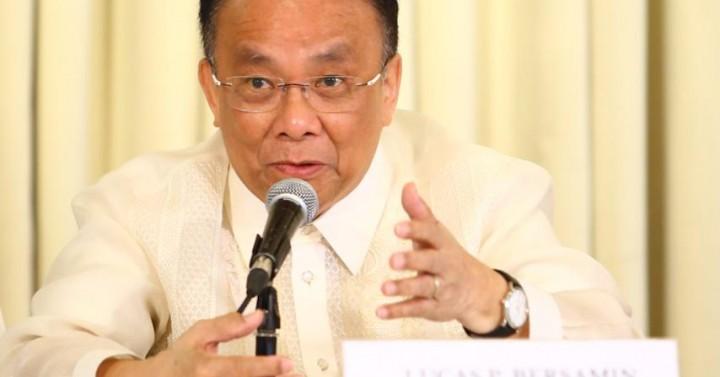
His appointment as the 40th executive secretary of the Philippines in September 2022 was rather met with raised eyebrows. That was because it was common perception that his record as associate justice, later as chief justice, of the Supreme Court was not only lackluster. It was rather associated with cases of partisan political origins.
Lucas Bersamin would decide in favor of his appointing president or the sitting president. Independence of mind was conclusively not prominent among his judicial values. Let us not underestimate the Filipino public capable of discerning if one is a legal eagle or a political interest ward.
Was Bersamin persuaded by his political affiliations? That his family was a political dynasty of Abra was a given. His brother Luis P. Bersamin Jr. was congressman of Abra from 2001 to 2006. Presently, another brother Eustaquio is governor of Abra since 2025 and was also a previous governor from 2007-2016. Their patriarch Luis F. Bersamin was governor of Abra from 1947 to 1951.
Lucas Bersamin’s beginning career as lawyer and regional trial court judge was worthy of notice. He was 9th placer in the Bar exams of 1973 completing an average of 86.3%. In the 2000 Judicial Excellence Awards (JEA), he received two awards for the Best Decision in Civil Law and the Best Decision in Criminal Law. In the 11th JEA in 2002, he was named Outstanding RTC Judge for 2002 for the Chief Justice Jose Abad Santos Award. As Court of Appeals justice, he was named a member of the Senate Electoral Tribunal.
In March 2003, President Gloria Macapagal Arroyo appointed Lucas Bersamin as justice of the Court of Appeals. Six years later, on April 3, 2009, Arroyo appointed him associate justice of the Supreme Court. Filipino barristers agree that justices would, almost always, vote out of the warped sense of utang na loob (debt of gratitude).
Associate Justice Bersamin was among the 8 Arroyo-appointed justices who acquitted her from plunder on July 19, 2016 when Rodrigo Duterte had just assumed the presidency. The new president had publicly tendered what were perceived to be swaying opinions: that her plunder case was weak, and that he is offering her presidential pardon. The public saw that as the end of Bersamin’s award-winning days.
Almost nine years after sitting in the high tribunal, Rodrigo Duterte finally rewarded Bersamin with the position of chief justice on November 26, 2018. The Duterte presidency being the most controversial in the history of the Philippines for its partiality to bend the law, Bersamin was on the way of tarnishing his own image for his own political survival.
These are the string of cases brought before the Supreme Court when Bersamin upheld Rodrigo Duterte:
Nov. 2016, on the hero’s burial for the Dictator Ferdinand Marcos at the Libingan ng mga Bayani.
First, the dissenting opinions were those of Chief Justice Sereno, Senior Associate Justice Antonio Carpio, Associate Justices Marvic Leonen and Alfredo Caguioa.
Nine justices voted to bury Dictator Marcos as a hero. Among them, of course, was the Ilocano Lucas Bersamin. Public opinion for it was swift and ruinous. In social media, the Libingan was renamed Libingan ng mga Bayani at Isang Hindi.
Oct. 2017, Sen. Leila M. de Lima, sole petitioner for G.R. No. 229781 for certiorari, Prohibition with Application for a Writ of Preliminary Injunction, and Urgent Prayer for Temporary Restraining Order and Status Quo Ante Order regarding her detention on drug charges.
Voting 9-6, the Court ruled against De Lima to nullify the arrest warrant issued against her by the Muntinlupa RTC. Among the nine, yes Bersamin. Being an issue close to Duterte vitriol and vendetta, the justices who voted against De Lima were vilified by the public. Conversely, De Lima was top of mind by voters in 2025.
Dec. 2017, when the third extension of martial law in Mindanao was brought before the high court as a justiciable question. The petitioners were high profile, among them Edcel Lagman, Tom Villarin, Gary Alejano (for G.R. No. 231658); Cristina Palabay, Renato Reyes, Eufemia Cullamat, Antonio Tinio, Arlene Brosas, Sarah Jane Elago, Mae Paner, et al (for G.R. No. 231771); and Norkaya S. Mohamad, Sittie Nur Dyhanna S. Mohamad, Noraisah S. Sani, Zahria P. Muti-Mapandi (for G.R. No. 231774).
Bersamin was among the justices who concurred to allow Duterte the 3rd extension of Mindanao martial law. Those who dissented were Sereno, Carpio, Leonen, and Caguioa.
May 2018, on the three cases brought before the SC: the quo warranto petition seeking to invalidate Sereno’s appointment as chief justice, that the quo warranto is the proper remedy for the Sereno case, and that Sereno violated the Constitution for her failure to file her Statements of Assets, Liabilities and Net Worth (SALN).
Bersamin was one of the eight who voted for the quo warranto; one of the nine who voted that the quo warranto is the proper remedy; and one of the nine who voted that Sereno violated the SALN provision in the Constitution.
By this time, Duterte as the emperor without clothes was clear — that he ruled by vengeance and retaliation instead of the rule of law. Who is the justice who could pass verdict against Duterte’s wishes? By then, it was clear that only a handful could do so and they were not Duterte appointees. Bersamin was absolutely not among them.
Aug. 2018, the Supreme Court en banc voted to uphold the Ombudsman’s indictment for plunder of senator Jinggoy Estrada who was then undergoing trial at the Sandiganbayan. Six voted to concur, four voted to dissent, and four inhibited. Bersamin was among those who dissented, with associate justices Presbitero Velasco, Diosdado Peralta and Andres Reyes Jr., the present chair of the Independent Commission for Infrastructure (ICI).
Bersamin’s repute as a weak advocate against graft and corruption was sealed.
The most absurd had actually passed in July 2016. It was a celebrated case – the grant of bail to the jailed Juan Ponce Enrile (G.R. No. 213847, Juan Ponce Enrile, Petitioner, vs. Sandiganbayan [Third Division], and People of the Philippines, Respondents.) The Sandiganbayan rejected Enrile’s prayer for bail; he then went to the Supreme Court to contest the Sandiganbayan decision. The SC ruled in his favor, against which a Motion for Reconsideration was filed by the People of the Philippines.
The People presented very cogent arguments, among them that “a fragile state of health” was never a Constitutional and procedural ground in granting bail, that it had no Constitutional, legal and jurisprudential basis. It also said (the People was represented by the Office of the Special Prosecutor of the Office of the Ombudsman which filed a Motion for Reconsideration) that:
“The DECISION openly ignored and abandoned the Constitutionally-mandated procedure for determining whether a person accused of a crime punishable by RECLUSION PERPETUA or Life Imprisonment such as plunder can be granted bail.”
The Court denied the Motion for Reconsideration, therefore granting bail to Enrile. Dissenting were Leonen, Sereno, Carpio, del Castillo, Perlas- Bernabe, and Caguioa (6). Concurring to reject the Motion for Reconsideration were Bersamin (the ponente), Velasco, Leonardo-de Castro, Peralta, Perez, Mendoza, and Brion (7). Two justices, Reyes and Jardeleza, did not participate.
Remember always that if we ask in wonder why Enrile was freed from prison, do not forget the name of the ponente, Lucas Bersamin.
So why do we pay the salaries, perks and other privileged emoluments of Supreme Court justices? Is it so that they can subvert the republic with the rule on political dominion and survival, or to fortify democracy with the rule of law?
After retirement from the high tribunal, Rodrigo Duterte appointed Bersamin chairman of the Government Service Insurance System on Feb. 6, 2020. And there’s your rub.
The views in this column are those of the author and do not necessarily reflect the views of VERA Files.