
Remembering IBON executive director Sonny Africa’s pronouncement that things in the Philippines are bad and will probably get worse overshadows the good feelings generated by Alex Eala’s scintillating baseline battles against tennis giants and victory at the DC Open.
According to Africa, the Philippines is “stuck in the past in terms of domestic policies and about seeing the changes in the world that are working to the detriment of the economy and the Filipino people,” and so must change its development strategies.
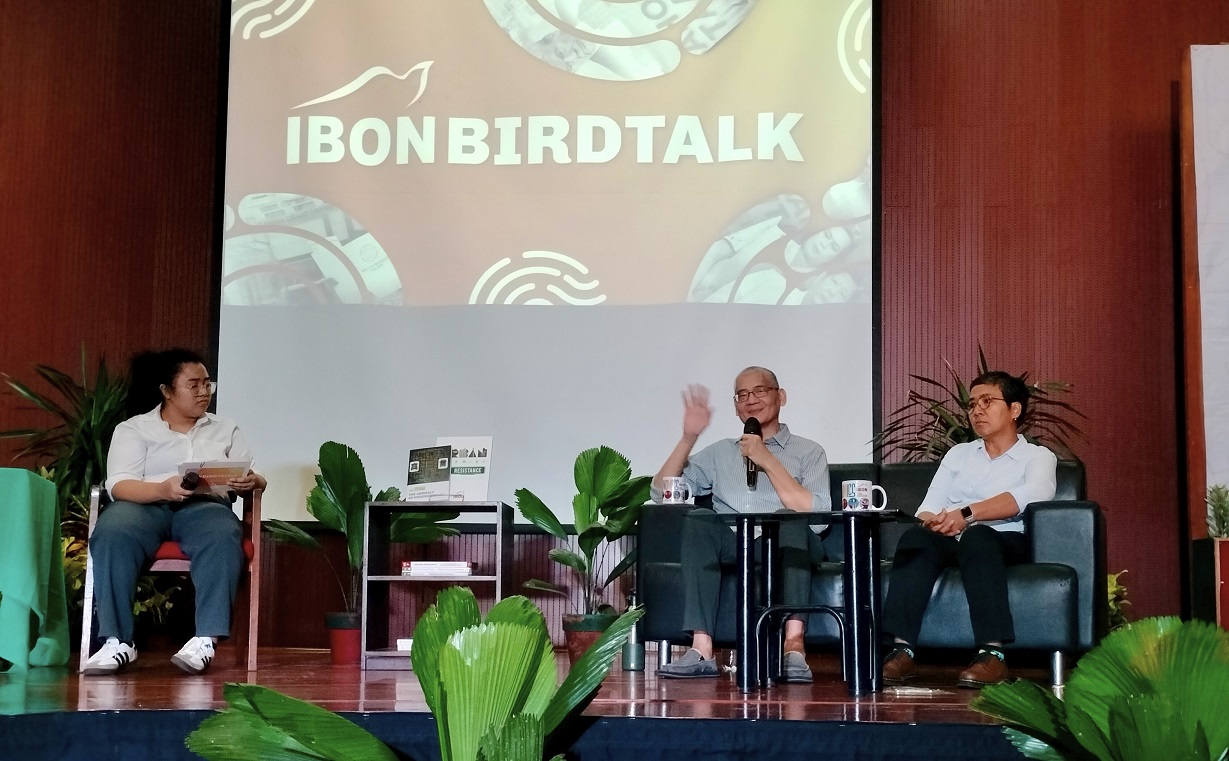
Africa and Rosario Guzman spoke at the IBON Midyear BirdTalk 2026 held last July 23 at the University of the Philippines’ School of Economics in Diliman, Quezon City. He presented his analysis of the Philippine economy in Navigating global instability for national development. Guzman, IBON research head, discussed President Ferdinand Marcos Jr.’s policies in The Politics of Dodging — unraveling vested interests in PH policymaking.

Poor country
Africa debunked the Philippines’ recent classification as an upper-middle-class-income (UMIC) country by the World Bank (WB), which ranked 130 out of 201 nations categorized as low, lower-middle, upper-middle, and high economies.
“It’s mere statistical classification, with no qualitative transformation,” he said. “Crossing the WB income threshold [reflected] average Gross National Income (GNI) per capita, not broad improvements in employment, incomes, productivity or living standards.”
The UMIC status isn’t holding true because, one, the Philippines is at the bottom one-third of the poorest countries in the world. Second, its GNI per capita of US$4, 850 is one-third of the global average of US$14, 244. Third, it doesn’t measure development because “economy is about the welfare of the people, not just economic growth,” Africa said.
He said ordinary Filipinos don’t feel it because the growth model that the Philippines’ UMIC status was based on couldn’t “create decent work with livable pay.” His data showed the poor and low-income classes comprising 14.4 million families (70 million Filipinos) earning below ₱22, 000/month. The lower-middle class is composed of seven million families (26 million Filipinos) earning between ₱22,000 and ₱36,000/month. The rich has 400,000 families (one million Filipinos) earning above ₱180,000 to ₱17 million or more/ month.
Africa said the UMIC status disguises the unemployment crisis because the real unemployment figure is at 4.5 million, which balloons to 7.9 million if unpaid family workers are counted. The employed may number 38.7 million (78 percent) — 13.5 million self-employed, 4.4 million with a farm/business, 1.9 million household workers, 19 million workers in informal establishments — but Africa said “their jobs are really bad — with low pay, no benefits and contracts.”
He added: “The minimum wage on average is worth 21 percent less today than in 1989, or an equivalent value of ₱70 today (2025).”
The jobs crisis is exacerbated by widespread poverty and hunger, Africa went on. Figures, since the start of the Marcos administration, showed 14.5 million families (52 percent) seeing themselves as poor and 6.8 million families (23.2 percent) experiencing involuntary hunger, reflecting what he said was a worsening food insecurity despite the continued Gross Domestic Product (GDP) growth.
Weak framework
Africa said the Philippines’ problem stems from an “exhausted growth development model that’s vulnerable to external shocks, and weak against sluggish global growth and weakening trade and investment, and “growing big power protectionism.”
He said household spending, the Philippines’ main source of growth (70 to 75 percent of GDP), is waning because wage work and remittances— the main drivers — are fading. Similarly, exports have been flat and foreign direct investments (FDI) have fallen since 2017. He compared the average GDP growth of the three administrations: 6.3 percent under Benigno Aquino III (2010 to 2015); 3.8 percent under Rodrigo Duterte (2016 to 2021, including the pandemic lockdown); and 5.4 percent under Marcos Jr. (2022 to June 2026, including rebound).
Another factor is the declining manufacturing and agricultural sectors, Africa said: Manufacturing’s GDP was 17.4 percent (the smallest in 76 years since 1949) and agriculture was 7.9 percent (the smallest in the country’s history) in 2025.
One more element, he said, is the protectionist national industrialization strategies of the United States and other countries, which the Philippines does not have. For context, with G7, out of the 27, 112 protectionist measures, 11, 057 safeguard America’s interests. Under BRICS, out of the 21,642 protectionist measures, 8,020 protect China’s interests. Examples of protectionist policies are the United States’ CHIPS and Science Act 2022 and the America First Trade Policy, America First investment; China’s 2006 to 2022 five-year plans and Made in China 2025; and the European Union’s Chips Act 2023 and Critical Raw Materials Act 2024.
Africa said economic security in protectionist policies had become national security, with the superpowers increasingly treating industrial capacity, semi conductors, artificial intelligence (AI), critical minerals, energy systems, logistics, and supply chains as matters of national security.
He continued: “Governments, but mostly the US, are actively intervening to secure these strategic sectors, replacing the old neoliberal assumption that markets can guarantee prosperity. China has risen industrially and its manufacturing share of global value-added has overtaken…the US.”
‘It’s not about us’
America’s strategic priorities are shaping Philippine policies, Africa said, citing the Philippines’ becoming a military staging area versus China and a “subordinated node in the US’s regional defense industrial base” providing “location, labor, and natural resources (critical minerals, energy, and water) and military access while being restricted in controlling technologies and operations.”
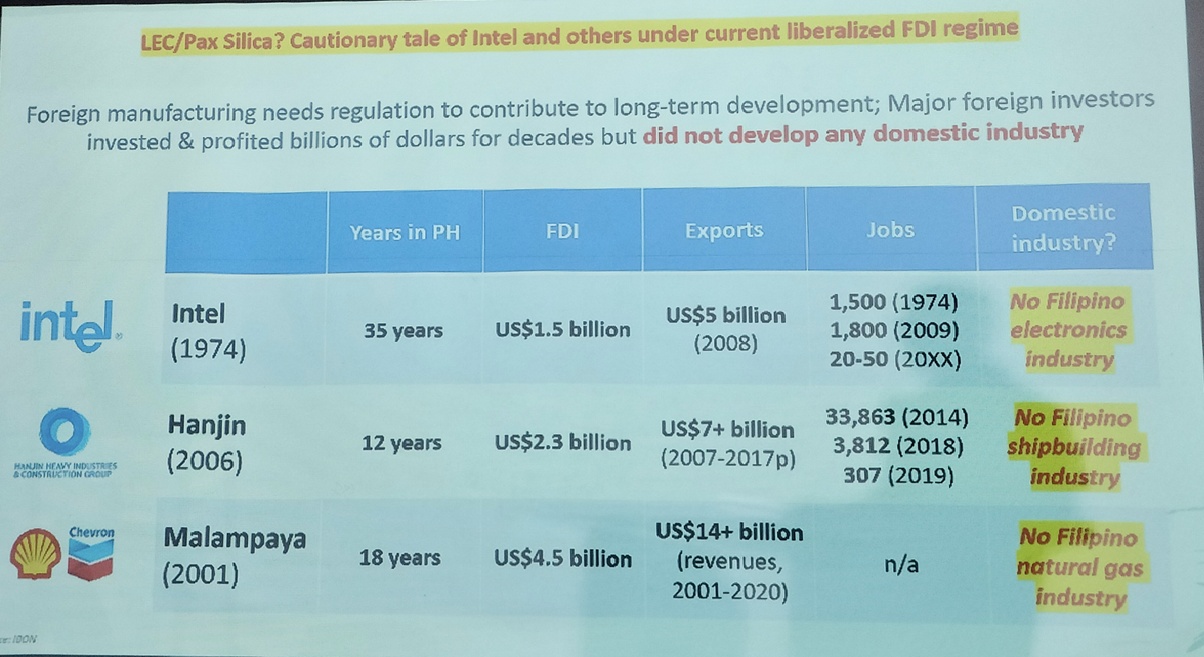
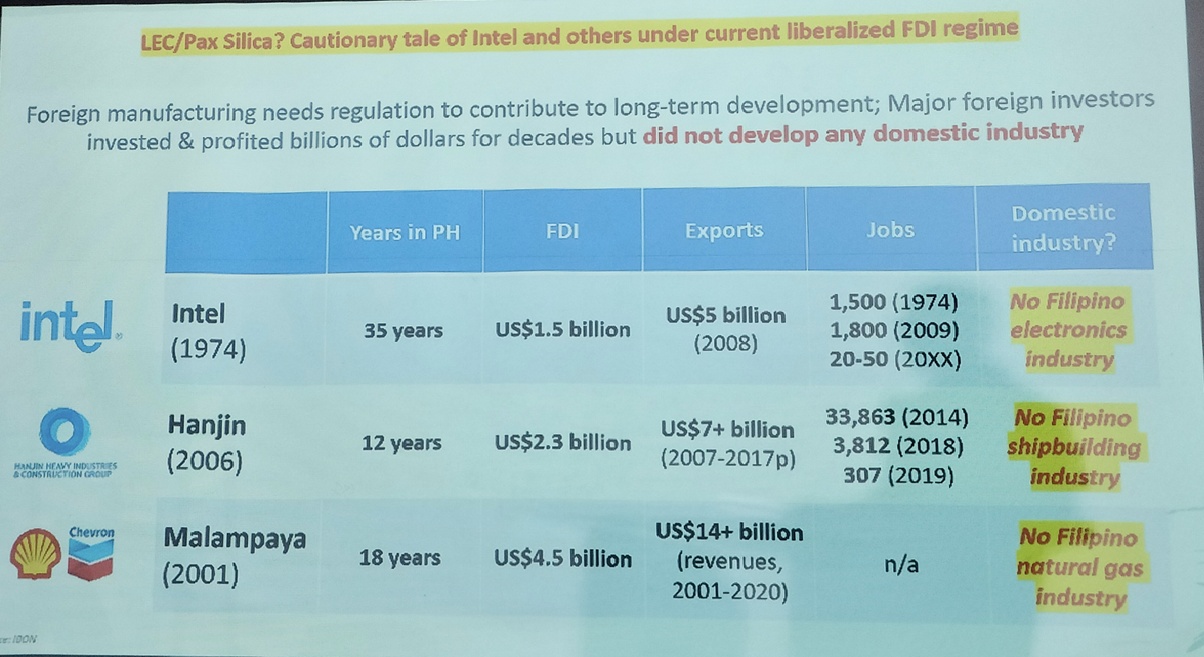
He said the US-led Luzon Economic Corridor (LEC) and the planned Pax Silica project about which the Marcos Jr. administration is stoked have a huge impact on its policymaking. As he put it, the Pax Silica initiative is a cautionary tale of Intel, Hanjin Heavy Industries and Construction Group, and Petron and Chevron under the current liberalized FDI regime, “where major foreign investors invested and profited billions of dollars for decades but didn’t develop [the] domestic industry.”
Pax Silica seeks to convert a 1,619-hectare land in New Clark City, Tarlac, into a hub for semiconductor and advanced AI microchip production within LEC. The water and electricity requirements are said to be comparable to the consumption of water by 600,000 households and the electricity output of three large coal plants or one nuclear facility.
“Pax Silica is not about us. It’s about the US,” declared Africa. He showed a chart that pinned the Philippines’ role in the supply chain as source of intermediate materials while everything else — design (chip architecture etc.), manufacturing equipment and tools, wafer fabrication, assembly, testing, and packaging — is done by the US.
BBM’s policymaking
Referring to Marcos Jr. by his nickname, Guzman said silence — aka the politics of dodging — has been BBM’s technique of resorting to the blame game without acknowledging the errors the administration has made for years.
The administration’s “policymaking is for foreign capital and domestic oligarchs,” asserted Guzman, pointing to the economic incentives that increased profiteering: “green lane” for strategic investments, 100-percent foreign ownership of renewable energy projects, 99-year foreign land lease, privatization of essential public services, lifting the ban on new mineral agreements, etc.
Guzman said the situation has led to increasing profits with Build Better More, BBM’s flagship infrastructure development initiative, accelerated right-of-way, and surge in renewable energy projects. Top oligarchs Ramon Ang, Enrique Razon, and Manny Villar “got the big ticket of construction projects,” she said.
Razon, whose net worth is now ₱1.27 trillion, is involved in mining, fuel and oil, power, water, real estate, finance, hospitality, and ports and logistics. Guzman said the gross revenues of his top conglomerates registered ₱177.3 billion for International Container Terminal Services Inc., ₱66.6 billion for Manila Water Co., and ₱53.9 billion for Bloomberry Resorts Corp. However, she said, as Razon’s businesses expanded, concerns were also raised about the impacts on communities. Consumers criticized Manila Water’s rate hikes, and civil society groups questioned Prime Energy Resources Development — a subsidiary of Prime Infrastructure Capital, the infrastructure arm of Razon’s businesses — taking over the Malampaya Deep Water Gas-to-Power Project. And fishers and environmental advocates are opposing the Razon-linked reclamation projects in Manila Bay.

Guzman echoed Africa’s statements on how America’s strategic priorities are shaping Philippine policies. With the country as a defense industrial base, “the Philippines [is] prioritizing US economic and military interests while narrowing the Philippines’ policy autonomy,” she said. “It’s protecting the US supply chain while liberalizing the Philippine economy and tolerating rotten politics as long as it serves US interests.”
Along with BBM’s dodging technique, Guzman said, there is political repression, with social movements faced with systematic oppressive methods. She cited what she called Marcos Jr.’s “lawfare,” i.e., the use of US counterinsurgency methods in the country, three “terror bills,” etc.
The counterterrorism frameworks that human rights groups and legal organizations label “terror bills” are the Anti-Terrorism Act of 2020 or Republic Act (RA) No. 11479; Terrorism Financing Prevention and Suppression Act of 2012 (RA No. 10168 National Security); and the Anti-Communist Directives (NTF-ELCAC framework).
Guzman said the situation is complicated by Sen. Ronald “Bato” dela Rosa’s Senate Bill No. 1366 (or the proposed Terror Grooming and Radicalization Prevention Act) filed in September 2025. The bill seeks to combat the “radicalization of vulnerable groups” and carries punishments of ₱10-million fine for use of “psychological, ideological, religious, cultural [and] academic methods” on Filipinos and 15- to 40-year imprisonment.
Better Philippines
How to improve the lives of Filipinos? Guzman raised the need for a politics demanding accountability. Africa advocated for Filipino industrialization.
“It’s about building national productive power with Filipino firms producing complex high-technology goods with Filipino science and technology, using local labor, skills, science, and natural resources, and raising economic productivity and employment quality,” Africa said.
It’s not enough, he continued, to increase foreign investment and economic activity in the country. For example, he said, the US-PH Pax Silica agreement needs a larger plan for Filipino industrial development, i.e., defining priorities and creating domestic productive capabilities and protection and support for Filipino companies. At the same time, the agreement should indicate how the LEC infrastructure will develop agriculture, public transportation, manufacturing sector, small and medium enterprises and cooperatives, etc.
It’s imperative, Africa underscored, that the Pax Silica initiative protect Filipinos’ labor rights and welfare; implement stringent environmental and resource conditions (consumption of electricity, water, and land, etc.); and use technologies relevant and supportive of domestic production.