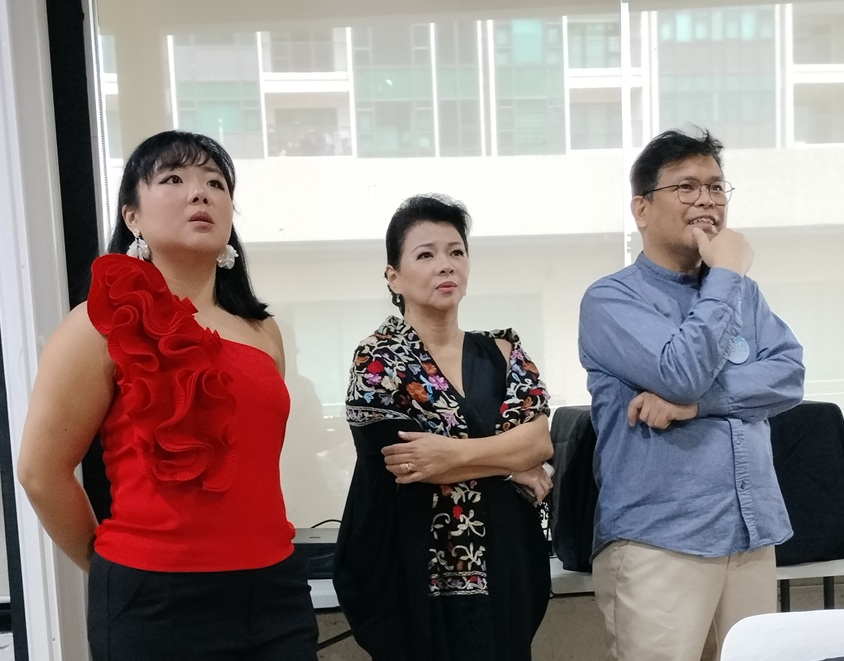
Michelle Mariposa is a playful gypsy singing “Habanera” from “Carmen.”
The late impresario Pablo Tariman would have been right at home at the table of Rachelle Gerodias and Michelle Mariposa, the Philippines’ celebrated soprano and mezzo soprano, respectively, who were casually talking about childcare before the press conference began. Tariman was, after all, surrogate father to and school “fetcher” of grandson Emmanuel Acosta, and he had written about Gerodias for Vera Files more than a decade ago.
The conversation arose from Gerodias being asked how her two boys were doing. She said their grandmother didn’t have to chase after them that much, and that one of them is now into comic book writing after dipping his toe in choir singing at his school. Meanwhile, Mariposa said her relaxation time turned into babysitting her two nephews during a family trip to Bohol. “I just closed my eyes and they were off somewhere. We had to run after them. I was so tired after,” she said, adding, like Gerodias, that she preferred the boys’ rambunctiousness over silence, the latter being quite foreboding.
The occasion was Manila Symphony Orchestra’s (MSO) press conference on Jan. 7 at Circuit Makati, in which it announced the yearlong program to mark its 100th anniversary celebration. The presser also featured performances by Gerodias, Mariposa, and pianist Gabriel Paguirigan with the MSO. Notably, the opera singers are headlining MSO’s “Concert IV — Legacies in Songs” honoring soprano Conching Rosal (1926-1985).
The MSO’s celebration begins with “In Pursuit of Excellence” on Jan. 22 at the Samsung Performing Arts Center in Makati, with the Philippine Madrigal Singers, pianist Muyu Liu, and guest conductors Darrell Ang and Mark Anthony Carpio. The musical highlights are Beethoven’s “Leonore Overture No. 3” and “Emperor Concerto,” and Ryan Cayabyab’s “Misa 2000” and “Te Deum.”
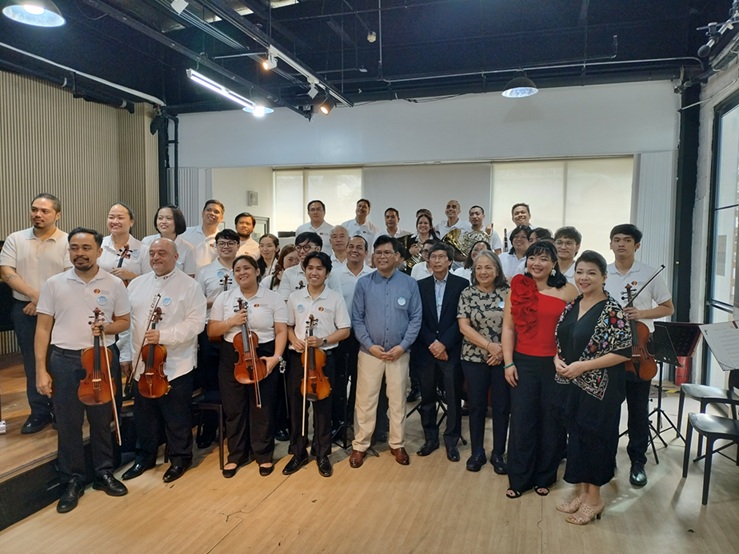
Orchestral performances
Known as Asia’s oldest orchestra, the MSO will present six concerts. “Concert I — Centennial Opening: Sleeping Beauty” runs from March 13 to 15 at the Aliw Theater in Pasay City. Ballet Manila and Russian conductor Alexander Vikoluv collaborate in staging Princess Aurora’s awakening through orchestral music and astounding choreography.
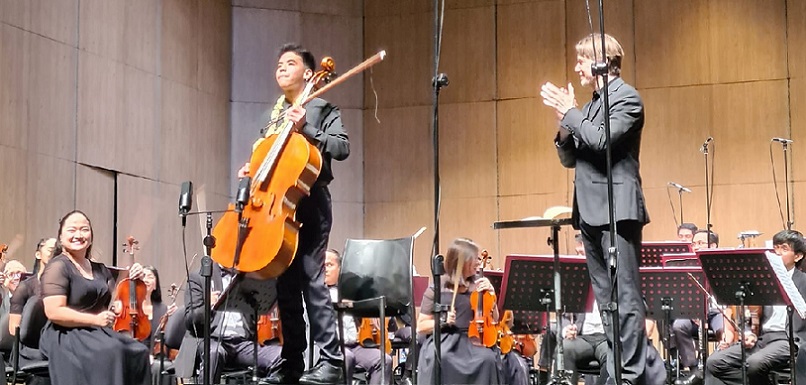
“Concert II — Rising Stars of the Philippines” is scheduled on May 30 at Proscenium Theater in Rockwell, Makati. Violinist Jeanne Marquez, cellist Damodar Das Castillo, conductor Joshua Dos Santos and the MSO will perform, among others, Brahms’ “Double Concerto in A minor, Op. 10.”
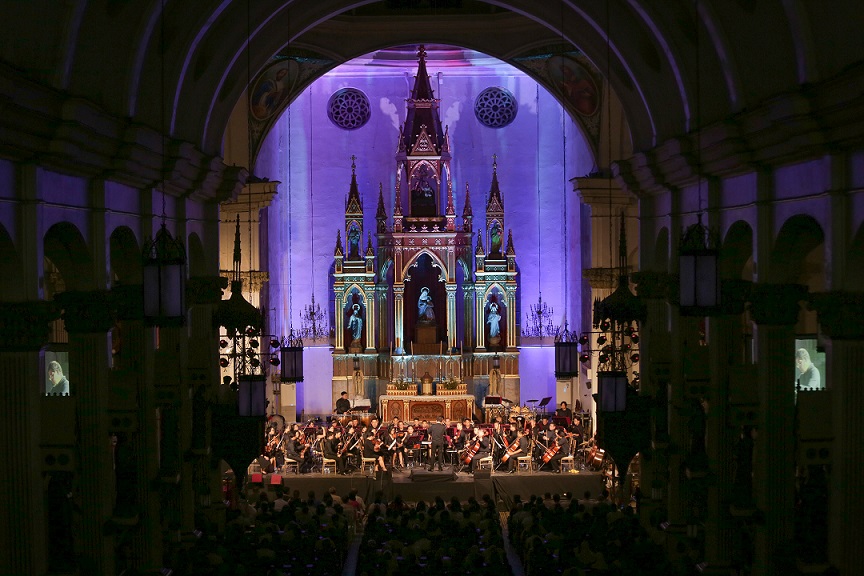
“Concert III — Symphony of a Nation: 100 years of music, 80 years of Fil-Am Friendship” will be presented on July 4 at the Manila Metropolitan Theater. That night of Philippine symphonic music — from its roots to the bold, contemporary voice — features violinist Emanuel John Villarin and Parisian conductor Thanos Adamopoulos.
“Concert IV — Legacies in Song: MSO’s 100 years and the voice of Conching Rosal” will be held on Aug. 29 at the Far Eastern University auditorium. It will showcase excerpts from Bizet’s “Carmen” and other operatic treasures. (Rosal portrayed the title role in the first Filipino language version of “Carmen.”)
“Concert V — Philippine Master Composers: Past, Present and Future” is set on Oct. 24 at the Ateneo de Manila University’s Hyundai Hall, Areté. It will feature masterpieces by Filipino composers and a new composition by National Artist for Music Cayabyab, who is also a member of the MSO board.
“Concert VI — MSO 100 Centennial Finale” is scheduled in January 2027, with French-Belgian cellist Camille Thomas and conductor Marlon Chen highlighting the MSO’s impressive orchestral works that reflect gratitude for the past and hope for the future. The venue will be announced later.
Nascent orchestra
In his “MSO at 100: The Unfinished Symphony” slide presentation, MSO executive director Jeffrey Solares said the orchestra was founded in 1926 by Austrian conductor Alexander Lippay under the patronage of the Asociación Musical de Filipinas. The inaugural concert was held at the Manila Grand Opera House, with the MSO playing “Leonore Overture No. 3” and Brahms’ “Gestillte Sehnsucht” (“Longing at rest”), Solares said, adding that the string and wind players were from the University of the Philippines Conservatory of Music and the Philippine Constabulary Band, respectively.
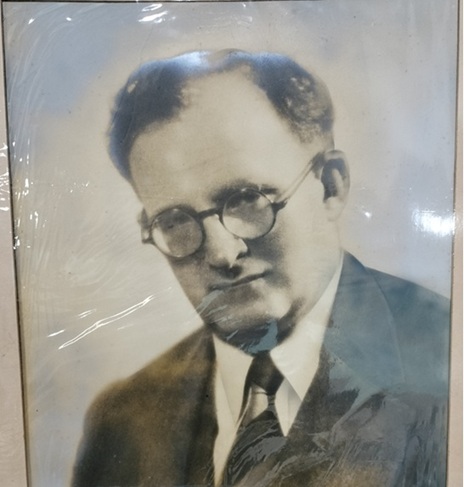
The 1926 concert was a full symphony, said Solares, with Ramon Corpus serving as concertmaster or leader of the first violin section. Corpus’ musical legacy is kept alive by his violinist-grandsons, the cousins Coke Bolipata and Hector Corpus. (Per Google, Bolipata further honored Corpus by naming a hall in his honor at Casa San Miguel, the family’s art center in Zambales.)
At present, Alessio Benvenuti and Sara Maria Gonzales are the MSO’s concertmaster and associate concertmaster, respectively.
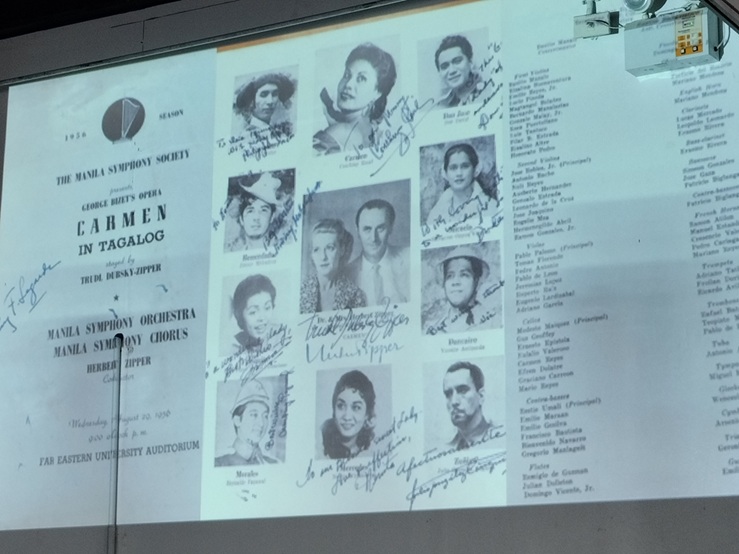
Filipino musical giants were MSO members, Solares said, and proceeded to read their names from a collage of concert programs in his slide presentation: Composers Nicanor Abelardo and Antonio Molina were in the cello section, and lyricist Levi Celerio was in the second violin section.
Alexander Lippay passed away in 1939 and was succeeded by Herbert Zipper, another Austrian conductor and a survivor of the concentration camp in Dachau, Germany, Solares said. The orchestra disbanded at the beginning of World War II in 1941; the Japanese government tried to revive it, but the members adamantly refused to play, citing loss of instruments and musical scores, according to Solares. In 1942, the Japanese government formed the New Philippines Symphony Orchestra.
At this point, Solares paused his presentation and Mariposa sang “Longing at rest” with Paguirigan on piano and Charmers Berbaza on violin. Mariposa was mesmerizing with her powerful mezzo rendition of Friedrich Rückert’s poem about a persistent inner yearning finding no peace that Brahms set to music.
Postwar years
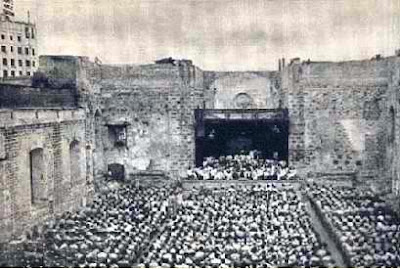
The MSO’s first postwar concert was held at the ruins of the roofless Santa Cruz church in Manila, playing Beethoven’s “Symphony No. 3” and Dvorak’s “New World Symphony.” Solares said 1956 was a notable year not only because it was the 30th anniversary of the orchestra, but also because the opera “Carmen” was performed in Tagalog for the first time and staged in Binondo and Tagaytay.
In yet another pause, Mariposa sang the Tagalog version of “Habanera” from “Carmen.” She was captivating as she channeled the coquettish way with which Carmen let her lover know that she wasn’t serious with him.
Gerodias performed next, singing Abelardo’s “Mutya ng Pasig” and entrancing everyone with her crystalline voice. Thunderous applause followed her performance.
Rachelle Gerodias stuns the audience with “Mutya ng Pasig.”
Solares mentioned the orchestra’s milestones, such as the founding of the MSO Music Academy and the Manila Symphony Junior Orchestra, which was part of the MSO’s original intention when it was established. The other is the “overhauling of the board to professionalize the group,” as mentioned by MSO board president Marianne Hontiveros in her welcome remarks. “Artists have to be paid for their performances. They must have a livelihood [because] being a musician isn’t just a gig,” she said.
Struggle
The MSO’s journey was no cakewalk, and reaching a centennial is incredible. As Hontiveros put it: “How many orchestras survive for 100 years?” But jubilant as Solares was about the orchestra’s longevity, he admitted that leading it is not easy: “It’s not just the wars and the pandemic. Every day is a struggle. Is there money in the bank to pay the artists, to send scholars to study, to help a sick member? MSO needs a concert hall, retirement benefits, and higher salaries.”
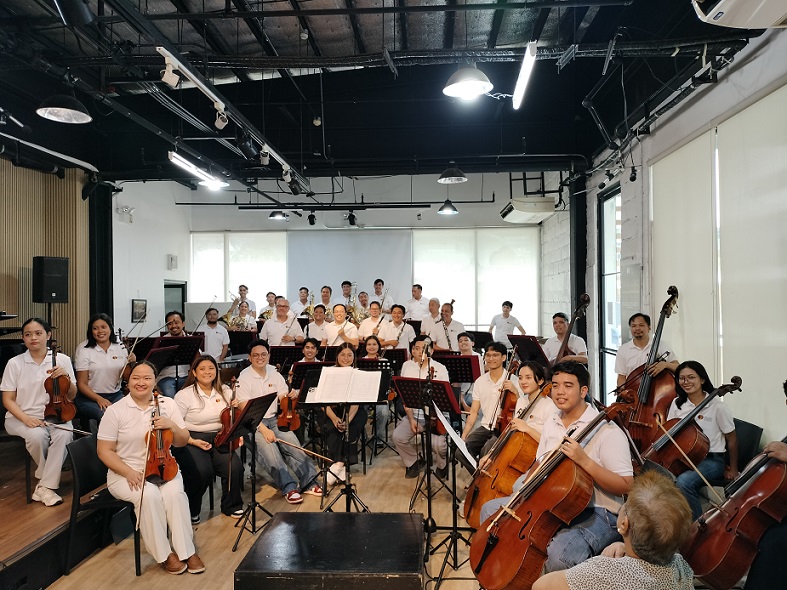
How do the musicians keep at it? Violinist Alfie Encina, speaking for the string section, said they “teach in the day and attend rehearsals and concerts at night.” He added: “It’s a full time [job] because we have a lot of engagements, like concerts and playing in parties.”
Tellingly, Solares is sticking to his guns and will not go pop despite its high audience reception. The MSO will continue to play concertos and symphonies. (Its most popular concert to date is “A Night in Hollywood,” held in June 2025.)
“Symphony music isn’t native to Filipinos [and] it was a struggle [playing] at first, but we played on,” Solares said. “The audience needs to be exposed to symphony music [and] we never based our program on what the audience could take.”
Goverment support needed
Solares hopes that in the coming years the government will finally lend its support to the orchestra. “The letters are in their archives,” he said, referring to the MSO’s unanswered messages to the government asking for help and sent as far back as the 1950s.
Sara Gonzales spoke out, reiterating the MSO’s development despite the lack of government funding: It established a music school; formed a youth orchestra; set up a scholarship program for budding musicians; went on tours; and cultivated “relationships with musicians who said the aura is nice and the camaraderie is good.”
Solares is now also focusing on more engagement from the community and “creating a civic orchestra to show that it’s possible to survive as a private orchestra.”
He declared: “MSO isn’t finished, hence my presentation title of ‘The Unfinished Symphony.’ We’re still fighting for what MSO set out to accomplish.”
Season subscribers get up to 50% off on all MSO100 VIP season concert tickets. For details, visit Manila Symphony Orchestra’s website (www.manilasymphony.com) and social media accounts: Manila Symphony Orchestra (YouTube and Facebook), @manila.symphony (Instagram), and @manilasymphonyorchestra (TikTok).