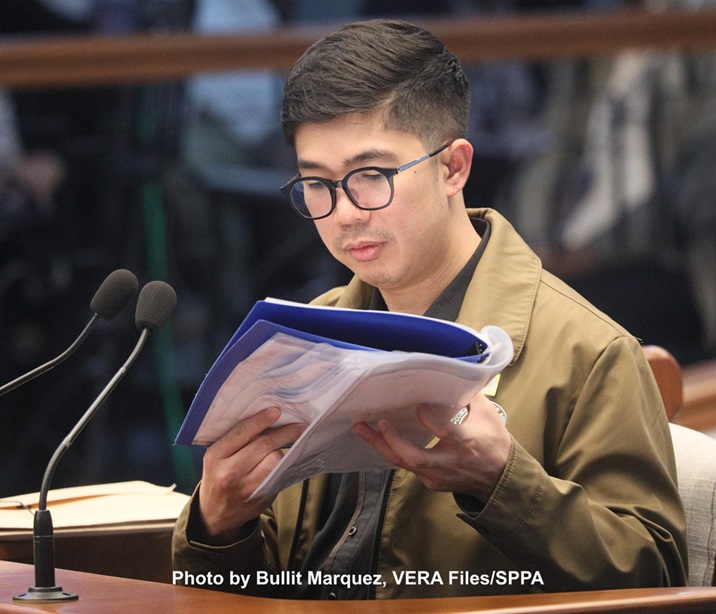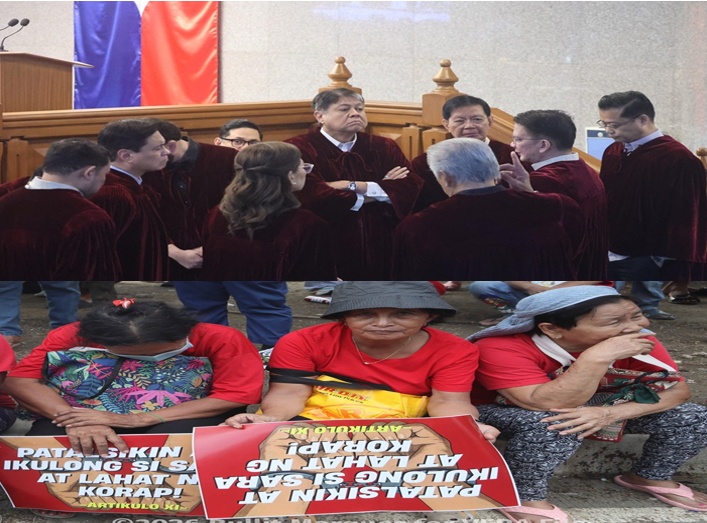
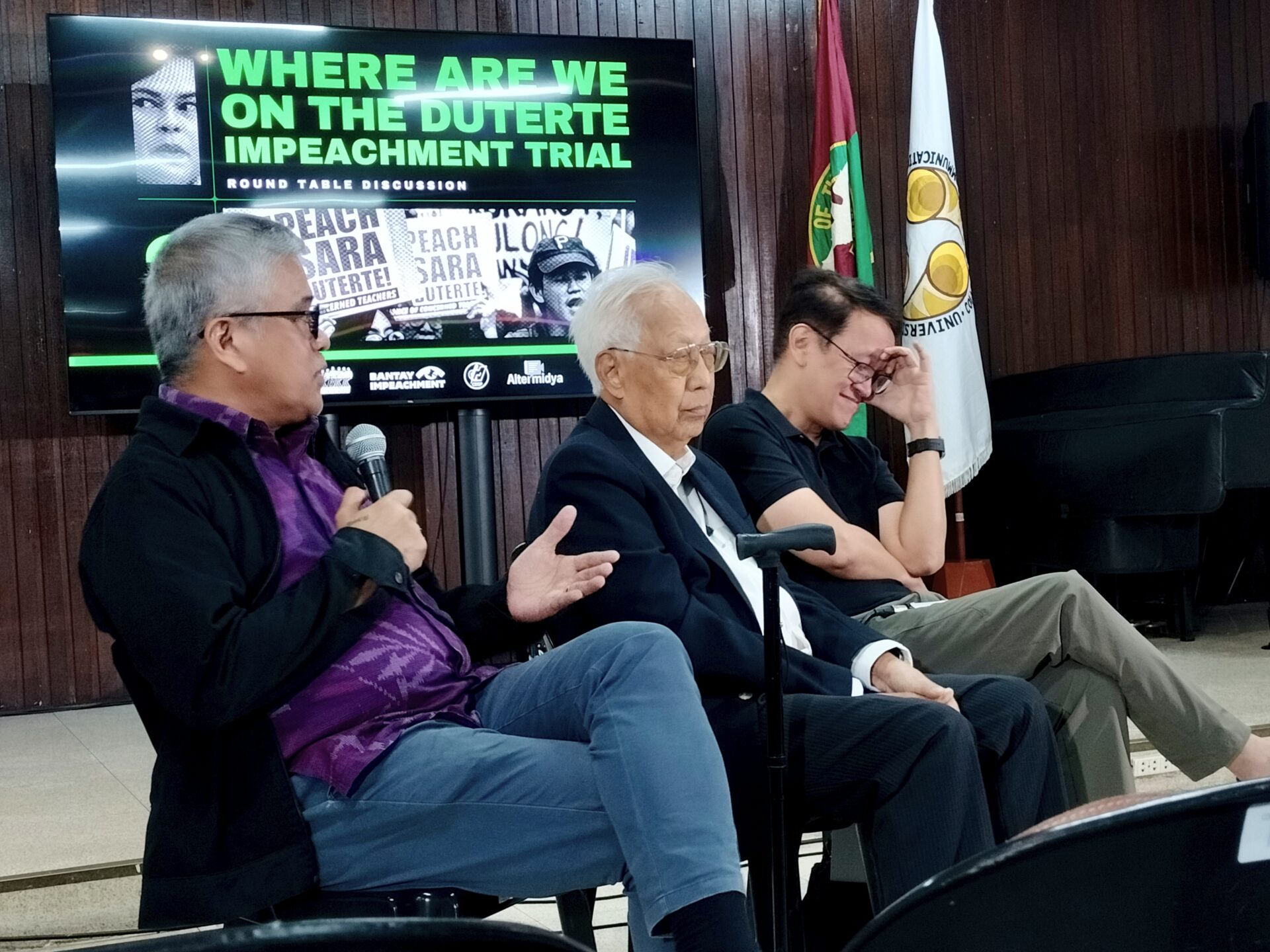
Former lawmaker Carlos Zarate was the first speaker at the roundtable discussion titled “Where are we on the Duterte Impeachment trial?” at the University of the Philippines College of Media and Communications (UP CMC) in Diliman on Oct. 8.
This was before the prosecution decided on Oct. 13 to drop three of the four articles of impeachment against Vice President Sara Duterte and focus solely on Article II, which accuses her of unexplained wealth.
The other speakers in the forum were former Commission on Elections chair Christian Monsod and Bagong Alyansang Makabayan president Renato Reyes Jr.
In her opening remarks, UP CMC Dean Maria Diosa Labiste underscored the necessity of the subject of the discussion. “It’s important for journalists to ask … the question if we are to move towards normalizing …accountability,” she said.
David San Juan raised a similar thought. San Juan, lead convener of the Kilusang Bayan Kontra Korakot (KBKK), said discussing the impeachment trial of Vice President Sara Duterte is important because it shows continued vigilance over the process and the Senate’s judgment, and answers the questions of citizens still undecided on the VP’s guilt or innocence on the charges. He cited related questions such as: How is President Ferdinand Marcos Jr. spending his confidential funds? Why is there no progress in the flood-control investigations? Is it an impeachable offense to have money and houses not declared in one’s statement of assets, liabilities and net worth?
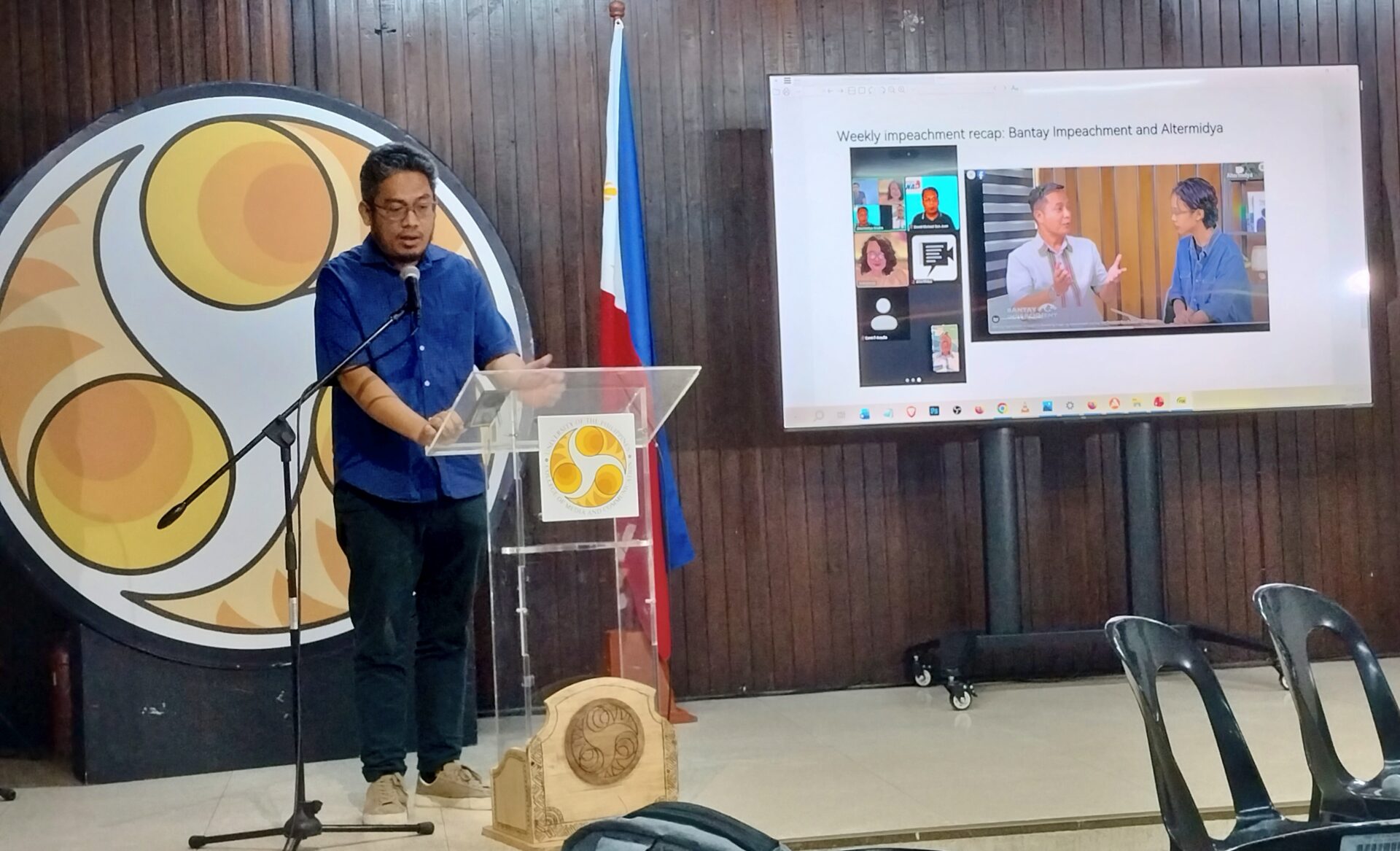
KBKK is an anti-corruption civil society movement composed of community leaders, professionals, students and workers. It organized the roundtable discussion along with Bantay Impeachment, UP CMC, and the College Editors Guild of the Philippines.
‘Stronger’ prosecution
Zarate, in his remarks titled “Looking through Theatrics: The Evidence so Far,” said the VP’s impeachment trial has moved beyond allegations and counterallegations, with the prosecution building evidentiary documents. But evidence does not carry the same weight in all the sections of Article 11 of the Constitution (accountability of public officers), he pointed out.
The prosecution faces the central problem of proving irregularities and the VP’s involvement in them, and reconciling the financial evidence with her SALNs and other official documents, said Zarate, a former Bayan Muna party-list representative who served from 2013 to 2022.
Significantly, he described the prosecution as “stronger.”
Zarate recapitulated Article 11 of the Constitution, the basis for the impeachment trial: Section 1 states that public officers must be accountable to the people. Section 6 says the Senate has the power to hold the impeachment trial and no person can be convicted without the 2/3 vote.
He said the burden of evidence has shifted to the defense, yet the burden of proof (“If the evidence can survive the scrutiny,” he said) remains with the prosecution.
Of the articles of impeachment against Duterte, Article 1 (alleged misuse of confidential and intelligence funds) has the largest documented evidence, establishing irregularities that can’t be misconstrued as simple accounting mistakes, Zarate said.
But “the prosecution [faces the] hard issue of the disallowance of the Commission on Audit (COA) of confidential and intelligence funds because it isn’t synonymous with graft,” he said. “Given this, the prosecution has to establish the VP’s culpability to constitute an impeachable offense.”
For Article 2 (alleged unexplained wealth), he said the broad allegations of SALN discrepancies have become more concrete with the financial documents presented. But the prosecution is up against the defense’s argument that the withdrawals of Duterte’s husband, Manases Carpio, are not unlawful transactions.
Article 2 is the “busiest evidentiary front” out of the four articles of impeachment, with subpoenas issued to financial agencies, said Zarate. The significance, he said, is less on the volume of the financial records than on giving the senator-judges something “concrete to look into than political narratives.”
Article 4 (assassination threats) is the “cleanest factual case of the prosecution because it’s stark in its simplicity,” Zarate said. He added: “The prosecution didn’t need to present witnesses because of the authenticated recordings from the National Bureau of Investigation. Also, the fight was over the VP’s meaning — i.e., hyperbole, an expression of anger — as the defense belabored the absence of evidence (no hit man). But the prosecution didn’t need to prove there’s an assassination plan.”
Zarate concluded: “The ultimate stake holder in the accountability process is the Filipino people. They need a credible assessment, a truthful declaration of wealth.”
‘Has she done that?’
Monsod, in his talk titled “The Voting Threshold Issue,” said Article 11 is the basis of the impeachment trial because the VP swore to faithfully and conscientiously fulfill all her duties, preserve, defend, and execute all of the country’s laws, and do justice to everyone.
“Has she done that? Has she lived up to her oath of office?” he asked, citing the grave threats as an example of a violation of “her oath to do justice to every man.”
As one of the framers of the 1987 Constitution, Monsod said Article 11 is limited to those who may be removed by impeachment — the president, vice president, ombudsman, members of the Supreme Court etc. — because “they have no one above them to discipline or ask them questions.”
“Their responsibility and accountability are directly to the people,” he said. “The impeachment … [represents] the people because they need to be protected if any of those officials don’t abide by their own oath of office.”
Monsod also said impeachment is a political, not judicial, proceeding. He admitted to being taken aback by the seemingly partisan senator-judges, pointing out that the Constitution “doesn’t say ‘partisan,’ it says ‘political.’”
“There’s a big difference,” he said.
He went on to say that he and his co-speakers have misgivings about the Supreme Court’s stance given certain decisions it has made, such as those involving Leila de Lima when she was detained as a senator and Maria Lourdes Sereno when she was impeached as chief justice.
“The legitimacy of elected officials is in the votes they get from the people, and the legitimacy of appointed officials, including the members of the Supreme Court, is in their independence,” he said.
On the 2/3 vote, Monsod said the framers of the 1987 Constitution including himself referred to the 1935 Constitution and, finding the 3/4 vote (or 18 votes) for impeachment difficult, decided on the 2/3 vote.
“You can’t change the 2/3 because we didn’t mention ‘24 senators’ [but] ‘all the members of the Senate,’” he said.
Former Supreme Court associate justice Adolfo Azcuna, also a framer of the 1987 Constitution, mentioned exceptions to the number 24: the dead, resigned, expelled, or physically unfit
Monsod added the legally unfit, linking it to the plunder law, which states that a senator accused and detained cannot exercise any function and power or participate in the proceedings of the office: “He’s only a senator in name, but not in substance.”
“The 24 should be read in the context of the times,” Monsod asserted. “It was never meant to say that it doesn’t matter whether you’re dead, alive, sick, or in prison, and that as long as you’re a senator, you become a denominator. The ratio of 2/3 is…sacred.”
Outcomes and implications
Reyes outlined the potential course of events when the senator-judges vote in his remarks titled “The Verdict: Scenarios and Consequences.” He unequivocally proclaimed the VP’s conviction, which, he said could get “ugly and, in Sara’s words, bloody.”
He underscored the political crisis that made the impeachment trial “see the light of day,” saying it wouldn’t have gotten past Congress if the relationship between the President and Vice President hadn’t turned acrimonious. Also, he said widespread protests calling out the administration’s lukewarm stance toward the corruption cases had to happen for the impeachment process to move forward.
The impeachment trial is important because it’s the anchor on which the senator-judges would vote to acquit or convict, Reyes said. Simply put, “the verdict should be based on evidence.” But he warned that voting can be influenced by the dynasties in the Senate. He cited Senators Mark and Camille Villar, siblings, with Mark recently defecting to the majority bloc. Reyes said he found the phenomenon “interesting” because of the advantage of a political dynasty splitting the vote.
“The framers of the Constitution didn’t anticipate that 1/3 of the Senate would be siblings,” he said.
On the aftermath of a verdict of conviction, Reyes said not everyone would be happy because “we’re going after Sara for [supposed misuse of] ₱612 million in confidential funds when the President’s funds are from confidential and intelligence funds.”
“The standards applied to [her] should also apply to the other officials,” Reyes said. Thus, he said, a guilty verdict on the VP should open the people’s eyes to the Philippines’ broken system because, he pointed out, a conviction doesn’t mean the system of accountability is truly working.
Summing up, Reyes said it’s up to the people to make sure all those involved in corruption are held accountable. Leaving the resolution to politicians/political dynasties will turn it into an “issue of horse trading or political maneuverings,” he said.
‘From the bottom up’
In the Q&A portion, on the question of safeguards against the Duterte and Marcos families, Monsod said the people should exercise sovereignty. “The transformation should come from the bottom up,” he declared. He added that a tough antidynasty law should be enacted as soon as possible.
Addressing the young people in the audience, he wondered what they were willing to sacrifice if they love their country. He said they must “help the poor take power.”
The question was raised: What would happen if those detained on plunder charges, like Sen. Rodante Marcoleta, showed up to vote? Zarate said there is no legal safeguard preventing them from doing so if the Sandiganbayan grants them bail. Reyes said the safeguard is the people who’d expose these senator-judges’ partiality because the Dutertes wouldn’t “take [conviction] sitting down.” Monsod said the VP only needed to be convicted on one article of impeachment.
Finally, the speakers were asked about their thoughts on the defense’s ways of challenging the prosecution.
Reyes said the defense always argues that the VP and her husband weren’t aware of irregularities in their finances. But, he said, it’d be difficult to always claim ignorance or forgetfulness because the VP is legally obligated to disclose her assets and financial standing.
Zarate said the defense always tries to punch holes in the prosecution’s words, raise procedural objections, and create doubt. He said that while the use of the alias Mary Grace Piattos “isn’t illegal, the disallowance of the COA isn’t on the aliases but on the way the money was spent.”
He added that the defense would have difficulty disproving betrayal of public trust because the VP’s nondisclosure of assets, liabilities and net worth is a clear betrayal of public trust and a violation of the law.