

There is no let- up in state-related violence in the first months of 2026 which show sharper intensity than last year.
When the Armed Forces of the Philippines killed 19 individuals in its counterinsurgency offensive in Salamanca, Toboso, Negros Occidental, last April 19, it was an expected escalation from a force that killed 145 alleged insurgents last year.
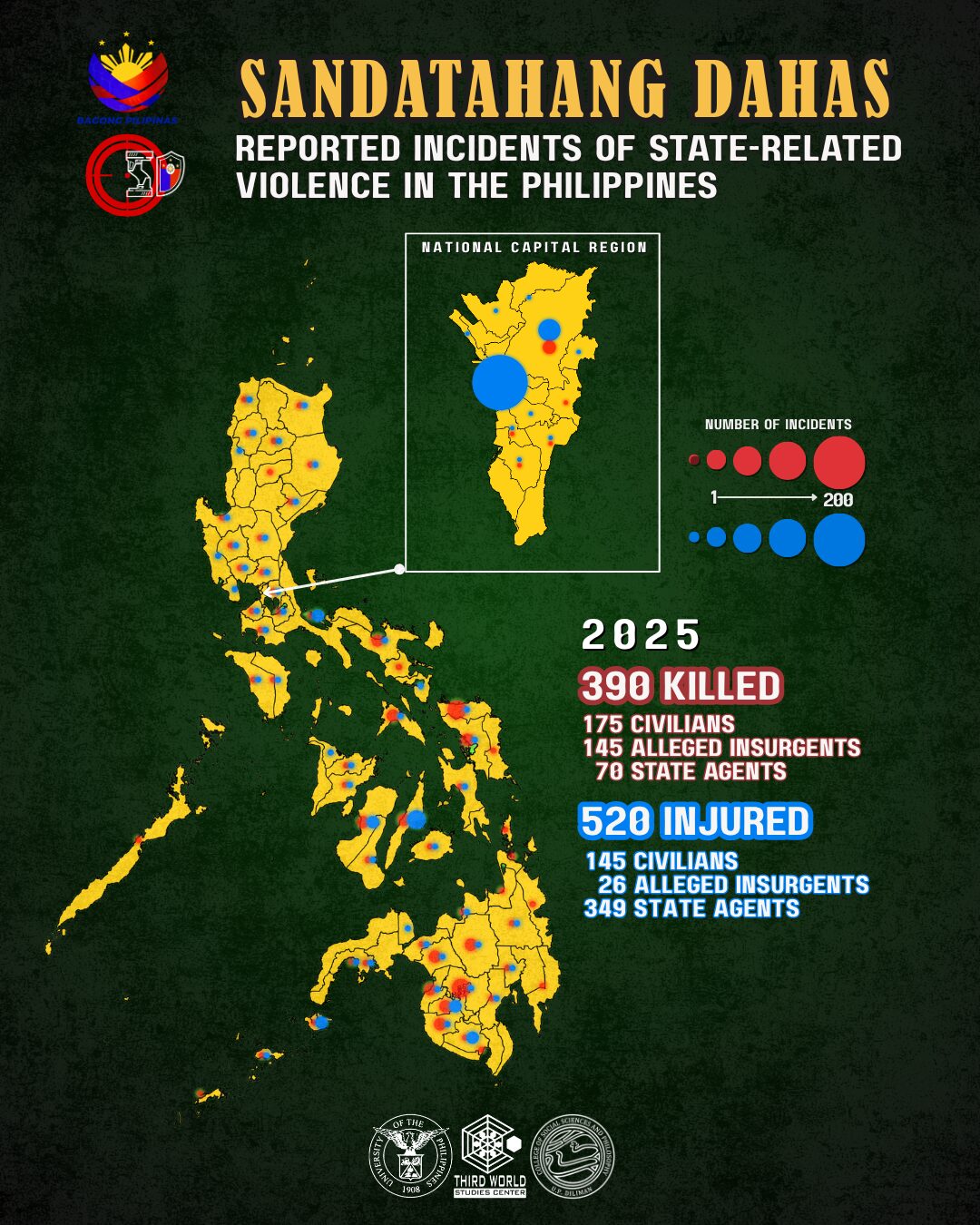
In 2025, 390 individuals were killed and 520 were injured in reported incidents of state-related violence, as recorded by the Sandatahang Dahas (Armed Violence) monitor of the UP Third World Studies Center. The police and the military account for 85 percent of the killings (175 civilians, 145 alleged insurgents, and 12 fellow state agents). And in a sign of resistance to armed state authorities, the civilian public caused 52 percent or 269 of all cases of injuries, which were mainly directed at the police during law enforcement operations.
State-related violence is defined here as an act of injurious or lethal violence inflicted by or on public security agents (PSA); in other words, a gun-bearing member of the state, pertaining to members of the Philippine National Police and the Armed Forces of the Philippines, among others.
Victims and perpetrators are classified into civilians, alleged insurgents, and public security agents (or state agents). Alleged insurgents pertain to anti-government forces that resort to political violence yet may have significant ideological differences and varying degrees of strength and legitimacy as a movement, such as the New People’s Army (NPA), Dawlah Islamiyah, and the Moro Islamic Liberation Front, among others. We classify these as alleged insurgents because we note how, in some cases, there have been conflicting narratives from the AFP and the victims’ families regarding their civilian status. Despite this, any member of these groups–alleged or confirmed–are seen by the military as terrorists.
Sandatahang Dahas data relies on news sources of state-related violence. Official statements of law enforcement organizations in the Philippines regarding injury or death, or both, in their rank or those caused by them, are also considered legitimate sources of information. Because it is only possible for Sandatahang Dahas to count reported incidents, we recognize that our numbers are likely an undercount; it is possible that other incidents of state violence have escaped media coverage and thus were not included in this yearly report.
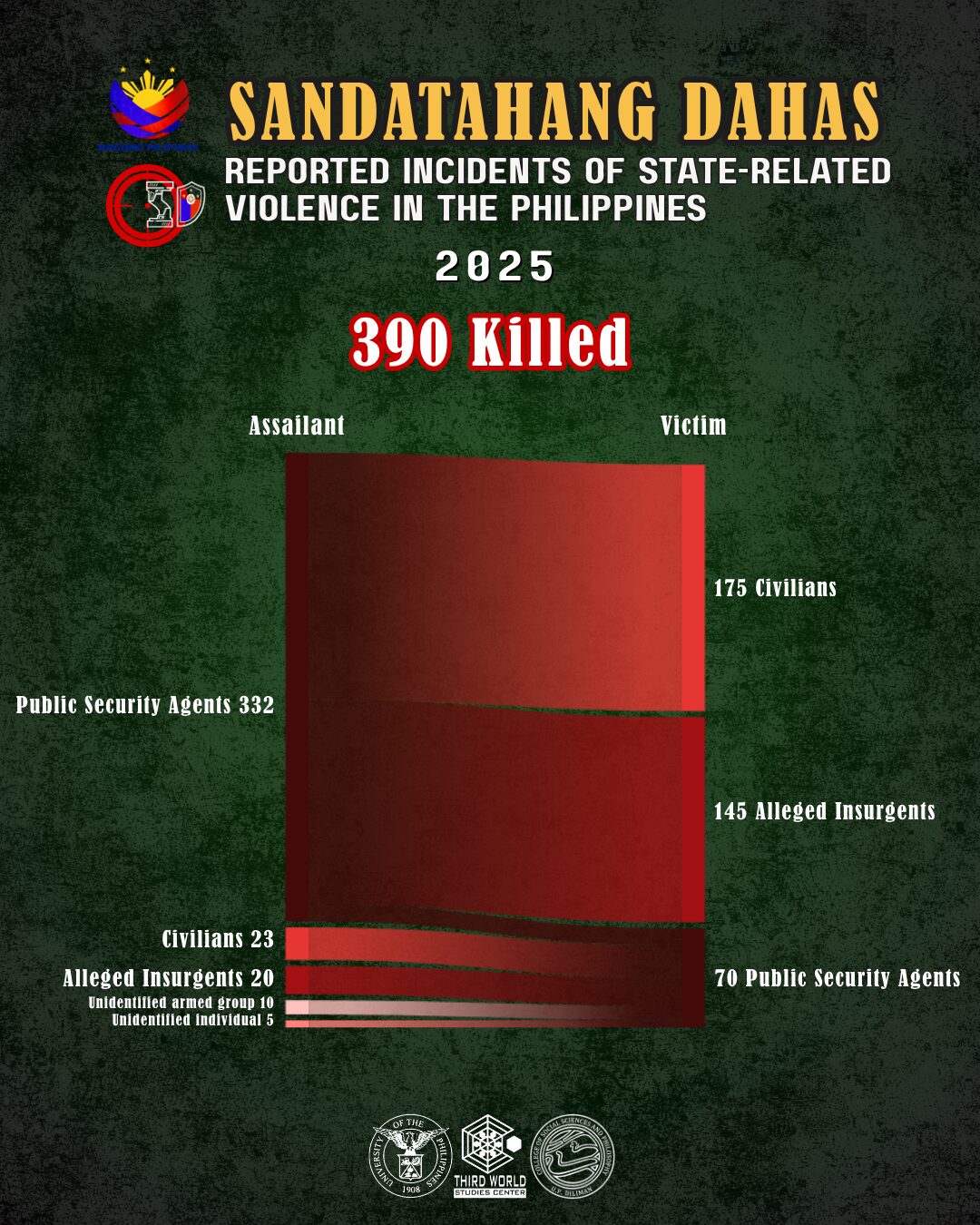
Civilians constitute nearly half of the recorded killings at 175 (45 percent). Of these, 134 were killed during law enforcement operations while ten were gunned down during routine checkpoints, seven died while in the custody of state agents, and 24 were killed due to other circumstances such as domestic disputes. Men make up most of the victims at 162 (93 percent), while women constitute 5 percent (9). Lastly, four individuals (2 percent) died whose sex was unreported in the news.
Age is a harder demographic point to track because a majority of the news sources do not report it. Of the 175 killed civilians recorded, the ages of more than half of these were unreported (95 or 54 percent). Alarmingly, three minors were killed by state agents this year, all during official law enforcing duties.
Meanwhile, Sandatahang Dahas recorded 145 alleged insurgents killed in 2025. Most of this number (123 or 85 percent) are reported to be members of the NPA. Eighteen members of the Dawlah Islamiyah were killed, with two of them also classified as members of the Bangsamoro Islamic Freedom Fighters (BIFF). One Abu Sayyaf member and three MILF members, one of them a commander, were killed by soldiers in 2025.
Of the 145, 70 percent (101) were men, 8 percent (12) were women, and 22 percent (32) were individuals whose sex was unreported in the media. With many victims killed in encounters with the AFP, their identities are often undisclosed. It was very rare that the ages of these victims were revealed in the news reports. Of the 145, 91 percent (132) had their ages unreported. On the other end of the age spectrum, two of the oldest victims of state-related killings in 2025 were alleged insurgents: two alleged NPA members aged 68 and 72 years old.
Lastly, 70 state agents died in 2025. More than half of these were AFP members (36 or 51 percent) distributed across all its branches. Police officers followed at 47 percent (33), while one member of the Philippine Drug Enforcement Agency was killed. Notably, only around half of the state agents killed in 2025 died during law enforcement operations (37 or 53 percent). The rest died in incidents outside of their official duties.
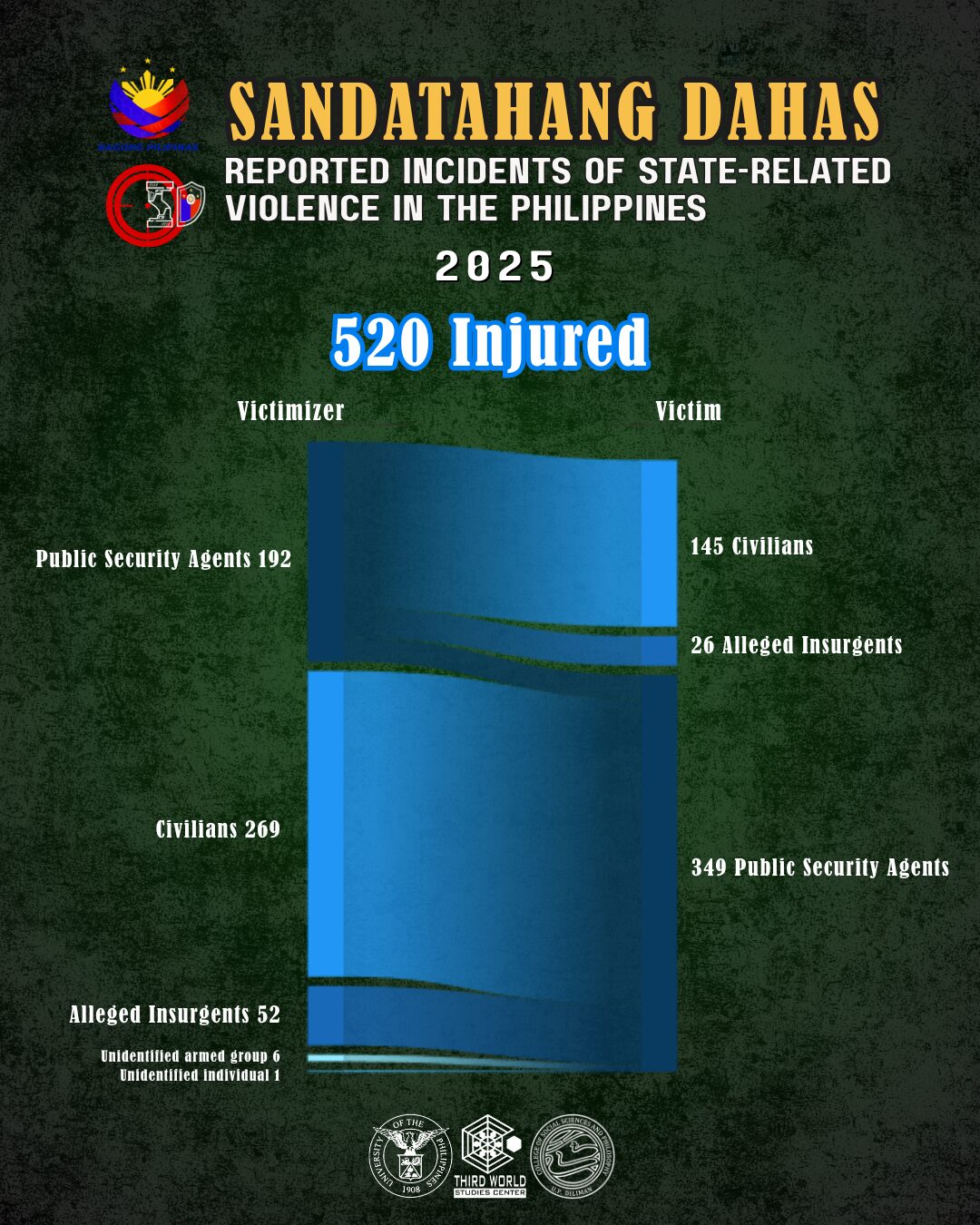
Of those injured, state agents are the majority with 349 incidents, or 67 percent. Of these, 77 percent (269) were police officers while 20 percent (70) were from the AFP, divided into all three of its branches (the Army, 61; the Navy, two; and the Air Force, three) and the Citizen Armed Force Geographical Unit, which had four injured. Seven PDEA agents and three members of the Bureau of Jail Management and Penology were also injured this year. Of the 349 state agents injured, 131 were men, three were women, and 215 individuals’ sex was unreported.
Meanwhile, state agents injured 145 civilians. More than half (61 percent or 89) were injured during law enforcement operations, while 9 percent (13) were injured while in state agents’ custody. Nearly 30 percent were injured in other circumstances, such as domestic disputes and altercations while serving fake warrants. Of the 145 injured civilians, 82 percent (119) were men and 14 percent (20) were women. Six individuals’ sex was unreported.
Twenty-one teenagers aged 13 to 19 years old were injured by the police in 2025. Only five of these cases occurred during law enforcement operations. Of the 21, six were girls (the youngest of whom was 14 years old) who were raped by police officers. Sandatahang Dahas classifies sexual violence as a form of injury when it clearly violates the victim’s bodily integrity. Similar to the killings, a significant number of the injured civilians’ ages were unreported (67 persons or 46 percent).
Alleged insurgents were infrequently injured by state agents, with 26 reported cases in 2025. More than half (65 percent or 17) are NPA members, 31 percent (8) are part of Dawlah Islamiyah (with three of these also classified under BIFF), while one individual (4 percent) is an MILF member. All these incidents occurred during official law enforcement operations. Of the 26, 62 percent (16) were men, 12 percent (3) were women, while the sex of 27 percent (7) was unreported. Two minors, aged 16 and 17 years old, were killed by the AFP for reportedly being NPA members.
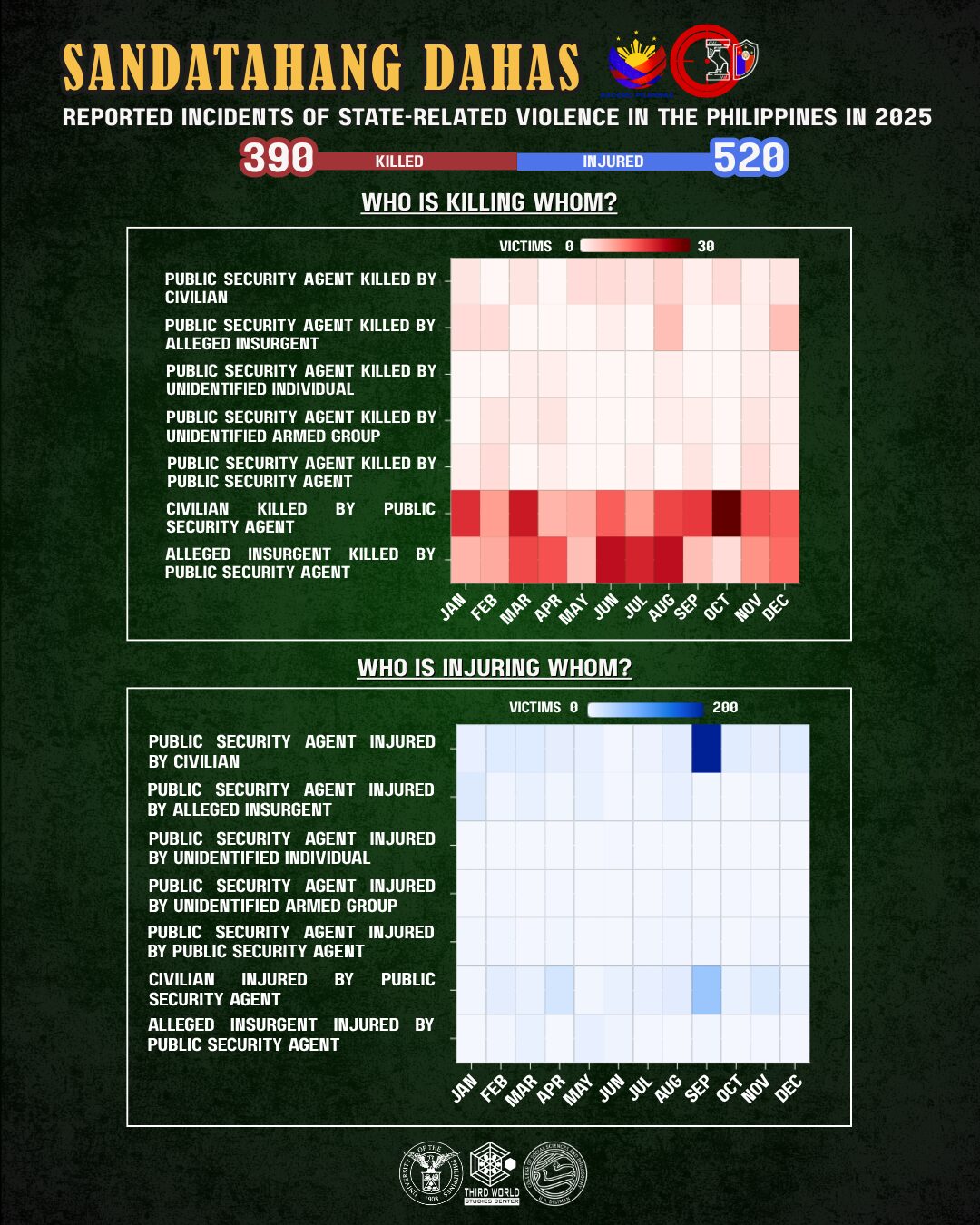
In 2025, the incidents recorded under Sandatahang Dahas varied in their circumstances. The following trends were noted.
Anti-Insurgency
A significant portion of state-related violence in 2025 concerns insurgents, notwithstanding the claim of Pres. Ferdinand “Bongbong” R. Marcos Jr. in his 2025 State of the Nation Address: “Wala na ring nalalabing grupong gerilya sa bansa, at titiyakin ng pamahalaan na wala nang mabubuo muli” (guerilla groups in the country have ceased, and the government will ensure that there will be none of them again).
The AFP led anti-insurgency operations, sometimes with the assistance of other public security units. These operations often resulted in encounters with insurgent groups. Sometimes the insurgent groups would ambush state forces. Both sides sustained a significant number of casualties: among the alleged insurgents, 145 were killed and 26 injured; among the state agents, 20 were killed and 52 injured.
The 123 alleged NPA members killed by the AFP in 2025 included prominent leaders: Myrna “Maria Malaya” Sularte in Butuan, Agusan del Norte; Christopher “Bal” Endrinal, Ramil “Paeng” Recto, Danilo “Ter/Dado” Budino (along with two members) in Lagonoy, Camarines Sur; and Fidel “Ivan/Red” Lagado (and two members) in Jaro, Leyte, among others.
Of the 18 Dawlah Islamiyah members killed, two were reportedly leaders: Nasser “Mas’od/Mahater” Daud in Bacolod-Kalawi, Lanao del Sur and Najib “Abu Jihad” Laguindab in Pagayawan, Lanao del Sur.
On the other hand, 20 state agents (19 AFP members and one policeman) died at the hands of alleged insurgents: two were killed by the MILF, two by the Dawlah Islamiyah, and 16 by the NPA.
Incidents were concentrated in Regions V (Bicol), VIII (Eastern Visayas), and the Bangsamoro Autonomous Region of Muslim Mindanao . By far, Region VIII amassed the largest number of insurgent victims, with 37 killed and one injured. After more than half a century of attacks and counterattacks, the insurgents have turned locales into familiar redoubts that the state agents in turn have turned into kill zones. Hence the accretion of violence in these particular regions.
Anti-Drug operations
State agents continue to kill in anti-drug operations. In 2025, deaths from drug-related operations made up around 22 percent of all state-related killings (87 of 390). Sandatahang Dahas counted 80 civilians and alleged insurgents, as well as seven state agents, who died in such circumstances. The Dahas Project counted 89 victims due to slightly different parameters. For example, the case of alias “Tinang” in Palo, Leyte, was not included in Sandatahang Dahas because he died of cardiac arrest during a drug buy-bust operation. This does not fall under Sandatahang Dahas’ definition of state violence, but it is considered a drug-related killing based on the Dahas Project’s inclusion criteria.
Of the 87 victims, seven were alleged insurgents (four from Dawlah Islamiyah, and one each from the NPA, MILF, and Abu Sayyaf). Two civilians died while in police custody due to drug-related charges. On June 13, Arnold Duran, a buy-bust suspect, was reportedly beaten by police officers before succumbing to a heart attack in Danao City, Cebu. Juan Amarilla Cantilla was arrested on March 19 during a buy-bust operation in Dalaguete, Cebu. Three days later, he allegedly committed suicide inside the comfort room of a PDEA detention facility in Lahug.
Additionally, 10 percent (7 of 70) of all the state agents who died this year died due to their involvement in anti-drug operations.
As for injuries, 11 state agents and 14 civilians were injured during anti-drug operations in 2025. Notably, five state agents (four policemen and one Marine private) were all injured in a clash against two alleged drug dealers in Datu Odin Sinsuat, Maguindanao del Norte, who both died during the operation.
Despite these significant casualties and injuries, many of whom are state agents themselves, President Ferdinand “Bongbong” Marcos has recently reiterated that his drug war does not resort to violence. This has been echoed by PNP Chief Jose Melencio Nartatez Jr., who has stated that every death involving the PNP is being investigated.
Protests
While no state-related killings were reported to have happened during civil protests, 35 percent (183) of the injuries for 2025 occurred during such circumstances. All of these injuries took place during the month of September. Historically, protests are held every September in the Philippines to remember the brutality of Ferdinand Marcos Sr.’s martial law, which officially started on September 21, 1972. In 2025, this month also coincided with the height of the controversies surrounding ghost flood control projects helmed by the Department of Public Works and Highways.
On the first Friday of the month, groups organized a protest in front of the House of Representatives in Quezon City to demand accountability for the ghost projects. It was reported that eight police officers were injured. A 20-year-old transwoman named Raja Lynn Bausing was also choked and violently grabbed by a police officer during the protest.
The Sept. 5 protest would come to foreshadow a level of brutality unparalleled in this decade thus far. During the Sept. 21 protest, 151 police officers and a minimum of 43 civilians were injured. Because of the breadth and intensity of its violence, a separate report has been written specifically about these numbers.
State agents vs state agents
Consistently throughout the year, state agents have harmed each other. Three AFP officers were killed by fellow members, while nine police officers were similarly killed by other police officers. Only one of these incidents occurred during a legitimate law enforcement operation, wherein Cpl. Ronnie Sarto was shot dead during a hot pursuit operation after he robbed a convenience store in Marilao, Bulacan.
The rest of the incidents were due to personal disputes between state agents. In Marawi City, Lanao del Sur, two policewomen shot each other, resulting in the death of one and the injury of another. The two were reportedly a couple who were having a heated argument due to jealousy.
Notably, five incidents occurred inside state establishments themselves. Pat. Rodel Abelido was shot inside the PNP Special Action Force Compound in Sipocot, Camarines Sur due to a laundry dispute with fellow patrolman Jhonel Idos. Twenty-two-year-old Pvt. Charlie Patigayon was beaten to death by his fellow soldiers at a reception rites activity at the 6th Infantry Battalion in Datu Piang, Maguindanao del Sur. Police suspect he may have been hazed prior to the ceremony, resulting in his death. In Abra, two police officers, a lieutenant and a staff sergeant, were shot dead at the Provincial Explosive Ordinance Disposal and Canine Unit office. The staff sergeant had reportedly accused the lieutenant of misconduct prior to the incident, leading the lieutenant to shoot him while off-duty. Another officer heard the commotion and shot the lieutenant back.
As for injuries, 21 state agents were harmed by their fellow state agents in 2025. Only five of these occurred during a legitimate law enforcement operation, while the rest were due to personal disputes. However, an incident occurring during a law enforcement operation does not absolve it of its excessive brutality. CCTV footage caught PDEA Agent alias “Ron” being beaten by police officers before being arrested in Cotabato City, Maguindanao del Norte despite his repeated cries for them to stop.
Domestic and sexual violence
Domestic and sexual violence committed by state agents has become an alarming trend throughout the months of 2025—ten individuals were shot by police officers, with all but one shot by the victim’s partner. That outlier was shot by her policeman son-in-law. Of these 10 incidents, six resulted in the victim’s death.
In Digos City, Davao del Sur, Pat. Orland Porquido Dinoy shot his live-in partner and her mother during a heated argument at their residence after his partner had reprimanded him for going home drunk. His partner died instantly, while her mother was severely wounded.
Two body dumps of women killed by their policemen partners have been recorded in 2025. An unnamed 24-year-old woman was found dead with a gunshot wound in Bayambang, Pangasinan. The suspect has been identified as her boyfriend, a policeman. Police cited debt as a possible motive; the suspect reportedly never returned the money he loaned from the victim despite several reminders from her. On the day before she was killed, the victim had just received her salary. As of Oct. 20, 2025, the policeman has been arrested for murder.
These incidents suggest a disturbing pattern of police officers resorting to gun violence to end personal arguments, resulting in the deaths or critical injuries of their partners and relatives.
In 2025, Sandatahang Dahas recorded 16 incidents of state agents committing sexual violence. One of these incidents resulted in the victim’s death, a woman named Bhryliant Pearl Prado. She was brutally killed alongside her husband at their home in Samal Island, Davao del Norte. The suspect was a CAFGU member who is believed to have assaulted Prado before killing her. He has since been detained.
Of the 16 victims, six were fellow state agents (or agents in training). Multiple complaints of sexual assault have been filed against Maj. Anthony France Ramos, an instructor at the PNP Academy (PNPA) in Silang, Cavite. The National Police Commission noted that the suspect specifically targeted cadets with ongoing cases. Ramos abused his power by ordering them to do “body checks,” wherein they would undress and the abuse would ensue. He has since been dismissed.
State agents abuse their authority over civilians as well. And in 2025, they were preying on girls. Six of the 16 victims of sexual violence were girls aged 18 and younger, with the youngest being a 14-year-old girl who was raped by a police officer in Ginatilan, Cebu. The suspect was the acting commander of the Malabuyoc Municipal Police Station at the time of the incident. As of writing, he has now been classified as absent without leave, but has not yet been apprehended.
In General Santos City, five girls were victimized by police officers in three separate incidents: a 17-year-old girl was raped inside a police bunkhouse; two 17-year-old girls were stopped by police officers while they were riding a motorcycle, supposedly for traffic violations, before being taken to a separate location and raped; and an 18-year-old girl and her companion, reportedly a lesbian, were raped inside a police car near the General Santos City Police Office Station by two of its officers after they had reported a separate crime.
There have been two recorded incidents, both in Cavite, wherein police used the pretense of enforcing anti-drug operations to rape two women, one of them an 18-year-old. The police arrived at alias “Nena’s” house in Bacoor to serve a warrant against her partner, allegedly a drug pusher. Upon finding out that he was not home, 14 police officers proceeded to rape the victim. Unsatisfied, they even stole some of the victim’s money and belongings before leaving. They have since been relieved while the investigation is ongoing. Similarly, alias “Iza” was repeatedly raped by the deputy police chief while detained for illegal drug charges at the Novoleta Police Station. According to her, she had experienced similar abuse from the same police officer when she was first arrested in 2024. The deputy raped her multiple times in exchange for a lower sentence.
Despite the PNP’s and Napolcom‘s repeated statements that they have a zero tolerance policy against their officers committing such acts, there has been no news of the perpetrators being arrested.
Geographical spread
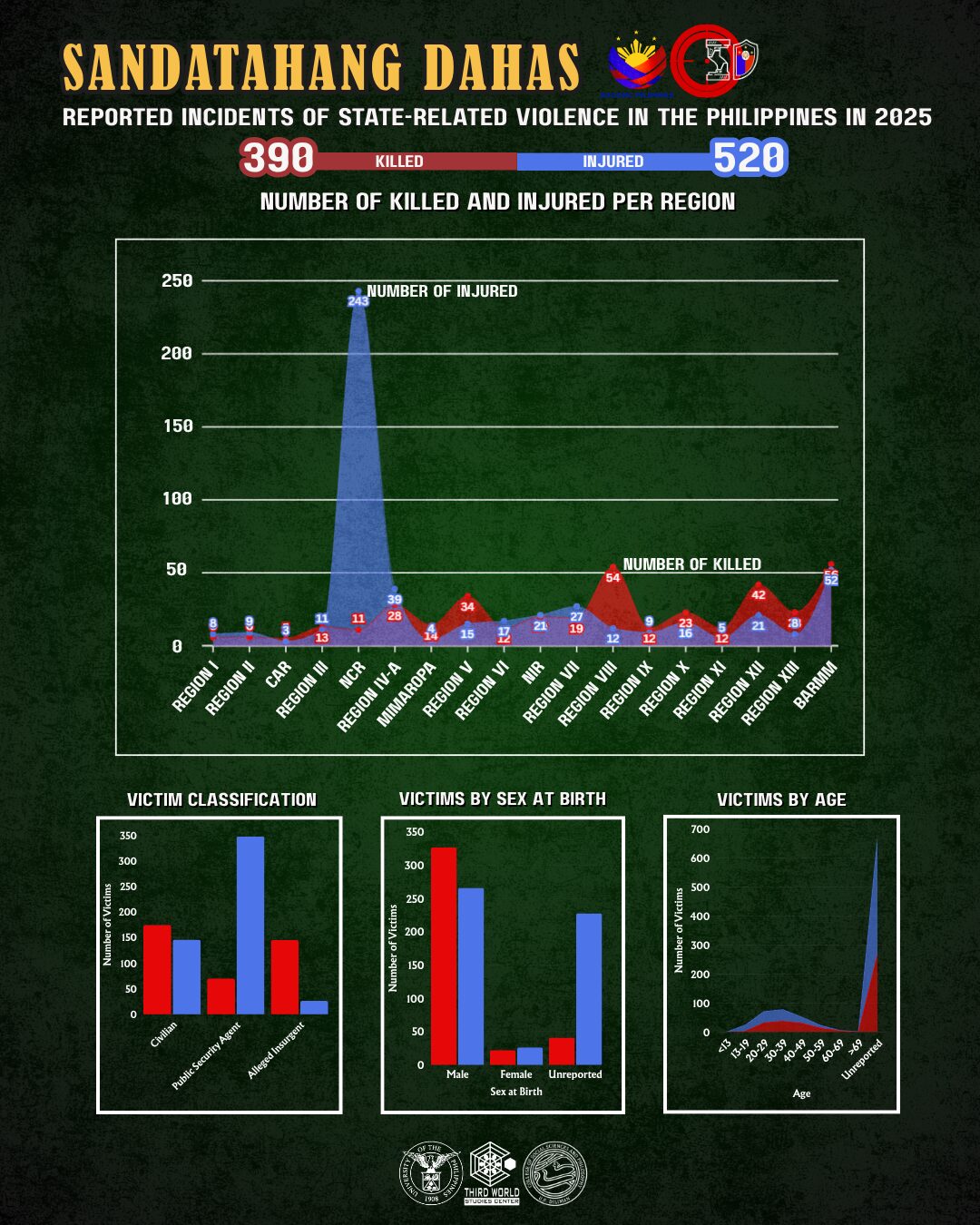
Of the 910 incidents of state-related violence recorded in 2025 (390 killings and 520 injuries), nearly half of these were concentrated in Luzon: 117 individuals killed and 332 injured were monitored across its regions. Notably, 58 percent (194) of the injuries recorded in Luzon were due to the September 21 protest alone. The National Capital Region has the highest number of overall incidents in the country, with 11 killed and 243 injured. The northern regions of Luzon recorded relatively fewer instances of state-related violence than the island group’s southern regions. Region I had six killed and eight injured; Region II, six killed and nine injured; CAR, five killed and three injured; and Region III, 13 killed and 11 injured. Further south, Region IV-A recorded 28 killed and 39 injured, MIMAROPA had 14 killed and four injured, while Region V had 34 killed and 15 injured.
Mindanao comes in second when it comes to the number of incidents, reporting 168 killed and 111 injured. A majority of the incidents were concentrated in its western part. Specifically, BARMM incurred the highest number, with 56 killed and 52 injured. Region IX had 12 killed and nine injured; Region X, 23 killed and 16 injured; Region XI, 12 killed and five injured; Region XII, 42 killed and 21 injured; and Region XIII, 23 killed and eight injured.
In Visayas, 105 individuals were killed and 77 injured in state-related incidents. Region VIII had the highest number of incidents, with 54 killed and 12 injured. Over half of these victims (38 of 66) were NPA members. Region VI had 12 killed and 17 injured, the NIR had 20 killed and 21 injured across its three provinces (no incidents were recorded in Siquijor), while Region VII had 19 killed and 27 injured.
Over 75 percent of the country’s provinces recorded at least one incident of state violence in 2025 (62 of 82). With state agents continuing to be the overwhelming perpetrator of such incidents, both within and outside their actual law enforcing duties, this brings into question whether state agents’ internal correction units are actually holding their offending officers accountable.
As this is Sandatahang Dahas’s first annual report using its own method of tracking and counting state-related violence in the Philippines, it cannot yet conclude on year-on-year trends or to say with certainty that this year was more or less violent than the last. It has limited its discussion to the recognizable nexus of state violence, to the circumstances that often give rise to assaults and who resists them, and to the bodies found in the familiar geography of an unending insurgency.
Monitoring of incidents in the first months of this year, however, indicates that 2026 may just be as deadly to insurgents, civilians, and state agents alike. Or even be much worse.
[Aidrielle Raymundo is a university research associate at the Third World Studies Center (TWSC), College of Social Sciences and Philosophy, University of the Philippines Diliman. She also did the graphics accompanying this report. The data for this monitor were compiled with the assistance of TWSC researchers Joel Ariate and Arrianne Fajardo, and TWSC student assistants John Matthew Cabural, Nadine Castillo, Eugene Claire Belen Espino, LJ Meriño, and Aaliyah Nicole Ybera. Former TWSC student assistants and interns Timothy Antoniette De Jesus, Madeleine Ann Ibe, Allyssa Nuez, Jemrick Giuseppe Pagulayan, and Michael Perang also greatly contributed to this effort. To learn more about Sandatahang Dahas, visit its website and for the latest updates, follow the Sandatahang Dahas in these social media platforms: X (formerly Twitter), Instagram, Threads, and Bluesky. For more detailed reporting during each month of 2025, see the Sandatahang Dahas monthly reports.]