
Efforts to regulate online disinformation have intensified in the Philippines, with lawmakers proposing new penalties and authorities launching initiatives with major news organisations. These moves come as the news media industry is being reshaped by shifts in distribution, platform use, and audience behaviour, alongside persistent press freedom concerns.
Lawmakers in the 20th Congress are proposing criminal penalties, regulatory oversight, and takedown mechanisms for allegedly false or misleading online content. Although not yet implemented, this package of bills would allow authorities to order the removal of disinformation and impose fines or prison terms on publishers, platforms, or individuals who fail to comply.
Some proposals include safeguards for legitimate journalism. However, a number of proposals look set to treat journalists as aggravating offenders, triggering maximum penalties if they are found liable for spreading disinformation. Press freedom advocates warn that vague definitions and broad takedown powers could expand state authority over freedom of speech.
The government has also stepped up other anti-disinformation initiatives. In March, the Presidential Communications Office launched “Oplan Kontra Fake News,” bringing together major newspapers to counter false narratives, and later set up an Anti-Fake News Desk and reporting platform where the public can flag suspicious content for assessment and possible referral to agencies. By May, the initiative had moved into enforcement, with the PCO saying it had referred several cases to the Justice department after the arrest of a former broadcaster over a cyberlibel case involving allegedly fabricated medical records of President Marcos.
ABS-CBN has continued running without a broadcast franchise since 2020 by shifting to a platform-distribution strategy and expanding partnerships with other networks and platforms. The company has also faced internal tensions tied to a family dispute among its owners, including a rejected proposal to shut down the network.
Over the past year ABS-CBN has revived well-known news brands across multiple channels. The network relaunched its streaming service iWant, which now carries news programming such as ANC and DZMM TeleRadyo, and revived the DZMM Radyo Patrol 630 brand and its iconic call sign through a joint venture with Prime Media, now operating across radio, television, and streaming platforms.
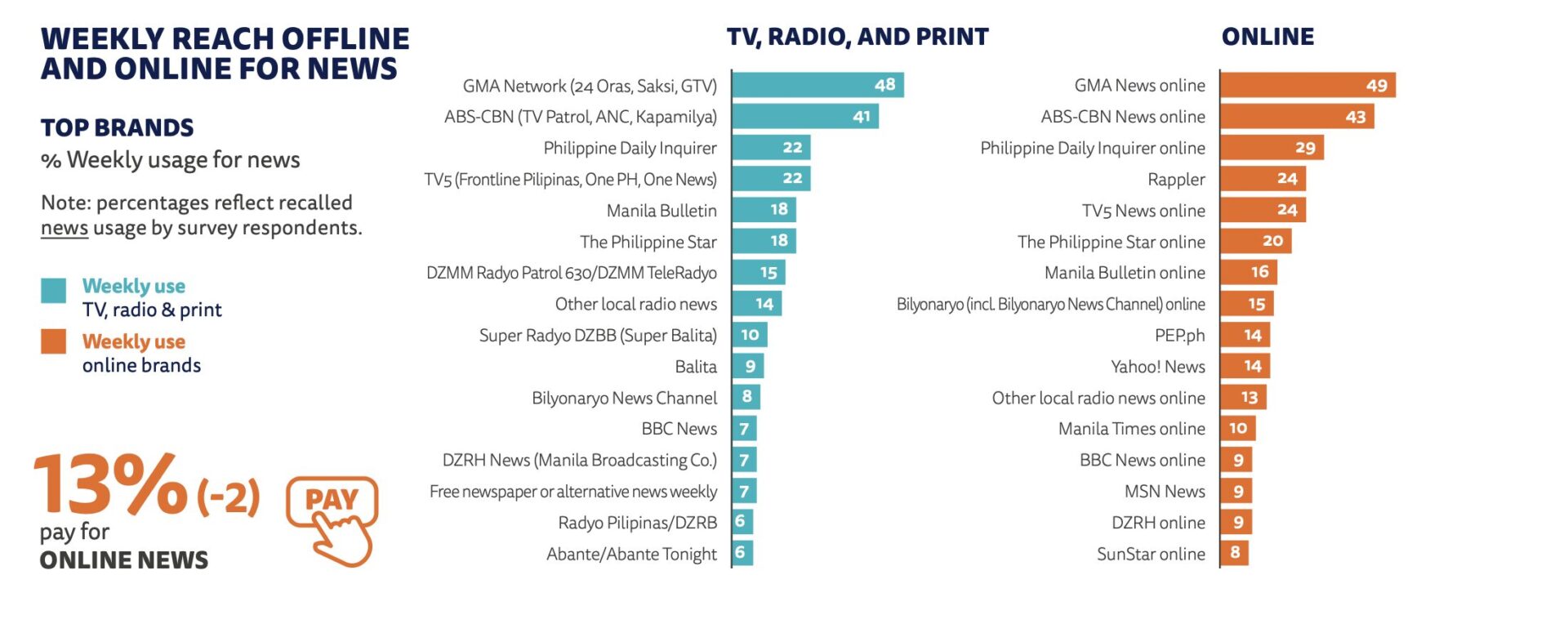
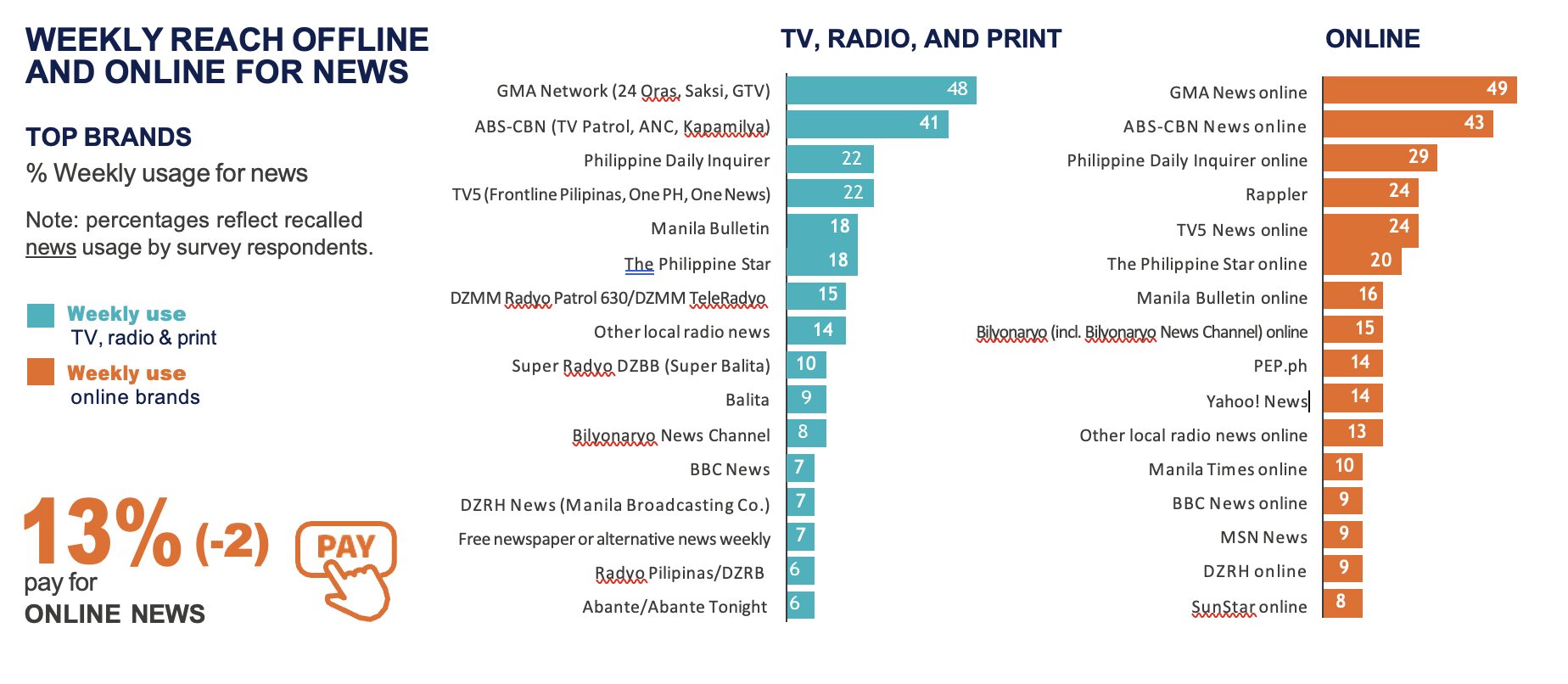
DZMM Radyo Patrol 630 has resumed 24-hour programming and brought back veteran broadcasters. Data from this year’s Digital News Report suggest that the brand restoration and multi-platform strategy has helped rebuild its reach. Offline DZMM climbed back to reach 15% of Filipinos, though still below the 20% reach it enjoyed in 2020 before the franchise loss.
New entrant and digital-native Bilyonaryo has expanded into broadcast. Its Bilyonaryo News Channel reaches audiences through cable and smart-TV platforms such as Samsung TV Plus and TCLtv+, and it has also entered the North American market. Sister outlets, including Politiko, Abante, DWAR/Abante Radyo, and Mellow 94.7 BFM, reinforce its cross-platform reach.
Included for the first time in this year’s Digital News Report, Bilyonaryo recorded 15% online reach and 8% offline reach, partly reflecting the growing importance of connected-TV consumption, with 53% of Filipinos accessing news via smart TVs.
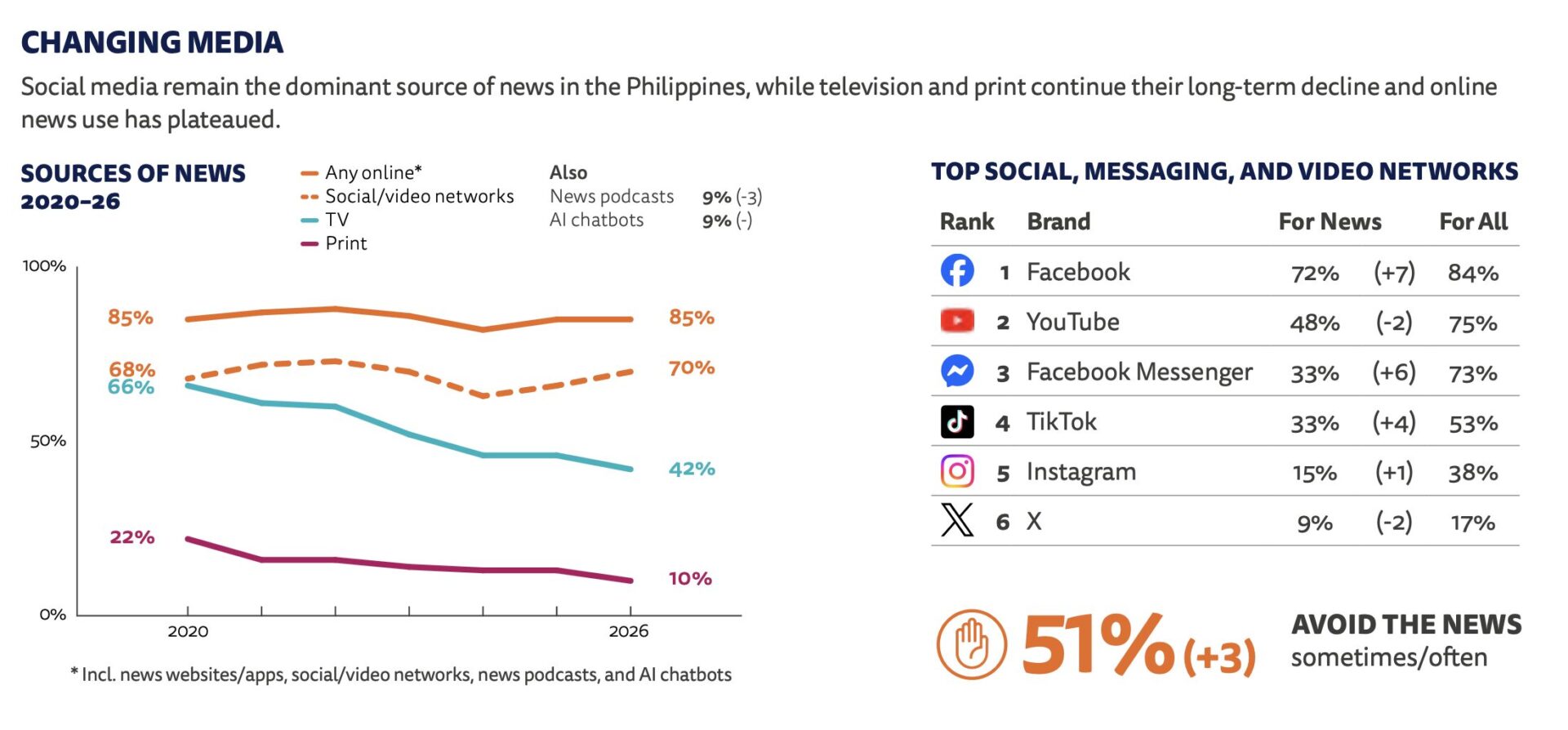
Content creators are also playing a growing role. About one-third of people (36%) report consuming content from creators or influencers mainly focused on the news. A larger proportion (46%) get some content from creators who mostly cover other topics but sometimes discuss current events. Many of the most popular journalist-creators are affiliated with established media organisations, though they often focus on softer or personality-driven content.
Industry groups have also experimented with collaborative models to support local journalism. The Philippine Press Institute’s (PPI) News Commons initiative, launched during the pandemic to aggregate content from member newspapers, began distributing advertising revenues in mid-2025 to participating community publications. PPI and two community outlets also partnered with Rappler to create public chat rooms for shared storytelling and audience engagement.
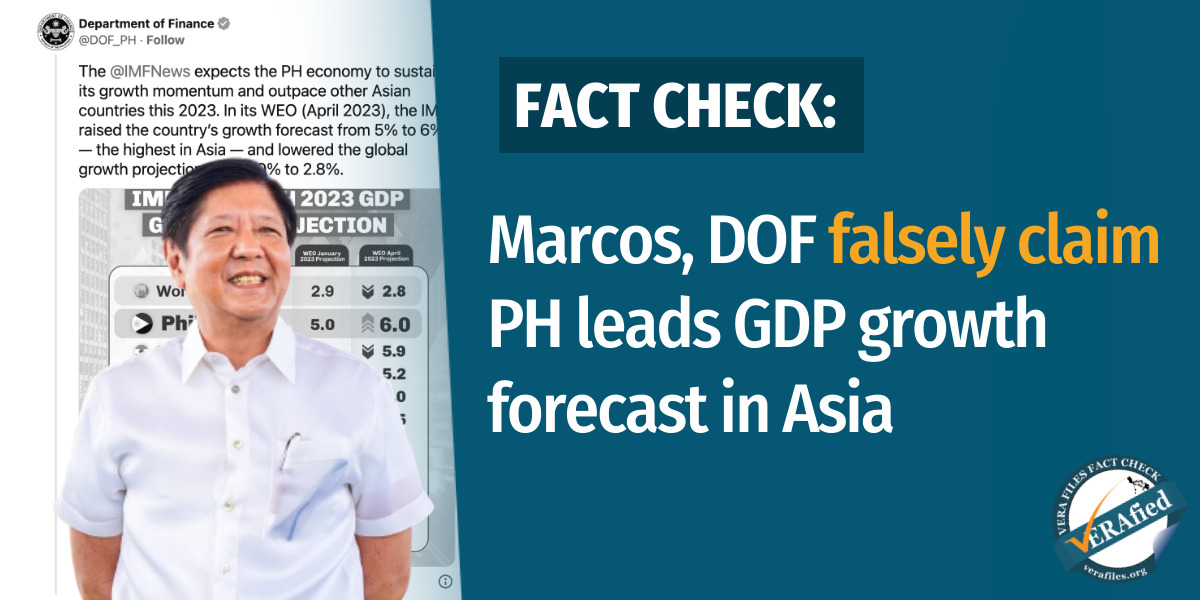
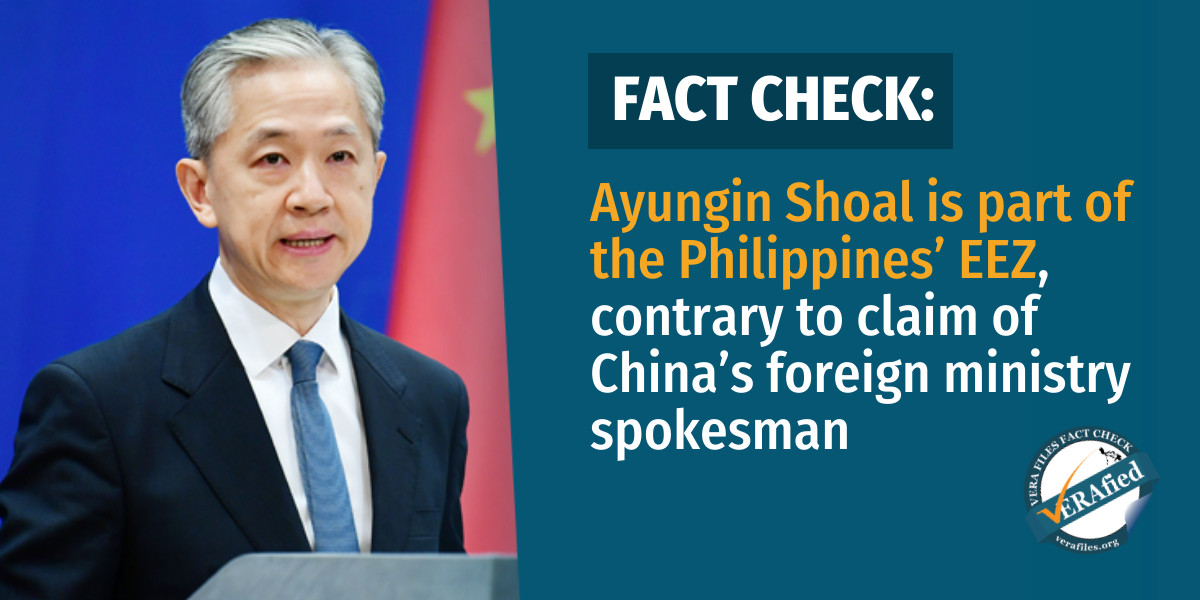
Newsrooms are also experimenting with artificial intelligence tools. Fact-checking organisation VERA Files launched SEEK, an AI tool trained on its fact-checks archive, while smaller regional outlets are testing AI-assisted production. Palawan News now uses generative tools to produce daily video news with limited staff. Some organisations have begun publishing AI policies, though industry standards are still uneven.
Press freedom remains a prominent issue. Journalists have had some success using legal remedies to challenge harassment and intimidation. In November, a local court voided the National Telecommunications Commission’s 2022 order to block alternative news site Bulatlat and 25 other websites. An anti-disinformation group has also secured identifying information from Meta linked to accounts involved in the red-tagging of a Mindanao journalist through arbitration facilitated by the National Privacy Commission.
But concerns nonetheless persist. Four radio broadcasters were killed after the May 2025 mid-term elections, bringing the number of journalists killed under the Marcos administration to ten. In January, community journalist Frenchie Mae Cumpio was convicted of financing terrorism after nearly six years in detention and has since become a global press freedom icon.