The first 25 years of the 21st century is almost over, and the turmoil around us continues. A recent exhibit, Hardware 3: Resistance is Fertile at Kaida Contemporary, Quezon City, reflects on the country’s socio-political trajectories through 33 art works by 12 visual artists attuned to the pulse and sentiments of the streets and to the particularities of history.
Participating artists include Alfredo and Isabel Aquilizan, Jes Aznar, Mideo Cruz, Antipas Delotavo, Boy Dominguez, Manny Garibay, Renato Habulan, Boyet De Mesa, Nonito Pongan, Cap Reyes, and Jose Tence Ruiz, the curator.
Old issues
The cycle of elections and empty promises, the ever-growing gap between the poor and the rich (even saying this has become a cliche), the systemic corruption from the lowest to the highest in power, and the lack of accountability. Today, it is the flood control projects.
Tomorrow, it will be a different modus operandi; nevertheless, corruption is corruption.
Issues of human rights and social justice abound amidst impunity, extrajudicial killings, red-tagging, militarization, environmental destruction, and climate change. The list only grows longer.
Remember and reflect
Filipino artists continue their distinct expressiveness in depicting societal dissonance. Their works make us reflect, ponder, and ruminate on the possibilities of a much better society. What does it take to really get there?
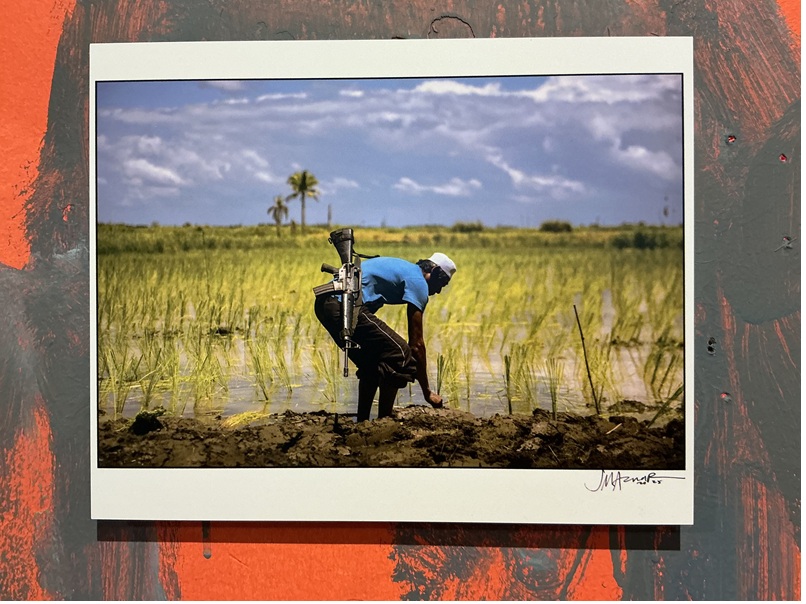
Jes Aznar sets a tone of defiance and persistence in his Untitled, 2025, a dye sublimation print on aluminum of a man planting rice with a semiautomatic rifle slung around his shoulder. Vigilance is key, in planting rice or in war. His other work in the exhibit, Against the Dying of the Light speaks of protests, demonstrations, and police brutality, a familiar scene in the streets of Manila, an image captured in 2018 and printed in 2025.
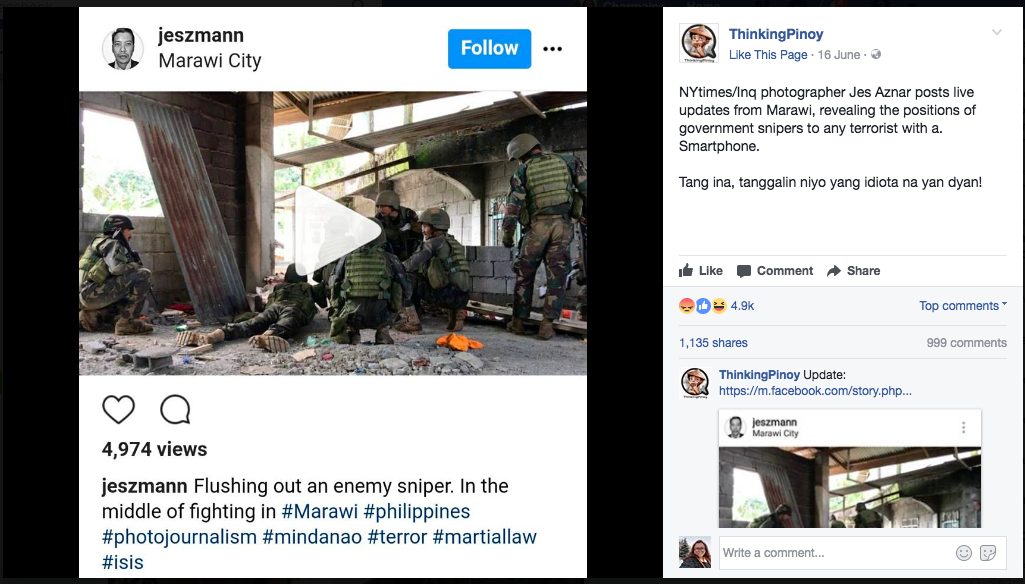
A fine arts major in advertising from the University of Santo Tomas, 1991-1994, Aznar attended a photojournalism program at the Ateneo de Manila University in 2007. He shoots “long term documentary photos about human rights, land, feudalism and hegemony” in the country.
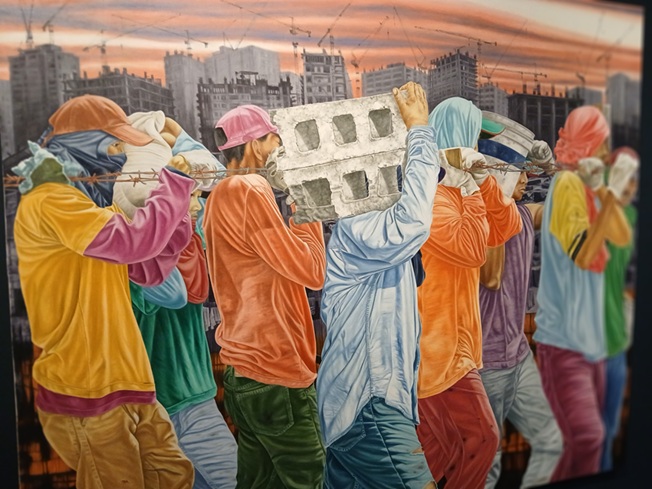
Workers, with only their youth and muscles as capital, build high rises for BPOs and condominiums for you and me. And yet, they remain forever homeless and landless. Rise Up, 2025 by Nonito Pongan reminds us that these workers must be set free from their barbed wire existence. Taking its sweet time, the seeds of discontent continue to fester and foment.
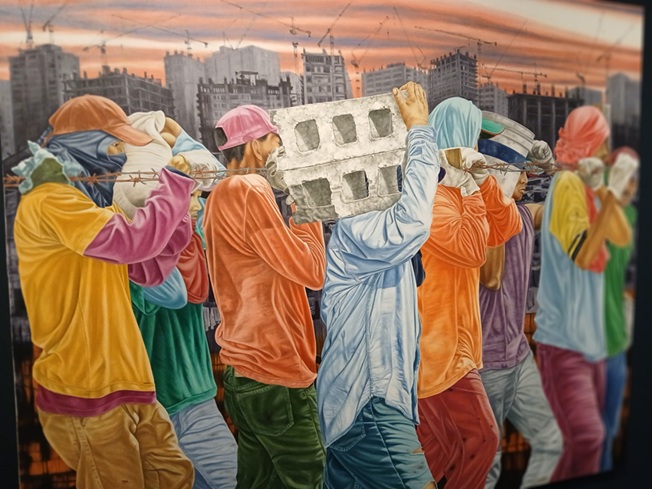
A civil engineer by profession, Pongan studied fine arts at Philippine Women’s University and has become a fulltime visual artist recently.
Antipas Delotavo (b. 1954, Iloilo City) in Status Quo, 2025 and Marginals, 2018 continues with his series of objects and figures partially obscured along the periphery of an art frame. He asks, is it really more of the same?
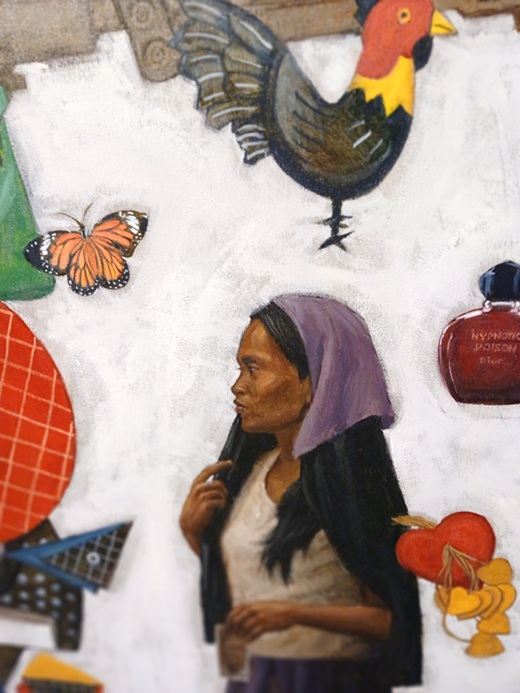
A fine arts graduate of Philippine Women’s University, his awards include Art Association of the Philippines, 1978-1979; Philippine Art Awards, 2000; Hall of Fame, Gallery Genesis Kulay sa Tubig contests; Thirteen Artists Awards, Cultural Center of the Philippines, 1990. He painted the official Malacanang portrait of President Corazon C. Aquino.
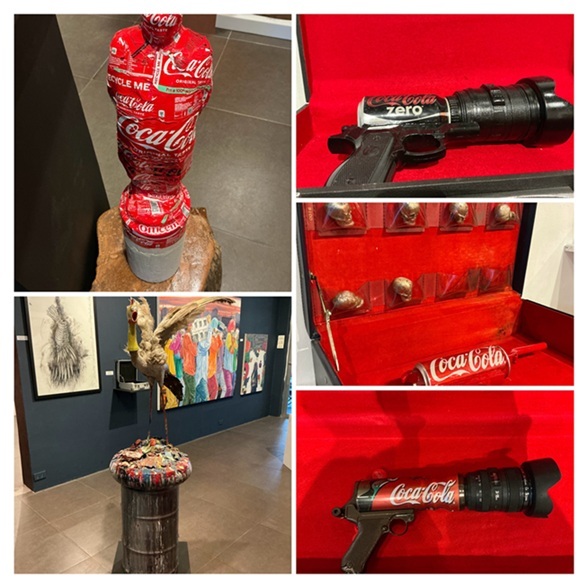
Mideo Cruz (b. 1973, Cabanatuan, Nueva Ecija) resurrects works in storage for more than a decade such as Loaded Vision: Engines of Disobedience, 2013, a series of works encased in red or black felt-lined metal cases, using found objects and spray paint. Are they weapons of consumerism for mass distraction/destruction?
His awards include Visiting Fellow, Asian Cultural Council, New York, 2008-2009; Ateneo Art Awards, 2006; and the Thirteen Artists Awards, CCP, 2006.
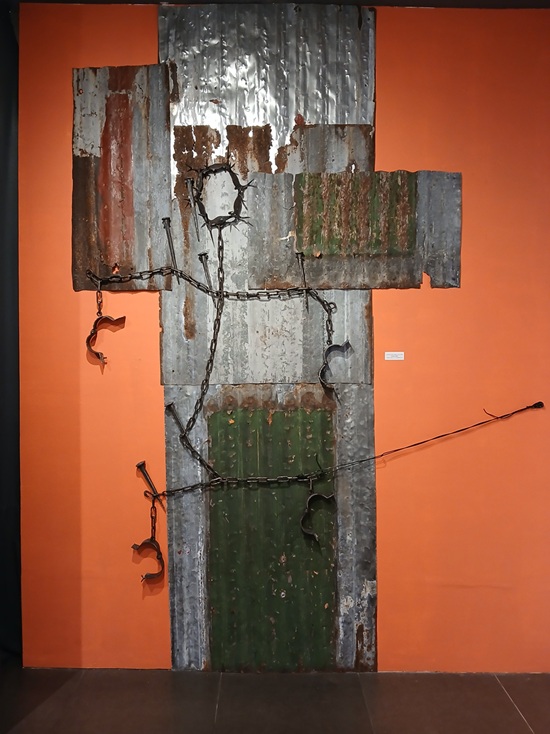
Primed, 2025, a sculptural work by Alfredo (b.1962 ) and Isabel (b. 1965) Aquilizan, is made of forged metal on rusty corrugated iron, with barb wires for a head, metal chains for the body, dangling open shackles, and hand-forged nails. It speaks of sacrifices and sufferings of a people crucified daily by plunder and corruption.
A husband-and-wife art team, the Alquilizans are known for their large-scale installations and sculptures and the use of nontraditional materials such as cardboard, found objects, used rubber slippers, tin cans, reclaimed teakwood, baby sweaters, or hand-embroidered fabrics.
Their themes revolve on home, migration, family, and cultural displacement. Moving to Australia in 2006, their most recent award is the 2025 Asia Pacific Arts Awards, Legacy category from the Australian Government.
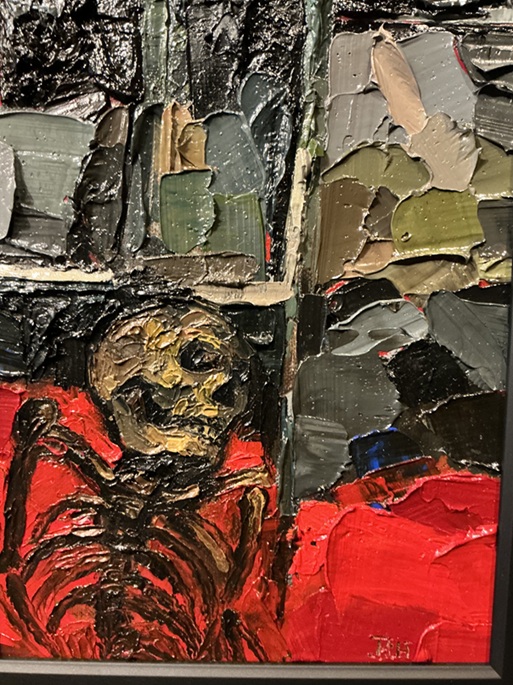
Renato Habulan (b. 1953, Tondo, Manila). His two works in this exhibit include Boceto 23,25, 2025 and Boceto 24, 25, 2025.
One of the founders of Kaisahan, the forefront of social realism in the 1970s, he is a fine arts graduate of the University of the East in 1976, a recipient of the Thirteen Artists Awards, CCP, 1990; Professional Achievement Award, UE, 1996; and Watercolorists Hall of Fame, 10th Kulay sa Tubig Invitational, 1999.
A mentor to many young artists, Habulan has helped Alfredo Esquillo organize an artist-run space at the Eskinita Art Gallery, Makati Cinema Square. In 2020, Habulan founded Agos Studio as a mentoring program in response to the global pandemic.
For him, mentoring is a way of building “a community of artists, gallery owners, and collectors knowledgeable not only in terms of art but also in the conditions of society.”