During the Sept. 23 impeachment trial of Vice President Sara Duterte, Sen. Alan Peter Cayetano raised a hypothetical scenario involving the absence of Sen. Loren Legarda.
The senate was debating whether the two-thirds threshold required for conviction should be based on the chamber’s full 24-member roster or solely on present and participating senators.
Four senators were absent from the proceedings: Ronald “Bato” Dela Rosa (in hiding), Rodante Marcoleta and Jinggoy Estrada (both detained), and Legarda (on medical leave), leaving only 20 active senators.
In his oral arguments, Cayetano asked House prosecutor Rep. Chel Diokno:
“What if Senator Loren Legarda signs the Treaty of Paris and comes back to the Philippines under that treaty, so 22 na. How do we apply what we’re talking about now in the view of the prosecution?”
But can a Philippine senator sign treaties? Here’s what you need to know:
1. Who can sign treaties?
A treaty refers to an international agreement between countries in written form that is governed by international law, according to the United Nations’ 1969 Vienna Convention on the Law of Treaties.
In the Philippines, the authority to negotiate and enter into treaties belongs to the President as the chief architect of foreign policy.
In the case of Pimentel Jr. v. Office of the Executive Secretary (2005), the Supreme Court explicitly ruled that “in the realm of treaty-making, the president has the sole authority to negotiate with other states.”
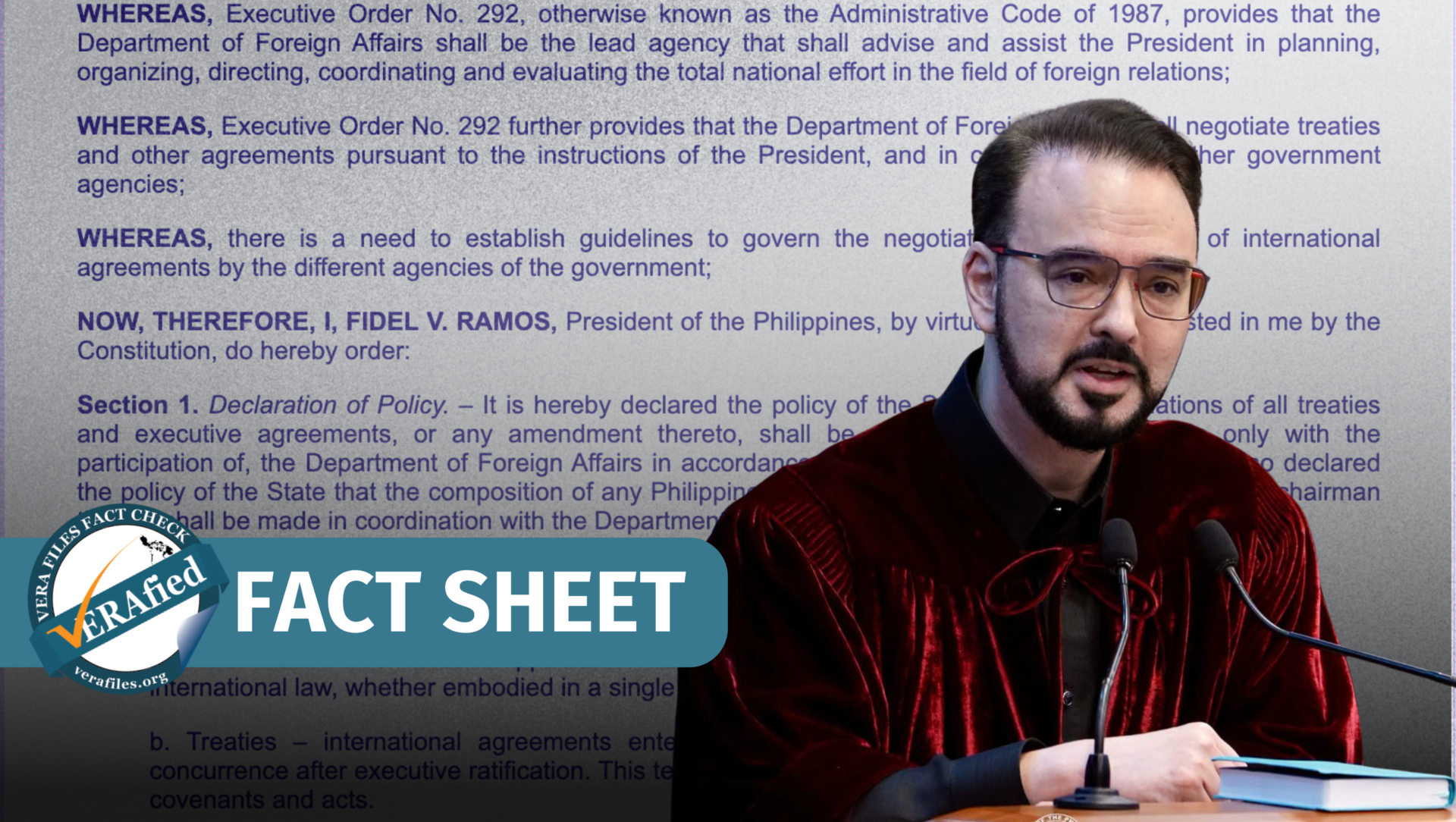
Under Executive Order No. 459 (s. 1997) and reinforced by Memorandum Circular No. 51 (s. 2024), prior presidential authorization is mandatory before any official can negotiate or sign international agreements, foreign loan or grant accords, or government guarantees. To enable representatives to act on the country’s behalf, the president issues a formal grant of “Full Powers.”
EO 459, however, exempts the following officials from needing full powers prior to negotiating or signing treaty or executive agreement by virtue of their functions:
-
- Secretary of Foreign Affairs
- Heads of Philippine diplomatic missions
- Representatives accredited by the Philippines to an international conference/organizations
2. What is the role of senators?
The Senate does not negotiate or sign treaties; its role is concurrence. In order for a treaty to be valid, the 1987 Constitution requires the concurrence of two-thirds of all senate members.
Section 21 Article VII states that “no treaty or international agreement shall be valid and effective unless concurred in by at least two-thirds of all the members of the senate.”
3. What is the current treaty between PH and France?
Cayetano appeared to conflate two different agreements.
The Treaty of Paris he mentioned refers to the historic peace treaty signed on Dec. 10, 1898 between the United States and Spain, which ended the Spanish-American War and ceded the Philippine archipelago to the U.S. for $20 million.
At present day, the bilateral treaty currently in the works between the Philippines and France is the Status of Visiting Forces Agreement (SOVFA), which establishes a framework for joint military exercises, training, and other operations. Defense Secretary Gilberto Teodoro Jr. and French Armed Forces Minister Catherine Vautrin signed the said agreement in Paris on March 26.
With the Senate Committee on Foreign Relations approving the SOVFA for plenary concurrence on Sept. 10, the agreement has long moved past the executive signing stage. This means there is no treaty in France waiting for a Philippine signature.
4. Where is Legarda now?
Legarda has been on medical leave since August due to a lung problem. According to Senate Secretary Renato Bantug Jr., she extended her leave through Oct. 9. Her last attendance at the Senate plenary session was on July 29.
National Bureau of Investigation Director Melvin Matibag revealed that travel records indicate that the senator departed via Hong Kong, with France as her final destination. Her son, Rep. Leandro Leviste, took a separate flight to Hong Kong on the same day, according to Matibag.