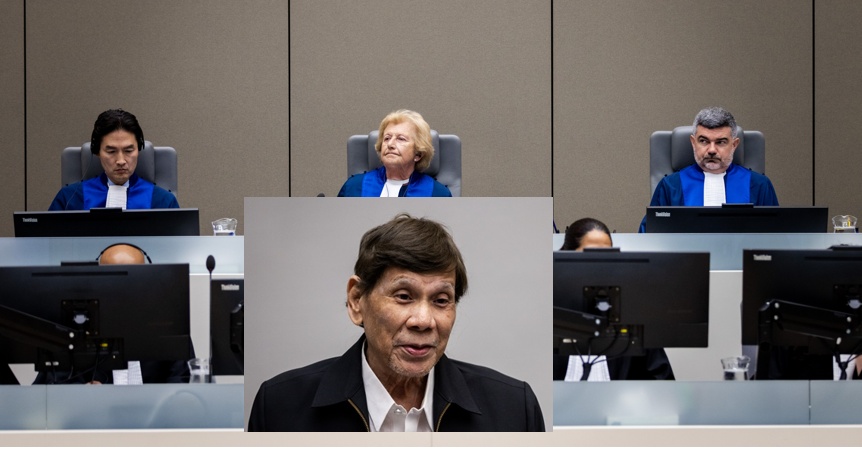
The three judges of Trial Chamber III had reached their decision on Rodrigo Duterte’s fitness last September 28, 2026. It was only on October 8 that the decision was disseminated to the public.
The reason for that is significant to note. The Chamber had to first adopt “necessary measures to facilitate the Accused’s participation in his trial.” This is a court where Duterte can expect fairness and impartiality. Consider, for example, what measures it adopted to ensure that Duterte will be treated without bias and prejudice: at the time that he sits for trial, Duterte is free to receive “(non-)privileged telephone calls and visits,” among other privileges.
As the Duterte trial begins next month on November 30, his family and supporters will be assured of a court of law capable of unbiased and accessible justice.
On his health condition to stand trial, the Chamber appointed last June 12 a panel of experts consisting of three doctors to undertake the medical examination of the former strongman. Both parties – the prosecution and the defense – agreed to the composition of the panel.
After the Panel of Experts submitted its report, the defense, the prosecution, and the common legal representative of the victims each submitted their observations on the medical report.
The prosecution noted that the medical report was unanimous and to which it agreed that Duterte was fit to stand trial. It agreed that Duterte was “capable of meaningfully exercising his procedural and fair trial rights.”
The CLRV submitted that the medical report was a “clear and consistent scientific conclusion.” Hence, “the applicable legal criteria governing an accused’s fitness to stand trial are satisfied under the established jurisprudence of the Court.”
The defense submitted that the “examinations conducted by the experts appointed by the Trial Chamber to assist it in determining Mr Duterte’s fitness to stand trial paint a clear picture of the current situation: Mr Duterte suffers from significant memory impairment that prevents him from retaining recent information and reliably accessing memories.”
It also asked the Trial Chamber to “seek greater medical certainty from the experts as to the nature and extent of Mr Duterte’s cognitive impairments.” For this purpose, it requested the Chamber “to order the neurologist to conduct all necessary ancillary examinations.”
In other words, the defense was absolutely permitted by the court to openly question the findings of the appointed experts. Such due process was never known under Duterte’s extrajudicial killings because due process was deliberately suppressed.
What exactly did the Panel of Experts conclude? Inter alia, it said that it found “no evidence of worsening of mental state or cognitive abilities, though we find some evidence of inconsistencies.”
On Duterte’s general health condition, the Expert Panel reports that his “general physical health appears to have been optimised.” It said this is “attributable to the high standard of medical and nursing care, including diagnostic rigor and pharmacological rationalization.”
On the so-called cognitive impairment, the Chamber revealed that Duterte underperformed his neurological tests. Whether he did this on purpose the Chamber did not say.
When the hearings commence in Nov. 30, Duterte will be allowed to take hourly breaks and have a number of nursing staff available for medication and care. He will also be medically re-assessed every six months.
“The Chamber is satisfied that the Accused is able to effectively exercise his fair trial rights in the proceedings and is therefore fit to stand trial.”
The views in this column are those of the author and do not necessarily reflect the views of VERA Files.