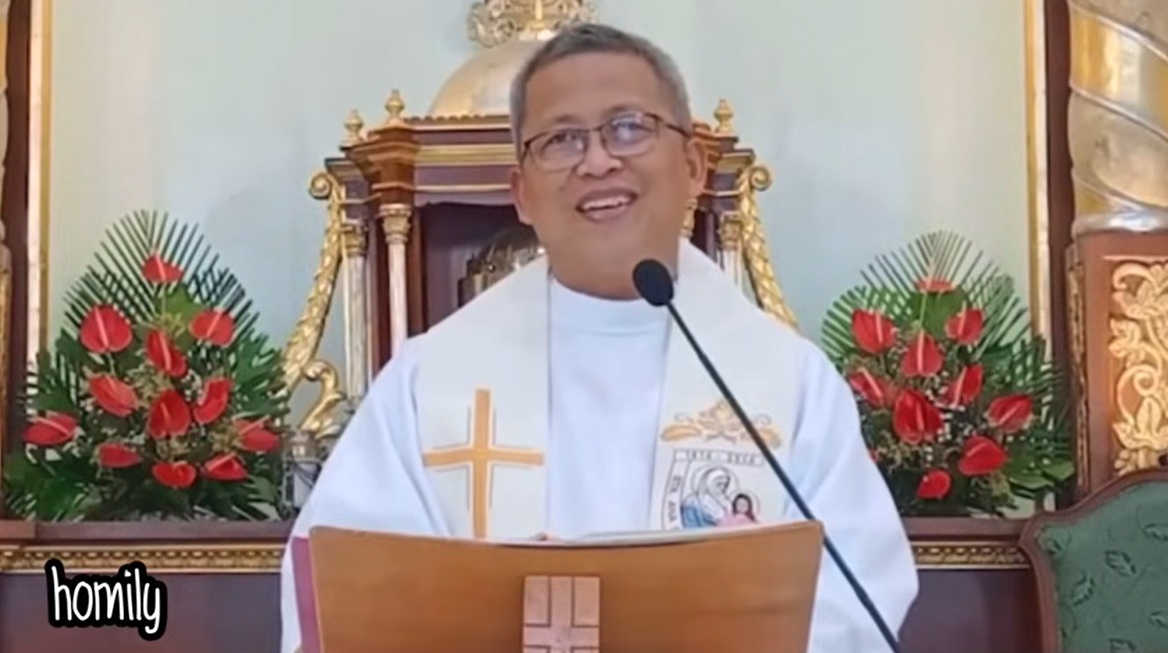
Five days after Rodrigo Duterte was arrested and flown to The Hague on Marcn 11, 2025, a parish priest in Cebu province used that Sunday’s holy mass homily to denounce the arrest. Parishioners were not surprised. This was not the first time for this parish priest to openly use the pulpit for his political support of the Dutertes.
This present suffering of the family of president Duterte, does it fall under godly suffering? Their suffering must be untold, imagine your own father who is nearing 80 years old will spend his next birthday in jail. His prison is far from his family which will not be easy for them to visit him because it is in a foreign land. His arrest did not undergo due process because he was not allowed to face a competent judicial authority. He was just directly brought on a plane without giving him his human right as an accused.
That is just a snippet of the entire rant that Sunday of Fr. Cresenciano Ubod, a priest of the Archdiocese of Cebu presently assigned as pastor of Compostela town. Ubod is said to be a canon lawyer (unverified). If true, that alone is a discordant reality. That part of his homily gives away his ignorance of canon law’s civil law counterpart (both founded on the truth), let alone of crimes against international humanitarian law, genocide, and crimes against humanity.
When we as lay faithful encounter priests who espouse their being Duterte Diehard Supporters from the pulpit, what do we do?
We have the freedom of reference of the Code of Canon Law in the Catholic Church promulgated in 1983. There is something there to educate us, namely the particular provisions that address the political partisanship shown by Fr. Ciano Ubod. Is that permitted by the Church?
In Book II (The People of God), Part 1 (The Christian Faithful), Title III (Sacred Ministers or Clerics), are the pertinent provisions:
Can. 287 §1. Most especially, clerics are always to foster the peace and harmony based on justice which are to be observed among people.
2. They are not to have an active part in political parties and in governing labor unions unless, in the judgment of competent ecclesiastical authority, the protection of the rights of the Church or the promotion of the common good requires it.
Catholic canon law, as well as magisterial documents, and official guidelines, forbid Catholic priests from engaging in partisan politics in their mass homilies.
While the Church mandates that faith must inform political choices, it distinguishes between preaching moral principles and endorsing political parties or candidates, with the former encouraged and the latter discouraged or prohibited.
Why forbidden? Even AI knows the answer: Priests are intended to be “centers of unity” for their communities. Taking sides politically can alienate parishioners and turn the priest into a “candidate of some” rather than a “father to all”.
Priests have a duty to form the consciences of the faithful regarding moral and social issues. This often interacts with politics but is distinct from partisan campaigning. For instance, priests should preach on Catholic Social Teaching, including the protection of life, care for the poor, and religious liberty. Indeed, they must help laypeople analyze candidates and policies based on Catholic principles, without telling them whom to vote for.
The problem also lies in the use of social media. In social media, many priests have discarded their priesthood and speak as partisan personae. Fr. Ubod’s homilies are aired on YouTube. Think how much his errors are multiplied a thousand times. Think of the number of Catholics he has brought into error. Ubod was even shown in social media participating in the “Tay kami naman” signature campaign.
Can such priests be sanctioned? Canon 1371 allows for sanctions against a cleric who disregards a “lawful command or prohibition” from their Ordinary (bishop) and, after being warned, persists in disobedience. The priests can be suspended, removed from his pastoral duties, transferred, or dismissed from the clerical state in cases of persistent disobedience. This is the most severe penalty.
A friend in Cebu City who is a participative Catholic asked several of his priest friends: why is it that Fr. Ciano Ubod has not been sanctioned? The reply he got was kind of even bizarre to the ecclesiastical state.
I have asked close to a dozen priests and all of them have told me that Ubod is a top financial supporter or donor in the Archdiocese of Cebu. He worked hard for the Capelinha de Fatima Replica in San Remigio to be built. He was asked to solicit and he delivered millions. He was among those who worked hard to raise funds for the birthday of a church high official and again he delivered.
Next: Archdiocese of Davao
The views in this column are those of the author and do not necessarily reflect the views of VERA Files.