
Migrants from the Philippine travel the world, and the longing for home always stays with them. Six artists and their 16 paintings express their yearning for home in an exhibition titled Sown by the Traveler: Women and Migrants in Philippine Art, at UPV MACH (UP Visayas Museum of Art and Cultural Heritage), Iloilo City.
Curated by Patrick D. Flores from the collection of the Lopez Museum and Library, it runs until May 8, 2026.
The title, taken from Jose Rizal’s poem, To the Flowers of Heidelberg (April1886) expressed his deep longing for the Philippines, while studying ophthalmology in Heidelberg, Germany.
The six artists had lived and worked all over the world: Fernando Zobel in Spain, Alfonso Ossorio in the United States, and Macario Vitalis and Juvenal Sanso in France. Both Anita Magsaysay-Ho and Nena Saguil had spent considerable time in France, United States, and Hong Kong. Saguil lived and died in Paris.
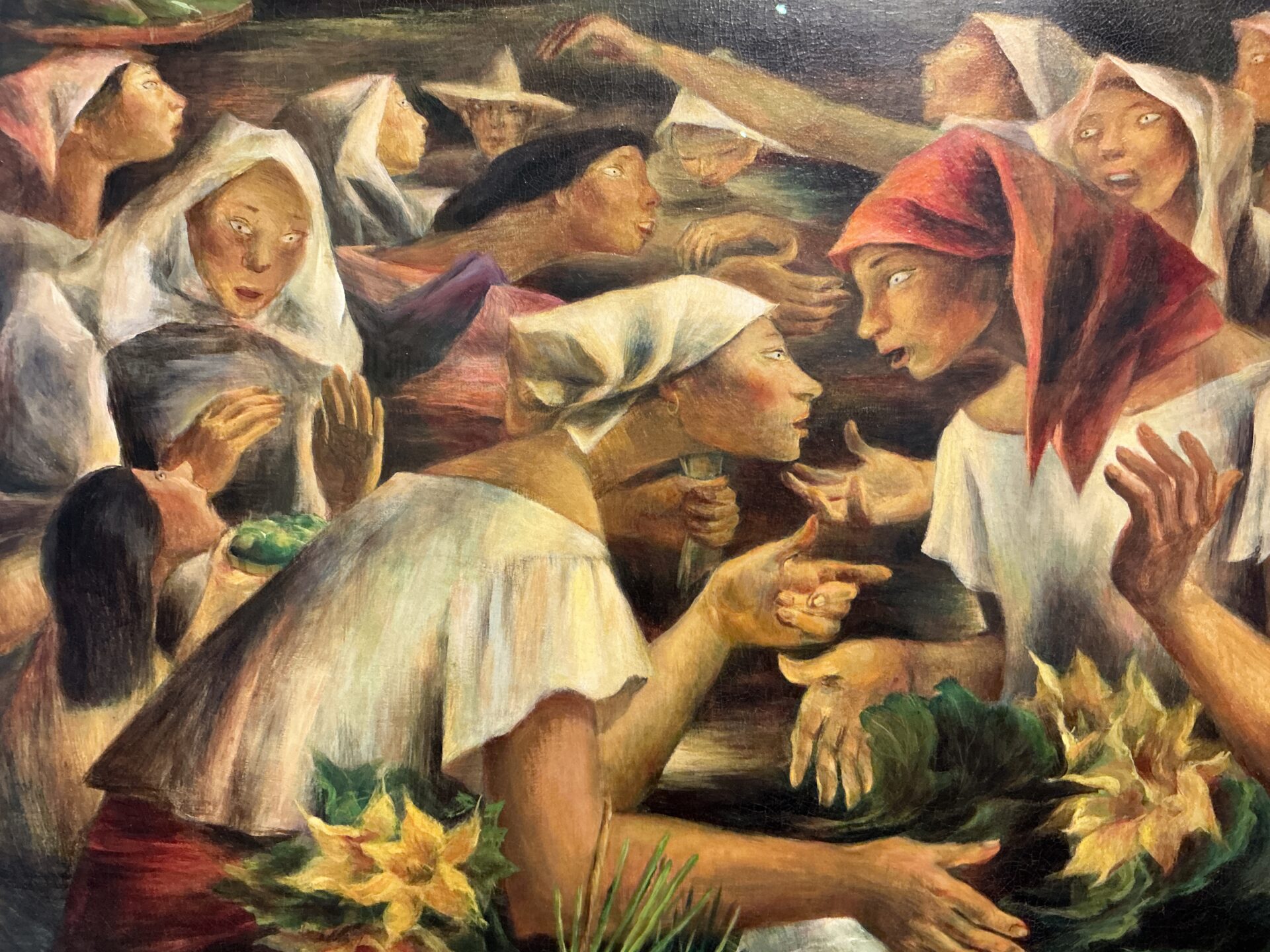
Anita Magsaysay-Ho (1914-2012): One of the most important modern painters in the country, she often depicted everyday scenes of Philippine life and culture, especially focused on women at work in the farm, field, market, and home. Stylized, angular, and abstracted, her figures are highlighted with bold lines and light and dark tones.
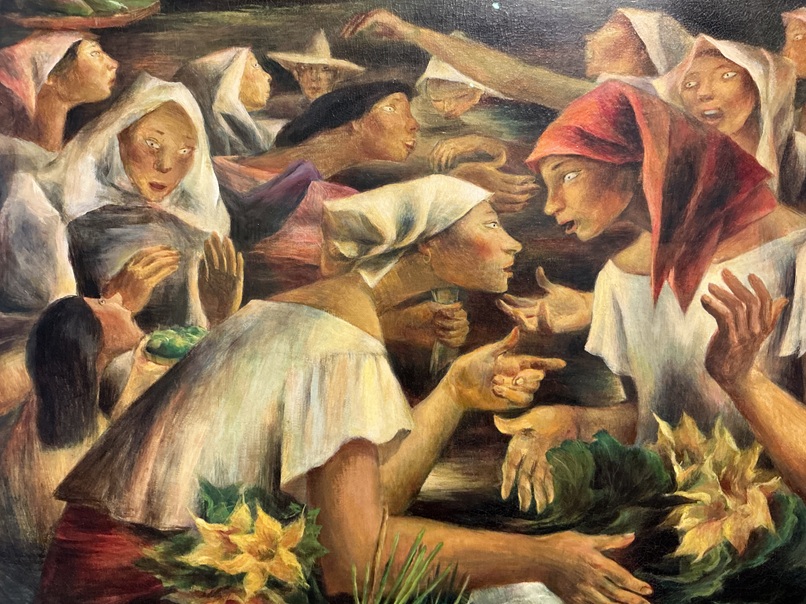
In In the Marketplace,1955, Magsaysay-Ho presents a group of animated vendors huddled in a lively interaction, their sociality shining through in the local wet market— a communal space of interconnection in Philippine society.
After her studies in U.P., Magsaysay-Ho took courses in oil painting and drawing at the Cranbook Academy of Art in Michigan and the Art Students League in New York in the 1930s.
Magsaysay-Ho always celebrated the women of the Philippines, as noted in her biography In Praise of Women, 2005 by Alfredo Roces. The Filipino woman was her source of inspiration, “…their movements and gestures, their expressions of happiness and frustration; their diligence and shortcomings; their joy of living.” Magsaysay-Ho also strongly identified with their “strength, hard work and quiet dignity…”, as she is one of them, she added.
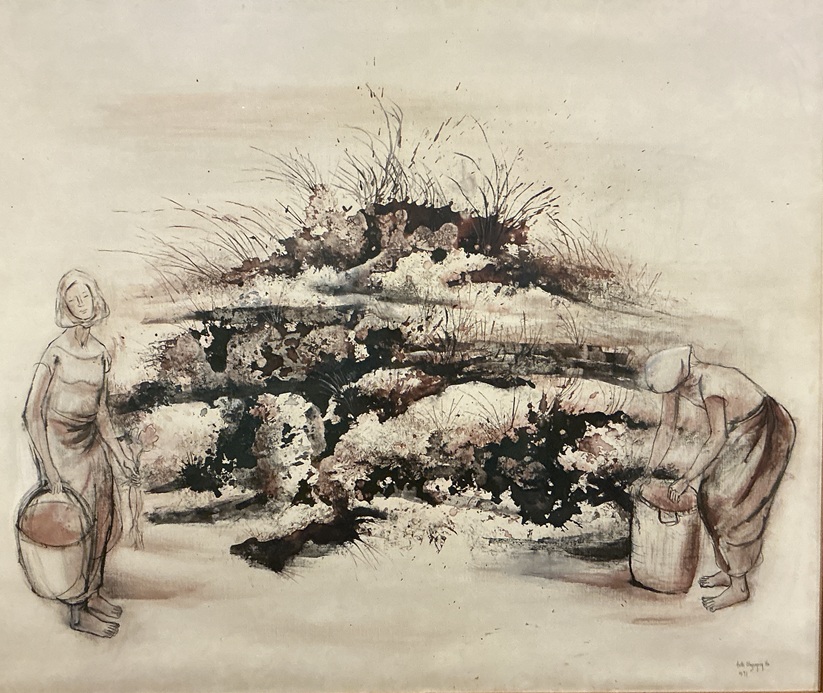
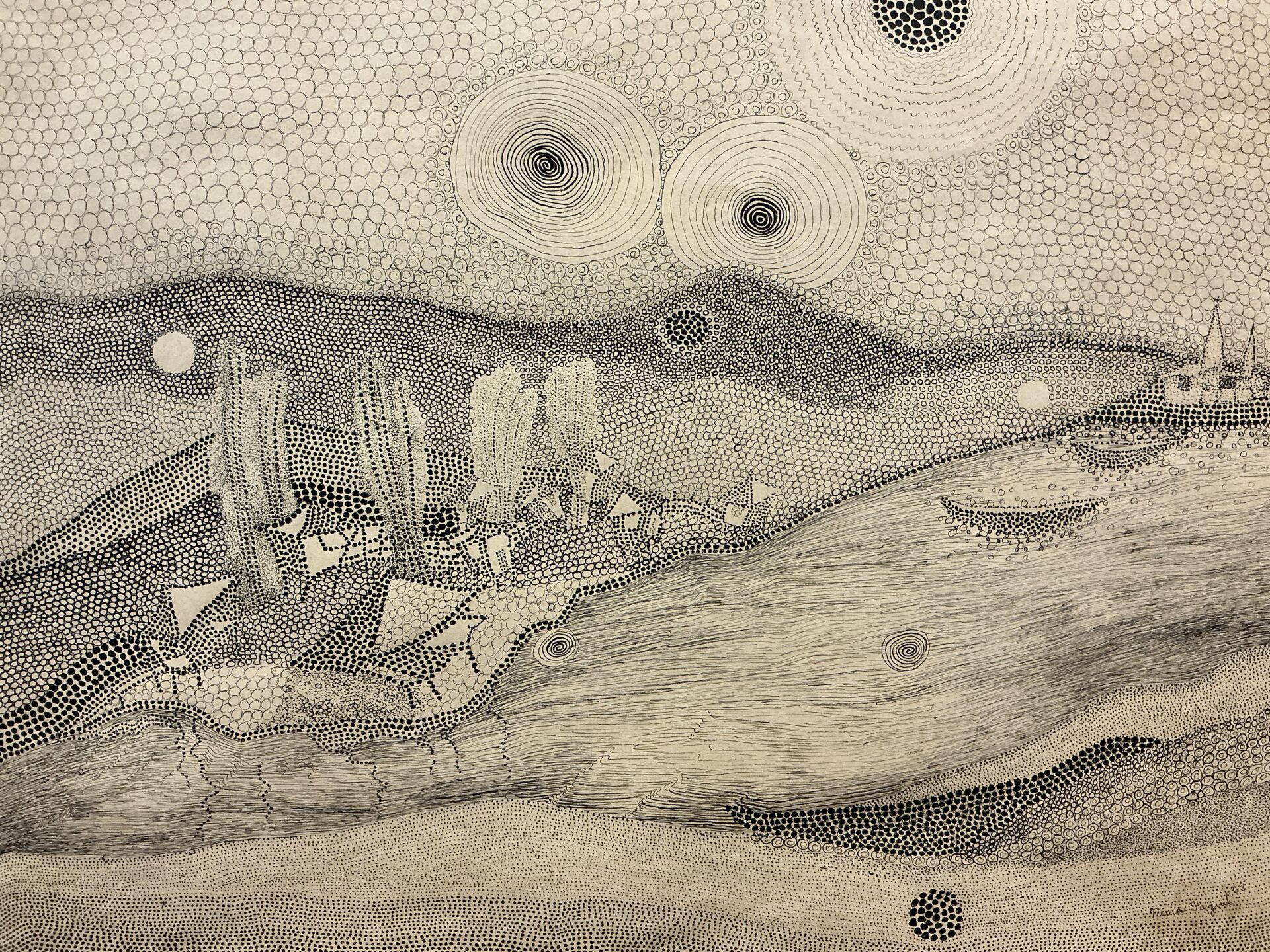
Nena Saguil (1914-1994): With three paintings included, Saguil is a pioneer in Philippine modernism, best known for her cosmic abstractions, as seen in Landscape, 1968, a pen-and-ink work on paper where she shows her forte in using circular forms and shadings in light and dark to create a mountainous landscape, speckled with cottages and vegetation that unfolds with a sense of calmness.
Saguil graduated from the School of Fines Arts, University of the Philippines in 1933, in the same class as Anita Magsaysay-Ho. She was the only woman artist included in the landmark “First Exhibition of Non-Objective Art” in 1953 by the Philippine Art Academy. She earned scholarships in Spain and France where she studied abstract art.
In her first solo exhibit in 1957 at the Galeries Raymond, Saguil showed her new abstract style of lines and geometric shapes.
The 60th Venice Biennale in 2024 featured Saguil, Magsaysay-Ho, and three other Filipino artists in the Biennale’s International Art Exhibition with its theme “Stranieri Ovunque — Foreigners Everywhere.”
Alfonso Ossorio (1916-1990): Born into a wealthy family, he graduated with a fine arts degree from Harvard University in 1938 and also studied at the Rhode Island School of Design. In 1950, he was commissioned by his father to do a mural entitled The Angry Christ for the Chapel of St. Joseph the Worker in Victorias, Negros Occidental. His fiery depiction of the Last Judgment initially antagonized the locals; today, it is a pilgrimage site.
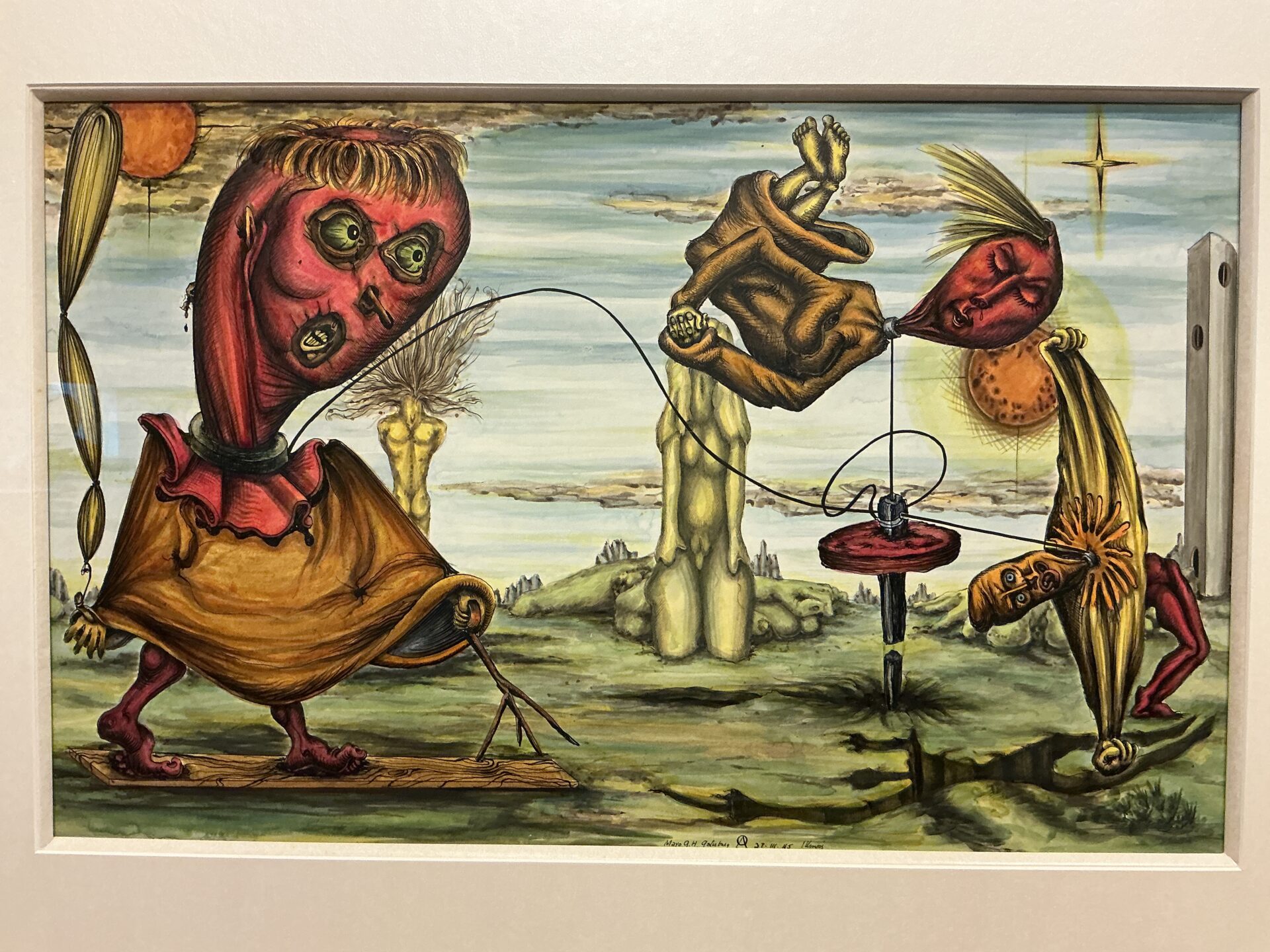
His early works played with surrealist images, influenced by the early years of Abstract Expressionism and Art Brut movements through his close friendship with Jackson Pollock and Jean Dubuffet, as seen in Faineants (Loafers), 1945.
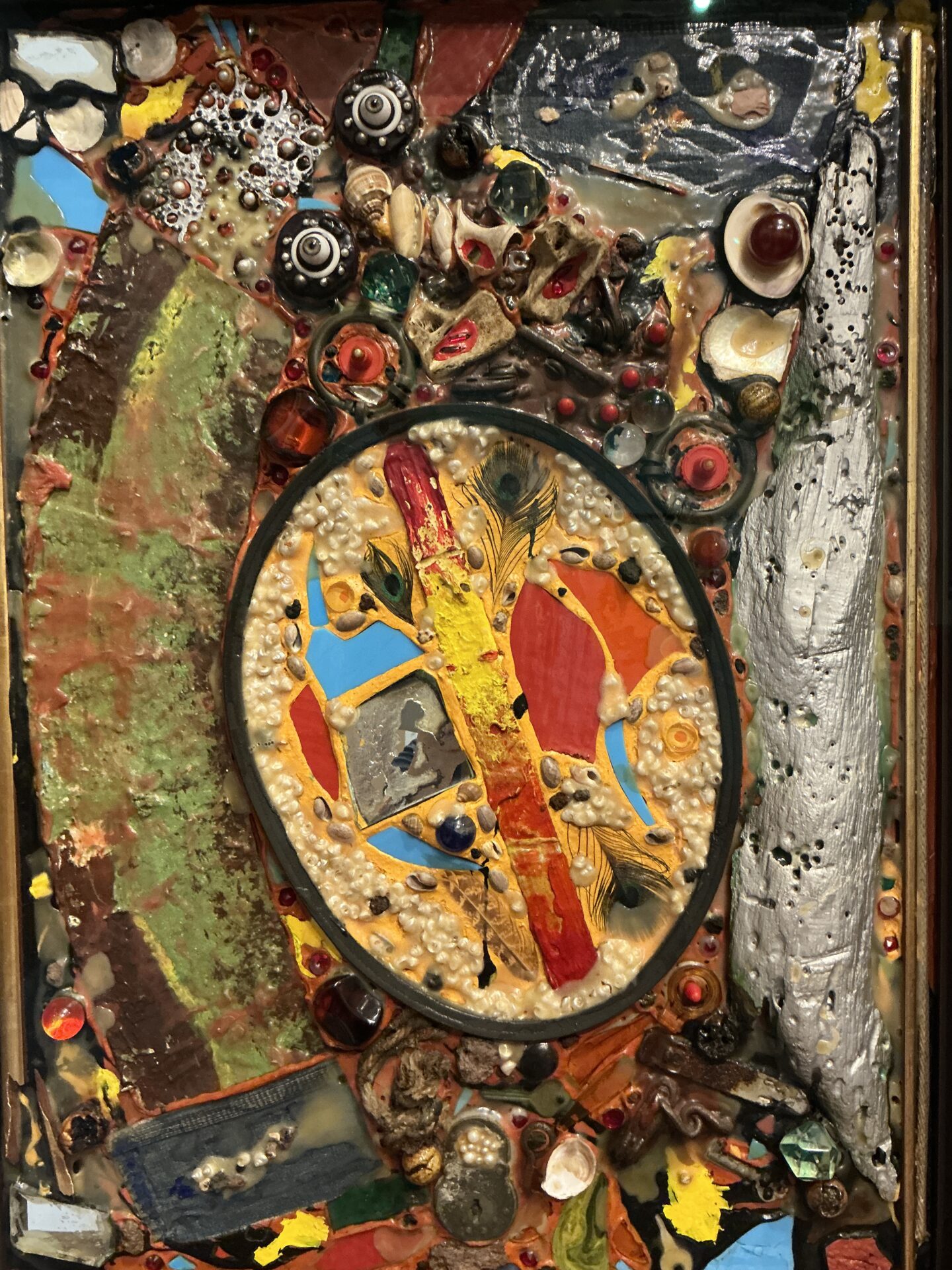
He is best known for his assemblages of found objects in the early 1960s which he called “Congregations.” He believed that by reworking ordinary throw-away objects, it could give a spiritual sheen or a magical touch that could uplift the viewer, connecting the ordinary to the extraordinary.
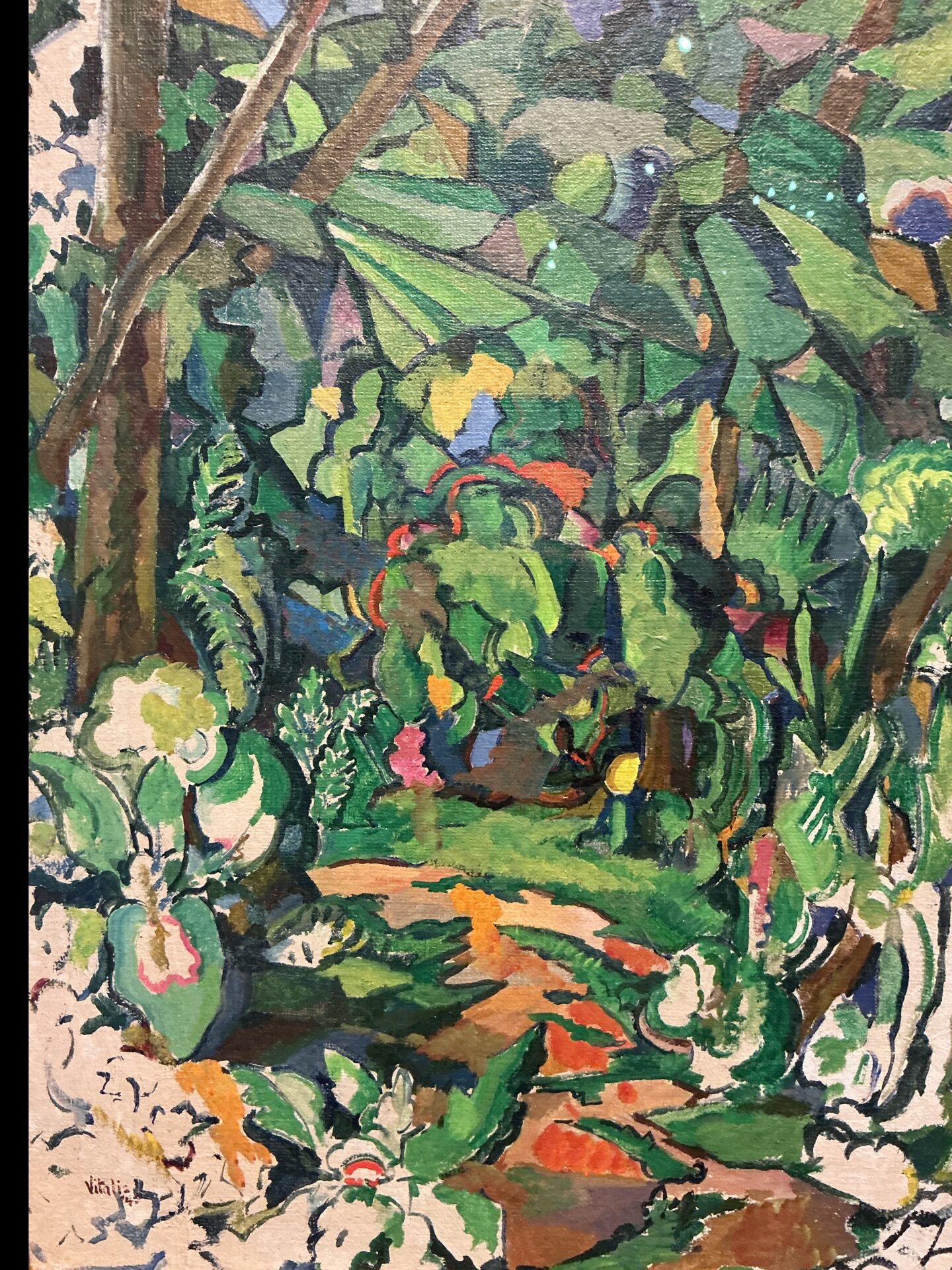
Macario Vitalis (1898-1990): In Philippine Reminiscence (1945), Vitalis captures the green vegetation of his tropical homeland through a verdant-filled canvas. It depicts a lush garden path surrounded with plants forming an arch of greenery. Entering it seems so enticing, just like the idea of coming home, after long years of wandering away.
At the age of 17, he knew he wanted to be a painter and took private lessons. A poor young man, he went to the United States in 1917 and studied at the California School of Fine Art and the Pennsylvania Academy of Fine Arts. In 1926, he moved to Paris where he studied at the Académie de Beaux-Arts de Montmartre. Eventually, he settled in Plestin-les-Grèves, Britanny. In 1984, he had a major retrospective exhibition covering over 50 years of his works in Plestin-les-Greves; in 1986, the Cultural Center of the Philippines held a retrospective exhibition honoring Vitalis.
For many migrants, distance and longing for home becomes a driving force, an impetus to succeed in their own ways. For artists, their work becomes an enduring artistic legacy for its people.