
Ten years after the 2016 South China Sea arbitral award, the question is no longer whether the ruling remains legally relevant. It does. The more difficult question is whether legal victory matters when the facts at sea continue to be shaped by coercion, dredgers, coast guard vessels, maritime militia, and naval power.
From a Philippine perspective, the answer is both sobering and defiant: the Award has not stopped China, but it has changed the terms of the struggle.
The Award was a landmark legal victory. It rejected the legal basis of China’s “nine-dash line”, clarified the maritime status of key features in the Spratly Islands, and affirmed that China had violated the Philippines’ sovereign rights within its exclusive economic zone. It gave Manila what small and middle powers often seek from international law: clarity, legitimacy, and an authoritative vocabulary of rights.
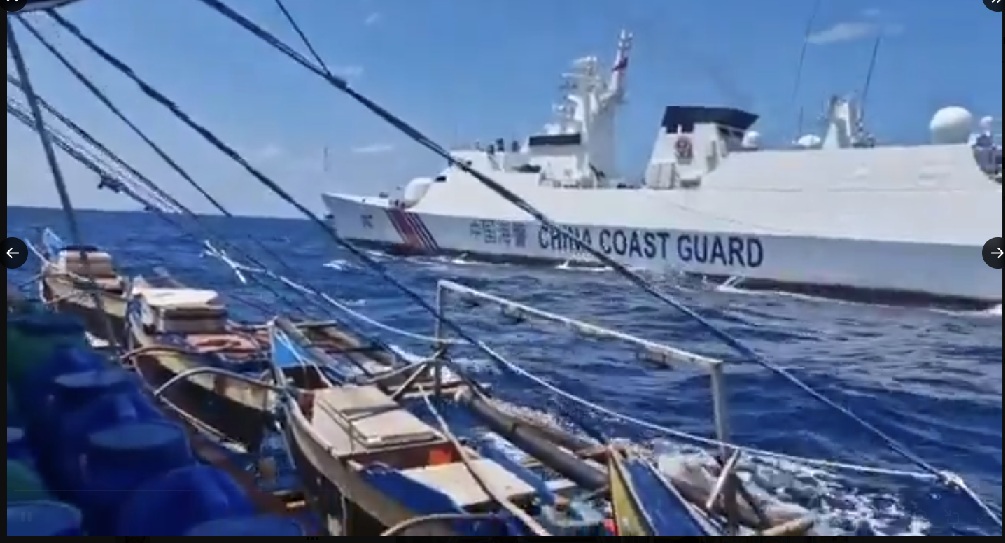
Yet the past decade has also exposed the limits of law. China rejected the ruling and continued to assert control over vast areas of the South China Sea, expanding its use of grey-zone tactics. Philippine vessels have been blocked, shadowed, water-cannoned and harassed. Recent incidents near Scarborough Shoal and Second Thomas Shoal, as well as Chinese patrols during the 2026 Balikatan exercises, underscore a simple truth: the dispute is not frozen history but a live contest over presence, access and control. Reports of renewed large-scale dredging at features such as Antelope Reef—potentially marking a new phase of island-building—reinforce that trajectory.
This is why the tenth anniversary of the Award should not be treated as a polite legal commemoration. It should be read as a warning.
The South China Sea is not simply a dispute about rocks, reefs and maps. It is a test of whether international law can survive sustained defiance by a powerful state. It is also a test of whether smaller states can use law not as a substitute for power, but as a multiplier of strategy.
From this perspective, a recurring critique within Philippine legal discourse deserves careful attention. It is often observed that the gains of the Award have yet to be fully consolidated in domestic law, policy, and consistent state practice. The point is well taken. The Award is final and binding, but it is not self-executing. Without sustained institutional embedding, its full strategic potential risks remaining underdeveloped.
At the same time, this critique can be framed more precisely.
The more analytically precise question is not whether the Philippines has failed to implement the Award, but how it understands implementation itself. If implementation is conceived narrowly as formal legal codification, the record appears incomplete. But if it is understood more broadly as the integration of law into diplomacy, strategy, and state practice, what emerges is an evolving, albeit uneven, process. The task ahead is to reconcile these dimensions and ensure that legal clarity is matched by institutional and strategic coherence.
This reframing matters because the Philippines has, in recent years, begun to move in this broader direction. Its transparency strategy which involves documenting and publicising incidents at sea, has transformed encounters into legally framed narratives of rights and violations. Its diplomatic engagements increasingly embed the Award as a shared legal baseline with partners such as the United States, Japan and Australia. Its operational posture, while constrained, reflects a growing effort to align presence at sea with legal entitlement.
Yet if the next phase is to be more than incremental, the Philippines will need to translate this evolving approach into a more deliberate programme of implementation, one that is legal, diplomatic, and strategic at once.
First, implementation requires legal consolidation at home. This does not mean rhetorical reaffirmation of the Award, but the careful alignment of domestic legislation, maritime zone definitions, fisheries regulation, and administrative practice with its findings. Clarity in law reduces ambiguity in action. It signals that the Award is not merely an external judgment but an internalised legal position of the Philippine state.
Second, implementation demands disciplined and consistent state practice at sea. Presence matters. Regularised coast guard patrols, support for Filipino fishermen, and the maintenance of lawful access to maritime zones are not simply operational choices; they are legal acts that reinforce entitlement. Over time, such practice contributes to the consolidation of rights in a way that litigation alone cannot achieve.
Third, the Award must be embedded in diplomatic architecture. This includes its systematic incorporation into bilateral and multilateral engagements, from defence cooperation agreements to ASEAN discussions and beyond. The objective is not to compel acceptance, but to normalise the Award as the default legal reference point for the South China Sea. In this sense, implementation becomes a process of shaping expectations across the region.
Fourth, there is a need to institutionalise evidence and narrative. The documentation of incidents through video, satellite imagery, and official reporting should form part of a sustained evidentiary record. Law operates not only through rules, but through proof. A well-documented pattern of interference strengthens both diplomatic and legal positioning, whether in future negotiations or potential proceedings.
Fifth, implementation requires coalition-building grounded in law. The Philippines cannot enforce the Award alone, but it can situate it within a wider network of states committed to UNCLOS. Joint statements, coordinated patrols, and capacity-building initiatives all gain normative force when anchored in the Award’s legal conclusions.
These pathways reflect a deeper reality: implementation is not a single act but a sustained practice. It is less about dramatic enforcement than about cumulative effect.
This is the strategic power of law. It converts facts into claims, incidents into evidence, and coercion into reputational and legal cost.
China may reject the Award, but it cannot escape it. Every act of coercion is now measured against an authoritative legal baseline. Beijing can dominate the water on a given day, but it struggles to dominate the narrative without confronting the legal reality that the Award has created. In this sense, the ruling denies China the comfort of ambiguity.
At the same time, the Philippines must resist the opposite temptation: to treat law as sufficient in itself. International law is not a coast guard cutter. Its effectiveness depends on how it is integrated with diplomacy, defence, and alliances.
The challenge, then, is not whether the Philippines has moved too slowly, but whether it can sustain a coherent long-term strategy — one that treats the Award not as an endpoint, but as a foundation.
The deeper significance of the Award lies in how it has reshaped the normative terrain of the South China Sea. It has clarified that historic rights claims cannot override UNCLOS, that artificial islands do not generate maritime entitlements, and that maritime zones must be grounded in law, not power. These principles now structure how states understand and engage with the dispute, even if they are contested in practice.
The irony is that China’s continued defiance has made the Award more, not less, important. Because it is resisted, it remains alive. Because it is challenged, it continues to frame the terms of contestation.
Ten years on, the South China Sea Award is neither a dead letter nor a magic shield. It is something more complex and more consequential: a legal instrument embedded in a long strategic struggle.
For the Philippines, the task is not simply to remember the Award. It is to operationalise it through law, practice, diplomacy, and sustained presence. The real anniversary question is not whether Manila won in 2016, but whether it can convert that victory into enduring maritime resilience, regional leadership, and legal resistance in the face of power.
That is the unfinished work of the Award.
(*Dr Lowell Bautista is Associate Professor at Western Sydney University School of Law and an internationally recognised expert in public international law and the law of the sea, particularly the South China Sea and maritime security. He was recently awarded the prestigious American Society of International Law Lieber Prize for outstanding scholarship in international humanitarian law.)